

Tirthankar Mitra
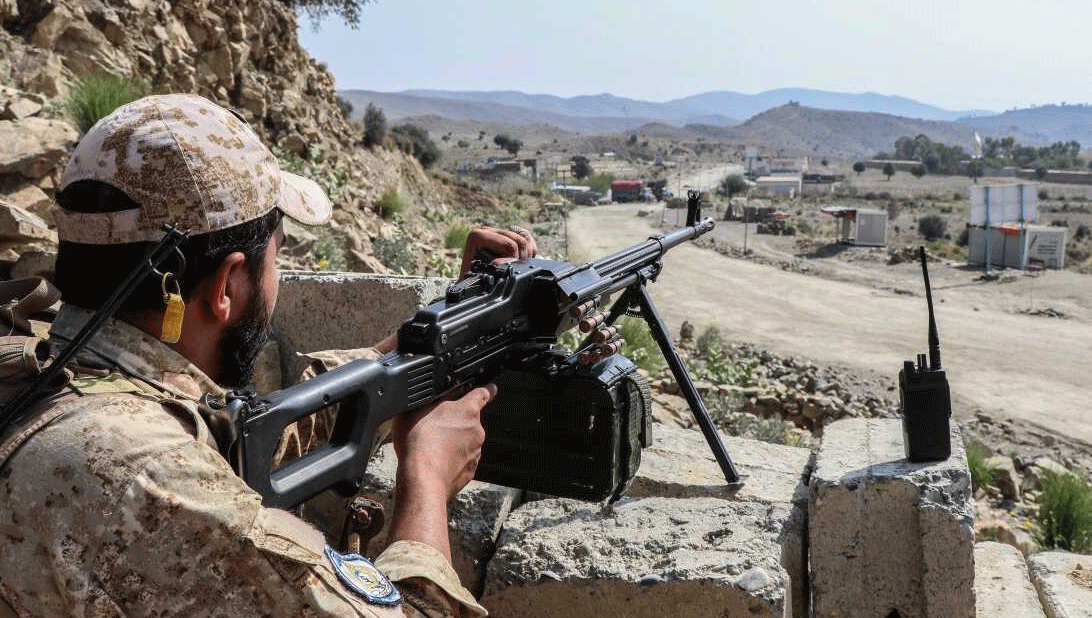
Even as part of Middle East is under a shroud of a war locking Iran, America and Israel, another war is raging nearer home. Fighting along the Durand Line has intensified post Pakistan bombing Kabul and other Afghan cities recently.
Pakistan’s strike follows it’s accusation of Afghanistan’s Taliban dispensation of sheltering anti-Pakistan militant groups. The situation threatens to explode into a security nightmare for the region.
Of late, Pakistan suffered a wave of terrorist attacks. Many of them have been claimed by Tehrik-e-Taliban Pakistan (TTP). This outfit, though distinct from Afghan Taliban is ideologically linked to the powers that be in Kabul. The Afghan Taliban has trashed the charge that it has given TTP a launching pad to attack Pakistan.
But it has fallen on deaf ears. After months of skirmishes and bombing along the border, Pakistan declared an open war on Afghanistan last week. Since then Afghanistan claims to have hit Pakistan border posts. The Taliban further claimed that it has foiled a Pakistani attack on Bargam airbase.
It was built by US and its allies during the years when NATO was in Afghanistan. Though Taliban is yet to have an airforce of its own, letting Pakistan gain control of Bargam is one of the last things in its agenda.
None of the sides seems intent to relent. The Afghan-Pak confrontation has the potential of creating a dangerous dynamic where the face off could spin out of control even as world attention remains fixed on Middle East. Militarily, Afghanistan is no match for Pakistan. In conventional warfare, Afghanistan is dead meat .
For instance, the Taliban regime does not have an airforce. Pakistan has one though it has failed to deliver in successive conflicts with India, its presence can still be devastating for the rifle toting Taliban forces. The arms equation between the two adversaries is uneven. But in many ways, it makes the fighting all the more dangerous.
There are instances galore that a mightier nation can lull itself into thinking that it can do whatever it wants. It need have no fear about real consequences. Nothing can be further from the truth. The swamps of Vietnam and twin towers of US stand witness to consequences previously unheard of.
One hopes that policy makers in Pakistan are aware that their country can be bled in asymmetric war fare. Terrorist groups are far more tuned to this task than men in uniform. Afghan Taliban can actually move terror groups within Pakistan. It can decide where to remove the guardrails and how much havoc groups like TTP can wreak within Pakistan.
This is no small matter. More so, since Pakistan has its own areas of unrest as in Balochistan. Matters are worrying for India too. The conflict comes at a time when India is trying to build a bridge with the Taliban.
India has criticised Pakistan over its bombing of Afghanistan. On the other hand, it has consistently been critical of terrorism no matter who the perpetrator or the victim is. Pakistan may indeed be reaping what it sowed. But India cannot afford to be seen to be rejoicing. (IPA Service)
 Follow our WhatsApp channel
