

‘Drone challenge being tackled’
*Alert to maintain zero infiltration
Sanjeev Pargal
JAMMU, Nov 29: The BSF today said Pakistan Government has shifted over six dozen terror launch pads to depth areas in Pakistan post Operation Sindoor conducted by the Indian Armed Forces from May 7 to 10.
CLICK HERE TO WATCH VIDEO
The terror launch pads are used by the Pakistan army and terror commanders to keep the terrorists at one place before launching them into Jammu and Kashmir from different sectors including the Line of Control (LoC) and International Border (IB).
Follow the Daily Excelsior channel on WhatsApp
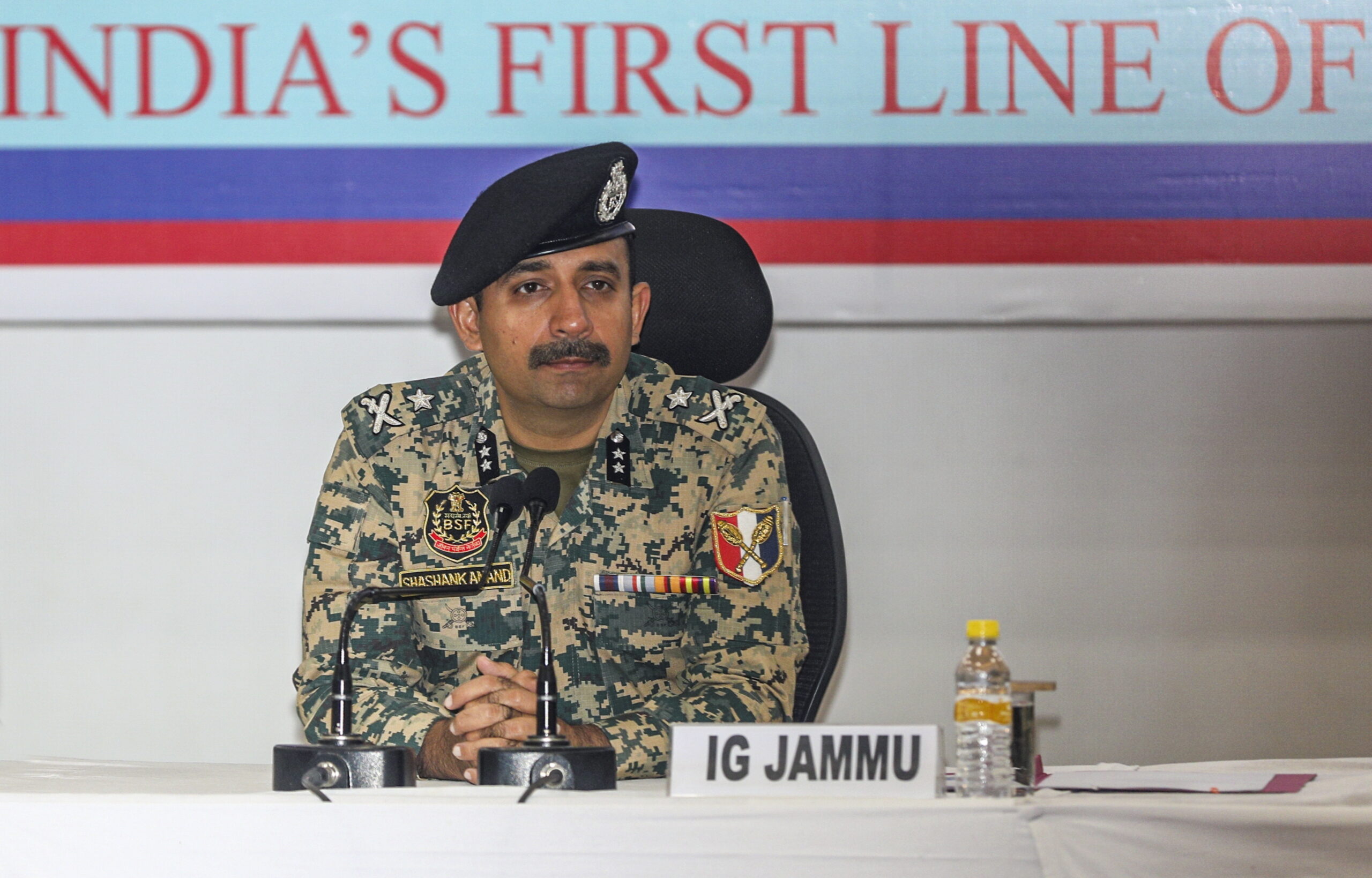
BSF Inspector General, Jammu frontiers Shashank Anand, DIG Vikram Kunwar and DIG Kulwant Rai Sharma addressed a joint press conference at BSF Paloura Headquarters today.
Kunwar said the BSF destroyed many terror launch pads across the International Border during Operation Sindoor. Thereafter, Pakistan Government shifted the launch pads to depth areas. Presently, 12 launch pads are being run from Sialkot and Zaffarwal, away from the border areas while 60 launch pads are functional in other depth areas. All these launch pads were shifted from forward areas after Operation Sindoor.
This has been done by the Pakistan Government to save launch pads in the event of another round of strikes by the Indian Armed Forces but now there is nothing out of reach of India inside the neighbouring country. However, presently, no training camp of the terrorists is functional close to the International Border.
Asserting that number of launch pads keep on fluctuating as some of them are closed and new ones come up, Kunwar said the launch pads are activated when the terrorists have to be pushed. Only two or three groups of the terrorists are kept at one time.
The BSF, Anand said, is ready to follow the orders of the Government if it decides to resume Operation Sindoor. “If we talk about 1965, 1971, the 1999 Kargil War, or Operation Sindoor, the BSF has a good experience of all kinds of wars, be it conventional or hybrid warfare. We are ready. If we get a chance, we are capable of causing more damage than what we did in May. Whatever policy the Government decides, the BSF will play its role in it,” he said.
Anand said Pakistani Rangers took a lot of time to recover from damages caused by the BSF during Operation Sindoor. He added that the Rangers have tried to strengthen their defence but the BSF is keeping surveillance on all their activities. However, he asserted, presently there is no movement (of terrorists on the border) to raise an alarm.
Maintaining that the BSF is fully alert to maintain “zero” cross-border infiltration of terrorists in the Jammu region, the IG BSF said the flood-damaged infrastructure was restored and strengthened within a month.
The BSF infrastructure including fencing and some forward border posts were damaged in Monsoon fury in August this year which caused floods.
“Whatever the circumstances or weather conditions, the BSF remains alert 365 days of the year and 24 hours, day or night in sensitive border region of Jammu. Whether it’s rain, fog, cold or heat, we have been trained not to leave the posts,” Shashank said.
“Our two brave soldiers attained martyrdom during Operation Sindoor in May, fighting the enemy, while one of our brave soldiers drowned in Pargwal, manning a forward post in September, despite being a good swimmer. He did not leave the border post and preferred death, which shows that our soldiers consider the country supreme,” he added.
Anand said the BSF is aware of the activities across border and always gets timely inputs about possible infiltration attempts by the terrorists. Besides, he added, various agencies work together like the BSF, IB, NIA, Special Bureau and sister agencies through which inputs are received continuously.
On reconstruction of damaged infrastructure because of Monsoon fury in August this year, Anand said “the BSF not only achieved its target but also further strengthened the border grid. Now, we have developed a system that is two or three times better. So, the damage that came, we took it as a challenge. We got an opportunity, and we saw how we can improve our system further”.
He said all possible infiltration routes were plugged with the deployment of manpower and enhanced surveillance during floods,” he said.
Asked about the challenge on the border in the coming winter months, especially during the foggy conditions, he said the soldiers posted there are equipped with the required weapons and equipment.
“We also have such technology, which can detect the activities that are happening around the border in the fog. So, I think we are ready to face any challenge,” Anand said.
Responding to a question on narco-terror nexus, the IG BSF Jammu said the Government is employing a 360-degree top-to-bottom and bottom-to-top approach to ensure strict action against all the accused.
“It is absolutely right that some people sell their country, and the same is true in Jammu and Kashmir, Punjab, and Rajasthan. And the anti-national forces take advantage of this to carry out narcotic smuggling,” he said.
The IG BSF Jammu Frontiers said that drone technology and aerial dimensions have become decisive elements of modern warfare.
“The BSF and other agencies are tackling the challenge of drones. We are increasing our capabilities, and we hope to be even more successful in the next year. The drone and anti-drone innovations are in a continuous process of research and development, with the BSF working closely with its industry partners. The future conflicts or cross-border firing incidents will inevitably have a strong aerial component, making counter-drone preparedness a top priority,” he said.
The BSF, he said, has upgraded training, procured advanced counter-drone systems and ensured round-the-clock monitoring without disrupting civilian air traffic.
The BSF has also established the School of Drone Warfare in Gwalior, signing MoUs with IIT-Delhi, IIT-Chennai and the KF Hussain RJIT engineering institute to train students and force personnel for emerging aerial security challenges.
The IG said that in all the recent wars worldwide, including the brief India-Pakistan conflict in May, the countries involved tried to exploit the aerial dimension in their own way.
The focus of the BSF is on how to keep the border population and those in the hinterland safe during any future conflict, he said.
“A lot of work is being done on this. The Government has also announced that community bunkers will be increased in the border areas of Jammu and Kashmir,” Anand said.
DIG Sharma said the force is gradually moving from border guarding to border management.
“Since we have been entrusted with this task, we not only have to ensure the physical security of the people, but their social and economic security as well. If you look at the whole scenario, the ability to connect with the border population is constantly increasing. We are constantly standing with each other,” he said.
Highlighting the various achievements of the BSF in 2025, Kunwar said the force is manning approximately 200 km of the International Border (IB) with Pakistan across the Jammu region, and is also deployed along the Line of Control (LC) alongside the Indian Army.
“The BSF Jammu played a key role in Operation Sindoor, while simultaneously facing multiple challenges emanating from Pakistan, including cross-border firing, infiltration attempts, narcotics smuggling, and drone operations.
“True to its tradition, BSF Jammu effectively thwarted all such adversarial attempts, foiled nefarious designs, and contributed significantly to the success of Operation Sindoor,” DIG Sharma said.
The key achievements of BSF Jammu in Operation Sindoor include foiling a major infiltration bid from the Pakistan village of Dhandar opposite Samba, neutralising seven terrorists, and the destruction of three launch pads (Bhaironath, Mastpur, Looni) and engagement of 118 Pakistani posts, the officers said.
The key operational achievements include neutralisation of three Pakistani intruders and the apprehension of six others along the International Border in the Jammu sector, they said.
The BSF troops also seized 9.563 kg of narcotics and apprehended five drug peddlers during the year, besides recovering five drones, they added.
The BSF also apprehended a LeT guide, Mohd Arib Ahmed from Pakistan-occupied Jammu Kashmir, in Rajouri on June 29, recovered a huge cache of arms and ammunition from Mendhar in Poonch, and rescued 69 civilians during the floods in August-September, the officers said.
 Follow our WhatsApp channel
