

By Dhurjati Mukherjee
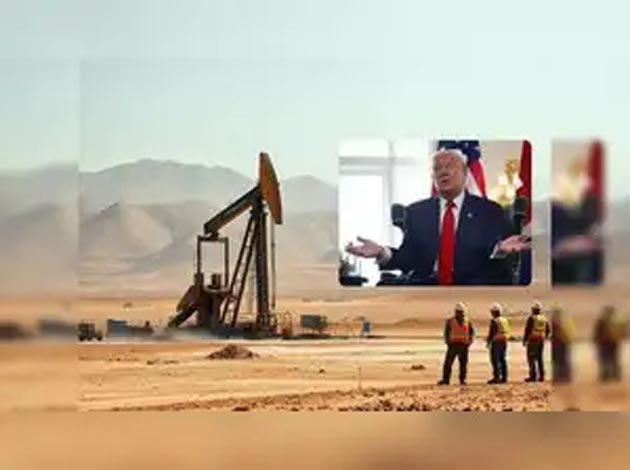
American President Donald Trump’s reference to Pakistan’s massive oil reserves sounds like a manoeuvrefar from realism. “We have just concluded a deal with the country of Pakistan, whereby Pakistan and the United States will work together on developing their massive oil reserves,” President Donald Trump wrote on his Truth Social platform. “We are in the process of choosing the oil company that will lead this partnership,” he added.
Various estimates peg Pakistan’s proven reserves of conventional oil at 0.2 billion barrels and natural gas at 529.5 billion cubic metres. These appear modest when compared to India, which, at last count, was estimated to have oil reserves of about 4.8 billion barrels and natural gas of 1149 billion cubic metres. Pakistan’s domestic production, meeting 15 to 18 percent of oil and about 60 percent gas demand, has remained modest as exploration efforts yielded incremental discoveries.
And while the US has Pakistan’s largest refiner, Cnergyico, to import 1 million barrels of oil from American West Texas Intermediate (WTI) crude from global commodity trader Vitol in October, Trump imposes additional 25 percent tariff on India for buying Russian oil.These threats appear to put pressure on India to buy American oil and make defence purchases. If the tariff threats are carried out,these would affect the Indian economy undoubtedly. Both Goldman Sachs and Moody’s Ratings have predicted a slowdown of the economy and GDP shrinking to just 6 percent. In such a situation, India may have to think of alternative ways of finding new export markets.
According to the US Energy Information Administration (EIA) data, Pakistan had 363.3 million barrels of proven and recoverable oil reserves as of 2016, placing it at No. 52 globally. At current consumption levels of around 556,000 barrel per day, would cover less than two years of domestic demand without imports or new discoveries. Trump’s remarks possibly stem from recent seismic surveys in Pakistan’s offshore Indus Basin, which identified large underwater structures with powerful oil and gas structures. These preliminary findings may have sparked speculation that these deposits could rank among the world’s top reserves.
Pakistan’s oil potential could take around four-five years at the least, if not more, just to confirm and begin production. Moreover, infrastructural requirements like refineries and pipelines, would mean huge investments. With a massive external debt of $126 billion, it appears doubtful whether Pakistan would be able to bear the expenditure. Trump too has not clarified whether his country would start exploration activities and bear the costs involved. But even if that happens, America willput pressure on Pakistan to purchase various high-cost defence equipment, like it has done with India.
Interestingly, Islamabad relies heavily on China for military equipment and must consider Beijing’s response if the US pursues exploration in Pakistan. The recent ceremony marking the PLA’s anniversary highlighted Pakistan’s close defence ties with China, raising doubts about potential US partnerships in energy or other sectors.
However, building up an oil reserve in Pakistan may serve two purposes– one to repay his (Trump’s) gratitude to that country for being nominated for the Nobel Peace Prize and the other to tell both India and China that the US would also invest there. But since no plan has been announced, only time will tell what action the US President will take and start actual work in building up the oil reserve.
It is indeed difficult to understand what Trump intends to do in the South Asian subcontinent and the relationship he seeks to develop,especiallywith Pakistan and India. It’s no secret about his reservations on the formation of BRICS and India’s active role in that organisation. In fact, the US President does not want any third front and would back only those countries that show total allegiance towards the US.
Some analysts suggest that the United States is seeking to influence the ongoing relationship between India and Russia, developed over decades. During the 1971 war with Pakistan, the US supported Islamabad while Russia supported India. Over time, Russia has supplied defence equipment and technology to India. In addition to cooperation with Russia, India has established defence agreements with France and Israel and does not currently purchase American defence equipment due to higher costs and lack of technology transfer.
Trump’s tenure and his statement should be viewed asmere pressure tactics aimed principally at India. Moreover, he may be losing out on his traditional support and popularity thanks to his absurd statements and contempt against nations. The US criticism of India’s close ties with Russia is seen as unjustified. These are expected to remain stable regardless of potential changes in US-Russia dynamics or a Trump-Putin summit. While India’s relationship with China may improve, it will not undermine its strong connection with Russia, and significant rapprochement with China has limits. Political analysts anticipated unpredictability under Trump but did not foresee high tariffs. A Russia-India-China trilateral summit may occur by year-end, possibly including Brazil, which could challenge US dominance.
India will prioritise national interests in its purchasing decisions, seeking affordable and accessible products. As Prime Minister Modi has stated, foreign policy is guided by national interest. India values its historic ties with Russia and aims to maintain strong relations, preferring not to risk these by allowing greater US influence in its markets.
Yet, according to Reuters reports India’s state refiners have not purchased Russian oil for the last week, marking a dramatic turn in one of Moscow’s strongest energy relationships since the onset war in Ukraine. Eyebrows will continue to be raised till the tariff deal is signed up. —INFA
 Follow our WhatsApp channel
