

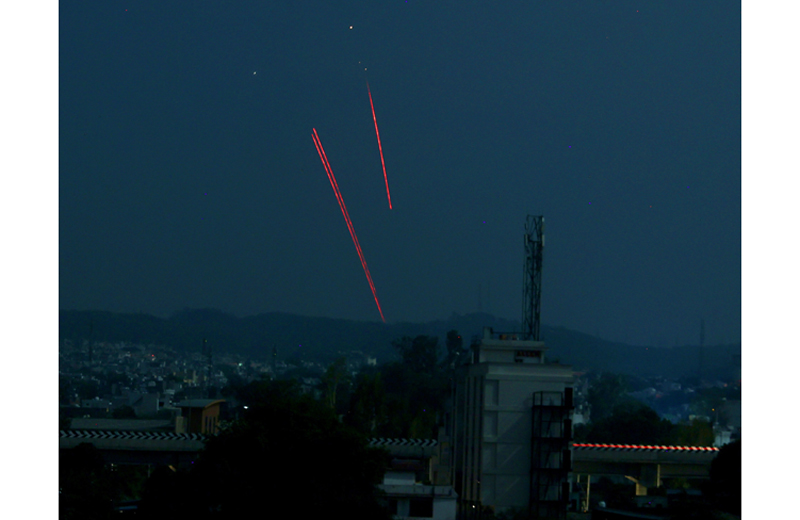
Military installations, airbases, civilian infra were targets
*L-70 guns, Schilka Systems used to counter aerial threats
*No casualties, damage reported from anywhere in the region
*Indian Air Defence Ecosystem shows its strength
Sanjeev Pargal
JAMMU, May 9: For the second consecutive night, Pakistan army tonight launched drone attacks targeting military installations, airbases and civilian infrastructure in six districts of the Jammu region but powerful Air Defence System of the Indian Armed Forces successfully thwarted all attacks launched from both Line of Control (LoC) and International Border (IB).
Follow the Daily Excelsior channel on WhatsApp
Nearly 100 drones were fired by Pakistan from LoC and IB targeting sensitive installations in six districts of the Jammu region including Jammu, Rajouri, Poonch, Samba, Kathua and Udhampur at 8.20 PM tonight, the officials said.
While the last night’s attack lasted around 25 minutes, today it continued for about two hours over different period of times from 8.20 PM to around 10.30 PM,” they said, adding the Air Defence System immediately got activated and L-70 guns, Zu-23 and Schilka Systems besides S-400 started chasing the aerial objects and brought all of them down.
“No target has been hit by the swarms of Pakistani drones,” the officials said, adding there were no casualties or damage anywhere.
Sirens blared and blackout was enforced again in Jammu City at 1.35 am but there was no immediate report of any attack.
In Jammu district, military installations, airbases and civilian infrastructure were the targets of Turkey and Chinese made drones launched by Pakistan in Satwari, Sunjuwan, Nagrota, Akhnoor and other places. Similar attacks targeting sensitive locations were carried out in Samba, Kathua, Udhampur, Rajouri and Poonch districts between 8.20 pm to 10.30 pm.
Officials said this was major success of the Indian Armed Forces that for second consecutive night, they downed all drones fired by Pakistan aiming military installations. However, today’s attack was more severe. Yesterday, only Jammu district was under attack while today, Pakistan targeted military installations in six districts and the attack lasted over two hours as against 25 minutes yesterday.
A blackout was immediately enforced as sirens echoed at all places where drone attacks were launched by the Pakistan army. While the markets were already closed, people stayed indoors.
Part of a drone downed by the Air Defence System was recovered in Lakhanpur, the gateway to Jammu and Kashmir.
The drones, as per the officials, were launched from Pakistan side of the International Border in Jammu, Samba, Kathua and Udhampur districts and from the Line of Control (LoC) in Rajouri and Poonch districts.
A Defence spokesperson said the drones were spotted in Baramulla, Srinagar, Awantipora, Nagrota, Jammu, Ferozepur, Pathankot, Fazilka, Lalgarh Jatta, Jaisalmer, Barmer, Bhuj, Kuarbet and Lakhi Nala.
“Drones have been sighted at 26 locations ranging from Baramulla in the north to Bhuj in the south, along both the International Border and the Line of Control with Pakistan,” he said.
These include suspected armed drones posing potential threats to civilian and military targets, he added.
“Regrettably, an armed drone targeted a civilian area in Ferozepur, resulting in severe injuries to members of a local family,” the spokesperson said.
The injured have been provided medical assistance and the area has been sanitized by security forces.
“The Indian Armed Forces are maintaining a high state of alert, and all such aerial threats are being tracked and engaged using counter-drone systems,” said the spokesperson.
The situation is under close and constant watch, and prompt action is being taken wherever necessary, he said.
“Citizens, especially in the border areas are advised to remain indoors, limit unnecessary movement, and strictly follow safety instructions issued by local authorities. While there is no need for panic, heightened vigilance and precautions are essential,” the official said.
Along with the drone attacks, Pakistan army and Rangers started shelling and firing at various places along the IB and LoC.
Indian Army and BSF retaliated shelling and firing effectively.
Sources said India’s rapid, coordinated response to missile and drones attacks showcased strength of its Air Defence Ecosystem-built painstakingly over the past decade and, at the same time, exposed the hollowness of Pakistani Air Defence System.
The Integrated Counter-Unmanned Aerial System (UAS) Grid, S-400 Triumf systems, Barak-8 missiles, Akash Surface-to-Air Missiles, and DRDO’s anti-drone technologies came together seamlessly to create an aerial shield that held firm in countering the Pakistan’s missiles and drone attacks, the officials said.
“This level of preparedness didn’t materialize overnight. Since 2014, the Narendra Modi Government has systematically upgraded India’s air defence architecture. Rs 35,000 crore deal for five S-400 Triumf Squadrons, signed in 2018, with three squadrons are now operational along the borders with Pakistan besides China,” they said.
Deployment of Barak-8 Medium-Range Surface-to-Air Missiles (MR-SAM), procured under $2.5 Billion deal signed in 2017 with Israel, is now actively guarding frontline bases like Bhatinda in Punjab, they said, adding that indigenous Akash missile batteries and DRDO-developed counter-drone systems and Man Portable Counter Drone Systems (MPCDS) to jam and disable hostile UAVs were installed in 2024.
They said it was combat debut of loitering munitions- suicidal drones ordered in 2021 and manufactured in India. These drones executed simultaneous, precision strikes taking Pakistan’s defences by complete surprise.
Additionally, Israeli-origin Harop drones-now locally built-were deployed to target and destroy air defence assets in Karachi and Lahore. These platforms, combined with the strategic deployment of Rafale fighter jets equipped with SCALP and HAMMER missiles, demonstrated India’s capability to project power with surgical precision, they said.
 Follow our WhatsApp channel
