

NEW DELHI, Apr 19:
The CBI today booked BEML chairman V R S Natarajan for alleged cheating, criminal conspiracy and corruption in connection with tendering process for hiring a private consultancy firm and carried out searches at several locations including his residence.
The case related to award of contract for the implementation of Enterprises Resource Planning Project in the public sector undertaking during 2004-09.
The agency has now named Natarajan and Coimbatore-based Astral Consultants’ Director C S Srivatsan as accused in the case of alleged tweaking of tenders in favour of the private company by the BEML.
According to the CBI probe, Natarajan and Srivatsan were part of alleged criminal conspiracy to award work worth Rs 40 crore to Astral Consultants.
Natarajan is already being questioned by the CBI in a separate case regarding alleged irregularities in procurement and supply of Tatra all terrain vehicles to army but he is not an accused in the case.
Teams of CBI officials reached the Bangalore-residence of Natarajan, residence of Srivatsan, besides Coimbatore office of Astral and took into their possession some “incriminating” documents related to the tendering process and communications exchanged with the company, CBI sources said.
Repeated attempts to contact Astral failed as the company did not answer phone call or respond to emails. Natarajan also did not respond to phone calls and messages.
“It is alleged that the accused persons were parties to a criminal conspiracy entered amongst themselves at Bangalore and other places during 2004-09 to cheat BEML in the matter of award of different works relating to the implementation of Enterprises Resource Planning Project in BEML causing wrongful loss to BEML and wrongful gain to others,” CBI spokesperson said here. (PTI)
CBI books BEML chief
Centre refuses to take stand on Ram Setu
NEW DELHI, Apr 19:
The Centre today refused to take any stand on the issue of declaring mythological Ram Setu a national monument and asked the Supreme Court instead to decide it.
Appearing before a bench headed by justices H L Dattu and Anil R Dave, Additional Solicitor General (ASG) Haren Raval submitted that the Government after consultations on the issue has decided that it would not take any stand on it.
He said the Government would stand by its earlier affidavit, filed in 2008, in which it had said that the Government respects all religions but it was of view that it should not be called upon to respond to the issues of faith, except in recognising their existence.
The bench was hearing a petition filed by Janata Party president Subramanian Swamy seeking the court’s direction to declare Ram Setu a national monument.
The apex court earlier on March 29 had granted two weeks to the Centre to take a stand on the issue.
“If you say you don’t want to file counter affidavit, we can go ahead with the arguments in the case,” the bench had said.
The case relating to Ram Setu came under judicial scrutiny due to a bunch of petitions filed in the apex court against the ambitious Sethusamudram project, whose execution allegedly was to damage the mythological bridge.
Sethusamudram project is aimed at constructing a shorter navigational route around India’s southern tip by breaching the mythological Ram Setu, said to have been built by Lord Rama’s army of monkeys and bears to the demon king Ravana’s kingdom Lanka.
As per the Sethusamudram project, the shipping channel is proposed to be 30 metres wide, 12 metres deep and 167 kms long.
The Centre in its earlier affidavit, cleared by the Cabinet Committee of Political Affairs (CCPA) chaired by Prime Minister Manmohan Singh, had said the Government respects all religions but was of view that it “should not be called upon to respond to the issues of faith, except in recognising their existence.”
The amended affidavit was filed after the Centre had withdrawn its two affidavits in which it had questioned the existence of Lord Ram and “Ram Setu”.
Following an outcry led by the Sangh Parivar over the controversial affidavit, the apex court on September 14, 2007 had allowed the Centre re-examine entire materials afresh to review the Rs 2,087 crore project. (PTI)
5 senior officers of J&K selected for PM’s award
Excelsior Correspondent
JAMMU, Apr 19: Five senior officers of the State will be conferred with Prime Minister’s Award for Excellence in Public Administration on the Civil Services Day at Union Capital on April 21.
These officers are Chief Secretary, Madhav Lal, Director General of Police, Kuldeep Khoda, Chief Electoral Officer, B R Sharma, Principal Secretary Planning, B B Vyas and Special Secretary to Chief Secretary, R K Varma.
These officers have been chosen for the highest award of the Government of India for the year 2010-11 for their special initiatives and valuable contribution in the successful conduct of the Panchayat elections in Jammu and Kashmir after several decades.
The award will be conferred on them by the Prime Minister, Dr Manmohan Singh, on the Civil Services Day celebrations at Union Capital on April 21.
It is worthwhile to mention here that massive turnout was recorded in the Panchayat elections, which were held after several decades.
Later, Government constituted a committee headed by Chief Secretary, Madhav Lal, whose recommendations regarding devolution of funds, functions and functionaries of 14 departments, were accepted in totality by the Government to empower these grass root level democratic institutions.
India test fires Agni-V
DHAMARA, ODISHA, Apr 19:
India today made a giant stride when it test-fired nuclear-capable Agni-V Inter- Continental Ballistic Missile that has brought China within its reach with a strike range of over 5000 km.
The surface-to-surface Agni-V was launched from a mobile platform from the Wheeler Island off the Odisha coast at 8:07 A.M. That placed India at the threshold of an elite five-member club that possesses ICBMs.
The 17.5 metre-tall and two metre-wide missile with a launch weight of around 50 tonnes, including a 1.5 tonne dummy warhead, blasted off from the island launchpad leaving behind an orange plume.
It rose to a height of 600 km before re-entering the atmosphere to hit a target over 5000 km away in the Indian Ocean, defence sources said.
Earlier, the missile was to be launched last evening but it had to be put off due to bad weather.
The sophisticated missile can carry a nuclear warhead of more than one tonne.
This is the first time India has produced a missile that has brought China within its range and it is being considered a big deterrent capability though Government itself does not specifically mention any target.
“We had a successful launch of Agni-V,” Defence Research and Development Organisation chief V K Saraswat said after the three-stage solid propellant missile was test-fired .
Prime Minister Manmohan Singh, Vice President Hamid Ansari, Defence Minister A K Antony and BJP president Nitin Gadkari congratulated the defence scientists on their achievement.
Agni-V had a smooth and perfect vertical lift-off from the launcher and a thorough analysis was done to assess its health parameters after retrieval of data from the wide range of sophisticated communication network systems, Saraswat said.
“It was a perfect launch and the missile hit the pre-determined target and the mission met all its parameters, Integrated Test Range Director S P Dass said.
“We can call it an ICBM as it has the capability to travel from one continent to another,” Dass said.
Three ships located in midrange and at the target point tracked the Vehicle and witnessed the final event, a DRDO statement said.
All the radars and electro-optical systems along the path monitored all the parameters of the Missile and displayed in real time, it said.
The high speed on board computer and fault tolerant software along with robust and reliable bus guided the Missile flawlessly, the DRDO said.
Saraswat said the DRDO would conduct two more validation tests before starting the production of this missile.
“Today, we have done a great event for the country. All the team work that has gone in for the last three years has given a fruitful result,” Tessy Thomas, Chief Scientist, Project Agni-V, said.
“All aspects such as payload, engineering, speed and other mechanisms were integrated in the missile and they performed successfully,” Avinash Chander, Chief Controller Research and Development (Missile Systems) told.
A senior DRDO scientist said that the missile would be ready for induction into the armed forces by 2014.
“The 5000-plus kilometre range fulfils our strategic needs and moreover we are developing a deterrent capability,” former DRDO chief M Natarajan said.
Natarajan said DRDO has developed a missile to meet the country’s strategic needs and identified threat perceptions and this missile answers all those.
Hailing the successful launch of the indigenously developed missile, Prime Minister Singh said it represents another milestone in India’s quest to add to its security preparedness.
Defence Minister Antony described the maiden test flight of Agni-V as an “immaculate success” and a “major milestone”.
“The nation stands tall today. We have joined the elite club of nations (to possess the ICBM capability),” Antony told Saraswat on phone after the test flight of the missile was declared successful.
“This launch has given a message to the entire world that India has the capability to design, develop, build and manufacture missiles of this class, and we are today a missile power,” Saraswat said.
The missile achieved exactly what we wanted to achieve in this mission. This missile from the drawing board to launch pad has happened in about three years,” Chander said.
Preparation for Agni-V test had gathered momentum after India achieved successful results from the first development trial of Agni IV, which has a strike range of more than 3,500 km, from the same launch pad on November 15, 2011.
Apart from Saraswat, who is also the scientific advisor to the Defence Minister, a host of top defence scientists, military officials and functionaries of concerned agencies were present at the site to monitor, supervise and witness the maiden test of the new generation missile.
Top scientists present at the test site said at least 20 laboratories of the DRDO were engaged for several months to prepare the state-of-the-art missile.
About 800 scientists, staff and support personnel had been engaged to make the first ever launch of the Agni-V a success, they said.
Unlike other missiles of indigenously built Agni series, the latest one – Agni V – is the most advanced version having several new technologies incorporated in it in terms of navigation and guidance, warhead and engine, said a scientist associated with the project.
“The three propulsion stages, developed completely indigenously by DRDO, performed exactly the way they are intended to. The indigenously developed Composite Rocket Motors have performed well and made India completely self-reliant,” the DRDO said. (PTI)
Cultural Academy violates CIC order
*Information seeker cheated
Jehangir Rashid
SRINAGAR, Apr 19: Without showing any respect to the provisions and guidelines set out in the Jammu and Kashmir Right to Information Act, 2009, the Academy of Art, Culture and Languages (AACL) has provided incomplete information to an information seeker under the RTI Act.
The Academy has also bye-passed directions from Chief Information Commissioner (CIC), G. R Sufi who had asked the Public Information Officer (PIO) of the AACL to provide the information without charging any amount from the information seeker. Although, the PIO agreed in principle to provide the information without any charge the information seeker had to pay Rs 900 as copying charges for 89 pages.
The CIC also took a strong note of the delay resorted by the Academy in providing information to the RTI applicant. He observed that since information has been denied to the RTI applicant he (RTI applicant) should be given benefit of doubt and not a single penny should be charged from him.
Haji Ahsan Ali Gonkhapa resident of Choskor-Kargil had submitted RTI application on September 15, 2011 in which he had sought details about the appointments made on class-IV posts in the Ladakh region.
Under the rules of RTI Act of 2009 the PIO of the AACL was expected to dispose off the RTI application within 30 days. However, he did not do so and the information seeker was denied the information.
Following this development, the RTI applicant approached the State Information Commission and lodged a complaint with the Commission about the denial of information. The SIC took up the matter on March 29 and the CIC himself heard the case.
“This is a complaint filed by Ahsan Ali Gonkhapa before the PIO AACL which was received on 16-09-2011. The order was to be passed by the PIO on or before 15-10-2011. The PIO Dr. Shakeel-ur-Rehman states that the information seeker was informed for the payment of Rs. 680 as copying charges before the time limit of 30 days vide his letter number RTI/Oct/2011 dated 10-10-2011,” said the CIC in his order.
In his decision number SIC/CO/RK-21/Comp/11-2011/88 the CIC said that the complainant insists that he has not received such requisition till date. He said the PIO confirms that this letter was written on 10-10-2011 and sent by ordinary post. The PIO said that the letter could not be diarized due to shortage of staff.
“Though nothing has been brought before this Commission which will irrevocably substantiate that this letter was posted on date, the fact remains that the information seeker has not received this requisition. Therefore, benefit of doubt should be given to him,” said the CIC.
The CIC while quoting the facts and circumstances of the case said that it is proper to pass order under Section 7 of the RTI Act and it is incumbent on the PIO to dispose off the complainant’s request. He said that if the PIO finds that no such information is prohibited under Section 8, the information be given free of cost adding that the PIO has agreed to same.
Following the CIC’s decision, the RTI applicant got the information from the AACL but that was incomplete.
In his application the information seeker had sought details about the details of orderlies/chowkidars and sweepers appointed in AACL from the Ladakh region along with the qualifications of the applied candidates. He wanted to know the details of the applicants who were called for the interview.
The information seeker had also sought details as to how many applicants have driving license. He wanted a list of the candidates who have been appointed on the posts along with their qualifications. The information seeker wanted to know whether the selection list was published in local paper.
The information seeker prayed for the copies of the newspaper that carried the selection list. He wanted to inspect the document of the selected candidates from the Ladakh region.
The information provided by the AACL contains information about the particulars of persons who applied for the posts of orderly and chowkidar however no information has been given with respect to those applying for the posts of sweepers. The Academy did not provide information about the persons who were called for interview for these posts.
The AACL also failed to provide information about the candidates who are possessing valid driving license. The Academy also failed to provide information about the newspaper that carried the list of the selected candidates. Under the RTI Act although the information seeker has a prerogative to inspect the document the RTI applicant in this case was denied the opportunity.
The RTI applicant has moved an application on April 2 addressed to Secretary, AACL in which he has mentioned that the information provided is not up to the mark.
Special focus on cases of influential people: Law Panel
NEW DELHI, Apr 19:
Cases involving “influential” persons deserve “special focus” to avoid long delays in investigation and trial, but at the same time any blanket direction to set up special courts whenever such personalities are involved should be avoided, the Law Commission has said.
The panel also said that though there could be special focus on the criminal cases involving “influential public men”, the steps to be taken should be part of the “larger plan” to check delays and deficiencies in investigation into serious crimes and to ensure progress of trials without hindrances and hurdles placed by the accused.
“The Commission is of the view that the cases of influential persons in public life need to come up for special focus for the reason that the experience shows occurrence of long delays both in investigation and trial…,” the Commission has said in its latest report dealing with ‘expeditious investigation and trial of criminal cases against influential public personalities’.
The panel, which advises Government on complex legal issues, said persons holding public offices have a role to play in democratic governance and the people have legitimate expectation that the elected representatives are clean and free from criminal misconduct. “Thus, public are equally interested in early conclusion of trial. The cloud cast on them should not linger on for years and decades,” it said.
On the question of setting up of special courts to try such personalities, the report pointed that creation of more special courts to deal with corruption cases is an area which is engaging the attention of the Centre and the High Courts.
“Crimes allegedly committed by influential persons holding high offices in extraordinary situations such as Emergency was held to be a justifiable ground to set up Special Courts. But, any blanket direction to set up Special Courts wherever influential public personalities are involved ought to be avoided, especially viewed from Article 14 angle,” (which deals with equality before law) the report said.
On the issue of defining the term ‘influential person in public life’, the Commission felt that such definition is “not feasible and it does not serve any purpose”.
But at the same time, it said an illustrative list was perhaps more appropriate. It said MPs, MLAs or MLCs including former and present ministers, mayors, chairpersons of municipalities/zila parishads, elected or nominated chairpersons (non-officials) of other state-level public bodies and important office bearers of political parties at state level can be treated as influential persons in public life.
Suggesting a variety of measures, the panel said a copy of FIR concerning the involvement of influential personalities in cognisable crimes should be forwarded to district police chief, besides the magistrate.
It said the investigation should be taken up promptly and completed as far as possible within three months and at any rate not later than six months.
The report, submitted to the Supreme Court in a writ petition (Virender Kumar Ohri Vs Union of India and others), also suggested that any representation by the aggrieved persons or victims regarding undue delay in the disposal of criminal cases should receive “due attention” of the District Judge as well as the High Court committee.
The Commission suggested a need for earmarked police personnel for court duties as regular police takes such duties lightly.
The panel also supported the need to empower the Directorate of Prosecution with independent powers for effectively supervising the working of public prosecutors. (PTI)
Blueprint of first ever State Planning Board prepared
*Proposal to be placed before Cabinet for approval
Mohinder Verma
JAMMU, Apr 19: On the directions of the Chief Minister, Omar Abdullah, the Planning and Development Department has worked out blueprint of the first ever State Planning Board and the same would be placed before the State Cabinet in the near future for consideration and approval. The setting up of state level apex body would go a long way in building a long and constructive vision of planning, particularly for providing promotional stimulus to key drivers of the State’s economy.
Official sources told EXCELSIOR that suggestion for setting up of State Planning Board was under consideration of the State Government for quite sometime and now the Planning and Development Department has prepared a detailed blueprint of the same.
“Such an apex body can serve as a think-tank and play an effective advisory and recommendatory role for evolving integrated approach to policy formulation in critical areas of human and economic development”, they said while disclosing that such a need has also been highlighted by the State Finance Commission in its report, which was submitted to the Government in November 2010.
“The State Planning Board can also play a role of mediator and facilitator for devising a framework for allocation of resources for equitable development of different regions across the State”, sources said.
As per the blueprint, Chief Minister would be the Chairman of the Planning Board while as an eminent personality with vast experience of dealing with economic, social development, formulation, implementation of public policy and administrative and legal issues (to be nominated by the Government) would be its Vice-Chairman.
Finance Minister, Minister for Power, Minister for PWD, Chief Secretary, four eminent personalities, who have distinguished themselves in the spheres of trade, commerce, health, education, development planning and technology (to be nominated by the State Government) would be its Members. The Administrative Secretary of the Planning and Development Department has been proposed to be Member Secretary of the Planning Board.
The Vice-Chairman will have the status of the Chief Secretary and the Members (other than Ministers), will have the status of Principal Secretaries to the State Government. It has also been proposed in the blueprint that Advisors to Chief Minister, Chairpersons of Advisory Boards, two Members of Parliament, four Members of Legislative Assembly, three members of Legislative Council and Economic Advisor can be associated as Special Invitees.
The State Planning Board, according to the blueprint, would make an assessment of material, capital and human resources of the State including technical personnel and explore the possibility of augmenting such resources as are found to be deficient in relation to the requirement.
Moreover, the Board would formulate long term, medium term and annual plans for the most effective and balanced utilization of resources, determine priorities and the allocation of resources for the successful implementation of the plan, identify the factors which retard economic development and determine the conditions which should be established for accelerated growth.
It will also have the responsibility of appraising and evaluating the progress achieved in the implementation of plan, programmes and projects and recommend the modification in policy and other corrective measures that may be necessary to achieve the intended objectives. Moreover, as per the blue-print, the Board will advise the Government on matters of socio-economic development and, guide the district authorities, urban local bodies and Panchayati Raj Institutions in formulation of development plans in the decentralized framework to synchronize with the overall State plan priorities. It will also monitor closely the progress of development and welfare schemes by conducting periodic reviews.
About the working of the State Planning Board, the blueprint said it will be carried out by eight divisions within the Planning and Development Department. These divisions include Perspective Planning, Multi-Sector Planning, Area Planning, Human Resource Development, Industry and Infrastructure, Agriculture and Rural Development, Monitoring and Project Appraisal and Economics and Statistics.
HC stays Health Deptt order on fixing rates in pvt sector
Fayaz Bukhari
SRINAGAR, Apr 19: The State High Court has stayed a Health Department order in which rates were fixed for doctors, private nursing homes and diagnostic centres of the State without categorization.
The Health Department (under Government order number 89-HME of 2012 dated 03-02-2012) had fixed rates to be charged by the Private Clinical Establishments, Nursing Homes, Hospitals, Diagnostic Centres from patients for the treatment, diagnostic and other facilities in the State without their categorization.
The Court has, however, said that the Health Department is at liberty to constitute the Committee for categorization in terms of Government Order No. 286-HME of 2010 dated 29-04-2010 and Order No. 453-HME of 2010 dated 06-09-2010 if they choose it.
Under these two Government orders, committees were formed to fix the rates for these facilities provided by the Private Clinical Establishments, Nursing Homes, Hospitals, Diagnostic Centres from patients for treatment.
But the Government without categorization fixed uniform rates for the facilities provided by these Private Clinical Establishments, Nursing Homes, Hospitals, Diagnostic Centres from patients for treatment. The Court has given four weeks to the Health Department to file objections.
The court stayed the Health department order in response to the writ petition filed by Kashmir Private Hospital and Nursing Homes Association, Srinagar through their counsel Advocate Nazir Ahmad Malik.
The petitioners have taken a plea that the Health Department has failed to constitute a Technical Expert Committee for seeking opinion for the fixation of rates to be charged by the Private Clinical Establishments, Nursing Homes, Hospitals, Diagnostic Centres from patients for treatment.
The petitioners while challenging the order have taken plea that there are three star hospitals, two star hospitals and other category hospitals where facilities are different from one another. The petitioners’ plea further says that some of these establishments have quality accommodation, quality diagnostic machinery, highly qualified and experienced doctors but have been categorized with those which lack these facilities.
The petitioner have prayed that the Government order is illegal, bad and unconstitutional as it is violation of Article 14, 19 (g) and beyond the scope of Clause 6 of Article 19 of the Constitution of India.
The petitioners have also challenged the Health Department order on the basis that it is against the Medical Council of India guidelines. It says under these guidelines neither the central government nor the State Government can fix rates for medical practitioners, Private Clinical Establishments, Nursing Homes, Hospitals, Diagnostic Centres.
The petitioners have also taken a plea that all these establishments or services are unaided and as such they can’t be compelled by the Government to charge a particular fee for performing various types of surgeries.
Union Ministry seeks explanation from top Health officials
0% implementation of NRHM activities
Neeraj Rohmetra
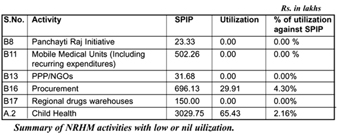
JAMMU, Apr 19: Even as the State Health Ministry had celebrated with great fanfare the foundation day of National Rural Health Mission (NRHM) last week, the Union Ministry of Health and Family Welfare has expressed serious concerns over various lacunae in the implementations of several programmes being introduced as part of the Mission.
The Union Ministry, while pointing out several areas of concern has sought clarifications from the top Health officials of the State regarding the poor implementation of NRHM programmes and take some remedial measures immediately.
While some of the core activities of the NRHM have shown miserably low expenditure, there were other programs showing far excess expenditure beyond defined limits. The Ministry has told the State officials to examine the reasons for the same and share the exact details with them, said a letter written by Director (Finance), Ministry of Health & Family Welfare vide D.O. NO. G-25020/5/3009-NRHM (F) dated 08-02-2012, which has been addressed to Commissioner Secretary, Health and Medical Education Department and Mission Director, NRHM, J&K.
The letter has instructed the State Health officials to initiate remedial measures to bring improvement in programme/ financial management, better utilization of funds under various activities of RCH and Mission Flexible Pools.
These observations have been made by the Union Ministry in its latest Financial Monitoring Report of Jammu and Kashmir while conducting a detailed financial analysis of the funds released, utilized, unspent balance and the trend of expenditure under various components of RCH and Mission Flexible Pools.
While elaborating on the areas of concern, the Report comments, “the State has reported very low expenditure on its core activities under Mission Flexible Pool. The acitivities of the Program, which had registered low expenditure, included United funds (44%) and Annual Maintenance Grant (49.83%)”. The Corpus Grants to Hospital Management Society/ Rogi Kalyan Samiti (Patient Welfare Committee) – a concept in which a group of trustees is formulated to manage the affairs of the different hospital has also registered a very low expenditure (58.26%).
The Union Ministry has also asked the State Government to look into as to why less than 75% expenditure has been reported under mainstreaming of AYUSH (Ayurveda, Yoga, Unani, Siddha and Homeopathy). This has happened despite the fact that NRHM seeks to revitalize local health traditions and mainstream AYUSH (including manpower and drugs), to strengthen the Public Health Systems at all levels in the State.
While the State Health Department has been maintaining lower expenditure in some programs of NRHM, it had been over-zealous in implementation of others like the category of Hospital strengthening. The Ministry has questioned the rationale of the excess expenditure and told the officials to examine the entire issue.
“The State has incurred expenditure to the tune of 1243.44% under Hospital Strengthening even as out of the total expenditure of Rs 51 crores nearly 12.8 crores is expenditure against the committed unspent balance of 2010-11”, says the report.
Expenditure reported by the State under New Constructions/ Renovation and Setting up (32.8%), Innovations (46.5%) and other Expenditure Power Backup, Convergence (32.8%) is less than 50% of the approved SPIP. “The health officials need to look into this”.
While commenting on the RCH Flexible Pool, the Report says that out of the approved annual SPIP of Rs 124.56 crores, reported expenditure is only Rs 51.56 crore during the third quarter under RCH Flexi pool i.e only 41.39 %.
The State has reported low expenditure on the core activities including Child Health (2.16%) and they need to identify the reasons for this whilst taking necessary steps to improve its performance. Expenditure reported by the State under Maternal Health (other than JSY) (41.85%), Infrastructure & Human Resource (46.3%), Programme Management (47.48%) is less than 50% of the approved State Programme Implementation Plan (SPIP).
There is also need for improvement in performance of several activities including Urban Reproductive and Child Health Care (RCH) and Pre-Natal Diagnostic Technique (PNDT). The State has also reported negligible expenditure under Training (14.11%).
Interestingly, there are several other activities which have shown nil (0%) or very low utilization including Mobile Medical Units, PPP/NGOs, Procurement, Regional drugs warehouses, Panchayati Raj Initiative and Child Health. Since the Panchayati Raj institutions are still in their infancy, the State has also failed to utilize the funds provided under NRHM for them. This had also been pointed out by the Union Health Minister, Ghulam Nabi Azad during his visit to Billawar yesterday.
Since many areas in the country including hilly areas of Jammu and Kashmir are prone to accidents and lack basic health care infrastructure limiting access to the health services at present, the provision of Mobile Medical Unit (MMU) in each District was one of strategies aimed to take health care to the doorsteps of people. Though the State was provided nearly Rs 5 crores under this head, it had failed to utilize funds (0%) meant for this purpose.
The State has also reported negligible expenditure under Referral Transport (11.21%), PPP/NGOs (0.00%), Procurement (4.3%), New Initiatives/Strategic Interventions as per State health policy and for the important Regional drugs warehouses (0.00%).
11 DIGs, 7 SSPs approved for promotion by DPC
11 SSPs get Selection Grade
*8 posts of IGPs identified, two on cards
Sanjeev Pargal
JAMMU, Apr 19: In a major decision, the Departmental Promotion Committee (DPC) today approved 11 Deputy Inspectors General of Police (DIGs) and seven Senior Superintendents of Police (SSPs) for promotion and granted Selection Grade (SG) to 11 SSPs making them entitled for promotion as DIGs in future.
While one of the DIGs SJM Gilani, who was on deputation with the Central Bureau of Investigations (CBI) and figured at Serial No. 1 in the seniority list, has been given proforma promotion in his present organisation, 10 other DIGs have been promoted as IGPs.
The DPC comprising Chief Secretary Madhav Lal, Home Secretary B R Sharma and Director General of Police (DGP) Kuldeep Khoda met here this morning after two adjournments during past one and a half month and approved the proposal of Police Headquarters for promotion of entire batch of 1994 IPS officers from DIGs to IGPs and 1998 batch IPS officers from SSPs to DIGs.
Official sources told the Excelsior that the DPC “approved for promotion” 11 DIGs of 1994 batch and seven SSPs of 1998 batch after about two hour long meeting in the Civil Secretariat this morning.
“As all IPS officers of 1994 batch and 1998 batch were eligible for promotion to next higher rank, they have been approved for promotion”, sources said.
Mr Khoda told the Excelsior that eight vacancies of IGPs for newly promoted officers have been identified while efforts were on to identify two other posts.
“The exercise would take next two to three days. We are trying to get two posts `outside the police’ for newly promoted IGPs like Transport Department etc where IPS officers had served in past. The entire exercise for creation of posts would be over in next two to three days”, he said, adding as far as promotion of seven SSPs to DIG was concerned, there was absolutely no problem of vacancies.
Ten posts of DIGs became available today itself with promotion of an equal number of officers as IGPs.
Even if one post `outside the police’ was available, the task would be over as IGP Vigilance Organisation Z H Chisti is retiring next month, which would create another post.
Mr Khoda said the Selection Grade has been given to SSPs, who had become entitled for it.
A final nod to promotions approved by the DPC would be given by the Cabinet, sources said, adding that a major reshuffle in Police Department was on the cards with promotion of 17 senior police officers. Adjustment of the newly promoted officers would lead to a major reshuffle in police hierarchy, sources said, adding the reshuffle would take place only when all 10 clear cut vacancies were proposed before the Cabinet.
Excelsior had exclusively reported that 11 DIGs and seven SSPs would be promoted in the DPC.
The DIGs promoted as IGPs included SJM Gilani, who was on deputation to CBI, Abdul Ghani, DIG Central Kashmir Range, Srinagar, Mohammad Suleman Salaria, DIG Vigilance, J&K, Sunil Sharma, DIG CID Jammu, Farooq Khan, DIG Jammu-Kathua range, Dr Kamal Saini, DIG IRP Jammu, PR Manhas, DIG Security J&K, Yogender Koul, DIG Crime, J&K, Alok Puri, DIG Administration, Munir Ahmed Khan, DIG North Kashmir Range, Baramulla and Abdul Qayoom Manhas, DIG Trainings, Armed Police Headquarters.
All of them were 1994 batch IPS officers.
The SSPs promoted as DIGs were Rajinder Gupta, SSP CID (Special Branch) Jammu, Parminder Singh, SSP Special Security Group, J&K, Showkat Ahmad Malik, SSP CID (Special Branch) Kashmir, Ahfadul Mujtaba, SSP Vigilance, Jammu, Abdul Hamid, Commandant IRP Ist battalion, Mushtaq Mohammad Sadiq, Principal, Police Training College (PTC), Manigam and Shakeel Ahmad Beigh, SSP Udhampur.
Eleven SSPs, who have been given Selection Grade making them entitled to promotion as DIGs in future are, Anand Jain, former SSP Jammu, SR Samuel, Commandant IRP 13th battalion, Nitish Kumar, who was on deputation with National Investigating Agency (NIA), Manmohan Singh, SSP Traffic Jammu, Ashkoor Ahmad Wani, SSP Poonch, Ali Mohammad, SSP CID Headquarters, Vijay Singh Samyal, Commandant IRP, JL Sharma, SSP Kathua, Bashir Ahmad Itoo, SSP Human Rights Commission, Israr Ahmad Khan, SSP Samba and Nissar Ahmed, SSP Crime Branch, Jammu.
All of them were 1999 batch IPS officers.
The promotions were due for past quite sometime and had been hanging in balance. The DPC fixed twice during past one and a half month had to be cancelled due to different pretexts.
Sources said the DPC finally met this morning for two hours. While there was consensus on promotion of seven SSPs to DIGs as clear cut vacancies were available for them, the problem did crop up in promotion of DIGs to IGPs in the absence of 10 vacancies, which were required for promotion of entire 1994 batch IPS officers. Rouf-ul-Hassan was the only 1994 batch officer, who had already been promoted as IGP and posted as IGP Armed/Indian Reserve Kashmir.
Since one of the DIG SJM Gilani was to be given proforma promotion in view of his posting with the CBI, only 10 posts of IGPs were required in the State.
The DPC also sought clarification on Annual Performance Report (APR) of a DIG, which was clarified by the Police Headquarters paving the way for promotion of all DIGs of 1994 batch, sources said.
They added that eight vacancies of IGPs have been identified by the Police Headquarters and efforts were on to identify two other posts. Police authorities were trying to identify two posts `out of Police Department’ i.e. in the civil administration like Transport etc. An IPS officer had earlier held the post of Transport Commissioner. Sources said the exercise would be completed in next two to three days after which all 10 vacancies would be placed before the Cabinet for promotion and postings of 17 officers.
Four cadre posts of IGPs, which were available for promotions included IGP Crime, J&K, IGP Security, Director Sher-I-Kashmir Police Academy (SKPA) Udhampur and IGP Technical Services J&K. While Raja Aijaz Ali and Dr Ashok Gupta had retired as IGP Crime and Director SKPA respectively, Arun Choudhary and Ashok Gupta had earlier held the post of IGP Technical Services and IGP Security. Mr Choudhary was presently posted as IGP Police Headquarters.
The Government sanctioned the cadre posts. Three ex-cadre posts, which have already been created by the Government included IGP Human Rights, IGP Law and Order and IGP North Kashmir Range Baramulla. However, there were less chances of an officer getting posting as IGP NKR Baramulla range as the post was created during summer unrest of 2010.
Gulzar Singh Slathia, IGP Armed had earlier held the post of IGP Human Rights while Pankaj Saxena had served as IGP NKR Baramulla.
Other posts included IGP/MD Police Housing Corporation and Director Civil Military Liaison.
Sources said there was no proposal before the DPC for promotion of IGPs to Additional DGPs due to only one vacancy. There were four IPS officers of 1987 batch and the Government wanted to promote all of them simultaneously as ADGPs after creation of three more vacancies.
According to sources, there was only one vacancy of ADGP in CID. Four IPS officers of 1987 batch included VK Singh, who was on Central deputation in Singapore, SM Sahai, IGP Kashmir, Dilbagh Singh, IGP Jammu and Owais Ahmad IGP Personnel/Training Police Headquarters/Technical. First three of them were Regular Recruits (direct IPS officers) while Owais Ahmed was KPS conferred with IPS from 1987.
Two IPS officers of 1987 batch-Dr Ashok Gupta and Raja Aijaz Ali had retired on February 29 as Director SKPA, Udhampur and IGP Crime.
VK Singh is scheduled to return to the State in June or July this year after completion of Central deputation.