

NEW DELHI, May 13:
Country’s largest real estate player DLF is all set to start its own fire brigade beginning with Gurgaon and Chennai, making it probably the first private company to dabble into such activities.
DLF, which is credited to have established almost the entire Gurgaon—one of the first MNC hubs of the country, will set up at least three fire stations in this NCR city as also in southern city of Chennai, in the next two months.
The three stations, mainly to safegauard DLF properties, would have about 120 employees and more such stations could follow going forward.
“With the burgeoning urban population, providing secure living spaces should be a top priority. This move is in line with DLF’s philosophy that the life of our residents and those working in DLF premises are our top priority,” DLF Head (Fire Safety) S K Dheri told.
These will be the first private fire stations in India that will cater to nearby areas also, along with the three complexes of DLF, in the case of need, he said.
“These fire stations will be located in the Cyber City and DLF Phase V in Gurgaon and the IT SEZ in Chennai. These stations are expected to be operational in the next two months,” Dheri said.
DLF has procured the three hydraulic platforms—two 90 metres and one 60 metres height—from Finland, which is the first time in India that lifts of this height will be available for rescue and fire fighting operations, he claimed.
“The height of the equipment is very crucial for conducting rescue operations in a high-rise building in the eventuality of a fire outbreak. These hydraulic platforms at DLF fire stations are capable of carrying a load of 400 kg,” he said.
The company will have 25-40 people per fire station in the three locations, he added.
He, however, did not share the size of the investment that the company has made in this venture.
Elaborating on the facilities, Dheri said DLF will keep two fire tenders per station with the fire dousers having the capacity to carry 18 kilolitres of water per vehicle.
Dheri said the company already has some fire safety mechanism at its complexes that are managed by its own employees, who conduct fire safety drills and evacuation procedures among others.
“More than 150 qualified fire officers are working round the clock to ensure safety of their occupants—whether owners or tenants. Besides this, the company is maintaining all the systems and equipment at its own cost,” Dheri said. (PTI)
DLF to start its own fire brigade
Fin Min examining CBDT committee report on black money
NEW DELHI, May 13:
Nearly ten months after it was formed to examine ways to check the menace of black money, a committee under the chairmanship of Central Board of Direct Taxes (CBDT) chief has submitted its report to the Finance Ministry.
The Ministry, however, declined to share its details saying “action taken” on the basis of the report is to be laid in the Parliament.
The Government had on May 27 last year constituted the committee to examine ways to strengthen laws to curb the generation of black money in the country, its illegal transfer abroad and its recovery.
The committee was mandated to consult all stakeholders and submit its report within a period of six months, that is by November-end. However, its tenure was extended thrice—in November, January and February, 2012 — to enable it to complete its work by March.
“The report, submitted by the Committee on March 29, 2012 to the Government, is being examined by the Government and action taken thereof is to be laid before the Parliament,” the Finance Ministry said in a reply to an RTI query.
It also declined to share the copy of the report as it is “exempted under Section 8(1)© and Section 8(1)(e) of the RTI Act, 2005”.
The Section 8(1)© bars “information, the disclosure of which would cause a breach of privilege of Parliament or the State Legislature”.
Whereas, Section 8(1)(e) exempt disclosure of “information available to a person in his fiduciary relationship, unless the competent authority is satisfied that the larger public interest warrants the disclosure of such information”.
The committee included Member (Legislation and Computerisation), CBDT, Director Enforcement (ED), Director General of Revenue Intelligence (DRI), Director General (Currency), Joint Secretary (Foreign Tax and Tax Research), CBDT and Director of Financial Intelligence Unit-India (FIU-IND) as members.
According to the information given by the Ministry, the Committee has conducted seven meetings on June 9, 2011, July 29, 2011, September 23, 2011, December 21, 2011, March 21, 2012, March 26, 2012 and March 28, 2012.
Earlier, replying to another RTI application, the Government has said there was “no authentic figures” about the amount of deposits held by Indian citizens in Swiss banks, which are exclusive of their lawful and legitimate deposit.
The government has also commissioned a study to estimate quantum of black money in the country which is expected to complete its work by September this year.
The study is being done by three institutes—National Institute of Public Finance and Policy, National Institute of Financial Management, National Council for Applied Economic Research.
The Government has said negotiations of 16 new Tax Information Exchange Agreements (TIEAs) to keep a tab on flow of black money have been concluded with Bahamas, Bermuda, British Virgin Islands, Isle of Man, Cayman Islands, Jersey, Monaco, Saint Kitts and Nevis, Argentina, Costa Rica, Guernsey, Macau, Liberia, Marshall Islands, Congo and Gibraltar.
Besides, India has initiated a process to negotiate with 74 countries to broaden the scope of the Article concerning exchange of information to specifically include banking information and information which has no domestic interest.
Finance Minister Pranab Mukherjee is likely to table a ‘white paper’ in the Parliament on black money during the ongoing Budget Session.
The Government is giving special attention on cross border transactions and business deals which has resulted in collection of taxes of Rs 22,697 crore in the last financial year, sources said. (PTI)
No medical admission beyond July 15, or face contempt: SC
NEW DELHI, May 13:
The Supreme Court has framed a series of guidelines for admission to MBBS and BDS courses in the country, saying after July 15 each year, neither the Government nor the medical or dental councils shall issue any recognition or approval for that academic year.
“The commencement of new courses or increase in seats of existing courses of MBBS/BDS are to be approved/recognised by the Government of India by 15th July of each calendar year for the relevant academic sessions of that year.
“After 15th July of each year, neither the Union of India nor the Medical or Dental Council of India shall issue any recognition or approval for the current academic year. If any such approval is granted after 15th July of any year, it shall only be operative for the next academic year and not in the current academic year,” the bench of justices A K Patnaik and Swatanter Kumar said.
The judges said violation of the orders would invite both contempt proceedings and initiation of departmental action against the violating its directions.
The bench initiated contempt proceedings against six officials in connection with the admission granted to two girls – Akansha Adile and Priya Gupta – in the MBBS course for the academic year 2006-07 in the Government NMDC Medical College, Jagdalpur in Chandigarh, on September 30, after overlooking the claims of several other meritorious students and the time schedule.
Contempt proceedings were initiated against the director general, Directorate of Health Services; S L Adile, director of Medical Education; the dean of Jagdalpur College; and M S Banjan, P D Agarwal and Padmakar Sasane, members of the selection committee. Akansha is the daughter of S L Adile.
However, considering the fact that the two girls are in their final year of MBBS study, the bench though holding their admissions illegal, imposed a cost of Rs five lakh on each of them which it said shall be used for development of Jagdalpur college.
The court said any college which grants admission for the current academic year, where its recognition/approval is granted subsequent to 15th July of the current academic year, “shall be liable for withdrawal of recognition/approval on this ground, in addition to being liable to indemnify such students who are denied admission or who are wrongfully given admission in the college.
“Any medical or dental college, or seats thereof, to which the recognition/approval is issued subsequent to 15th July of the respective year shall not be included in the counselling to be conducted by the concerned authority and that college would have no right to make admissions in the current academic year against such seats,” the bench said.
According to the apex court, admission to the medical or dental colleges shall be granted only through the respective entrance tests conducted by the competitive authority in the state or the body of the private colleges.
“If any seats remain vacant or are surrendered from All India quota, they should positively be allotted and admission granted strictly as per the merit by 15th September of the relevant year and not by holding an extended counselling.
“The remaining time will be limited to the filling up of the vacant seats resulting from exceptional circumstances or surrender of seats. All candidates should join the academic courses by 30th September of the academic year,” the bench said.
Referring to the two girls’ illegal admission, the bench said, “The prescribed procedure for grant of admission was given a go by and the rule of admission on merit stood frustrated as a consequence of such admission process,
“Where the time schedules have not been complied with, and rule of merit has been defeated, there nepotism and manipulation have prevailed. The stands of various authorities are at variance with each other and none admits to fault,” the bench said. (PTI)
HC to hear plea for taking N D Tiwari’ blood sample forcibly
NEW DELHI, May 13:
The Delhi High Court would hear tomorrow a plea for taking forcibly the blood sample of veteran Congress leader N D Tiwari for his DNA test to decide the paternity suit of Rohit Shekhar, who claims to be his biological son.
Nearly a fortnight after the Delhi High Court asked Tiwari to give his blood sample for DNA test to decide the paternity suit, Shekhar had moved the court last week for forcibly taking his blood sample for the test.
In an application to single-judge bench of justice Reva Khetrapal, Shekhar had sought a direction to former Andhra Pradesh governor Tiwari to comply with high court’s December 23, 2010 and April 27, 2012 orders.
Alternatively, Shekhar pleaded to the court to appoint a commissioner to take Tiwari’s blood samples with assistance from police force, as mandated by the court’s April 27 order.
“Direct the non-applicant 1 (Tiwari) to furnish blood samples at the earliest convenience of this court. In the event that Tiwari fails to appear on the date fixed by the court, appoint a Commissioner to draw blood samples of Tiwari by force or otherwise,” Shekhar said in his application.
He also sought the court to direct the police to provide assistance to the Commissioner, to be appointed by the court.
On April 27, a bench of Acting Chief Justice AK Sikri and Rajiv Sahai Endlaw had said police force can be used to compel Tiwari to give blood sample for the DNA test in case he refuses to undergo the test on the paternity suit.
The bench had passed the orders while hearing Shekhar’s plea challenging the single judge’s September 23 last year order which had stated that Tiwari cannot be compelled but an adverse inference can be draw from his repeated refusal to give blood samples.
After the high court ordered taking Tiwari’s blood sample – even forcibly if needed, Tiwari even approached the apex court, which too refused to give him any relief.
“Enough is enough. You (Tiwari) were not present on earlier occasions. Having regard to your age, we had told you to give sample in a sealed cover. We gave you protection under Article 21, but enough is enough,” a bench of justices Aftab Alam and C K Prasad had said.
Shekhar, in his application, has said that the Congress leader be asked to bear the cost of the execution of the order and be restrained from leaving the country to avoid observing the judicial order.
Earlier, a single-judge bench had said that the order asking Tiwari to undergo the DNA test for ascertaining the paternity Shekhar was “un-implementable and unenforceable” and hence, he cannot be forced to give his blood sample for this purpose.
Setting aside the order, the division bench of the high court said “…Police assistance and use of reasonable force for compliance thereof” can be taken as judicial orders needed to be executed.
Shekhar, in 2008, had filed the paternity suit for getting
the Congress leader declared his biological father and the single judge and a division bench of the high court had asked Tiwari to go for the DNA test.
The Supreme Court also did not stay the order and opined that Tiawri should abide by the court orders as vital evidence may be lost for forever considering his old age.
Tiwari, a former chief minister of Uttar Pradesh and Uttarakhand, who had also held key ministerial portfolios at the Centre, was forced to resign as Andhra Pradesh Governor in 2009 amid allegations of sexual misconduct against him. (PTI)
No pay disparity between teachers of Govt and pvt schools: HC
NEW DELHI, May 13:
The teachers of unaided private schools are entitled to same pay and emoluments as those of Government schools, the Delhi High Court has held.
Rejecting an appeal by a private school, a bench of Acting Chief Justice A K Sikri and Justice Rajiv Sahai Endlaw upheld the single judge’s order directing Rukmini Devi Jaipuria School, Rajpura Road, to pay arrears of salary to its teachers with effect from January one, 1996.
Directing the school to pay the arrears in four weeks, the bench also imposed a cost of Rs 30,000 on it.
The court dismissed the school’s argument that the pay commission recommendations are only applicable to the Government-aided schools and not to private schools.
The court accepted the contention of Ashok Agarwal, the counsel for the teachers, that it’s a travesty of justice that the teachers are denied their lawful salary without any justification.
The court also held that the employees of all unaided recognised private schools are entitled to benefits of pay and emoluments from January 1, 1996, the date the fifth pay commission recommendations became applicable and the schools cannot deny or delay the same on the ground that it could not recover fee from the students.
According to the teachers, they were paid the arrears by the school with effect from April 1997 instead of January 1996.
Their lawyer argued before the court that many private schools are violating the recommendations of the Pay Commissions even though they have collected surplus funds from the students.
“Their audit records show that the private schools have crores of rupees lying as surplus which they collected from the students on the pretext of implementing the Fifth and Sixth Pay Commission,” Agarwal contended.
He submitted that Section 10 of Delhi School Education Act mandates that the employees of all the unaided private recognised schools are entitled to benefit of pay and allowances etc as per the Government school teachers. (PTI)
RIL yet to supply gas to Bawana power plant, production hit
NEW DELHI, May 13:
Despite the Delhi Government building a 1,500 MW capacity power plant at Bawana at a cost of Rs 4,500 crore, Delhiites are expected to reel under severe power cuts this summer with Reliance Industries Ltd not supplying gas to the plant even after directions from the Oil Ministry.
After failing to get gas for the plant from RIL as per an earlier understanding, the Delhi Government in February had sought intervention of Finance Minister Pranab Mukherjee, who heads an Empowered Group of Ministers (EGoM) on gas allocation so that plant could at least generate 750 MW of power.
The EGoM in its meeting on February 24, heeding to the Delhi government’s request, had allocated 0.836 mmscmd (million metric standard cubic metres per day) to the plant from Reliance’s Andhra offshore KG-D6 fields but the company is yet to supply the fuel.
“We have made several requests to the RIL to supply the gas allocated by the EGoM. But the company is yet to honour the direction of the Oil Ministry saying there has been a drop in production of gas from KG-D6 fields,” a top Delhi Government official told.
The government was relying heavily on generation of power from the Bawana plant to meet the growing power demand during the summer months. As per Government estimates, the maximum demand is expected to go beyond 5,200 MW against the last year’s 5,028 MW.
The city gets 2,400 MW from central quota, while nearly 1,000 MW is produced by Delhi’s own electricity generating stations. As per projection by Central Electricity Authority, the power demand in Delhi will jump to 8,700 MW by 2017.
Officials said commissioning of the plant may also result in drop in power tariff in the city as cost of power procurement will come down. They said cost of per unit of power from Bawana plant would be in the range of Rs 4.30 to Rs 4.70.
Power being bought from Jhajhar power plant in Haryana currently cost in the range of Rs 5.50 to Rs 6.10 per unit.
The Delhi Government last year had sought intervention of the Prime Minister’s Office also in getting natural gas for the Bawana plant following refusal of Reliance Industries Ltd to supply the fuel.
The commissioning of second module of the power plant is slated for next month which will take the production capacity at the plant from current 750 MW to 1,500 MW.
Three turbines of the plant with a production capacity of 750 MW were synchronised last year, while construction of three other turbines were also completed.
The Centre had allocated 0.93 mmscmd gas from Reliance’s Andhra offshore KG-D6 fields for Bawana for 2009-10 and 2010-11 but as the plant missed scheduled deadline, the Delhi Government could not sign the Gas Sales Purchase Agreement with RIL.
In April last year after synchronisation of two gas-fired turbines of 250 MW at the plant, the Delhi Government had approached RIL to sign the contract.
But Reliance said it was in not in a position to sign the contract as available gas has already been allocated to other entities. (PTI)
Court asks Govt to probe into CWC functioning
NEW DELHI, May 13:
The functioning of Child Welfare Committee (CWC) has come under the scrutiny of a Delhi court which directed the city Government to look into the allegation as to how the committee had released the minor girls, who were victims of human trafficking, to their relatives.
The court’s order came in a case pertaining to the raids conducted by the Crime Branch of the Delhi police and an NGO at various placement agencies here last year from where many girls, including minors, were recovered and their custody was handed over to the CWC.
The NGO ‘Shakti Vahini’ had recently told the court that the girls have been released by the CWC without its consultation and the victims have again been pushed to work as maids, while one of the girls has also been raped by a placement agency official.
“As an immediate measure, I hereby direct that a copy of the application along with its annexure placed before this court, be forwarded to the director of Department of Women and Child Development and also to the secretary, Social Welfare Department, GNCT, Delhi, who will look into the allegations involved and shall inform this court with regard to the remedial measures taken at their ends,” Additional Sessions Judge (ASJ) Kamini Lau said.
The court also said as per available records, the issue raised by the NGO appears to be genuine and it cannot be ignored due to the seriousness of the matter.
“Prima facie, the grievances of the NGO (Shakti Vahini) appears to be genuine and it is writ large that the rescued children are being again pushed back into placement at various places through other agencies.
“The entire purpose of the rescue and rehabilitation as contemplated under the act appears to be defeated,” it said.
During the hearing, NGO Director Subir Roy and one of its official Rishi Kant, had said they were aggrieved with the CWC’s decision which refused to provide any restoration information about the rescued girls and due to lack of details, they were finding it difficult in tracing the children.
The NGO had also apprised the court that many of the children rescued by them were given by the CWC to their relatives who have again pushed them back to the same work.
“Some of those girls have not been found till date on account of which we are unable to provide any help to victims so that they could depose before the court,” the NGO said.
Out of the rescued girls so far, only four have appeared before the court to record their testimonies after several reminders to the CWC.
The court noted that a minor, who was earlier rescued, is again back to work through another placement agency and in the last hearing, she was brought to the court by her employers.
“How the minor witness, who at the time of recovery, had disclosed her address as that of Bangladesh was released to some relative rather than being handed over to the FRRO for deportation?,” the court asked the CWC.
It also said due coordination with the NGO in terms of the provisions of Juvenile Justice (Care and Protection of Children) Act should be ensured for rehabilitation of rescued children and they should also be produced in the court at the time of recording of witnesses statements. (PTI)
Supremacy of Parliament must be preserved: Leaders
PM for introspection over frequent disruptions
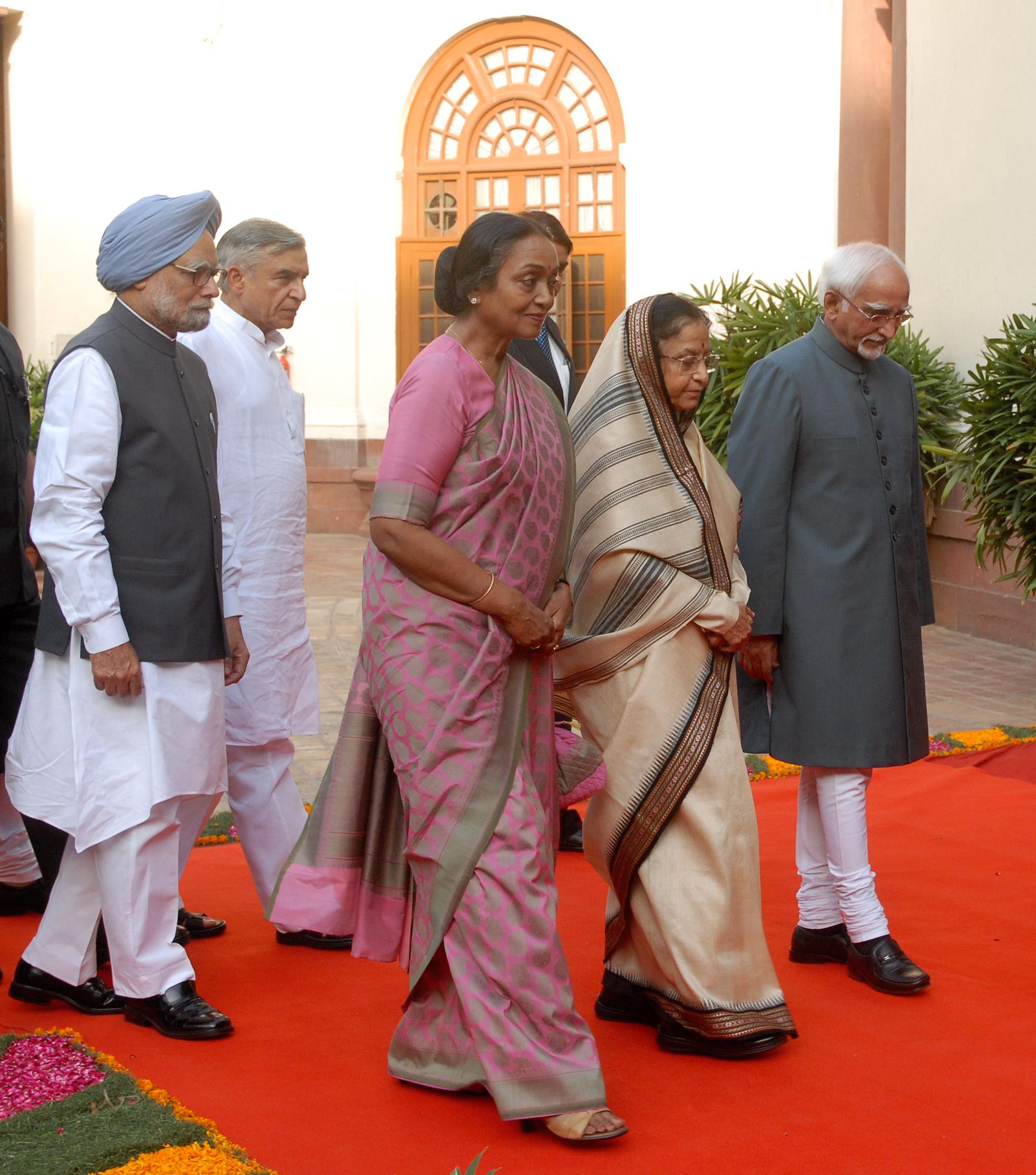
NEW DELHI, May 13:
Concern over repeated disruptions that have raised questions over the efficacy of Parliament’s functioning today marked the 60th anniversary of its first sitting in free India with leaders pressing for “sincere” introspection to restore the dignity of the institution.
Cutting across party lines, leaders asserted that supremacy of Parliament must be preserved, holding that laws are made by it and not mobs, apparently a reference to civil society campaign against Parliamentarians while pressing for setting up of Lokpal.
The leaders took pride in the fact that India has managed to hold on to democracy and was a shining example in the world despite many pressing problems like acute poverty, sustained terrorism and hiccups for democracy in the neighbourhood.
However, a faint reference was made to the brief period of Emergency of 1970s, which was corrected constitutionally soon after.
At the end of the day-long debate, both the Houses passed unanimous resolutions to “uphold and maintain the dignity, sanctity and supremacy of Parliament” and to “make it an effective instrument of change” while strengthening democratic values and principles.
The members in both the Houses also resolved to enhance the accountability of the Government towards the people through the oversight of Parliament.
There were some cynical voices, which referred to similar resolutions passed on the occasion of 50th anniversary of India’s independence when a vow was taken not to resort to disruptions.
Prime Minister Manmohan Singh, who set the tone for introspection as he flagged concerns in the Rajya Sabha over “repeated disruptions” and “unwillingness” for discussions, pressed for “substantive and sincere” introspection.
Winding up a day-long discussion in the Lok Sabha marking the 60th year of the first sitting of Parliament, he said public disenchantment is bound to rise if parties fail to collectively resolve to restore prestige of the institution.
“The daily routine of disruptions, adjournments and shouting in the House are leading many outside to question the efficacy of this institution and its place in public affairs,” the Prime Minister said.
Appealing to members to “write a new chapter and restore to it the sense of dignity and decorum” of Parliament, he said every MP should lead by example to restore the prestige of this institution.
“We need to resolve that the Rules of Procedure and conduct that we have collectively evolved would be honoured in letter and spirit,” he said.
While asking the country to reject those who mock the institutions of democracy, he admitted that many people often feel frustrated by the disruption of Parliament and “in our own way, each one of us shares the blame for this state of affairs.”
He said, “We are not a perfect democracy but we are a functioning democracy with mechanisms and safeguards that allow for the reconciliation of diverse interests and differences.
“It is the vitality and vibrancy of our democracy that keeps the nation united and moving on the path of progress,” he said.
A function was held in the central hall of Parliament where four members of the first Parliament were honoured.
The CPI (M) utilised the occasion to press for a combination of proportional representation system along with the ‘first past the post’ adopted by India in elections, contending that no Government at the Centre had commanded more than 50 per cent of the polled votes in the last 60 years.
President Pratibha Patil said the Indian democracy “cannot be allowed to falter” at a time when democracies of the world are operating in the complex situations including fractured mandates and explosion of the media.
She said, “Discussions can be difficult and divergent but yet solutions have to be found through discussions in Parliament and resolve through established Parliamentary practices.”
Vice President Hamid Ansari regretted that there was perceptible drop in the working days of Parliament.
“Deliberation is less frequent; legislation is at times hasty…An impression is afoot in some quarters that diligent parliamentary work is less rewarding in political terms,” he said.
Noting that new imperatives propelled them, Ansari said, “We do need to respond meaningfully to awakened expectation of a new generation in a changing world.”
Speaker Meira Kumar reminded the lawmakers that they were in Parliament to protect interests of people and there was no scope of lapse in discharge of the duties.
The Prime Minister underlined that it was “incumbent upon all of us to respect the great institutions of our democracy and respect the spirit of what is expected from the elected representatives.”
Finance Minister and Leader of the Lok Sabha Pranab Mukherjee echoed concerns over disruption in the Lower House when he lamented that a handful of members throttle “silent majority” and called for a mechanism that will eliminate disruptions.
“On many occasions, this House has been tumultuous, tempers ran high, but disruption was the least this House has adopted. Because when we disrupt the House then it serves no purpose. We cannot hear. We cannot speak,” he said.
Mukherjee said Parliament has acted as a “shock absorber” on several occasions and whenever there have been disputes, dissensions, the Lok Sabha has played a role in defusing it.
UPA Chairperson Sonia Gandhi emphasised that independence of Parliament must be protected at all costs and urged members to live up to the standards of the makers of Constitution.
BJP leader L K Advani shared Mukherjee’s views and said tolerance and understanding for each others’ views and debates in Parliament can solve issues.
Leader of Opposition in Rajya Sabha Arun Jaitley said a major challenge before the country was to improve polity and good governance. (PTI)
First LS had started with 2 minutes silence
NEW DELHI, May 13:
The first sitting of Lok Sabha on May 13, 1952, had opened with observance of two minute silence and order of the President to appoint G V Mavlankar as Speaker.
The first sitting of Lok Sabha 60 years ago had started at quarter to 11 am, according to Parliamentary records.
Since it was first sitting of the maiden Lok Sabha no question was published.
Parliamentary Secretary read the order of President Rajendra Prasad that since posts of Speaker and Deputy Speaker of Lok Sabha are vacant, as per provision of section 95 of Constitution he is appointing G V Mavlankar to discharge the function of Speaker.
The first member to turn up for taking oath was none else than Pandit Jawaharlal Nehru as member of Allahabad East and Jaunpur West constituency.
The first adjournment motion during the maiden Lok Sabha on May 15 had come on the issue of food subsidy. But, it was not taken up after Speaker said that members would get chance to raise the issue during discussion on budget. (PTI)
Take steps to avert clash: DM to Army
Officers, jawans to be attached
NEW DELHI, May 13:
Unhappy over the initial report, Defence Minister A K Antony has asked Army to take immediate “corrective” steps to see that incidents like the clash between jawans and officers at a firing range near the India- China boundary in Nyoma, Ladakh do not recur.
The Minister is understood to have expressed his displeasure to the Army top brass over the initial report that is said to have attempted a cover up on the clash that has raised questions over discipline in an important unit of an artillery regiment, highly-placed sources told here.
He has now sought full details of the incident in Nyoma, they said.
The army had submitted a brief initial report about the incident to the Ministry on Friday evening, almost a day after the incident took place in the Mahe field firing ranges in Ladakh.
Sources said army had attempted to describe the whole incident as only a minor scuffle between jawans and officers but no details were provided.
The army had yesterday said the clash between the jawans and officers near Leh was an “isolated act of indiscipline” and not a mutiny and that the media had “sensationalised” the incident.
It also denied any arms and ammunition were used during the incident, saying, “The armoury has not been captured by the troops as is being reported wrongly.”
The Army has ordered a Court of Inquiry into a scuffle that broke out between officers and jawans in Ladakh after the Ministry sought a detailed report from it on the incident.
Army sources said the officers and jawans involved in the clashes will now be attached to the CoI ordered by the superior headquarters and will face action. The CoI is being headed by a Brigadier-rank officer.
Sources said Commanding Officer of 226 Field Regiment Colonel Prakash Kadam has been relieved of his command duties in view of the incident and another officer has been given the charge.
However, Army sources denied any such move.
Sources said there was also a possibility of the unit being disbanded after the completion of the disciplinary proceedings into the case. (PTI)