

WASHINGTON, May 14: The US and its allies are making significant progress in Afghanistan and are on track to achieve the 2014 goals of complete transition, President Barack Obama today said, after his Afghan counterpart Hamid Karzai announced the third tranche of areas to transition.
This “is an important step forward in our effort to achieve our objectives in Afghanistan,” Obama said in a statement after Karzai announced the transition of security responsibility for Kapisa, Uruzgan and Parwan provinces.
Likewise, security will also change hands in all provincial capitals.
As transition proceeds in these areas, nearly 75 per cent of the population of Afghanistan will be living in provinces, districts and villages where Afghan forces are leading, he said.
“The Afghan National Security Forces are strengthening their capacity as we remain on track to meet our goal of having the Afghan government fully responsible for security across the country by the end of 2014,” Obama said.
“A week from now, world leaders will gather at the NATO Summit in Chicago to discuss how we can effectively advance the transition process as our forces move from combat to a support role, and demonstrate our enduring support for the Afghan Government and Afghan National Security Forces,” said the US President.
Obama said he looks forward to meeting with Karzai and other NATO leaders in Chicago to discuss these critical steps that will strengthen Afghan sovereignty while responsibly winding down the war.
US Defence Secretary Leon Panetta said the announcement by Karzai in Kabul is another tangible sign of progress in their strategy and in the further development of Afghan leadership and responsibility for their own security.
“With more than 100 districts identified, this third phase will be the largest yet. When implemented, roughly three-fourths of the Afghan people will live in areas undergoing transition to Afghan security lead. It means that transition will be occurring in every province in the country, and in every provincial capital,” Panetta said.
“None of this would be possible without the growing strength of the Afghan National Security Forces, which remain essential to our shared goal of an Afghanistan that can secure and govern itself,” he said.
Panetta commend US troops and those of ISAF partners for their determination and commitment to this vital mission and applaud General Allen and Ambassador (Ryan) Crocker for their extraordinary leadership in Afghanistan.
“Thanks to their efforts, the transition to Afghan security lead is on track to be completed by the end of 2014. We will continue working toward our shared goal of an Afghanistan that provide security and greater prosperity for its people,” Panetta said. (PTI)
US making significant progress in Afghanistan: Obama
FARC calls for committee to discuss release
BOGOTA, May 14: Colombia’s FARC guerrilla group has decided to free a French reporter they kidnapped two weeks ago, although they have not given a date for his release, a Red Cross official said citing a statement from the rebels.
Heavily armed members of the Revolutionary Armed Forces of Colombia kidnapped Romeo Langlois, a reporter for France 24, during a firefight with troops carrying out an anti-drug raid in Caqueta, a rebel-stronghold in the south.
“The ICRC (International Committee of the Red Cross) has received a statement from the FARC in which they say they have decided to release Romeo Langlois,” ICRC official Daniel Munoz told reporters.
Munoz said yesterday the statement did not mention a date for Langlois’ release, but that the FARC has called for the mediation of a committee formed by an envoy from the French government, an ICRC representative and activist and former Senator Piedad Cordoba, who would discuss the terms for the Frenchman’s release with the rebels.
Munoz said the ICRC has been informed that Langlois is in good health, despite a wound he sustained in his left arm when he was kidnapped on April 28.
The group on Monday accused the Colombian government of manipulating journalists to bend public opinion against them and called for a debate on freedom of information as a condition for Langlois’ release.
President Juan Manuel Santos has repeatedly demanded Langlois’ liberation, but his defense minister on Tuesday said they were not going to negotiate with “terrorists.”
The FARC started as a Marxist peasant movement in the 1960s and later turned to kidnapping, extortion and drug trafficking. The European Union and the United States have labeled the FARC a terrorist group.
Following a US-sponsored crackdown, the FARC has lost steam in recent years. Several top commanders have been killed and its fighting force is said to be dwindling.
However, the drug-funded group is still a force in remote jungle areas, and has carried out a string of attacks on oil and mining projects in recent months.
Many youngsters in rural areas, where unemployment is high, voluntarily join the FARC ranks every year, but rebels sometimes kidnap children and force them to join their armed struggle.
In February the group said it would stop taking hostages for ransom to pay for weapons, uniforms or food. It did not say, however, that it would stop kidnapping for so-called political means to pressure the government.
(AGENCIES)
14 people, including 4 Indians, killed in Nepal plane crash
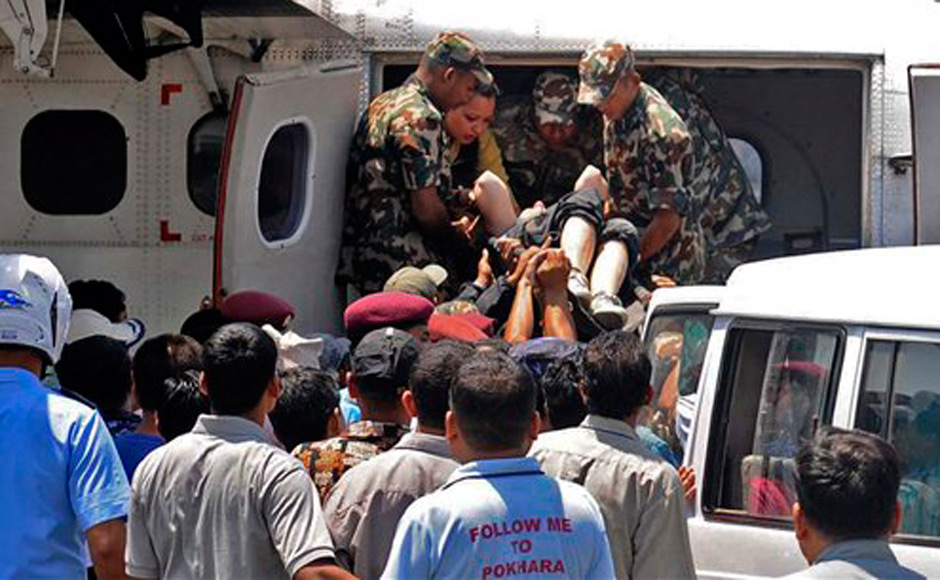
KATHMANDU, May 14: A private plane with 19 people on board today crashed in mountain airstrip in northern Nepal, killing 14 people, including four Indians, officials said.
The Dornier aircraft belonging to the private Agni Airlines crashed while trying to land near city of Pokhara, they said.
There were 19 people on board including one pilot, they said, adding that 14 of them were killed.
Four Indians are among the dead, they said.
Officials said five people were among survivors which include some Indians.
The injured people were taken to a nearby hospital.
Rescue team has been rushed to the spot. (PTI)
Bees ‘may improve robot vision’
WASHINGTON, May 14: Scientists have shown that a honeybee’s brain is sophisticated enough to learn rules and process visual problems, a finding which they claim suggests a robot could one day do the same.
An international team claims that honeybees also use multiple rules to solve complex visual problems, which has important implications for our understanding of how cognitive capacities for viewing complex images evolved in brains.
Lead author Dr Adrian Dyer at RMIT University in Australia said that rule learning was a fundamental cognitive task that allowed humans to operate in complex environments.
“For example, if a driver wants to turn right at an intersection then they need to simultaneously observe the traffic light colour, the flow of oncoming cars and pedestrians to make a decision.
“With experience, our brains can conduct these complex decision-making processes, but this is a type of cognitive task beyond current machine vision.
“Our research collaboration between labs in Australia and France wanted to understand if such simultaneous decision making required a large primate brain, or whether a honeybee might also demonstrate rule learning,” he said in a release.
For their study, the researchers trained individual honeybees to fly into a Y-shaped maze which presented different elements in specific relationships like above/below, or left/right.
With extended training the bees were able to learn that the elements had to have two sets of rules including being in a specific relationship like above/below, while also possessing elements differing from each other.
Dr Dyer said the findings showed that possessing a large complex brain was not necessary to master multiple simultaneous conceptual rule learning. “This offers the possibility of deciphering the neural basis of high-level cognitive tasks due to the simplicity and accessibility of the bee brain,” he added.
The research has been published in the ‘Proceedings of the National Academy of Sciences’ journal. (PTI)
BJP to approach NHRC seeking rights for Hindu refugees
GUWAHATI, May 13:
BJP will soon approach the National Human Rights Commission seeking constitutional protection for Hindu refugees from erstwhile East Pakistan and Bangladesh, party President Nitin Gadkari said today.
“Denial of citizenship to Hindu refugees is a violation of human rights. We’ll file a petition with the National Human Rights Commission so that such victims of persecution who have fled to India can secure their rights as per rules of the Constitution”, Gadkari told reporters here.
“As per the Constitution, any Hindu who is forced to flee any part of the world and comes to India on account of persecution has a right to Indian citizenship. That is a constitutional duty for us”, he said.
Accusing successive Congress-led governments at the Centre and in Assam of committing injustice to Hindu refugees by denying them citizenship, he said, BJP Human Rights Cell head Avinash Rai Khanna would soon visit Assam for doing ground work for the petition which was expected to be filed next month.
“The state BJP leadership has been directed to start a mass movement in Assam against the step-motherly treatment to Hindu refugees by the government”, Gadkari said.
BJP has also appointed a legal committee to study the feasibility of approaching courts on violation of constitutional rights of Hindu refugees.
“BJP General Secretary Ravi Shankar Prasad will head the three-member committee. They will visit the North East besides Assam to prepare a legal case”, he said.
“I’ll also ask Leader of Opposition in Lok Sabha Sushma Swaraj and Leader of Opposition in Rajya Sabha Arun Jaitley to raise the matter in Parliament”, Gadkari said.
The BJP chief, however, denied allegations that his party adopts different standards for Hindu and Muslim immigrants.
“We are not against any religious group but believe in justice and equality of all. We are not against indigenous Muslims. But government should deal with illegal immigrants as per the Constitution”, Gadkari said.
He charged “all Congress leaders from Pandit Nehru to Manmohan Singh and Tarun Gogoi have betrayed Hindu refugees who fled erstwhile East Pakistan. They are being humiliated by having their names in the D (Doubtful)-Voter list”.
Gadkari said BJP MP from Silchar Kabindra Purkayastha had submitted a private members Bill in the Lok Sabha seeking constitutional protection for refugees.
The BJP chief also accused the central government of failing to take proper account of the plight of Hindu minorities in Pakistan.
“Our party is worried over the injustice and atrocities being perpetrated on the minority Hindus in Pakistan. Their protection is our moral responsibility. The Hindu women of Pakistan have faced serious injustice and atrocities”, he said.
He was referring to recent instances of forced conversion of Hindu women in Pakistan. (PTI)
Number of sittings in Parliament gone down over the yrs: Study
NEW DELHI, May 13:
Indian Parliament might have come of its age and celebrating 60 years of its existence today but figures regarding its sittings and law making show that this ‘temple of democracy’ is not what it used to be once.
According to a study by PRS Legislative Research, Lok Sabha met for an average 127 days in the 1950s and Rajya Sabha for 93 days but it has drastically gone down to 73 days for both the Houses in 2011.
This is despite the All India Conference of presiding officers, chief ministers, minister of parliamentary affairs and leaders and whips of parties held in 2001 demanding that Parliament should meet for a minimum of 110 days every year.
In Parliament, concern over repeated disruptions and need for introspection dominated the debates as it today celebrated the 60th year of its first sitting in independent India.
However, the study says, it must be noted that Departmentally Related Standing Committees were instituted in 1993 and since then Parliament refers many bills to these committees. This work happens outside Parliament sittings.
The study also pointed out that the first Lok Sabha passed an average of 72 bills each year but this has decreased to 40 bills a year in the 15th Lok Sabha.
The highest number of bills passed in a year was 118 in 1976 during Emergency. The lowest number of bills was passed in 2004 when only 18 bills were passed in Parliament.
The study also pointed out that till date, Parliament has passed 14 private members’ bill and six of these were in 1956 alone.
In the current Parliament, 264 private members bills have been introduced in Lok Sabha and 160 in Rajya Sabha. Of these only 14 in Lok Sabha and 11 in Rajya Sabha have been discussed.
The study also pointed out that there are fewer under- matriculates and more post graduates in Lok Sabha these days compared to the initial years.
“The percentage of MPs without secondary education has decreased from 23 per cent in 1952 to three in 2009. The percentage of graduates has increased from 58 per cent in 1952 to 79 per cent in 2009. This includes MPs with post-graduate and doctorate degrees.
“More MPs have post-graduate degrees than in 1952. The percentage of post-graduates has increased from 18 per cent to 29 per cent,” it said.
However, the Parliament is getting older as there are fewer MPs under 40 and more MPs over 70 in Lok Sabha.
“There has been a noticeable shift in the age profile of MPs in Lok Sabha. The percentage of older MPs has increased significantly. In 1952, only 20 per cent of MPs were 56 years or older. In 2009, this figure had increased to 43 per cent,” it said.
In the first Lok Sabha, there was no MP over the age of 70. This number has risen to seven in the current Lok Sabha.
The number of MPs below 40 has decreased from 26 per cent in 1952 to 14 per cent in the current Lok Sabha, the study said adding women MPs are younger than their male counterparts.
At the beginning of the 15th Lok Sabha, the average age of women MPs was 47 while the average age of male MPs was 54 years. There were no women MPs over 70 years of age.
On the positive side, women representation in Lok Sabha has increased from five per cent in 1952 to 11 per cent in 15th Lok Sabha.
Though the percentage of women MPs has increased over the years, it is still lower in comparison to some countries. These include Sweden (45 per cent), Argentina (37 per cent), UK (22 per cent) and USA (17 per cent). (PTI)
Bollywood salutes mothers for all the love and support
NEW DELHI, May 13:
A mother has always been an essential part of all our lives and on the occasion of Mother’s Day Bollywood celebrities took to Twitter to salute them for always being their support.
“Just 1 day is nt enough 2 thnk n salute my Ma n al d mothers in d world! Motherhood is d most magical n amazing role of a woman!Total Respect! (sic),” actress Bipasha Basu posted on her Twitter page.
For actress Lara Dutta, it is her first Mother’s Day after she gave birth to a baby girl in January.
“My 1st Mothers Day with Saira coincides with my guru @SriSriSpeaks Birthday! Supremely blessed to have them both in my life,” she tweeted.
Actress Amrita Arora, who is expecting her first child with husband Shakeel Ladakh, said, “Wish my awsome mom n all the other Lovely moms out thr a vry Happy Mothers day….Big Respect to each n every1 of them. (sic)”
Raveena Tandon, who raises two kids with businessman husband Anil Thadani, posted pictures of handmade presents her children gifted her.
“My 4 and a half year old Son, Ranbirvardhan, made a card for me, and sweetly also made a Happy birthday card for Nani, then only Dadi was left.
“So the Beautiful heart that he has, without anyone of us telling him, made a beautiful Mothers day card for Dadi as well!!
“My daughter on the other hand had been preparing for this from 3 days, made a beautiful box for me,” Raveena tweeted.
Actress Sonakshi Sinha tweeted, “Maa tujhe salaam”, while Celina Jaitley, who recently gave birth to twins, said, “Most of all my mother taught me a good sense of humour… N she taught me ‘laughter is a natural tranquilizer’ … HAPPY MOTHERS DAY.”
It was not only the actresses who thanked their mom but actors too expressed their love for the most important person in their life.
“Happy Mothers day to all you lovely mothers here. Know this, that to your kids, you will always irreplaceable,” R Madhavan tweeted.
“’God bless u’ my mom’s words 2 me on every new adventure of life, always supportive n wherever she is now I still hear those words. Miss her.
“I never saw anyone more peaceful than my mother on the day she died. She seemed to have left with a smile on her face and a blessing for all,” filmmaker Shekhar Kapur said.
“I owe her everything, I love her unconditionally, love u Mom. Happy mothers day, Mom and all the Mom’s out there. You all are super special,” said Arjun Rampal.
“No gift to your mother can ever equal her gift to you – life. Happy Mothers Day,” Anupam Kher tweeted. (PTI)
‘Previously IAS officers had more say in selecting Secy to Minister’
NEW DELHI, May 13:
A tough guy as a Secretary for a doubtful minister? There were days when IAS officers had greater say in selecting a secretary for a minister, and could assign a suitable secretary to a minister, former cabinet secretary T S R Subramanian said this at a function to release ex-bureaucrat M K Kaw’s memoirs “An Outsider Everywhere: Revelations by an Insider” here.
“We’d a strong hand in selecting a secretary to a minister. If the minister was ramrod straight then we’d not care much about but if he was doubtful we gave him the toughest guy,” said Subramanian.
Lauding Kaw’s career as a bureaucrat, he raised the issue of moral integrity and the fall of character in the current generation of bureaucrats.
“They say the character of the IAS officers collapsed after the 1961 batch but it remained till 1964(Kaw, being from 1964 batch),” said the former cabinet secretary, in a lighter vein.
Praising the book Subramanian said, “It has a sardonic wit and an understated kind of humour. It’s going to make IAS officers lose their sleep but bureaucrats have become so thick-skinned, I don’t think they would.”
Kaw also believed that somewhere down the line some of the charm and the glamour of this profession was gone and it lost it’s magnetic appeal to draw the youth in, which existed earlier. That is why his next project is about the ‘icons of civil services’, people who were role models for others, he told.
“IAS today has lost some its glamour that existed earlier and if I can restore that glamour and inspire the youth to dream about it, then I think my purpose would be served in writing this memoir,” said the 1964 batch retired Indian Administrative Services (IAS) officer, who originally hails from Kashmir.
Kaw told that writing this book was difficult as not much material was available at hand but that after his first book revealing the “warts and all” of bureaucracy, he wanted to present the fine sights of the service.
“I wanted to present the fine sights of the service so that the future generation could inspire themselves and benefit from it, as the image of the service today has been sullied,” said the writer of ‘Bureaucrazy’ fame who earlier took a tongue-in-cheek look at the life of a bureaucrat.
Senior journalist M K Tikku who was present during the release said, “It is said about 10 per cent of IAS officers are nearly corrupt but less than 10 per cent stand their ground, who can speak their mind irrespective of what the high authority says, and it is in the atmosphere of gloom that this life stands out as a hope for the young generation.”
NC Saxena, member of the National Advisory Council and one of the guest speakers concurred with other guests that the book had episodes where one couldn’t stop laughing.
Recounting his own old experiences about Kaw’s humorous traits and easy-going personality, which he said he brings in the book, Saxena said, “Once, during his address at the Mussorie training academy Kaw had said that good-looking women marry the IAS officers while the not good-looking ones joined IAS, which somewhat got him (Kaw) into trouble with few women in the campus,” leaving the audience laughing.
So, why does this retired civil servant call himself a ‘perpetual outsider’?
“I have always been an outsider. Being a Kashmiri by birth, I spent fifteen year in Himachal Pradesh but for all practical purposes remained a non-Himachali. People who meet me after my spending 37 years in service say I don’t behave like an IAS officer.
“I write poetries yet I do not feel home among the poets. I’m not sure whether I’m an IAS officer who dabbles in poetry or a poet who just earns his bread in the IAS,” he says pointing to the title of his book.
The book is published by Konark Publishers. (PTI)
AI, IA merger has not progressed as desired: Ajit Singh
NEW DELHI, May 13:
Acknowledging that the merger of Air India and Indian Airlines has not progressed as desired, Civil Aviation Minister Ajit Singh has said some things had gone “seriously wrong” in the process.
“Obviously the merger didn’t go as planned, and there is something seriously gone wrong. My job is to see what is the current situation, learn from past mistakes and work to see that Air India succeeds,” Singh told Karan Thapar in CNN-IBN’s Devil’s Advocate programme.
He said, “We all agree that the merger hasn’t progressed or happened as it should have. But at this point of time we have to decide how to implement the Dharmadhikari report which takes care of most of these problems (integration of the human resources).”
Asked whether the airline management was not up to the mark in handling the challenge of merger, he said, “We are not here to indict the management, past or present. We are here discussing what the problems are with the airline. Merger didn’t take place, we know.”
To a question whether the government planned to privatise Air India, Singh said, “First, we have to put Air India on right track, make it viable.
“If you look around, the days of national carriers have gone. Any countries you look at, those days when national carrier was a reality, have gone. Those facts are before the government, our whole effort is to make Air India a viable entity.”
On being pressed further and asked whether the Government was making Air India viable to privatise it, he said, “At this point of time, we are not looking at that (making viable for privatisation).”
The Minister accepted it was difficult for the Government to run a service industry like an airline where “customer is king”.
“Top to bottom in a Government PSU, in a Government company, the culture is entirely different from what you need in the service industry,” Singh said.
But, at the same time, he also said that most of the good public sector units were being run by the Government servants and many private companies were in a bad shape despite being run by professionals.
Singh said both Air India and Indian Airlines were making profits till 2005 before the merger, despite being Government entities.
“So, it’s not impossible or beyond the realm of possibility that Government can’t run a service industry. Most likely it is difficult. Let’s try the difficult thing,” he said.
On the question of merger not taking place well and was half-heartedly or irrationally done, Singh said, “What I have come to know is that merger has taken place in about 70 per cent of the areas, marketing forces have been merged.
“But the key area of pilots, cabin crew and engineers, basically the human resource area, has not yet been merged. That’s why Justice Dharmadhikari committee was set up” as the employees have different areas of operations, different pay scales, he said.
“There could be many other reasons for the failure. But if you look at other mergers in this area that have also failed,” he said. (PTI)
A tribute to Tagore with 15 book titles
NEW DELHI, May 13:
Fans of Rabindranath Tagore could not have asked for more as 15 books, including a set of 12 translated by the master himself, have been brought out by a leading publisher to commemorate the 150th birth anniversary of the Nobel Laureate.
The set of 12 books, brought out by Niyogi, contains five plays, as many poetry collections and two books of essays. They were translated by Tagore during the first and third decades of the 20th century at a time when Europe and America were reading everything written by him and were agog with the excitement of discovering an Eastern genius.
With the degradation of moral values in the Western civilisation and the spectre of another world war looming large before them, they looked up to Tagore as a possible saviour and felt moved by his vision of a unified universe.
Despite this topical allusion, the greatness of these books remains unchanged even after the lapse of a century and their appeal is as strong as ever.
“It is, indeed, a great honour to pay tribute on the commemoration of the 150th Birthday of Gurudev by publishing 15 titles. I am honoured to get this opportunity to make this humble contribution in our efforts to spread the written words about his great works, around the world,” Bikash D Niyogi, managing director of Niyogi Books, told.
Along with three more books on the Nobel winner have been published to coincide with the birth anniversary celebrations.
“A Pictorial Biography on Rabindranath Tagore” by Nityapriya Ghosh chronicles the poet’s contributions in the context of the period to which he belonged while “Tagore’s Paintings: Versification in Lines” by Sovon Som outlines the creative process behind Tagore’s experiments with ink and colour.
“Tagore’s Mystique of Dance” by Utpal K Banerjee examines, with archival images, three key hypotheses: What were the evolutionary features of Tagore’s dance-persona? What seminal cross-cultural liaisons did he undertake to arrive at the choreographic genre of Rabindra Nritya? And, what dance- vocabulary and literary content could be its imprimatur?
Tagore derived inspiration from diverse sources while articulating his ingenuity in the realm of visual, literary and performing arts. However, there always emerged an unmistakable fount of creativity of his own, expressed through Rabindra Nritya (Tagore’s dance).
The publishing house also has more titles on Tagore is in the pipe line—“Architecture of Santiniketan” by Samit Das, “Tagore Dance Drama Omnibus” by Utpal K Banerjee and “Songs of Tagore” by Aruna Chakraborty.
The 12 books set comprises “The King of the Dark chamber”, “Fire Flies”, “Fruit Gathering”, “Gitanjali”, “Malini”, “Red Oleanders”, “Religion of Man”, “Sacrifice”, “The Crescent Moon”, “The Crown”, “The Fugitive” and “Nationalism”.
In “Religion of Man”, Tagore writes, “Nations are kept apart not merely by international jealousy, but also by their karma, their own past, handicapped by the burden of the dead.
“They find it hard to think that the mentality which they fondly cultivated within the limits of a narrow past has no continuance in a wider future, they are never tired of uttering the blasphemy that warfare is eternal, that physical might has its inevitable right of moral cannibalism where the flesh is weak.”
He says we in India are “unfortunate in not having the chance to give expression to the best in us in creating intimate relations with the powerful nations, whose preparations are all leading to an enormous waste of resources in a competition of brow-beating and bluff.” (PTI)