

NEW DELHI, May 12: India on Tuesday said that reports of China supporting Pakistan during Operation Sindoor corroborate what was known earlier and it is for nations that consider themselves responsible to reflect whether supporting attempts to protect terrorist infrastructure affects their standing.
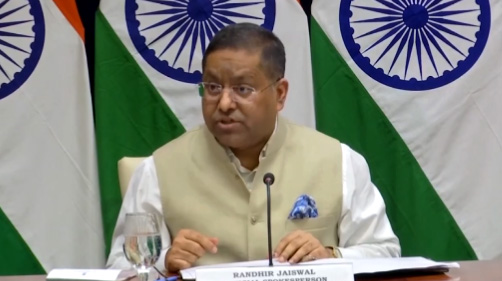
Ministry of External Affairs spokesperson Randhir Jaiswal stated this while responding to a question on Chinese official media reports that admitted to Beijing providing technical support to Pakistan during Operation Sindoor carried out by India in May 2025 to avenge the Pahalgam terror attacks.
“We have seen these reports that corroborate what was known earlier. Operation Sindoor was a precise, targeted and calibrated response to the terrorist attacks in Pahalgam, aimed at destroying state-sponsored terrorist infrastructure operating out of Pakistan and at its behest,” Jaiswal said at the press briefing.
“It is for nations who consider themselves responsible to reflect whether supporting attempts to protect terrorist infrastructure affects their reputation and standing,” he said.
Last week, China, for the first time, confirmed that it provided on-site technical support to Pakistan during the four-day conflict with India, according to Chinese official media reports.
China’s state broadcaster CCTV on Thursday aired an interview with Zhang Heng, an engineer from the Aviation Industry Corporation of China’s (AVIC) Chengdu Aircraft Design and Research Institute, a key developer of China’s advanced fighter aircraft and unmanned aerial vehicle design.
Zhang had provided technical support to Pakistan during the four-day war last May, Hong Kong-based South China Morning Post reported, quoting CCTV.
Pakistan’s air force operates a fleet of Chinese-made J-10CE jets, produced by an AVIC subsidiary. (Agencies)
It’s For Responsible Nations To Reflect: India On China Supporting Pak During Operation Sindoor
The Ethnic Fashion Guide: Women’s Suit Trends, Fabrics, and Best Picks

Indian ethnic fashion has never had a shortage of options, but the suit for women has always been the category that makes the most practical sense. It is complete on its own, it works across every occasion from a regular workday to a wedding function, and in the right fabric, it manages to be both beautiful and genuinely comfortable. The challenge has never been finding a suit; it has been finding the right one.
What BIBA’s current women’s suit set collection does particularly well is give every kind of woman a starting point. Seven silhouettes across prints, embroideries, fabrics, and occasion categories, from everyday cotton suits for women that hold up through long workdays to richly embroidered festive styles for the occasions that genuinely deserve the effort. If you have been navigating ethnic fashion without a clear sense of what works for you, this is a useful place to begin.
7 Women’s Suit Styles Worth Knowing This Season
The suits covered here are not passing trends. They are silhouettes with staying power, each suited to a different kind of woman and a different kind of occasion. From the clean and structured to the dramatically flared, here is a closer look at the style of suit set for women that are doing the most work in ethnic wardrobes right now.
1. The Straight Suit Set Every Woman Needs in Her Wardrobe
The straight suit for women is where most wardrobes begin and, for many women, where it stays, because it consistently delivers. A clean kurta that falls in a vertical line from shoulder to hem, paired with straight pants or a churidar, is the most polished and professional silhouette in ethnic dressing. In a solid cotton or a subtle printed fabric, it handles the office without effort. In embroidered chanderi with a dupatta, it becomes evening-ready. The ladies’ suit design looks like it was chosen deliberately, regardless of how quickly it was put on.
2. An Anarkali Suit Set for the Woman Who Believes in Making an Entrance
The Anarkali is Indian ethnic fashion’s most enduring dramatic gesture. A fitted bodice, a floor-length or mid-length flare, and a dupatta that completes the look, it is a silhouette that has survived centuries of fashion because it genuinely flatters and moves beautifully. A silk suit for women in an Anarkali cut in a deep jewel tone is the party wear choice that never needs a second opinion. In cotton with a floral print, it becomes a festive afternoon option that is entirely its own kind of special.
3. Why a Flared Suit Set for Women Is the Most Effortless Party Wear Choice
The flared suit set for women sits between the straight suit and the Anarkali in terms of drama and formality, which makes it the most versatile of the three. The kurta flares from the waist or hip, creating movement and volume without committing to a full floor-length silhouette. In a foil-printed fabric or an embroidered georgette, it becomes one of the strongest party wear options in the collection; festive enough for the occasion, relaxed enough to actually enjoy it. This is the best suit for women who want impact without overdressing.
4. A-Line and Kalidar Suits for the Days That Call for Grace Over Drama
A-line and kalidar suits are the quieter, more considered alternatives to the Anarkali. The A-line flares gently from the waist with a soft, universal flattery that works across most body types. The kalidar is more structured, with multiple fabric panels sewn together to create a precise flare from the waist that has a different quality from any other silhouette. Both read as traditional, and both carry embroidery beautifully. A kalidar women’s suit set in a chanderi yoke with concentrated threadwork embroidery at the neckline is the kind of investment piece that earns compliments every time it is worn.
5. Asymmetric Suits and the Case for Ethnic Dressing That Feels Personal
Asymmetric ladies’ suit designs bring a contemporary edge to ethnic dressing without abandoning the comfort and cultural familiarity of the kurta format. The uneven hemline, shorter at the front, longer at the back, creates visual interest and movement that makes the outfit feel more expressive than a conventional silhouette. In a bold geometric print or a Schiffli-embroidered fabric, an asymmetric suit set for women is the choice for the woman whose personal style has always been a little harder to categorise. She is not fully traditional, not fully contemporary, and this silhouette understands that completely.
6. The Layered Suit That Makes Styling Look Like It Came Naturally
A layered suit set is the format where ethnic dressing gets most interesting. A kurta worn over a contrast inner, or a jacket-style overlay over a fitted base, creates the kind of depth and dimension that a single-layer outfit rarely achieves. Layered suits for women in printed or embroidered fabrics give the outfit a considered, editorial quality that makes it look like considerably more thought went into the outfit than actually did.
7. Fusion Suit Sets for the Woman Who Makes Her Own Rules
The fusion suit set for women is where ethnic and contemporary dressing genuinely meet, rather than just coexisting in the same outfit. A crop top paired with contrasting palazzo pants and a layered Anarkali-style shrug. A structured blazer kurta over straight ethnic pants in a complementary print. A cotton suit for women silhouette with contemporary details; an unexpected neckline, a contrast lining, and a modern sleeve treatment, that gives the traditional format a completely fresh identity. Fusion suits are the best suits for women who have always felt that ethnic dressing should feel as personal as everything else in their wardrobe.
What Makes BIBA a Reliable Companion for Ethnic Dressing?
BIBA’s women’s suit set collection covers all seven of these silhouettes across cotton, silk, chanderi, and georgette fabrics; in prints, embroideries, and occasion categories that range from casual everyday dressing to wedding-ready festive wear. If you have been looking for a collection of the best suits for women that genuinely covers every occasion, every silhouette, and every kind of woman, BIBA’s current range is exactly that. Browse the full collection at biba.in.
Sparx launches the unique Shoe-Style Sandals Under ‘Summer Swag’ Campaign

Stock markets tank 2 pc as elevated oil prices, US-Iran tensions weigh on sentiment

Maruti Suzuki selects 6 start-ups to co-create new-age tech-based biz solutions

Retail inflation inches up to 3.48 pc in April: Govt data

Pakistan calls report on Iranian aircraft parked at airbase ‘misleading’

LG Sinha Launches Two Anti-Drug Programmes For Action Rooted In Family, Community Support

SRINAGAR, May 12: Jammu and Kashmir LG Manoj Sinha on Tuesday launched two initiatives as part of the ongoing anti-drug campaign in the UT and said addiction victims must be treated with dignity, reconnecting them to society’s mainstream through resolve and compassion.
The remarks came as Sinha led a march in Baramulla and engaged with citizens under the 100-day ‘Nasha Mukt Jammu Kashmir Abhiyan’ launched on April 5.
The two new initiatives — Community Immunisation Programme and Family Fortress Initiative — were launched by the LG, which, he said, will act as two innovative pillars under the campaign for the next 69 days.
Sinha said that just like communities have been taught to vaccinate against bacteria or viruses, the administration will partner with religious leaders and social groups to ensure community immunisation against drugs in five to 10 high-risk hotspot areas in every district.
“I urge schools, mosques, temples, gurdwaras, and NGOs to dedicate one hour weekly to strengthen this initiative through awareness. It will deliver real results, acting like an early warning system monitoring hotspots while building them into fully drug-free zones,” he said.
The LG said the Family Fortress Initiative will rely on the strong family and community bonds for the ultimate shield against drug addiction.
“Over the next 69 days, every school, college, and place of worship in Jammu and Kashmir should host a weekly family dialogue on drugs. These dialogues should be open and honest, paired with local campaign audits to spot and fix gaps,” he said.
Sinha highlighted that in the past 31 days, over 2,35,000 awareness and outreach events have been held across the Union territory. More than 44,000 OPD patients have been treated, nearly 700 drug smugglers and peddlers arrested and stringent action has been taken against the drug supply chain, he said. “Action has targeted every financial transaction of drug cartels, seizing crores in properties built from drug money by major smugglers. Across Jammu and Kashmir divisions, 300 driving licenses and over 400 vehicle registrations linked to drug smugglers have been recommended for cancellation.
“Enforcement agencies have ensured massive drug hauls. We have inspected more than 3,300 drug stores, and 150 licenses have been suspended for violating the norms,” he said.
Sinha further said nearly 3,000 CCTV cameras have now been installed at the drug stores across the Union territory.
“Over two dozen smugglers have been nabbed under the PITNDPS Act. I assure the people that we will chase every rupee, every asset, and shell company of drug traffickers, ensuring the harshest punishment for those who are destroying our youth’s future,” he said.
Fuelled by public support, this people’s movement is setting “historic records” in Jammu and Kashmir, and no past social campaign has seen such massive participation, he said.
“We have received nearly 3,000 calls for Tele-MANAS counselling and support in the past 31 days. I want our response to drugs to be rooted in science. “We don’t shame diabetes patients into health or cure cancer victims through stigma. Likewise, we must treat and rehabilitate addicts with dignity, reconnecting them to society’s mainstream through resolve and compassion,” the LG said.
Government officials and citizens must unite for surveillance, rally against drugs, and foster drug-free villages and towns, he added.
JKBOSE Declares Class 11 Results For Summer Zone

JAMMU, May 12: Jammu and Kashmir Board of School Education on Tuesday declared the Class 11 Annual Regular examination results for the Summer Zone of Jammu Division.
SEE RESULT GAZETTE CLICK HERE….
Technical Analysis Strategies: Combining Indicators and Patterns

Many traders rely on either indicators or price action, but combining them effectively can lead to more consistent and structured trading decisions. Very few take the time to combine both in a meaningful way. That gap can lead to inconsistent signals, delayed entries, and less reliable decision-making if not managed properly, entries come late, and decision-making becomes less reliable.
In reality, indicators and patterns are not meant to compete with each other. They serve different purposes. When used together, they give a clearer picture of what is happening in the market and why. That is where stronger trading strategies begin to take shape.
What Indicators Really Do?
Indicators are built to simplify price movement. They help identify trends, momentum, and potential turning points. Tools like moving averages or RSI take raw price data and turn it into something easier to interpret.
But there is a limitation that traders often overlook. Indicators are derived from price, so they tend to react to market movement rather than anticipate it. By the time an indicator confirms something, part of the move may already be over.
This does not make indicators useless. It just means they should not be used alone.
Reading the Story Behind Price With Candlestick Patterns
Price patterns, especially candlesticks, offer a different kind of insight. They can offer insight into how buyers and sellers may be interacting within a specific period. Instead of smoothing data like indicators do, they reflect immediate market sentiment.
Take bearish candlestick patterns as an example. When you see a strong rejection at higher levels or a shift in control from buyers to sellers, it can indicate a potential loss of momentum in the trend. It does not promise a reversal, but it tells you something has changed.
That subtle shift is what many traders miss when they depend only on indicators.
Why Combining Both Makes a Difference
When indicators and patterns are used together, they start to complement each other. One gives structure, the other gives context.
Imagine spotting a bearish candlestick pattern near a known resistance zone. On its own, it may not be enough to act on. But if an indicator also shows weakening momentum at the same time, the setup gains additional confluence, though it still requires proper risk management.
This kind of alignment helps filter out noise. Instead of reacting to every signal, you wait for situations where multiple factors point in the same direction. Over time, this leads to more consistent decision making.
Turning Observations Into a Strategy
Not every observation becomes a usable strategy. That transition requires clarity.
You need defined conditions. What exactly are you looking for? When do you enter? When do you exit? Without these answers, even good ideas remain inconsistent.
A simple approach could involve watching for bearish candlestick patterns at key levels and confirming them with an indicator that reflects momentum. The trade is taken only when both conditions appear together.
Keeping rules clear makes it easier to evaluate what is working and what is not.
Testing Ideas With Technical Analysis in Python
At some stage, visual analysis is not enough. You may feel that a setup works, but without testing, it is difficult to know how reliable it really is.
This is where technical analysis in python becomes useful. Instead of relying on memory or selective examples, you can test a strategy across large datasets while keeping in mind that past performance may not fully reflect future market conditions.
You begin to evaluate patterns more objectively, while also being mindful of overfitting and the risks of testing multiple variations. Does the setup hold across different time periods? Does it behave differently in trending versus sideways markets? These insights are hard to get without structured testing.
It also changes how you think. You move from guessing to verifying.
Where Most Traders Go Wrong
A common mistake is trying to do too much. Adding more indicators, more filters, more conditions. It feels safer, but often leads to confusion.
Another issue is assuming that a setup will behave the same way every time. Markets are not fixed. Relationships change, volatility shifts, and conditions evolve.
There is also a tendency to ignore execution. Slippage, costs, and timing all affect outcomes. A strategy that looks clean on a chart may not perform the same way in real trades.
Keeping things simple and realistic usually leads to better results than chasing perfection.
Risk Is Not Optional
No strategy works all the time. Losses are part of the process. What matters is how those losses are handled.
Managing position size, defining risk before entering a trade, and avoiding overexposure are all part of building sustainable trading strategies.
Traders who focus only on entries often struggle. Those who focus on risk tend to last longer.
A Real World Success Story
Ryan Soriano approached trading with a focus on building structure rather than relying on intuition. He worked on developing strategies that could be tested and improved over time, using coding and backtesting as core tools. Instead of depending only on chart patterns, he explored how indicators and data could support better decisions. This process helped him understand how strategies behave across different conditions. Over time, he became more confident in evaluating and refining his approach. His journey shows how consistent practice and structured learning can help traders move beyond guesswork and develop more reliable methods.
Where Structured Learning Can Help
Live classes, expert faculty & placement support. QuantInsti offers the EPAT program, which is built around practical skill development for real trading scenarios. It focuses on helping learners understand markets, build strategies, and apply data-driven thinking in a structured way. Quantra provides a more flexible route through its course library. Some courses are free for beginners starting with algo or quant trading, though not all courses are free. The platform is modular, so learners can choose topics based on their needs and pace. Its learn-by-coding approach encourages hands-on practice rather than passive learning. With per-course pricing and a free starter course available, it offers an accessible way to begin exploring areas like technical analysis using Python and building more structured approaches to trading.