Care of Underarm Skin
Care of Underarm Skin

Shahnaz Husain
Hair under the arms is generally considered unattractive by most women, who feel that it hampers the well groomed look when one is dressed in sleeveless and strappy attires, or swimsuits. Also, it is more difficult to maintain hygiene of the area if the hair is not removed, with problems of excessive perspiration and body odour getting worse. Underarms with hair can also be prone to fungal infections, specially during hot and humid weather. Many other problems may also occur with the underarms, like pigmentation and ingrown hair.
Darkening of the skin can occur under the arms, as a reaction to antiperspirants, deodorants or hair removal creams. Shaving can also cause darkening of the skin and also ingrown hair. This occurs due to shaving, which sometimes causes the hair to break off. The hair then grows inwards, getting trapped under the skin. If the underarm region becomes dark due to deodorants, avoid using deodorants while you are at home and apply it only during the time of day when you go out and there is more perspiration.
Shaving also causes the area under the arms to become darker, more so in India, where women have dark hair. Shaving does not remove hair by the roots, so the hair becomes visible very soon. Shaving may also cause the hair to become thicker and harder.
Another reason for darkening of the skin under the arms may be due to the regular use of hair removal creams. The chemicals in the creams react to some skins and may also cause darkening over a period of time.
Waxing is the best option, as it removes hair by the roots. As such, it is said to weaken the follicles over a period of time and thus discourage hair growth. The lemon and sugar mixture used by most beauty parlours also helps to lighten skin colour. Waxing also removes dead skin cells and actually brightens the skin. If you do waxing at home and make the wax yourself, make sure that the wax is not too hot, as it can cause burns on the skin. Test it on your finger when the mixture is slightly cool. To apply it for waxing, use a butter knife or spatula and apply in the direction of hair growth. Then, place a strip of clean cotton cloth on the wax, press down and smoothen it and then pull it off against the direction of growth. Once the cloth is off, wipe the area with a wet cloth and apply ice. This helps to close the pores. There may be redness and rash on the skin, which should disappear in about an hour. Waxing strips are also available, but getting your waxing done at a beauty parlour may give better results.
For dark skin under the arms, exfoliation would help. Use a scrub once or twice a week. Or, mix gram flour (besan) with yogurt, lemon juice and a pinch of turmeric into a paste. Apply three times a week on the area and wash it off after half an hour.
You can also think about permanent hair removal with laser therapy. Laser or intense pulsed light (IPL) is being used to remove hair permanently. Laser produces an intense beam of light, which is absorbed by the hair follicles. The laser disables the hair follicle’s ability to produce hair. Cooling devices are used to prevent damage to the rest of the skin. Re-growth occurs for sometime in some cases. It is an expensive method and it is very important to find a good laser clinic. Several sessions may be needed, depending on the kind and extent of hair growth. One can also use an epilator. This is a small gadget for hair removal and can be done at home. Initially, there may be some pain. However, if the hair is removed with an epilator when it is quite small, the pain may be less.
m-Governance : The next inevitable in-thing

Amit Sharma
“Oh, my Aadhaar Number has been generated and this is the confirmation sms I got for it”. We find these and similar other alike whispers around us when a confirmation sms is received from some government agency or organization. This is a form of m-Governance model in action.
Yes, m-Governance is next big thing which has happened in the world as yet another important corollary to e-Governance. And why not, when mobiles are so popular and they are being used as one of the most powerful means of communication and multi-tasking these days. Some call m-Governance as a subset of e-Governance, some term it as an independent methodology of modernized public delivery mechanism. However, it has much wider scope and future than we all think m-Governance has.
We find these days many countries in the world have been using m-Governance services for varied and vast purposes. Let me quote few glaring examples to prove how mGov revolution has taken over the world. In United Kingdom, Mexico & Hong Kong, there is a mGov service of Emergency SMS Alerts like Security warnings in case of security threats; SARS outbreak, etc. In India, Lokvani services in which follow-up can take place through IVRS & SMS. In Brazil, Sweden and Philippines, mGov models are used for Employment and Job related services. Countries such as Indonesia, Estonia and Spain use mGov models for provision of Information Inquiry Services. USA uses mGov model for Electronic Benefits Transfer like recently they did to provide assistance to hundreds of thousands of people in the aftermath of Katrina. In India, Ireland, The Republic of Korea, Spain, lot of Taxes and Other payments related services are provided SMS based services. Hong Kong, Malta, Spain and Italy use mGov service models for making Bookings/Appointments in various Government services. Sweden and Austria use mGov models for signing transactions with mobile signatures. France, Indonesia, Kenya, UK, Venezuela and Estonia provide a major mGov platform for elections and voting. Apart from this, many countries of the world successfully provide Government to Government (G2G), Government to Business (G2B) and Government to Employee (G2E) services through m-Governance platforms.
Let me stop over here as the list is very exhaustive and the quantum of m-Governance based services is increasing all across the world day-by-day. The major factor behind such fast-track growth in m-Services is the exponential growth in the number of mobile phone users across the globe. It has forced the planners and executors to switch over to creation of mobile-based applications for ease and convenience of citizens. We know that today a person may not possess a computer or laptop but it is very much possible that almost every individual whether residing in villages or urban belts will be possessing a mobile phone. So, it is now a reality that mobile phones have become the best medium of passage of various services to the citizens, whether information-based, transaction-based or data-based.
The major advantages m-Governance enjoys over e-Governance or conventional governance models are wider acceptance of these technologies by the public sector, large scale penetration of mobile devices, ease of use for citizens, easier interoperability due to it, bringing Government closer to citizens and above all, m-Governance services being much cheaper and economical than computer-based or e-Governance based services. So, m-Governance provides and additional channel of communication to users to access Government services. Its availability is 24x7x365 and m-based services have anytime general information retrieval and transaction processing. Another special advantage is that m-services have virtually no waiting time, whereas conventional approaches such as telephone calls or in-person visits may take much longer times. It really helps otherwise marginalized communities to communicate and interact via online technologies. We must realize it has helped in cutting all costs on printing, especially in densely populated areas. Also, the stakeholders have a better participation and involvement in Government processes and services. Everybody enjoys the privilege to be part of decision-making by expressing opinions, choice and visions with the usage of m-services like sms, gprs, ussd channels, etc.
Various social movements in Middle East Asia like Arab Spring which toppled many Governments in that part of the world, Anna Movement against Corruption & in favour of Lokpal Bill in India and even the recent successful election campaign by the NDA with the active usage of social networking methodologies are all off-shoots or corollaries & contemporary examples of m-Governance all around the globe, especially in India. M-Government is the future way towards all successful campaigns or the most powerful tool to reach out to a common citizen. The earlier, a Government realizes the importance of it, the better it is. Probably, the last Government in the Centre under-estimated its utility and importance and this also became a major reason of its failure to win over the confidence of people which became visible after the results of elections were out recently.
The state of Kerala has pioneered in implementation of m-Governance across the board in provision of various services to citizens of the state. There is a comprehensive m-Governance Project which has been successful implemented towards provision of more than 90 services in Kerala. It has indeed helped to create cost effective, efficient and round the clock Government information systems. Three major channels of mobile communication, namely Voice Applications, Signaling-channel based Applications and Data-Service based Applications are being used for this purpose. A comprehensive and integrated Service Delivery Platform is being created to roll-out various m-Services and interestingly, such platforms are based entirely on Open Source Technologies. It simply means that the platforms used for provision of m-Governance in Kerala are not bound by encryptions, passwords, security measures, etc. which has broadened the scope and base for provision of such services across the board in Kerala.
India may implement m-Governance with the usage of following 6-phase model to get better m-Gov services which can complement and supplement e-Governance in a better manner:
I – Making all Government websites mobile compliant/mobile site access should be promoted.
II – Plan strategies to popularize the use of mobile device technology in rural areas by giving subsidies, training and guidelines.
III – Implement m-Governance by developing mobile applications in local languages and more mobile utilization applications.
IV – Plan strategies to popularize the use of mobile devices technology amongst all citizens by education.
V – Develop mechanisms and platforms for the good design and delivery of m-Governance.
VI – Implement laws for m-Governance for better m-Gov based services.
However, few threats or challenges still loom over successful implementation of m-Governance in the nation such as Cost, Low levels of Literacy, Lack of Knowledge of English Language, Low Computer Literacy, Not enough Facilities in Mobile Devices for m-Governance, Need to develop Applications in each of Local Languages, Data Overload and Trust/Security in Money-based Services.
To sum-up, it can be concluded that with the kind of advancement in technology and greater push towards creation of lighter, simplistic and interoperable models of e-Governance, the day is not far when m-Governance will become a virtual reality and it shall become such an important reality that we shall mandatory use mobiles to access all Government services like we use mobile tickets commonly these days during rail and air travel. It shall definitely become a talk of the past when people use to feel harassed while visiting Government offices and standing in long queues as it has already become in provision of banking and railway reservation services.
{The author is a Senior KAS Officer and an e-Governance Expert of J&K Government). He can be reached at amitkas@gmail.com or amit1kas (Facebook ID)


Cipher Decipher
Hi Friends! We are back with your favourite column for the week. Please have a look at OUR MESSAGE before you send in your message to us.
1. To all from Raja Rajaz: “ Don’t search good people in life, only try to become good itself so that it might complete the search of someone”.
2. From Mohini to all: “ We cannot help everyone, but everyone can help someone”.
3. To all from Tony: “ Imagination doesn’t become great, until human beings are given to courage and the strength to create”.
4. From Rishab Gupta to all: “ Men are born to succeed, not to fail”.
5. To all from Shine Mahajan: “ It is not what you do far your children, but what you have taught them to do for themselves to achieve goal in life ”.
6. From Sachin Abrol to all: “ Jealousy corrupt people ”.
7. To all from Mrs Sharda Gupta: “ Reliance is an organic human experience that requires no supernatural explanations”.
8. From Usha Raina to all: “ The greatest warrior is not he who conquers his enemies but he who conquers himself”.
9. To all from K K Gupta: “ Expecting is the greatest impediment to living. In anticipation of tomorrow, it loses today”.
10. From Raiz-ul-Mughal to all: “ Education is the bow and knowledge is the arrow to hit the aim of excellence”.
11. To all from Mahima Kaul: “ Giving up does not always mean you are weak. Sometimes it just means you are strong enough to let it go”.
12. From Anil Kumar Nanda to all: “ There are two kind of people in this world. Those who remember names and those whose names are remembered”.
13. To all from Sanjay Dhar : “ God has blessed us with wealth and abundance with position and power so that we may be a blessing to others and we should use it for the welfare of people”.
BEST MESSAGE
The award of rupees 200 for this week’s best message has gone to MADASSAR NAWAZ SHEIKH R/o TOHEED NAGAR, W.NO: 1, MEAR DIET, KHORA, JAWHARNAGAR, RAJOURI for the message “ A journey of thousand miles must begin with a single step. If you cannot do great things, do small things in a great way”.
Congrats. The prize money would be sent to you through money order.
e-mail: cipher-decipher@dailyexcelsior.com
Coconut oil weakens in thin trade
NEW DELHI, June 14: Coconut oil prices fell in an otherwise steady wholesale oils and oilseeds market today due to slackened demand from retailers.
However, other edible and non-edible oils moved in a narrow range in limited deals and settled around previous levels.
Traders said sluggish demand and weak advices from southern region mainly weighed on coconut oil prices.
In the national capital, coconut oil slipped to Rs 2,600-2,680 per tin against last close of Rs 2,650-2,740.
Following are today’s quotations per quintal:
Oilseeds: Mustardseed 2,950-3,050 and Groundnut Seed 2,150-2,900.
Vanaspati Ghee (15-litre tin) 1,060-1,290.
Edible oils: Groundnut Mill Delivery (Gujarat) 7,200, Groundnut Solvent Refined (per tin) 1,250-1,300, Mustard expeller (Dadri) 6,500, Mustard Pakki Ghani (per tin) 1,150-1,200, Mustard Kachi Ghani (per tin) 1,200-1,300, sesame mill delivery 8,500 Soybean Refined Mill Delivery (Indore) 6,750, Soyabean Degum (Kandla)6,450, Crude Palm Oil (Ex-Kandla) 5,200, Cottonseed Mill Delivery (Haryana) 6,100, Palmolein (RBD) Rs 5,950, Palmolein (Kandla) 5,750 and Coconut (per tin) 2,600-2,680.
Non-edible oils: Linseed 7,700, Castor 9,400-9,500, Neem 5,300-5,400. (PTI)
Hariparbat-The abode of Goddess Sharika
Rubon Saproo
Hariparbat is a sacred hillock which can be seen from about twenty miles away from the western side of Srinagar city. The mount is considered very holy as it is the permanent abode of Jagatamba Sharika Bhagwati-the most adorable and magnificent deity with eighteen arms(Ashtadushbuja), who takes good care of the universe and her devotees. Sharika Devi is believed to be an incarnation of goddess Durga. There are many shrines located on all sides the Hariparbat and amongst them; the Chakreshvar shrine perhaps, is the holiest one. The hillock of Hariparbat has been a place of worship from ancient times and is regarded as one of the holiest places of Kashmir. It is truly believed that those who worship at Hariparbat-Chakreshvar are deemed to have worshiped all the gods and goddess of Hindu mythology.
There is a legend associated with this hillock. According to this, Kashmir was once a vast lake of water. It was called Satisar because it was the abode of mother Sati “the consort of Lord Shiva”. A demon Known as “Jalodbhav” is believed to have lived near this hillock (Hariparbat).He had made the life of people very miserable. The inhabitants called on the goddess Parvati for help. She took the form of an enormous bird “herr”, which is the Kashmiri word for maina, and carried a divine pebble in her beak and dropped on the demon, which grew larger and larger until it crushed him to death. After that a miracle happened and the divine stone converted itself into the hillock that has been ever since called the Sharikaparbat or Hariparbat. Further, it is Sharika Ji who has given the hill its name as Hariparbat since ‘Hari’ is derived from the Kashmiri ‘herr’ which is a bird and ‘parbat’ means hill.
The entire hill of Hariparbat is a hallowed place. It is stated to be the powerful centre in attaining spiritual bliss. Many great saints of Kashmir have performed Sadhana at this place from time to time and got blessed with Sakhshat Darshan of Jagat Amba Sharika. Among them were saints like Pandit Madhov Joo Dhar, Bhagwaan Gopi Nath Ji, Krishan Kar, Jeevan Sahib and Peer Pandit Padhshah. The dedicated and firm devotee of Sharika Bhagwati Pandit Madhov Joo Dhar was blessed with a boon of a daughter, who later becomes a great saint known as Mata Roop Bhawani in entire Kashmir. Another saint Peer Pandit Padhshah has performed circumambulation of the hillock on his knees for forty days in the wee hours of morning to get blessed. Likewise, Bhagwaan Gopi Nath Ji has spent about nine months at Hariparbat-Chakreshvar and had got the Devi’s darshan on many occasions.
The holiness of Hariparbat can also be well understood by the number of shrines located on all sides of hillock. These shrines follow a unique pattern.First, the Lord Ganesha temple is situated on the south-western corner of Hariparbat. Next, the Satresh Sathapana( the seven sons of Lord Brahma) also, known as Saptrishis. Further on the next, appear the thapna of goddess Kali. Then, emerges a vast land known as Siddh-Peeth, which is a place of awakened divine presence. After that, appears a stretch of an open land known by the name of Devi- Angan-the play field of mother Sharika. The next holy spot is the shrine of Chakreshvar, where the thapna (establishment) of the goddess is signified by a shila (rock), smeared with sindhoor. Then appear the shrines of Maha Lakshmi thapna-the goddess of wealth, Koul’s temple dedicated to Lord Krishna, the thapna of Lord Vamdev-the ‘consort’ of Ragnya Devi, Pokhribal- the shrine of Mata Rajnya and lastly a small Hanuman Ji temple. However, it is important to know that some of the above stated holy places are presently in ruins and could not be located easily.
In Hindu mythology, it is said that doing parikrama in a clockwise direction for an odd number of times is very pious. It is believed that offering parikrama or pradakshina (circumambulation) around the Hariparbat and particularly in the month of Magh is considered pious. This parikama (prakrum in Kashmiri) would begin from the temple of Lord Ganesha upto “ Kathi-Darwaza” .The devotees can prefer either of the two routes-one along the bottom of hillock and the other along the wall that encloses the locality around it. There are two main gates of this locality “Kathi-Darwaza” towards Chhati Padshahi and “ Sangeen Darwaza” towards Hawal.
The Shrine of Chakreshvar
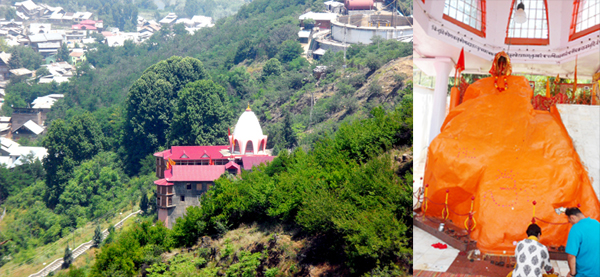
The revered shrine of Shri Shri Jagatamba Sharika Bhagwati is situated at the north-western slope of Hariparbat .This is also popularly known as the shrine of ‘Chakreshvar’, where the Goddess Sharika manifested herself in the form of rock (shila) on which a mystic geometrical pattern has been etched. This is the temple that the Hindus in general and Kashmiri Pandits in particular hold in the highest esteem. The shrine is as old as human settlement in Kashmir.It is dedicated to Jagatamba Sharika Bhagwati, who is believed to be a form of Durga Mata or Shakti.
“Jagatamba” means “the mother of all creation”; “Sharika” is her personal name and “Bhagwati” means “goddess”. So, Jagatamba Sharika Bhagwati is one of the many forms of Mahashakti. “Mahashakti” means “the great power or energy”. This divine energy assumes a human form in the shape of goddess Durga and her various incarnations. Sharika Ji is known by many names like Harre, Sharika Bhagwati, Maha Tripursundari, Rajrajeshwari, Ashtadushbuja, Durga, Mahashakti and Jagatamba.The goddess is the supreme mother of the universe and is regarded as the presiding deity (Ishat-Devi) of a section of Kashmiri Pandits.
Her shrine at Chakreshvar Hariparabt is not like a regular temple, but a lotus shaped concrete canopy beneath which lies a huge shila smeared with a paste of sindhoor (vermilion). The shila is the thapna (establishment) of Sharika Bhagwati.It is decorated with ropa varak (silver foils) and petals of red fresh flowers. The whole sacred rock seems to be like that Mata has hidden her face by turning closely towards the steep hill. Devotees pay their obeisance at the shila on a marble platform constructed for this purpose. There are two dharamshallas where devotees can stay for night. The sacred shrine can be approached from Deviangan at the foothills by a flight of 111 chiselled stones. The shrine is heavily guarded by Jawans of 82 CRPF contingent, who besides play a vital role during many occasions.
The mother Goddess reveals herself in a huge rock at Chakreshvar having mystic geometrical figures engraved on it. These are not an ordinary figures but represents ‘Shri Yantra’ or ‘Shri Chakram’ , also called Swayambha Maha Shree Yantra, which consists of circular mystic impressions and triangular patterns with a dot bindu at the centre.Usually, Shri Yantra are normally two types, however, the Yantra at Hariparbat is a three dimensional and is one of the most auspicious, important and powerful yantras. The description of this yantra are central red bindu, central white triangle, eight red triangles, ten blue triangles, ten red triangles, fourteen blue triangles, eight red lotus petals, sixteen blue petals ,three circles in yellow and the quadrangular ramparts all around constitute in Shri Chakram.
The figures have very important pattern and meaning in Shri Chakram. The central red bindu depicting Maha Tripur Sundari ( Bindu Triya), the central white triangle represents Chakra giving all success , the eight red triangles describing power that rules, the two groups of ten triangles(blue and red) represent Shakties and Yognis, the group of fourteen triangles describing all good luck, the eight red lotus petals depict different powers of human beings, the sixteen blue petals depicting sixteen Yoginies associated with the attainment of desire and the three yellow circles represent the Chakra ruling the three worlds.
However, the four triangles that point upwards represent Shiva and the other five pointing downwards represent Shakti. The intersecting triangles represent the creation, protection and absorption of whole universe by the pure divine force known as Sudha-Shakti. All these triangles are enclosed in a circle representing mystical lotus creation and the following circle with sixteen lotus petals describing sixteen phases of moon. The central point in the Bindu is chakra which symbolises union of Shiva with Shakti.
The most auspicious days for prayers at the shrine are Hure Ashtami (the eighth day of dark fortnight of Phagun month), Har Saptami, Har Ashtami and Har Navumi (the seventh, eighth and ninth days of Ashad month), Navreh (the new years day in Kashmiri) and the Navraatra days. However, Har Navumi is the birthday of Sharika Bhagwati. It is on this day, the devotees visit shrine in large numbers and make a sacrificial offering of Taher (rice boiled with turmeric powder and mixed with oil and salt). They also sing bhajans throughout the night to get blessed.