

Fayaz Bukhari
SRINAGAR, June 30: Security has been put on high alert in Kashmir ahead of Prime Minister Narendra Modi’s visit to the State later this week as last year’s memories of audacious attack on an Army convoy ahead of former PM Manmohan Singh’s visit is still fresh in the minds of security agencies.
At least 8 Army personnel were killed and several others were injured on June 25 last year, a day before former PM Manmohan Singh’s visit to Srinagar on high security Hyderpora By-pass.
Sources said security agencies have apprehensions that militants might carry out attack during the PM’s visit as they did last year. “Police, Army and para-military forces have been asked to remain alert and patrolling in the sensitive areas has been intensified to put pressure on militants”, said sources.
Security sources said that although militants are under pressure since early this year as 41 of them including 11 top commanders of Lashker-e-Toiba (LeT), Jaish-e-Mohammad (JeM) and Hizbul Mujahideen (HM) were killed and 23 were arrested by security forces but they have the capability of carrying out an attack to show their presence.
Sources said that security forces are keeping a close eye on suspicious persons including suspected Over Ground Workers (OGWs) of various militant outfits.
The main vigil has been intensified along the Srinagar Bypass which has become a potential target of the militant attacks since 2013. Srinagar Bypass has vulnerable areas along Southern side where from militants have easy access for any hit and run attack. Sources said that these areas are also being sanitized.
Last year there have been over a half a dozen militant attacks on security forces on Srinagar Bypass including one on Central Reserve Police Force (CRPF) camp in which 5 CRPF jawans were killed and another on an Army convoy in which 8 Army personnel were killed.
The vigil along the Line of Control (LoC) in Kashmir has been also intensified as according to sources around 400 militants are waiting on the launch pads for infiltration. There was no infiltration attempt this year but on the eve of PM’s visit security forces don’t want to take chances.
PM is inaugurating 240 Mega Watt Uri Civil-II at Kalgi in North Kashmir’s Uri area near the LoC with Pakistan on July 4. The area is in the firing range of Pakistani artillery units and it has witnessed shelling from across the LoC before 2003 LoC ceasefire between India and Pakistan.
Prime Minister is also visiting 15 Corps headquarters of Army where he will be briefed about the security situation in Jammu and Kashmir and along the Line of Control and border with Pakistan and Line of Actual Control (LAC) with China. He is scheduled to have lunch at Rajbhawan before leaving for Uri for inauguration of Uri Civil-II.
Security alert in Kashmir ahead of PM’s visit
Massive jump in PMRP cost, crosses Rs 35,000 crores
Sanjeev Pargal
JAMMU, June 30: A massive jump has been witnessed in cost escalation of projects undertaken in hands especially in Central sector in Prime Minister’s Re-construction Plan (PMRP), which would complete decade of its launch in the month of November this year.
Official sources told the Excelsior that cost of the PMRP, which was Rs 24,467 crores when it was launched in November 2004 by the then Prime Minister Dr Manmohan Singh as the head of UPA-I, has crossed Rs 35,000 crores and was roughly pegged around Rs 35,450 crores now.
“The cost was likely to go up as some of the projects undertaken in the Central sector were hydroelectric power projects and their cost has jumped manifold due to delay,’’ they said.
The PMRP would complete 10 years of its launch in November this year.
Out of a total of 67 projects/ schemes in four areas covering 11 sectors of economy, only 34 (a little over 50 per cent) have been completed so far even as the Re-construction Plan was due to complete 10 years in the next few months.
Dr Singh as head of UPA-I had announced Rs 24,467 crores worth PMRP for Jammu and Kashmir during his first two days visit to the State after taking over as the Prime Minister of India on November 17 and 18, 2004.
According to sources, the total cost of the PMRP projects has now jumped to Rs 35,450 crores due to delay in completion of some of the projects, whose deadline for commission has also expired. The Centre has, however, decided that all projects undertaken under the PMRP in both Central and State sectors would be taken to logical conclusion and funds released for them for their timely completion.
The new Government at the Centre headed by Prime Minister Narendra Modi has already decided that the PMRP, whose extended one year term had expired on March 31, 2014, would be extended for another year and Jammu and Kashmir would get due funds for the projects identified by it under the Plan during current financial year of 2014-15.
In fact, Home Minister Rajnath Singh had recently reviewed the PMRP for Jammu and Kashmir with his Ministry officials.
The Centre has so far released Rs 7814.50 crores for Jammu and Kashmir for the PMRP projects in the State sector while Rs 600 crores were due for release during current financial year along with annual plan and Centrally Sponsored Schemes.
Justifying cost escalation of some of the projects, sources said the cost has gone up only in case of major hydro-electric power projects, which faced a lot of hurdles in execution leading to delay in the time schedule fixed for their execution. The Centre has assured the agencies executing the hydro-electric projects in the Central sector of the PMRP that they would get funding based on the cost escalation. Similar is the case for the State projects, they said.
Going by pace of some of the projects/schemes, it could still take three to four years for their completion especially the hydro-electric projects, sources said pointing out that out of a total of 67 projects/schemes started under the PMRP under both Central and State sectors, only 34 have been completed so far. Work was on in 28 other projects/schemes while in case of remaining five projects, the proposals were in the stage of finalisation.
The Centre has so far released Rs 7814.50 crores for Jammu and Kashmir under the PMRP in the State sector. In 2005-06, J&K was allocated Rs 771.72 crores while the amount had come down to Rs 539.9 and Rs 576 crores in 2006-07 and 2007-08 respectively but it again went up to Rs 1012.97 crores in 2008-09 and Rs 1200 crores each in 2009-10, 1010-11 and 2011-12. The amount again came down to Rs 700 crores in 2012-13 and Rs 600 crores in 2013-14.
The plan, which was given to the State as an economic package for raising economic infrastructure damaged during the militancy, is being implemented in two sectors—Central and State. The Central projects, mainly power generating hydro-electric projects, are being constructed by National Hydro-electric Power Corporation (NHPC) while State sector projects are being executed by different agencies.
The State amount is released in installments every year with this year’s share kept at Rs 700 crores of which the State has so far received Rs 275 crores.
FM may double tax exemption limit
NEW DELHI, June 30:
Seeking to boost household savings, the Finance Ministry is considering doubling the exemption limit for investments by individuals in financial instruments to Rs 2 lakh.
Presently the investments and expenditures up to a combined limit of Rs 1 lakh get exemptions under Sections 80C, 80CC and 80 CCC of the Income-Tax Act.
Sources said the Revenue Department is assessing the burden on the exchequer in case of increase in the benefit limit. The announcement is expected in the Budget.
The Budget for 2014-15 will be presented by Finance Minister Arun Jaitley in the Lok Sabha on July 10.
There have been demands from bankers and insurers to hike the tax exemption limit from Rs 1 lakh per annum to encourage household savings.
The savings rate has come down from over 38 per cent of GDP in 2008 to 30 per cent in 2012-13.
The hike in the exemption limit, sources said, would provide much needed relief to the salary earners who are reeling under the impact of high inflation.
The Direct Taxes Code (DTC) too has recommended that the combined ceiling for investments and expenditures be raised to Rs 1.5 lakh per annum.
The financial instruments which enjoy exemption include life insurance premium, public provident fund, employees provident fund, National Savings Certificates, repayment of capital on home loan, equity linked saving schemes sold by mutual funds and bank FDs of five year maturity. (PTI)
Jitendra gets Yuva Vani restored
Excelsior Correspondent
JAMMU, June 30: Minister of State in the PMO, Personnel, Public Grievances, Science and Technology (Independent Charge) Dr Jitendra Singh has managed to fulfill the major demand of the Jammuites by getting Yuva Vani services of All India Radio restored.
The AIR had discontinued Yuva Vani service on June 1 on a decision taken by the previous UPA Government. The decision to stop Yuva Vani service had exclusively been reported by the Excelsior after which Dr Singh took up the issue with Minister of State for Information and Broadcasting (Independent Charge) Prakash Javadekar seeking restoration of the service.
Javadekar today rang up Jitendra Singh, who was at Sriharikota today in connection with launch of satellite PSLV-C23 and informed him that he has issued orders to restore the Yuva Vani service.
Javadekar told Dr Singh, an MP from Udhampur-Doda Lok Sabha seat, that technical reasons cited for stopping Yuva Vani service have been overcome.
“The Yuva Vani will now be relayed from a different frequency i.e. instead of AM frequency it will not be relayed from FM frequency, which will make the radio signals more clear,” Javadekar said.
Hailing Javadekar for his prompt response to the demand for restoration of Yuva Vani service, Dr Singh said the service is a major outlet for youth in terms of encouraging the young talent in broadcasting and art as well as in providing an outlet for grievance of the young ones to be aired on radio network.
Unpredictable neighbour
Relations with China for six decades and more in the past have taught us that Beijing is unpredictable. If we stretch the study of bilateral relations further, we can say that China is ungrateful. Soon after India won freedom, the US was formally prepared to grant India a seat in the UN Security Council. But the then Prime Minister Nehru, a man of idealistic disposition, told the US that China was a stronger claimant than India… Though Security Council membership for China didn’t come that soon, nevertheless India senselessly squandered the opportunity. And now that India is staking claim to membership, China opposes.
Vice President Hamid Ansari is in Beijing on a five-day official visit in connection with celebration of 60th anniversary of Panch Sheel agreement. This is yet one more proof of faithlessness of China. Sixty years ago in 1954, Prime Minster Nehru offered the five principles of co-existence at the Bandung Conference which China accepted and signed. The crux of Panch Sheel was that India and China, two big countries in South and South East Asia would live in peace and resolve their mutual issues in a peaceful and friendly manner. Indian Prime Minister Nehru was euphoric and gave the agreement more than necessary publicity. But China soon came out in her true colours. In 1962 China made an unprovoked incursion into our eastern territory and took us napping. Nehru could not withstand the shock.
Throwing the Panch Sheel to dust bin, China made no secret of her designs on our eastern state of Arunachal. Beijing openly said that she would not recognize the McMahon Line that had demarcated the boundary between India and China to the east and north. Not only did China lay claims to Arunachal Pradesh, she began claiming parts of Ladakh also. Her troops began making threatening postures along the border in Ladakh region. Way back in early fifties China had grabbed a large chunk of Indian Territory in Aksaichin area touching with her Xingjian province. Then again by entering into a clandestine and illegal treaty with Pakistan, China managed to grab about five thousand square kilometers of Indian Territory in Siachin region which remains in her control till date. China has built the Karakorum Highway through the region which is disputed between India and Pakistan.
Somehow one feels that there is only one-way relationship between the two countries. Despite profusion of commitments for peaceful coexistence with India, China has never relented in her clandestine claims over tracts of Indian Territory along the existing border. Beijing has only recently published a map showing Arunachal Pradesh as part of China. This is not the first time that China has issued a wrong map. In Ladakh, the PLA troops cross the border walk miles deep into Indian Territory of Ladakh, besmear stones and walls with red colour and Chinese flag and go back. What is their aim? This is simply to provoke India into retaliation.
Strangely on this plethora of hostility and animus, we go about trumpeting that there is maturity in relations between India and China and a solid edifice is being built on that understanding. China never supported us on Kashmir issue rather made its opposition clear when Beijing decided to issue visa to the citizens of J&K State and Arunachal Pradesh on an attached sheet as a mark of support to Pakistan which has been claiming the State of Jammu and Kashmir. After having built the Karakorum Highway clandestinely across Indian Territory, now China has ordered railway track survey that would connect Beijing and Islamabad again by passing through the territory that belongs to India. Beijing is unmoved by India’s protestation. In another hostile act, Chinese speed boats have been cruising inside Indian part of Pangong lake 60 kilometers east of Ladakh.
Vice President’s visit to Beijing may at best be called a symbolic visit of goodwill. We also have high ranking visitors from China and we show them due courtesy. The fundamental question is of China changing her age old policy of coveting more and more territories along her borders with other countries. She grabbed the vast buffer territory of Tibet and Aksaichin and now is claiming Arunachal and parts of J&K State in the region of Ladakh. China needs to establish her non-aggressive stance and behave as a sincere friend who cares for the interests of others as well while caring for her own.
Petrol, diesel prices up
NEW DELHI, June 30:
Petrol price was today hiked by a steep Rs 1.69 per litre and diesel by 50 paise a litre as the crisis in Iraq spooked international oil and currency markets.
The hike, effective midnight tonight, excludes local sales tax or VAT and the actual increase will be higher, varying from city to city.
Petrol in Delhi will cost Rs 73.58 per litre, up Rs 2.02 from Rs 71.56 at present. Diesel rates will go up by 56 paise to Rs 57.84 per litre.
“Due to geo-political unrest in the Middle East, there has been significant increase in international oil prices during the past two weeks.
“The international prices of gasoline (petrol) have increased by more than USD 4 per barrel, and the rupee-US dollar exchange rate has also deteriorated. The combined impact of both these factors has warranted an increase in petrol prices by Rs 1.69 per litre, excluding State levies,” Indian Oil Corp, the nation’s largest oil firm, said.
Diesel rates were hiked in continuation with the previous UPA Government’s January 2013 policy of raising prices in small doses every month to eliminate subsidy.
IOC said despite the 17 hikes since then, oil firms are losing Rs 3.40 a litre on diesel. Losses have increased from Rs 2.80 a litre earlier this month due to firming up of international oil rates and the rupee depreciating against the US dollar.
Besides diesel, the State oil firms lose Rs 33.07 a litre on kerosene sold through the Public Distribution System (PDS) and Rs 449 per 14.2-kg domestic subsidised LPG (cooking gas) cylinder.
IOC said at current rate the industry (IOC plus Bharat Petroleum and Hindustan Petroleum) are projected to end the fiscal with Rs 107,850 crore of revenue losses. (PTI)
Intrusion bid foiled on LoC
Excelsior Correspondent
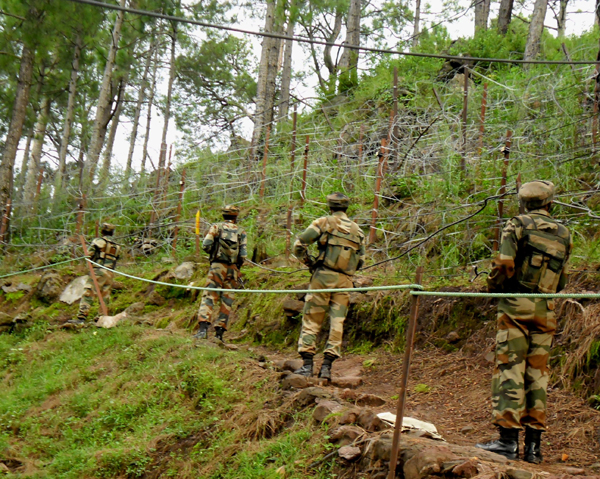
JAMMU, June 30: Army today foiled fresh infiltration attempt on the Line of Control (LoC) at Tarkundi forward area in Balakote sector of Poonch district and forced a group of four to five militants, who were trying to sneak into the Indian territory late last night, to retreat to Pakistan occupied Kashmir (PoK).
This was second infiltration attempt in Tarkundi forward area along the LoC during the past three days.
Official sources said troops observed movement of a group of four to five militants at around 10.35 pm last night when they were trying to move towards the Indian territory from the LoC in Tarkundi forward area of Balakote sector in Poonch district. Troops opened firing immediately to neutralize the militants, who were equipped with heavy weapons and explosive material.
The militants were four to five in number and were carrying ‘pithoo bags’ with them, sources said, adding that they returned to PoK immediately after the troops opened firing at them from their forward positions. The militants were believed to be the Pakistani nationals.
Troops sounded an alert all along the LoC in Balakote sector and maintained strict vigil to ensure that the militants didn’t make second attempt of infiltration like the one made by them on the intervening night on June 27 and 28 when one group of the militants had tried to enter into this side twice but failed due to alertness displayed by the Army personnel.
Sources said there were about 35 to 40 militants camping on Pakistan side opposite Balakote and Mendhar sectors awaiting an opportunity to sneak into this side. They have made repeated attempts to intrude but all their plans have been foiled by the troops manning the forward posts on the LoC.
Troops conducted searches in Balakote and Mendhar sectors this morning but found no traces indicating movement of the militants on this side of the LoC, sources said.
As reported by the Excelsior, Army has been maintaining high alert on the LoC in the wake of reports that the militants would intensify infiltration attempts on the LoC and try to infiltrate in view of forthcoming Assembly elections in Jammu and Kashmir.
The mess in Agr Directorate
Reports have come in indicating that something fishy is going on in the Directorate of Agriculture, Kashmir. It is all about the Director trying to favour some of the suppliers of insecticides, pesticides and weedicides, some of which are suspected to be misbranded. The row appeared when the Quality Control Laboratory, Lal Mandi, Kashmir found that out of 320 samples of insecticides etc. 26 were misbranded. It appears that through an unjustifiable administrative measure the Director of Agriculture wanted to accommodate the erring supplying companies. In the process, three agricultural analysts considered taking of fresh samples from misbranded products contrary to the clauses of the Insecticides Act and declined to cooperate in what they considered illegal act. The Director ordered their attachment.
This is a case in which suspecting finger is raised towards the Director of Agriculture Kashmir. He is accused of behaving in an arbitrary manner and trying to illegally favour erring companies that supply insecticides. This seems a case of corrupt practices being encouraged in a Government Department and as such the Minister for Agriculture should immediately suspend the officials involved and set up an enquiry to find out if the case can be sent to the Vigilance Commission for further action.
Pay ex-gratia to all 2010 victims: HC
Excelsior Correspondent
SRINAGAR, June 30: Jammu and Kashmir High Court today raised serious objection over fixing of cut of date on 2010 killings allegedly by security forces in Kashmir valley and directed the State Government to provide ex-gratia relief to families of the victims who have been excluded by putting the cut of date.
A Division Bench Comprising Chief Justice MM Kumar and Justice Hasnain Masoodi directed the Government that the cases are required to be segregated and ex-gratia be granted to all those who were killed between January 2010 to December 2010.
The Bench directed: “In view of the opinion expressed by us in various orders and in present order as well the cases are required to be segregated by granting ex-gratia to those who have been killed between January 2010 to December 2010, excluding the period of June 2010 to September 2010.
During the proceeding, the court asked the Government through its Additional Advocate General, Reyaz Khan (AAG) about the sanctity of this cut of date and 11 persons have been left out and deprived of ex-gratia. “Who has decided this cut of date,” added the Bench.
Showkat Makroo (ASGI), counsel representing the centre, submitted before the court: “We approached the State Government with regard to those 11 persons for providing their details and consent but they did not response till date.”
“Why you want to deprive your own people?” court asked the Government through AAG.
The Government has fixed the unrest period from June 2010 to September 2010 and an ex-gratia of Rs 5 lakh has been provided by the Central Government and it has been disbursed to 102 victim families.
Court further said that the exclusion of some period from the disturbance would not be sustainable because there is no reasonable nexus with the object sought to be achieved by fixing the cut of date (June, 2010 to September, 2010).
The Bench further said that it has come on record that civil disturbances were reported throughout the year 2010. “Therefore, the case needs to be considered adding that it would not mean that cases would also be considered who have not died due to civil disturbance”, court observed.
The court expressed his serious concern over filing of status report by under-secretary Home Department as the same could have been filed by the officer not below the rank of Deputy Secretary as per the business rules and warned the State for future by adopting such type of practice.
“We have in earlier proceedings raised objection to filing status report by undersecretary, however, that has not been taken seriously. Learned AAG is at pains to explain to us that it is a fair mistake and in future shall not be repeated,” the court said.
Article 370 is not a bridge
Prof. Dr. K.L. Bhatia
Article 370 does not display any special and unique status for Jammu and Kashmir within the framework of the Constitution of India. It only displays temporary and interim measure for Jammu and Kashmir within the ambit of the Constitution of India. To say that Article 370 is a bridge between India and Jammu and Kashmir State is a wrong notion as it manifests that the State and India were separate entities. One may recall Vishnupuran that states that the country which is spread from Utter Himalaya to Dakshin Sumdra is the complete geographical and territorial boundaries of Bharat and the people who live in this boundary are Bhartiyya. Jammu and Kashmir State thus befalls within this framework as an integral part of Indian State from time immemorial. Those who venture to say that if Article 370 is deleted or abrogated from the textual Constitution of India there will be no State of Jammu and Kashmir in the geographical map of India may have to take coaching or tutoring in the history of India. Those who claim that there can’t be any discussions within the frame work of the Constitution of India reveal their mindset against India and Indian Constitution.
It is a known factual position that Article 370 was neither conceived within the Instrument of Accession nor a part of the draft Constitution; it was presented before the Constituent Assembly of India on 17th day of October 1947 and deliberated as well as passed as a temporary and interim measure on the same day. It is a matter of historical truth, and there is nothing pretentious about it, that it was introduced in the Constituent Assembly of India by Shri Gopalaswamy Ayyengar after persistent persuasion by the representatives from the State of Jammu and Kashmir, viz., National Conference headed by late Sheikh Mohammad Abdullah, the sole political party at that time, on 17 October 1949 in the form of Article 306A followed by a limited discussion and adopted for inclusion in the text of the Constitution of India the same day.
It may be unequivocally stated that Jammu and Kashmir is no problem. The problem has been created in Jammu Kashmir by the inclusion of Article 370 as a temporary provision in the textual Constitution of India in its relation to Jammu and Kashmir that needs to be revisited and re-examined from geo-strategy and geo-politics perspectives. Had the founding fathers of the Constitution of India farsightedness of geo-strategy and geo-politics, they ought to have desisted as well as restrained from giving birth and berth to Article 370 in the Constitutional language of India. Article 370 is not the bye product of instrument of accession conceived under the Government of India Act, 1935 and the Indian Independence Act, 1947. Accession was made not with the intent to have Article 370. But J&K’s history and traditions demanded the interests of the State in joining the Indian Union and its Constituent Assembly and taking its due integrating status in the constitutional structure of India. Instrument of accession was an action plan for the accession of Indian princely states with the Union of India making it ‘Union of States’ as a step forward for the federalism as a basic structure of the Constitution of India. Instrument of Accession of J&K alike other Instruments of Accession aimed at the unity and integration of Union of India – Bharat, paving a way for the future of an Independent Constitution of India applicable to the whole India including the State of J&K amongst the Union of States of the Indian Federation
It is clear that the Instrument of Accession was unconditional. The acceding monarch Maharaja Hari Singh had never used the terms “will of the people’ or “wish of the people” or “plebiscite” or any other condition in the instrument of accession. It was in line with the Government of India Act, 1935 and the Indian Independence Act, 1947. It was compatible with all norms of international law. It was legally and constitutionally beyond any shadow of dispute. It was socially, morally and politically unquestionable. It justified the reasons for belated decision to accede to India. The accession was accepted by the Government of India on 27 October 1947. The accession was with regard to the undisputed geographical and territorial boundaries of the State as they stood in the political and geographical map of the State including POJK and COJK as on 15 August 1947 and 26/27 October 1947. The accession of Jammu Kashmir State to the Indian Union in terms of Instrument of Accession was an act of legal plenitude. Both the Acts of 1935 and 1947 stand repealed from the statutory books of India (Article 395), and, hence, instruments of accession also stand outside the realm of statutes, and as such a matter of past history, which is a dead history. The act of accession cannot be questioned. If this is questioned on the grounds of its possible illegality, unconstitutionality, then all accessions whether to India or Pakistan would be open to similar objections that may consequentially lead to disintegration inviting a Pandora box of intrigues as well as incongruities of stirring situations.
WHAT DOES ARTICLE 370 ENJOIN?
It is pertinent to mention three important components of Article 370, viz., “in consultation with the Government of the State”, “with the concurrence of the Government of the State”, and “the recommendation of the Constituent Assembly of the State shall be necessary”.
Article 370 contains 3 clauses:
1. Clause 1 provides that provisions of Article 238 of the Constitution of India shall not apply in relation to the State of J&K. Article 238 originally related to Part B States in the original constitutional language, which was repealed from the Constitution of India by seventh Amendment Act, 1956 as a consequence of States Reorganisation Act, 1956 doing away with Part A, B, C States. Unfortunately, it is a paradox that this Article continues to occupy a place in the language of Article 370.
Clause 1 also stipulates that the power of Parliament of India to make laws for the State of J&K shall be limited to (i) those matters in the Union List and concurrent List which, in consultation with the Government of the State, are declared by the President to correspond to matters specified in the Instrument of Accession governing the accession of the State to the Indian Union, viz., Defence, External Affairs, Communication, and Ancillary. (ii) such other matters in the said Lists as, with the concurrence of the Government of the state, the President may by order specify, i.e., Central laws in terms of matters enumerated in the Union List and Concurrent List shall not extend to the State of JK without the concurrence of the State Government. (iii) The provisions of Article 1 (and article 370) of the Constitution of India shall apply in relation to the State of J&K.
Article 1 became operative on the date of the adoption and enactment of the Constitution of India, 26 November 1949. Accession of the State of JK took place on 26-27 October 1947; J&K like other Native/Princely States became an integral part of Indian Federal Democratic Republic on the date of adoption and enactment of the Constitution of India, i.e., 26 November 1949.
(iv) such of the other provisions of the Indian Constitution and subject to such exceptions and modifications shall apply in relation to the State of J&K as the President may by order specify : Provided that no such order which relates to the matters specified in the Instrument of Accession shall be issued except in consultation with the Government of the State, and provided further that no such order which relates to matters other than those referred to in the Instrument of Accession except with the concurrence of the Government of the State.
By Constitutional (Application to the State of Jammu and Kashmir) Order, 1950 Article 1 (J&K as an integral part of the Indian Union) and Articles 5-11 (Citizenship of India — thus making all permanent residents of J&K as citizens of India) were extended and made applicable to the State of J&K immediately. Subsequent Constitutional Application to the State of JK Orders 1954, 1962, 1966, 1985 extended provisions of the Constitution of India with such exceptions and modifications, of course with the concurrence and in consultation with the Government of the State, from time to time. The Central Laws (over 370) were also extended and made applicable to the State of J&K with the concurrence of the State Government from time to time to bringing the State in the national stream.
By Constitutional application to the State of J&K Order, the President added a new Article 35A in the Fundamental Rights part of the Indian Constitution giving special privileges to the permanent residents of J&K, viz, purchase of immovable property within the State; free education and scholarships; and public employment. This addition raises some constitutional questions:
1. Does the President of India enjoy power under Article 370 to add a provision in the Fundamental Rights Part of the Constitution of India?
2. Can the President by Presidential Order create a classification between the citizens of India, i.e., citizens of India on the whole on the one side not to enjoy special privileges and the permanent residents of J&K as citizens of India on the other side enjoy special privileges which are otherwise denied to the citizens?
3. Can the President of India exercise constituent making powers under Article 368 by adding Article 35A?
4. Is this power compatible with the constitution spirit, constitution culture and constitution practice?
2. Clause 2 encapsulates that if the concurrence of the Government of the State referred to the matters in the Union List and the concurrent List was given before the Constituent Assembly for the purpose of framing the Constitution of the State is convened, it shall be placed before such Assembly for such decision as it may take thereon.
3. Clause 3 empowers the President to declare, by public notification, that Article 370 shall cease to be operative or shall be operative only with such exceptions and from such date as he may specify: Provided that the recommendations of the Constituent Assembly of the State shall be necessary before the President issues such notification.
The Constituent Assembly of the State finally adopted and enacted the Constitution of J&K on seventeenth day of November, 1956 that was inaugurated on 26 January 1957 duly approved the accession in terms of Instrument of Accession in unequivocal Preamble constitutional language the integration of the State of J&K to the Indian Union, viz., “in pursuance of the accession of this State to India which took place on the twenty-sixth day of October, 1947, to further define the existing relationship of the State with the Union of India as an integral part thereof”.
Section 3 of the Constitution of Jammu and Kashmir states: “The State of Jammu and Kashmir is and shall be an integral part of the Union of India”.
Section 4 of the Constitution of Jammu and Kashmir further states: “The territory of the State shall comprise all the territories which on the fifteenth day of August, 1947, were under the sovereignty or suzeranity of the Ruler of the State”.
Section 147 of the State Constitution empowers the State Legislature to amend the Constitution of the State except the amendment of Sections 3, or 4, or 5, or 147 or the provisions of the Constitution of India as applicable in relation to the State.
The Constitution of Jammu and Kashmir does not make any reference to Article 370 in its relation to India. So, where is the question that it is a bridge between the State and the Indian State!
A step to remove the gulf
In the backdrop of the above, the State Legislature enjoying constituent making power under Section 147 of the State Constitution can recommend to the President of India to abrogate, by public notification, Article 370. Article 368 does not curtail the power of the President under Article 370. Or, the Parliament of India enjoying constituent power under Article 368 on her own can delete or erase the proviso and thereafter delete or abrogate Article 370 from the textual Constitution of India. Article 368 does not curtail the power of the Parliament under Article 370. It is co-extensive with the power to amend. Parliament had done so by adding explanation in the language of Article 370 in 1965 by substituting the words Governor in place of Sadar-i-Riyasat and the Constitution of Jammu and Kashmir was accordingly amended by replacing Sadar-i-Riyasat and Prime Minister by Governor and Chief Minister vide sixth amendment Act 1965.
(The author is Professor National Law University Jodhpur)