

Rio de Janeiro, July 14:
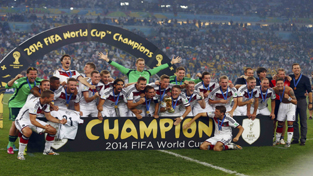
Germany wrote a new chapter in the history of international football as they became the first European team to lift the World Cup in South America, clinching a hard-fought 1-0 win over Argentina in the final, their triumph coming on the back of steely resolve and blood on the pitch here.
Substitute Mario Goetze scored the all-important goal in the 113th minute, combining with another sub Andre Schürrle, who provided him the assist, leaving thousands of Argentine fans at the iconic Maracana Stadium heartbroken and the Germans, including Chancellor Angela Merkel, ecstatic.
The golden generation of German footballers’ eagerness to win the silverware was best defined by Bastian Schweinsteiger, who was bleeding from a cut on his face following a rough challenge, after the game went into extra time.
The winning goal came when Schurrle made inroads down the left hand side and played a cross towards the near post for Gotze, who took it on his chest before placing it into the back of the net with his left foot.
The result meant Lionel Messi’s dream to join the pantheon of greats such as Diego Maradona and Pele ended in heartbreak. The 27-year-old Argentina captain had the chance to win the cup for his country at the start of second half, but this was not to be his day.
It was not the free-flowing football Germans dished out in the beginning of the tournament but, on the biggest stage of all, they appeared determined to not let go of this golden chance to script history.
This was Germany’s fourth World Cup triumph, and their first since reunification. Last time too, their title win had come against Argentina in 1990 in Italy.
After a rather subdued outing in the first half, Germany gradually applied pressure on the opponents in the second half, before upping the ante in the extra time.
The ploy worked for the Europeans as Argentina appeared to have lost the plot following a promising start, with some of them even resorting to physical game.
Joachim Loew’s side made its intentions clear at the start of extra time, with Schurrle and Mesut Ozil both getting a sniff of the goal.
The only consolation for Messi was winning the Golden Ball for being the best player of the tournament. The Golden Boot went to Colombian striker James Rodriguez for scoring six goals while Germany goalkeeper Manuel Neuer bagged the Golden Glove. (PTI)
Germany script history, beat Argentina 1-0 to win World Cup
Union Minister, Dr Jitendra Singh giving awards to meritorious students of class 10th and 12th from displaced Kashmiri Pandit community at a function organized at New Delhi.
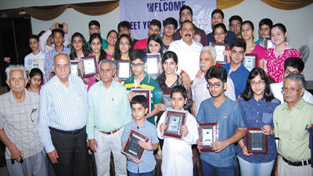
Union Minister, Dr Jitendra Singh giving awards to meritorious students of class 10th and 12th from displaced Kashmiri Pandit community at a function organized at New Delhi.
Chief Secretary, Mohammad Iqbal Khandey chairing inaugural session of workshop at SKICC.
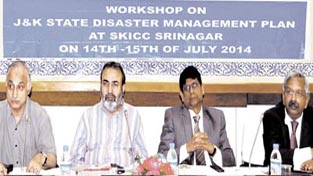
Chief Secretary, Mohammad Iqbal Khandey chairing inaugural session of workshop at SKICC.
Minister for PHE, Sham Lal Sharma addressing public gathering on Monday.

Minister for PHE, Sham Lal Sharma addressing public gathering on Monday.
Minister for Labour, Ajay Sadhotra chairing a meeting at Jammu on Monday.

Minister for Labour, Ajay Sadhotra chairing a meeting at Jammu on Monday.
People protesting over death of road accident victim at Bakshi Nagar on Monday. -Excelsior/Rakesh
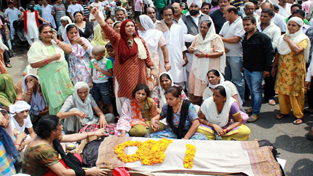
People protesting over death of road accident victim at Bakshi Nagar on Monday. -Excelsior/Rakesh
Cong leader Abdul Gani Vakil addressing party workers at Sopore on Monday.
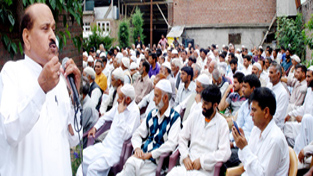
Cong leader Abdul Gani Vakil addressing party workers at Sopore on Monday.
Dental surgeons raising slogans during protest rally at Jammu on Monday.
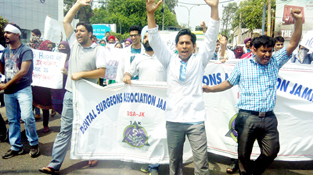
Dental surgeons raising slogans during protest rally at Jammu on Monday.
Helen Mirren credits husband for her belief in relationships
LOS ANGELES, July 14: Actress Helen Mirren has revealed that her director husband Taylor Hackford helped her to change her perspective on relationships.
The happily married director and 68-year-old actress got together in their late 30s and waited 13 years to wed on New Year’s Eve 1997, reported People magazine.
“Before I met Taylor, all my relationships took second place to my work. If I had to go to Africa, it was ‘Bye-bye, I’m off to Africa.’ And then he came into my life, and I started thinking, ‘Maybe it’s time to have a different attitude – and to say that my relationship is at least as important as my work.’ To give it the time,” she said.
The ‘Queen’ star said she often used to complain to her husband for not meeting her in life earlier.
“I used to say to Taylor, ‘I wish we’d met earlier on. We’ve missed so much time together’. And he’d say, ‘We’d never be together now if we met earlier,’ ” she said.
“And I think he’s actually right because we were both on a trajectory of work and ambition and, of course, to a certain extent, wanting to resolve ourselves as ourselves,” she added. (PTI)
Tribute to a martyrRavi Rohmetra Late Brig. Mohd. Usman stands as a personification of the secular traditions of the Indian Army. He made supreme sacrifice in the Battle of Jhangar on 3rd July, 1948. Brig. Usman was born on 15th July, 1912 at Bibipur which is a part of today’s Azamgarh district in Uttar Pradesh. Usman was educated at Harish Chander Bhai School in Varanasi. Despite intense competition, Usman succeeded in gaining admission to the prestigious Royal Military Academy at Sandhurst. Upon completion of his training, he was commissioned in Baluch Regiment and it was as a Baluch Officer that Usman had to face the cruel specter of partition in 1947. Despite intense pressure from the Pakistani leadership to join the Army of the new nation, Brig. Usman remained committed to the ideals of his motherland. The ultimate bait of becoming the Pakistan Army Chief also proved unsuccessful in tempting him and he remained steadfast in his resolve the serve the land of his birth. When the Baluch Regiment was allotted to Pakistan, Brig. Usman was transferred to Dogra Regiment. But war had already been thrust upon India when Pakistan sent tribal irregulars and its soldiers into Jammu and Kashmir. Even as the situation in the Kashmir Valley was stabilized the threat continued to be serious in the Jammu region. Brig. Usman Commander of 77 Para Brigade was side stepped to command 50 Para Brigade, deployed at Jhangar in December 1947. However, with odds heavily against him, Jhangar was wrested by the Pakistanis on 25th December, 1947. The Brigadier vowed to recapture Jhangar – a feat he accomplished three months later. With the fall of Jhangar, the emboldened Pakistanis seized Naushera and the situation looked grim indeed. Naushera was defended despite heavy odds and a numerically superior enemy was defeated. This proved to be the turning point in the campaign that earned Brig. Usman two titles of endearment – “Hero of Naushera” and “Savior of Naushera”. Jhangar, however, loomed large in his mind and the liberation of which became his obsession. After a month’s planning, he was able to put into motion his operation to free Jhangar and on 18th March, the Para Brigade achieved its objective. Jhangar was once again in Indian hands. But it was Jhangar that cost Brig. Usman’s life on 3rd July, during a lull in shelling. In a moving ceremony, Brig.Mohd. Usman was given a state funeral and a posthumous Mahavir Chakra. The enormity of his achievements from the nation’s point of view, can be gauged from the fact that on his being martyred on 3rd July 1948, he was given a state funeral in New Delhi by a grateful nation’s leadership. It is note-worthy that Brig. Mohd. Usman, MVC remains India’s only military commander to have been given this singular honour with the nation’s eminent leaders who include the then Prime Minister Pandit Jawahar Lal Nehru, Sheikh Abdullah, the then Defence Minister Sardar Baldev Singh, Maulana Abdul Kalam Azad and then CAOs Lt. Gen. (Late Fd Marhal) attending his funeral, before he was buried in the Jamia Milia Islamia at Delhi. It is also note-worthy that Brig. Mohd. Usman MVC remains India’s highest ranking military commander till date, to have made the supreme sacrifice on the battle field itself, while leading his men in action, in the face of the enemy.
Ravi Rohmetra
Late Brig. Mohd. Usman stands as a personification of the secular traditions of the Indian Army. He made supreme sacrifice in the Battle of Jhangar on 3rd July, 1948. Brig. Usman was born on 15th July, 1912 at Bibipur which is a part of today’s Azamgarh district in Uttar Pradesh. Usman was educated at Harish Chander Bhai School in Varanasi. Despite intense competition, Usman succeeded in gaining admission to the prestigious Royal Military Academy at Sandhurst. Upon completion of his training, he was commissioned in Baluch Regiment and it was as a Baluch Officer that Usman had to face the cruel specter of partition in 1947. Despite intense pressure from the Pakistani leadership to join the Army of the new nation, Brig. Usman remained committed to the ideals of his motherland.
The ultimate bait of becoming the Pakistan Army Chief also proved unsuccessful in tempting him and he remained steadfast in his resolve the serve the land of his birth. When the Baluch Regiment was allotted to Pakistan, Brig. Usman was transferred to Dogra Regiment. But war had already been thrust upon India when Pakistan sent tribal irregulars and its soldiers into Jammu and Kashmir. Even as the situation in the Kashmir Valley was stabilized the threat continued to be serious in the Jammu region. Brig. Usman Commander of 77 Para Brigade was side stepped to command 50 Para Brigade, deployed at Jhangar in December 1947. However, with odds heavily against him, Jhangar was wrested by the Pakistanis on 25th December, 1947. The Brigadier vowed to recapture Jhangar – a feat he accomplished three months later. With the fall of Jhangar, the emboldened Pakistanis seized Naushera and the situation looked grim indeed. Naushera was defended despite heavy odds and a numerically superior enemy was defeated. This proved to be the turning point in the campaign that earned Brig. Usman two titles of endearment – “Hero of Naushera” and “Savior of Naushera”. Jhangar, however, loomed large in his mind and the liberation of which became his obsession. After a month’s planning, he was able to put into motion his operation to free Jhangar and on 18th March, the Para Brigade achieved its objective. Jhangar was once again in Indian hands.
But it was Jhangar that cost Brig. Usman’s life on 3rd July, during a lull in shelling. In a moving ceremony, Brig.Mohd. Usman was given a state funeral and a posthumous Mahavir Chakra. The enormity of his achievements from the nation’s point of view, can be gauged from the fact that on his being martyred on 3rd July 1948, he was given a state funeral in New Delhi by a grateful nation’s leadership. It is note-worthy that Brig. Mohd. Usman, MVC remains India’s only military commander to have been given this singular honour with the nation’s eminent leaders who include the then Prime Minister Pandit Jawahar Lal Nehru, Sheikh Abdullah, the then Defence Minister Sardar Baldev Singh, Maulana Abdul Kalam Azad and then CAOs Lt. Gen. (Late Fd Marhal) attending his funeral, before he was buried in the Jamia Milia Islamia at Delhi. It is also note-worthy that Brig. Mohd. Usman MVC remains India’s highest ranking military commander till date, to have made the supreme sacrifice on the battle field itself, while leading his men in action, in the face of the enemy.