

Thursday, April 30, 2026
E-Paper
Home Blog Page 77503

BJP, Cong in war of words over TRAI Bill

NEW DELHI, July 14: The government and the Congress sparred over the TRAI (Amendment) Bill which was passed by Lok Sabha today, with Union minister M Venkaiah Naidu saying that Congress was countering it only for the sake of opposition and former minister Shashi Tharoor maintaining there were issues of principle involved.

“The Congress party is opposing for the sake of opposing,” Naidu said, adding that the Prime Minister has the right to appoint his Principal Secretary.

“As said by the Minister for Telecommunications, this is aimed at bringing parity with regard to different regulatory authorities. There is nothing unusual about it. There was a sort of a mistake or shortcoming earlier that has been rectified,” he told reporters outside the Parliament.

The TRAI (Amendment Bill) aims to remove legal hurdles in the appointment of former TRAI chief Nripendra Misra as principal secretary to the Prime Minister.

Speaking to reporters, Naidu said the Prime Minister was chosen by an overwhelming majority of the people of India and has got every right to choose an officer of his choice.

“And that officer has got impeccable character. Nobody has questioned his integrity, honesty and commitment and calibre also. So naturally, the house has approved it,” he said.

He justified taking the ordinance route to appoint Misra as the Principal Secretary saying the Prime Minister is not an individual but an institution and there was need to have his officer from day one.

Naidu further said that he was surprised at Congress’ objections over the ordinance claiming that “it is the Congress which has used, misused the ordinance route, umpteen number of times”.

Congress leader Shashi Tharoor said his party was raising issues of principle.

“This is not about him (Misra), it is not about the Prime Minister. What it is about is two issues of principle. The first is can you actually change a law to suit one person. What are you signaling about our democracy? What are you saying that ultimately if a law stands in the way of an individual, in this case, the Prime Minister, the individual’s wishes will take precedence over the considered law of the land,” he said.

Tharoor said there is another principle of concern about the future chairman of TRAI “because once the law is changed they will once again be susceptible to the influence of the government on matters involving such sensitive issues plus spectrum allocation and licensing, we have seen how controversial and how valuable these are.”

He said that the government does have a Constitutional right to do and added that it is also true that other regulators do not have this requirement.

“There is a case for standardising the requirement. But we should standardise to a higher standard and not to a lower standard. In any case there is no standard. By amending this bill, we are not bringing it on par with other bills. Each bill, each regulatory authority has its own stipulations,” he said.

Tharoor said that his party was not speaking against any individual but only about principle.

Congress and some other parties have walked out as they wanted to make a point of principle, which has been recorded in the house, he said.

He said that the government has a majority in the House and it was expected that the Bill would be passed in Lok Sabha. Asked about TMC’s stance on the issue, he said that these questions should be put that party. (PTI)
 

CM’s focus on roadways

Chief Minister Omar Abdullah has recently met with two Union Cabinet Ministers, namely Nitin Gadkare Minister for Surface Transport and National Highways and the Food Minister Ramvilas Paswan. With the former, he took up the matter of improving and upgrading existing roadways and building more tunnels and flyovers to make road transport in the State smooth and without obstruction. We have noticed that Modi Government is seriously concerned about expansion and upgrading of road connectivity in the state. This has been amply reflected in the Railway Budget and the Annual Budget 2014-15, both of which were recently presented in the Parliament. The Finance Minister announced allocation of funds for various works of road connectivity in the State. 4-laning of the National Highway – 1A is going on with full swing. There is no shortage of funds for this vital project. Of course, the engineers had encountered some problem in tunneling at two places in Chenani-Nashri link but it has now been surmounted. Union Government’s concern is not to be viewed only in the context of building roads to connect the borders only although that is of vital importance from security angle. 4-laning and 2-laning of National Highway and internal highways respectively have been clearly stated in the annual budget of the Union Government. Road connectivity to Ladakh through all weather projects of tunneling at Z Morh and Zoji La has also been undertaken.
In his detailed discussion with the Union Minister for Surface Transport and National Highway, the Chief Minister has demanded return of three link roads to the Sate and the reason given is that these are not well maintained. Well if the CM is satisfied that the State PWD can deliver the goods, let the trial be made. He has demanded that the Mughal Road should be declared as alternate National Highway. It is true that the Mughal Road was revived and rebuilt as the alternative to the existing National Highway – 1A though for many decades the fear lingered with the authorities that this road passed close to PoK and was vulnerable to enemy attacks. But at last, when it was decided that we should have the alternate road, the old Mughal Road was revived. It is but natural that the State  Government should approach the Centre with the request that this road be declared as National Highway so that its upgrading, maintenance and repair work etc. would be taken in hand by the Union Government. This is a vital link once used by the Mughal Emperors on their visits to Kashmir. However, further survey might be necessitated to find whether any major improvement in this link should be considered like the tunnel at Pir Ki Gali. . This road will prove a life line to two districts of Poonch and Rajouri.
As regards building flyovers in Srinagar and Jammu cities, survey and study has been reportedly conducted at Master Plan scheme and a blue print is ready. But actually no step has been taken towards easing traffic congestion in two capital cities. But the question is that will building of two flyovers really solve the traffic congestion problem of the two capital cites or that much more needs to be done? In particular, Jammu city traffic presents a very disappointing picture because the lanes and streets of the city are too narrow and the number of vehicles has increased at rapid pace during past two decades. Actually, the Master Plans drawn for the two cities should be taken up for further consideration and implementation. Raising satellite cites is the solution for reducing congestion in old cities.
The overall picture of road networking and connectivity in the State is encouraging. Uniform development of road connectivity in all the three regions and especially in the backward areas of these regions is a priority with the State and the Centre and sufficient hints have been thrown that J&K will have a new roadmap once the contemplated projects or the projects in pipeline are brought to completion.
Some urgent issues connected with food position in the State were discussed by the CM with Union Food Minister. There is weight in Chief Minister’s argument that his State would not rush to implement the Food Security Act which the previous Union Government had brought in at the fag end of its tenure. According to the CM, J&K State is covered by the current PDS mechanism. In implementing the Food Security Act, which has been endorsed by Modi Government, the Chief Minister fears that entire population that comes under BPL and is covered by existing PDS. may not be covered by the Food Security Act. Even the quantity of rations provided will come down from 35 kilograms to 25 kilograms per head. He provided the Union Food Minister with statistics regarding the demand and supply of food grains for the State and indicated that the supply deficit was a cause of concern for the State Government. It will be remembered that in recent months there has been public cry against short supply of food grains in many rural parts of the State especially in Jammu region. The State at present gets 63,067 tones of food grains per month from the Centre for 18.02 lakh families as per 2000 census whereas it is distributing to 19.72 lakh families thereby resulting in a monthly shortfall of 5,953 tonnes of food grains.
We have to be realists in regard to the food supplies position in the State. If the actual implementation of Food Security Act would bring any relief to the people of the State and not discriminate any section like the BPL or others, the State Government would have taken the foremost step in implementing the Act. This, however, is not the position. And also, Chief Minister’s argument that it is difficult for the State to meet the monthly shortfall of 5,963 tonnes of food grains is very cogent and has to be accepted. The State is not in a position to substantially increase food production to meet the shortfall. The Chief Minister has rightly expressed apprehensions that in case of failure of monsoons, his State will have to bear serious brunt for which his administration shall have to gear up.

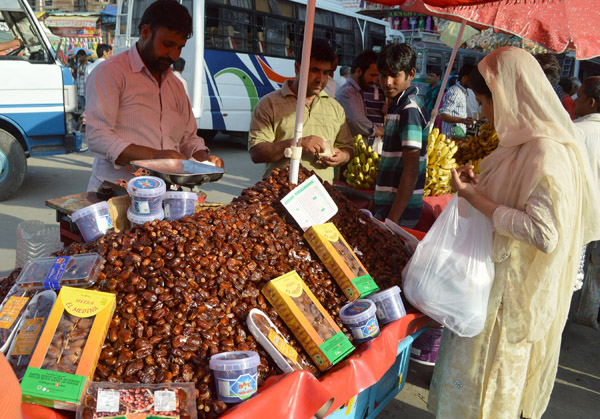
People buy dates from a roadside vendor during month of Ramadan in Srinagar. —Excelsior/Amin War

People buy dates from a roadside vendor during month of Ramadan in Srinagar. —Excelsior/Amin War

People buy dates from a roadside vendor during month of Ramadan in Srinagar.
—Excelsior/Amin War

Castorseed futures slip 1.36% on selling pressure

NEW DELHI, July 14:  Castorseed prices declined by 1.36 per cent to Rs 4,433 per quintal in futures trading today as traders preferred to offload holding on higher levels in line with weak global and physical market cues.
At the National Commodity and Derivatives Exchange, castorseed prices for September contract declined by Rs 61, or 1.36 per cent, to Rs 4,433 per quintal, clocking an open interest of 67,290 lots.
On the other hand, August contracts plummeted by Rs 57, or 1.30 per cent, to Rs 4,316 per quintal, with an open interest of 2,63,810 lots.
July contracts also eased marginally by Rs 4, or 0.09 per cent, to Rs 4,250 per quintal, with an open interest of 25,110 lots.
Marketmen attributed the fall to slackness in international demand.
Increased supply and withdrawal of support from consuming industries in physical markets also weighed on prices in futures markets, they added. (PTI)

Guargum prices fall 3.37% on weak overseas demand

NEW DELHI, July 14:  Guargum prices plunged by 3.37 per cent to Rs 16,060 per quintal in futures trade today following all round selling by traders amid a weak global and spot markets sentiment.
Marketmen said besides fall in export demand, increased supply and slackness in demand in physical markets, weighed on futures.
At the National Commodity and Derivatives Exchange, guarseed prices for November contract dipped by Rs 560, or 3.37 per cent, to Rs 16,060 per quintal, with an open interest of 3 lots.
July contracts also dropped by Rs 220, or 1.43 per cent, to Rs 15,120 per quintal, having an open interest of 14,066 lots.
Meanwhile, July contracts lost Rs 150, or 1.00 per cent, to Rs 14,870 per quintal, in an open interest of 404 lots. (PTI)

Crude palm oil prices fall 0.56% on profit-booking

NEW DELHI, July 14:  Crude palm oil prices fell 0.56 per cent to Rs 525 per 10 kg in futures trade today after speculators booked profits amidst subdued spot demand.
Besides, a weak trend overseas also put pressure on the prices.
At the Multi Commodity Exchange, crude palm oil for delivery in July fell by Rs 3, or 0.56 per cent, to Rs 525 per 10 kg, in a turnover of 112 lots.
Similarly, the oil for delivery in the August lost Rs 2.70, or 0.51 per cent, to Rs 517.30 per 10 kg, with a business turnover of 55 lots.
Market analysts said besides profit-booking by speculators at existing levels, a weak trend overseas and sluggish spot demand led to fall in crude palm oil prices.
Meanwhile, in Malaysia, imports of palm oil by India, the world’s largest buyer, probably dropped for the second month as a shrinking discount on soybean and sunflower oils have cut its appeal.
Palm oil in Malaysia slumped to the lowest in more than nine months as exports dropped.
Palm oil declined by 1.70 per cent to 2,346 ringgit (USD 736) a tonne on the Malaysia Derivatives Exchange. (PTI)

Mentha oil falls 0.95% on profit-booking

NEW DELHI, July 14:  Mentha oil futures drifted by 0.95% to Rs 728.60 per kg today as speculators locked-in gains at prevailing levels amid slackened spot demand.
At the Multi Commodity Exchange, mentha oil for delivery in July declined by Rs 7, or 0.95 per cent, to Rs 728.60 per kg in a business turnover of 422 lots.
Likewise, the oil for delivery in the August traded lower by Rs 6.50, or 0.86 per cent, to Rs 745.30 per kg in 90 lots.
The fall in mentha futures was mostly due to profit-booking by speculators after recent gains and sluggish demand in spot markets from pharmaceutical units, analysts said. (PTI)

Silver falls 0.74% on profit-booking, global cues

NEW DELHI, July 14:  Silver prices fell by 0.74 per cent to Rs 45,727 per kg in futures trade today amidst profit-booking by speculators and a weak trend overseas.
At the Multi Commodity Exchange, silver for delivery in September traded lower by Rs 341, or 0.74 per cent, to Rs 45,727 per kg in a business turnover of 753 lots.
Similarly, the white metal for delivery in December declined by Rs 356, or 0.72 per cent, to Rs 46,581 per kg in a business volume of 33 lots.
In the international market, silver traded lower at USD 21.43 an ounce in Singapore from USD 21.44 on July 11.
Market analysts said apart from profit-booking by participants, a weak trend in global markets led to the fall in silver prices at futures trade here. (PTI)

Gold falls 0.35% on weak global cues, profit-booking

NEW DELHI, July 14:  Gold futures fell 0.35 per cent to Rs 28,269 per 10 grams today as speculators locked-in gains amid a weak global trend.
At the Multi Commodity Exchange, gold for delivery in October fell by Rs 84, or 0.35 per cent, to Rs 28,269 per 10 grams in a business turnover of 18 lots.
On similar lines, the metal for delivery in August declined by Rs 68, or 0.24 per cent, to Rs 28,288 per 10 grams in 464 lots.
Market analysts said the fall in gold futures was mostly due to profit-booking by speculators and a weak trend overseas.
Meanwhile, gold prices fell to USD 1,336.69 an ounce in Singapore from USD 1,338.70 on July 11.

Lead futures gain 0.36% on spot demand, global cues

NEW DELHI, July 14:  Lead futures rose marginally by 0.36 per cent to Rs 133.50 per kg today amid demand in the domestic spot market and a firming global trend.
At the Multi Commodity Exchange, lead for delivery in August traded higher by 35 paise, or 0.36 per cent, to Rs 133.50 per kg, with a turnover of 36 lots.
The metal for delivery in July gained 35 paise, or 0.26 per cent, to Rs 132.45 per kg in a business volume of 412 lots.
Analysts said apart from domestic demand, particularly from battery-makers, the metal’s gain in overseas market, influenced lead prices at futures trade. (PTI)