

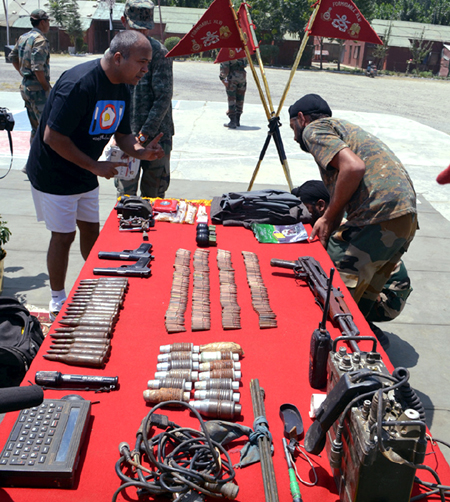
Army displaying arms and ammunition recovered from a hideout in Baramulla forests. -Excelsior/Aabid Nabi
Army displaying arms and ammunition recovered from a hideout in Baramulla forests. -Excelsior/Aabid Nabi
horoscope
Monday July 28-2014
Aries : You will achieve things today, not by the sleight of your hand but by your communication skills, says Ganesha. Your eloquence shall win many hearts. The stars suggest monetary benefits, but you need to guard against injury and minor ailments.
Taurus : You are likely to confront a turning point in relationships today, foresees Ganesha. Because you are in need of some compassion and support, you will feel the need to spend time with friends and relatives. Your beloved or better half may bring a change in mood by helping you shed your negative frame of mind, says Ganesha.
Gemini : Some of your personal belongings are very dear to you. You may have to grudgingly share them with someone else. A mild pang of jealousy may kick in. But, you are merely being protective of something very personal, so there is nothing wrong with that, says Ganesha.
Cancer : You will be in high spirits today, foretells Ganesha. It is a favourable day to engage in household activities, like gardening, cooking or even washing laundry. In the evening, work will be eclipsed by the pleasures of love.
Leo : The trader in you comes to the fore today. With an impeccable eye for recognising profitable avenues, you will quickly spot opportunities that arise from buying goods at cheaper prices, and selling them off at a rate that leaves you with a lump sum profit. Start with small transactions, and treat each transaction with care before you plunge into bigger ventures, like the Bull-n-Bear tussle of the stock markets. Ganesha wishes you all the success today.
Virgo : Ganesha predicts that your writing skills will possibly help you vent your feelings without offending others. You will successfully complete your pending assignments. Great success will knock at your door in anything and everything you undertake today, predicts Ganesha.
Libra : No matter what you do, some days are just not happening. Considering the random mood swings that affect you today, it’s in the best interest of others that you put up a ‘Beware of me’ sign. By being forewarned about it, you should be capable of handling your erratic behaviour. Just remember that nothing can affect your mental balance, and that this is just a phase. After slogging hard through the the day, you may desire to relax and pamper yourself later in the evening, suggests Ganesha.
Scorpio : The day today is riddled with minor, nagging ailments. Adopt a two-pronged strategy, advises Ganesha. One – change your lifestyle, and two – visit your doctor for regular examinations. Ominous at his best, Ganesha counsels to take care of your health.
Sagittarius : Today, you will most certainly put your heart and soul into your work. But it is rather unlikely that you will get the returns in proportion to the efforts you put in. Yet, at the end of the day, you will be more than satisfied that you have got the chance to display your innate talents, says Ganesha.
Capricorn : You will have heard of many emotional fools who let sentiments rule their lives. Try not be one of them, and if it’s too difficult a task, at least pretend not to be one of them, for Ganesha says going by your feelings can leave you at a low ebb. In other words, your feelings can come in the way of your success. A solution to this problem is to remain dispassionate and let the opportunist think you are a hard nut to crack.
Aquarius : If Elvis Presley is who you dreamed of being, today may be your day! You seem to impress one and all, and even money flows in! You play smart today and everything seems to work in your favour. Take care, says Ganesha, things may not be as they seem.
Pisces : You probably jumped out of bed this morning itching to talk to someone. And why not, since all your latent power of expression will spring out like a jack-in-the-box today. The pearls of wisdom you shower on people who are down-in-the-dumps today will make them feel good about their bluesy, taciturn selves, says Ganesha.
Govt planning media blitz to hard sell India for FDI
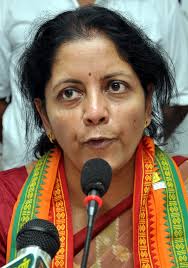
NEW DELHI, July 27: The Commerce and Industry Ministry is planning a media blitz – print, electronic and social – to hard sell India as an attractive investment destination.
“The objective of the campaign is to generate awareness about the investment opportunities and prospects of the country to promote India as a preferred investment destination in the source markets overseas and to increase India’s share of global FDI,” said a DIPP notice inviting request for qualification-cum-request for proposal.
India attracted USD 24.29 FDI in 2013-14 as compared to USD 22.42 billion in the previous fiscal.
The Department of Industrial Policy and Promotion said it intends to undertake on-line international Promotion and Media Campaign across all mediums (website, electronic, social media) throughout the world to brand India as an investment destination.
An interactive portal is also planned for this, it said.
DIPP, which deals with foreign direct investment (FDI) related matters, is under the Commerce and Industry Ministry.
The endeavour of the department is to target the traditional and important source markets overseas from where the country receives a large number of investment proposals.
“Through its overseas media campaign, DIPP intends to project and showcase India as a favoured investment destination, especially in the manufacturing sector,” it said.
It also said that the department intends to release its campaign in the overseas market, portraying the strengths of and opportunities in the Indian economy for investment and highlighting the comparative advantages India has over other investment destinations.
“To better target the campaign, the DIPP will use this interactive portal to collect data about projection investors and provide information and resolution to therein queries,” it added.
For the purpose, it proposes to appoint a IT application services agency, creative agency and a Digital Amplification & Social Analytics Agency for designing production and maintenance of the background of the portal.
The move is a departure from the past when ministers and secretaries used to travel abroad, hold investors meet and attend road shows to seek investments into the country.
Finance Minister Arun Jaitley have been emphasising the need to promote FDI to supplement domestic investments with a view to boost manufacturing sector and overall economic growth.
The government has recently announced relaxation of FDI policy in sectors including defence, construction and railways and insurance. (PTI)
India’s Sovereign rating to remain stable: Morgan Stanley
MUMBAI, July 27: India’s Sovereign credit rating is expected to remain stable over the next 12-month period, brokerage firm Morgan Stanley said in its research report.
“We expect India’s Sovereign Rating to remain stable in the next 12 months period. Decisive and timely action by the government to reduce the fiscal deficit through lower expenditure, moderate rural wage growth in line with productivity, and reduced energy subsidies would be needed to trigger an upgrade,” Morgan Stanley said.
India’s sovereign is currently rated BBB- by all rating agencies; only S&P has India on a negative outlook. While the rating agencies do not detail specific triggers for a downgrade, S&P is looking for stronger growth, fiscal account consolidation and lower inflation to revise the outlook to stable.
While India scores well for variables, such as GDP growth and FX reserves/GDP on Morgan Stanley forecast, it needs to show considerable improvement in inflation, fiscal balance and current account deficit to potentially be upgraded.
Morgan Stanley economics team expects India’s inflation rate to be reduced to 6.5 per cent over the next 12 months. While this is an improvement from the current level, it still compares unfavourably with the average BBB-rated EM sovereign (4.8 per cent), and average EM sovereign rated A and above (2.6 per cent).
Similarly, India’s fiscal balance expectation (-6.4 per cent of GDP) compares unfavourably with EM sovereigns rated BBB (-1.9 per cent of GDP) and A (-2.1 per cent of GDP).
The factors like reforms to target reducing inflation, cutting the fiscal deficit, and encouraging FDI inflows to boost productivity and improving growth, is critical for achieving the government’s aim of sustainable and higher growth. If these key areas are targeted effectively, it would not only boost productivity, but also improve the credit rating for the sovereign, the report said.
A pick-up in economic growth and rising private capital needs will be important drivers for Indian credit markets.
“We expect the size of the Indian USD/G3 bond market to reach USD 160 billion by 2018, driven by non-financials. Economic growth and capital needs will be important, but the key driver will be a gradual increase in reliance on debt capital markets. On average, the Indian USD/G3 bond market should see annual gross issuance in excess of USD 25 billion in the years to 2018,” the report said. (PTI)
An app to surf Internet anonymously
NEW DELHI, July 27: Security solutions firm F-Secure has introduced a mobile application, Freedome app, for surfing the Internet anonymously.
The company claims the app enables users mask their IP address and hide their real location. It further claimed that this app is an ideal choice to counter cyber snooping.
“When you connect to the Internet, your device is assigned a unique IP address. Freedome masks your IP, so you can surf anonymously under the protective F-Secure Cloud. All that is precious -– from identity to location -– stay hidden and private,” F-Secure Country Manager (India and SAARC) Amit Nath told.
Freedome can be used for total anonymity, even from F-Secure. F-Secure does not log user’ traffic or user name or contact details, he said.
“With Connection Protection, government officials and any regular user can stay anonymous, shielded wherever you go. While using WiFi, your traffic is encrypted so nobody can tap into your communications,” he said.
With the Virus Protection and Browsing Protection that Freedome app offers, one can face the world from the security of your own private network, he added.
Digital technology has transformed the world, empowered and connected people, but at the same time digital freedom and privacy rights are under attack, he said.
“Our users are totally anonymous from start to finish -– even from us. We are a security company, but we don’t believe security should come at the expense of privacy,” Nath added. (PTI)
Govt provides more clarity on ‘related party’ norms
NEW DELHI, July 27: The government has said relatives of directors or managers at private firms would be considered as related party under the new companies law.
The Companies Act, 2013, has stringent provisions for related party transactions under Section 188.
“… In section 2 of the Companies Act, 2013, in clause (76), in sub-clause (iv), after the word ‘manager’, the word ‘or his relative’ shall be inserted,” the Corporate Affairs Ministry said in an order dated July 24.
Prior to this, sub-clause (iv) read, “a private company in which a director or manager is a member or director”.
The Ministry has made the change through Companies (Removal of Difficulties) Sixth Order, 2014.
“The amendment enhances the definition of related party to include private companies in which relatives of directors or managers are members or directors,” Sudhir Soni, Partner in a member firm of Ernst & Young Global, said.
According to Soni, the change was required as this is an important class of related parties with whom transactions should be within the approval mechanism of Section 188.
Earlier this month, the Ministry had eased related party norms, exempting corporate restructuring activities, including amalgamations, will be excluded from the ambit of related party transactions.
Only ‘interested related parties’ with regard to a particular transaction would be precluded from voting on the same deal.
As per second proviso to Section (1) of Section 188, a member of the company, who is a related party, is not allowed to vote on a special resolution to approve a contract or arrangement.
“It is clarified that ‘related party’ referred to in the second proviso has to be construed with reference only to the contract or arrangement for which the said special resolution is passed,” the Corporate Affairs Ministry had said in a circular.
Under Section 188, ‘all related parties’ in a company would have been precluded from voting an any transaction with ‘any related party’, even if they weren’t a party to that specific transaction.
“It is clarified that transactions arising out of Compromises, Arrangements and Amalgamations dealt with under specific provisions of the Companies Act,1956/Companies Act, 2013, will not attract the requirements of section 188 of the Companies Act, 2013,” the Ministry had said. (PTI)
India’s steel production up 1.4% at 41.28 MT
NEW DELHI, July 27: India’s steel production grew at nearly half the world’s average in the first six months of this year, but the country still maintains the fourth position among top steel producers.
From January-June, India produced 41.28 million tonne steel, up 1.4 per cent over 40.72 MT in the year-ago period, as per the World Steel Association data.
In comparison, global production of the alloy stood at 821.34 MT in the first half of 2014, over 801.23 MT during H1 of last year, clocking a growth of 2.5 per cent.
Among major steel producing countries, China and South Korea were ahead of India in growth rate at 3 per cent and 9.1 per cent respectively.
However, Japan, US and Russia were behind. While both US and Japan clocked 0.9 per cent growth in the first six months; Russia’s growth was little less at 0.7 per cent.
China produced 411.90 MT steel, Japan 55.22 MT, US 43.49 MT and Russia 34.82 MT.
As per the current standing, India’s position remains same at the fourth place. In fact, India’s position in world’s steel production remained unchanged at the fourth slot for the last four years since 2010.
There was no change in the order of top three steel producing nations with China, Japan and the US retaining their slots in the respective order in 2013.
India produced 81.2 MT in 2013, 77.3 MT 2012, 73.6 MT in 2011 and 69 MT in 2010. (PTI)
‘Telcos must deliver promised Web speed for 80 pc usage time’
NEW DELHI, July 27: Telecom operators offering mobile Internet services have to ensure that the minimum download speed specified in their data plans is available to subscribers for not less than 80 per cent of usage time from August 23.
“Every service provider shall, in all its wireless (mobile and dongle) data plans, indicate the minimum download speed available to the consumers,” as per latest amendment by TRAI in standards of Quality of Service for Wireless Data Services Regulations.
At the end of May 2014, there were about 5 crore people using wireless Internet service either through mobile phones or dongles.
As per the amendment issued by Telecom Regulatory Authority of India, every service provider will have to ensure that minimum download speed published by them in plan or recharge coupons should be delivered to consumers at least for 80 per cent of the “usage time”.
The new regulation will come in force from August 23.
Consumers are being wooed by telecom companies in advertisements regarding high speed wireless data services and product packs in which they are promised high speed of up to 7.2 megabit per second or 21 megabit per second.
In general, even at 7.1 mbps speed, a mobile or dongle user should be able to download a video file equivalent to full-length movie in around 12-14 minutes.
Telecom operators have reported to TRAI that minimum download speed delivered on their most high speed 3G service is in the range of 399 kbps (less than minimum broadband speed is 512 kbps) to 2.48 mbps.
The regulator had shared its view earlier that minimum download speed for 3G and CDMA EVDO service should be 1 megabit per second with 95 per cent success rate.
For GSM and CDMA 2G, the minimum speed should be at 56 kilobit per second and for CDMA high speed data it is 512 kbps. The amendment,however, does not mention specific minimum speed.
TRAI has notified that minimum broadband speed should be 512 kilobit per second. 3G is generally considered as wireless broadband service. (PTI)
DoT seeks info on J&K,HP, U’khand villages having no telephone
NEW DELHI, July 27: The government is likely to approach regulator TRAI for details of the villages in Jammu and Kashmir, Uttarakhand and Himachal Pradesh that have no telecom connectivity.
“The Department of Telecom (DoT) is preparing a detailed project report on uncovered villages for which has it has asked TRAI to seek information from telecom operators on unconnected villages in J&K, Uttarakhand and HP,” an official source said.
The move is a part of the government’s agenda of raising rural tele-density to 100 per cent in the next 3-4 years.
The rural tele-density in the country is at present around 44 per cent.
According to DoT estimates, about 56,000-60,000 thousand villages in the country have no telecom connectivity.
The Universal Services Obligation Fund (USOF) wing under the Department has been given responsibility to facilitate telecom connectivity in rural areas. The DoT, however, plans to seek information on unconnected villages from TRAI.
Sources said most of the uncovered villages will get covered under various projects like installation of mobile networks in nine naxal-affected states at an estimated cost of Rs 3,500 crore, increasing connectivity in North East at a cost of Rs 5,100 crore, and plans for connecting Lakshadweep and Andaman & Nicobar islands.
The Telecom Regulatory Authority of India (TRAI) last week had recommended over Rs 2,400 crore-plan to provide telecom connectivity in Lakshadweep and Andaman & Nicobar islands.
However, uncovered villages in three states–J&K, HP and Uttarakhand– do not fall under the proposed schemes.
“From TRAI, DoT wants a list of all unconnected villages state-wise and urgent information is required for three states–J&K, Uttarakhand and HP,” the source said. (PTI)
Average CEO salary at top Sensex firms near Rs 10-cr
NEW DELHI, July 27: The average CEO pay at India’s top listed companies has risen to Rs 10 crore a year, but still remains less than one-tenth of over Rs 100 crore median remuneration paid to their peers in the US.
The top executives of the country’s biggest bluechip companies, forming part of the stock market’s 30-share benchmark index Sensex, were paid an average remuneration of Rs 9.9 crore in the latest fiscal 2013-14 — up from about Rs 8.5 crore in the previous year.
In comparison, the average CEO pay for the companies forming part of the US stock market’s 30-share benchmark index DJIA (Dow Jones Industrial Average) stood at USD 17.5 million (Rs 105 crore) during the last year.
The corresponding figures for the UK and Germany stood at about Rs 60 crore and Rs 50 crore, respectively, in 2013 — which are also significantly higher than the Indian average.
The average CEO pay for the Sensex companies would come down even further if the figures for the six PSU companies are taken into account, as their annual packages are considerably lower as they follow government regulations for salaries.
The average figure of Rs 10.06 crore for the fiscal year 2013-14 has been derived through an analysis of the latest pay disclosures so far made by the private sector Sensex companies in their latest annual reports.
However, the figures does not include the value of stocks owned by these persons, as also the other accrued benefits such as dividend payouts that may arise from share ownerships.
There are 24 private sector companies in the 30-share index, but six of them are yet to make public their 2013-14 annual reports. These six companies are Larsen and Toubro, Cipla, Bharti Airtel, Maruti, Sun Pharma and Hindalco.
Among these 18 Sensex companies taken into account, only four showed a decline in their CEO compensation for the latest fiscal, while the annual pay remained unchanged in one case — Reliance Industries’ Mukesh Ambani — at Rs 15 crore.
The pay package increased at TCS, Bajaj Auto, Axis Bank, ITC, Dr Reddy’s, Hero Motocorp, HDFC, HDFC Bank, ICICI Bank, Tata Power, Wipro, M&M and Tata Motors.
Those recording a decline in their annual CEO pay package included HUL, where Sanjiv Mehta took over the leadership baton from Nitin Paranjpe during middle of the fiscal in October 2013. Others with lower CEO pay during 2013-14 were Sesa Sterlite, Tata Steel and Infosys, whose outgoing CEO S D Shibulal was among the lowest paid in Sensex-club at just about Rs 16 lakh (down from Rs 65 lakh in previous fiscal).
Among those with higher pay packages, Hero Motocorp’s Managing Director and CEO Pawan Munjal got a total pay package of Rs 37.9 crore in 2013-14, up from Rs 32.8 crore in the previous fiscal. This included nearly Rs 3.5 crore as salary and Rs 29.8 crore as commission, among others.
In the US, technology major Oracle Corp’s Larry Ellison was the top-paid among blue-chip American firms with a pay package of USD 78.4 million (over Rs 470 crore), while Houston-based Cheniere Energy’s CEO Charif Souki topped the overall chart with remuneration of USD 142 million (over Rs 850 crore) in 2013. (PTI)