NEW DELHI, July 14: After rising to a five-month high in May, inflation dipped to 5.43 per cent in June mainly on account of decline in prices of food items and vegetables with the exception of potato and onion.
It was at 5.16 per cent a year ago in June 2013.
As per the Wholesale Price Index (WPI) inflation, prices of vegetables as a category declined by 5.89 per cent during the month, while that of potato and onion soared by 42.51 per cent and 10.70 per cent respectively in the wholesale market.
Inflation had soared to a five-month high of 6.01 per cent in May 2014.
Among other important items, prices of sugar and edible oils fell by 2.09 per cent and 0.75 per cent respectively during June.
The food items that became expensive during the month include fruits (up 21.40 per cent), followed by milk (10.82 per cent), egg, meat and fish (10.27 per cent) and rice (10.24 per cent).
The inflation of food items as a category, however, continued to remain high at 8.14 per cent during the month and will continue to be a cause of concern for the government which is gearing up to meet the impact of poor monsoon on the price situation. (PTI)
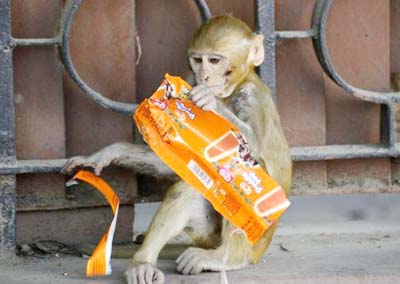
NEW DELHI, July 14: Mention of monkey menace in the corridors of power and how it can haunt even the high and mighty evoked peals of laughter in the Rajya Sabha today, even as a Congress member blamed the simians for mysterious disappearance of files.
Members burst into laughter in course of a serious debate on destruction of Home Ministry’s 11,100 files when Rajeev Shukla (Cong) condemned the act and said the situation was so bad that files were kept scattered in the corridors, where monkeys create havoc.
He said that to top it all, a minister in the present government was dead against any action against the primates.
Shukla said even former Prime Minister Manmohan Singh would shudder to recall how dreadful it was to pass through the corridors of Finance Ministry when he was Finance Minister.
Singh who was sitting in the opposition benches could not control his smile.
Shukla said it was a common practice to fix the blame of any missing file on monkeys and urged the government to initiate immediate measures to protect the files.
He said the situation had worsened to such an extent that the government had to hire ‘langurs’ to keep the monkeys at bay. (PTI)
NEW DELHI, July 14: Senior BJP leader and former Union Minister Ram Naik was today appointed as Governor of Uttar Pradesh and party’s veteran Delhi leader O P Kohli will move to Gujarat, in the first appointment of five Governors by the Narendra Modi government.
According to a Rashtrapati Bhavan communique, Naik will take over in Uttar Pradesh after B L Joshi, perceived to be a close confidante of Gandhi family, was asked to tender his resignation. Joshi was the first Governor who tendered his resignation after the Modi Government came to power on June 17 this year.
A three-time Parliamentarian, 80-year-old Naik has the rare distinction of being the only Minister who completed five years as Petroleum and Natural gas minister in one government.
Hit by cancer, Naik was bedridden in 1994 but fought back resolutely and overcame the deadly disease. He had announced in 2013 that he would not be contesting the 2014 elections.
78-year-old Kohli, who was a Rajya Sabha member from 1994 to 2000, takes over as Governor in Gujarat after 87-year-old Kamla Beniwal was shifted to Mizoram by the Government for remainder of her term till November this year.
A former Chief of BJP’s Delhi unit in 2009, Kohli has been associated with BJP since his student days and was President of its student wing — ABVP — and later became Chief of Delhi University Teacher Association.
According to the communique, Keshari Nath Tripathi, a former Uttar Pradesh Speaker will take over in West Bengal, a post which had fallen vacant after the resignation of M K Narayanan after he was nudged to resign.
A poet and author of books, Tripathi, who will turn 80 in November this year, was a five-time MLA and has written a few books like Commentary on “The Representation of the People Act, 1951” and two poetic books in Hindi – ‘Manonukriti’, ‘Aayu Pankh’.
In his student life, he went to jail in connection with the Kashmir Movement.
Balram Das Tandon, 87, founder member of Jan Sangh in 1951, was appointed Governor of Chhatisgarh after Shekhar Dutt tendered his resignation on June 18 after he too was sounded by the Union Home Ministry.
Tandon was the Deputy Chief Minister of Punjab in 1969 and later served as Cabinet Minister in Parkash Singh Badal’s government. A six time MLA, Tandon was critical of Badal government’s decision in 2012 of providing free electricity to state farmers.
Padmanabha Acharya, a member of working group on North East region of BJP and Co-Convener of Overseas Friends of BJP, was appointed Governor of Nagaland after President Pranab Mukherjee accepted resignation of Tripura Governor Vakkom Purushothaman, who was also officiating as Nagaland Governor.
The President asked Acharaya to perform the duties of Tripura Governor until regular arrangements are made, the communique said. (PTI)
LUCKNOW, July 14: As the Central Government plans to construct 15 lakh toilets in the banks of river Ganga with an aim to clean this mighty river, the officials are grappling with a bigger problem as how to change people’s mindset because people find it comfortable and convenient to defecate in open than in closed latrines.
“It is the culture which matters more than construction of toilets,” a study carried out in five states of India revealed. The study says, “Open defecation could be as much the issue of the mind as it is of more investment in construction of new toilets.”
The Narendra Modi Government has set a budgetary allocation of over Rs 2,000 crore to clean Ganga. In the first step it would construct toilets in 15 lakh households, 600 schools and 6,000 anganwadi spread over 1,500 gram panchayats, spread over in 220 blocks and 46 districts along the banks of Ganga. The survey carried out in rural north India by the Research Institute for Compassionate Economics (RICE) based at Connecticut, USA shows that nearly 89 per cent of Indian households without a toilet are living in rural areas per the Census 2011. Even if latrines were made by the Government for every household that didn’t already have one in states like Bihar, Madhya Pradesh, Rajasthan, and Uttar Pradesh, most people would still prefer to defecate in the open, the study said. The study is based on a survey conducted among 22,787 individual household members in villages of five Indian states i.e. Bihar, Haryana, Madhya Pradesh, Rajasthan, and Uttar Pradesh.
About 47 per cent of those who defecate in the open say they do so because it is pleasant, comfortable, or convenient. This preference coincides with little awareness of the health benefits of latrine usage. At least 51 per cent of people who defecate in the open report that widespread open defecation would be at least as good for child health as latrine use.
Given the fact that open defecation kills babies, impedes the physical and cognitive development of surviving children, and reduces human capital, the Government gave emphasis on toilet construction under the Nirmal Bharat Abhiyan. The recent paper fills up the knowledge gap in understanding why toilets constructed may not be in usage or demand by looking at the beliefs and preferences of the people. Indian households rarely build the types of inexpensive latrines that are widely used by poor households so as to reduce open defecation and save infant lives in Bangladesh, Southeast Asia, and sub-Saharan Africa, finds the study. The study shows that the big issue could be about changing social behaviour of the citizens regarding toilet usage. Generating demand for latrine use in rural India is essential if India has to achieve its goal of eliminating open defecation by 2019.
“It is very difficult to convince people to use toilets overnight. They are defecating in the open for many decades. Men and women generally go in different groups. That is the time when male discuss their business and women their family. This is the only time when elderly ladies criticize their bahus (daughter-in laws) or younger brides discuss their mother-in laws. This is a long tradition and cannot change in a jiffy,” Dr Bindeshwari Pathak, founder Sulabh International said. He said merely construction of toilets could not solve the problem of open defecation. “If the Government is serious it should start from the powerful people in the village. Once they start using laterins the message will go down and within a year or two the whole of village will start using toilets. (UNI)
PATNA, July 14: A JD(U) legislator has opposed an alliance between his party and RJD for the Bihar assembly elections, but senior party leader Nitish Kumar today said that there was a possibility of a tie-up, including with Lalu Prasad’s party, against the BJP.
Rajiv Ranjan, JD(U) MLA from Islampur in Kumar’s native Nalanda district, shot off a letter to the party opposing a tie-up with RJD.
“I have written a letter to state JD(U) President Basistha Narayan Singh expressing strong reservation against the tie-up with RJD against the ‘jungle raj’ (lawlessness) of which we came out to form our own party earlier,” the JD(U) MLA told PTI here.
Ranjan claimed that over 60 JD(U) legislators held the same view and there would be a strong reaction if the tie-up took place.
Former chief minister Nitish Kumar said though no structured talk of alliance with any party had been held, there was a ‘possibility’ of it with parties opposed to BJP politics.
“In view of political situation emerging in Bihar and the country, there is a possibility of understanding between parties which do not like the brand of politics of BJP,” Kumar told reporters here.
He was in favour of an alliance among JD(U), RJD, Congress and Left to defeat BJP in the state assembly elections next year.
Stating that he was unaware of the letter written by Ranjan and would collect the details, Kumar said “If JD(U) decides on an alliance it will be binding on everyone.
“Those not agreeing with the decision will be free to leave the party,” he said.
JD(U), RJD, Congress and CPI supported the trust motion of the Jitan Ram Manjhi government and also in the bypoll to two Rajya Sabha seats in which BJP lent support to Independents propped up by JD(U) dissidents against official candidates.
JD(U), however, was facing dissidence, with the party identifying 18 rebels who went against the party’s official candidates in RS bypoll.
The close coordination between Nitish Kumar and Lalu Prasad in recent days had triggered political debate in the state since Kumar was opposed to the RJD chief’s brand of politics and had walked out of the Janata Dal in 1994 and formed a separate party under the leadership of George Fernandes.
The fight against RJD’s ‘jungle raj’ had helped Kumar come to power in Bihar in November 2005 in alliance with the BJP. The two parties won the 2010 Assembly poll again with a handsome margin.
But, elevation of Narendra Modi forced parting of ways between JD(U) and BJP in June last year after remaining together for 17 years.
Justifying proximity with Lalu Prasad, Kumar had said earlier that the bigger issue was to fight the BJP and not RJD.
Lalu Prasad had said in case of alliance the vote share of the two parties would rise to 45 per cent, which would be much more than the nearly 30 per cent vote share of BJP. (PTI)
NEW DELHI, July 14: Jammu and Kashmir People’s Democratic Party today voiced grave concern over killing of “innocent” people, including children, in Gaza following attacks by Israel and staged a walkout in Lok Sabha.
As soon as the House met for the day, PDP leader Mehbooba Mufti wanted to raise the issue saying the House cannot remain silent over the killing of women, children and others in Gaza.
“Why are we silent? Whom are we afraid of? India is the only friend of Palestine since 1947. We have to condemn the attack. We have to discuss,” she said, supported by party member Tariq Hameed Karra.
She was supported by E Ahamed (Indian Union Muslim League), Saugata Roy (Trinamool Congress) and P Karunakaran (CPI-M).
Speaker Sumitra Mahajan, however, did not allow her to raise the issue saying she can not allow any discussion on the subject without receiving any notice.
“This is not the way. This is not fair. You have not given any notice. I cannot allow,” Mahajan said.
Unhappy with the Speaker’s ruling, PDP members staged a walkout. (PTI)
NEW DELHI, July 14: Congress today tried to corner the government on the meeting of an Indian journalist with terror accused Hafiz Saeed in Pakistan, saying it could not have taken place without the knowledge of authorities and claimed the scribe was “very close to Sangh parivar”.
Congress leaders raised in Parliament and outside the issue of journalist Ved Pratap Vaidik meeting the mastermind of Mumbai 26/11 terror attack and asked if the government had sanctioned it.
Congress MPs sought a detailed statement from the government on the “purpose and motive behind the meeting with India’s most wanted terrorist” and even demanded the arrest of the journalist.
“We are going to make an issue out of it because it is not the case of an ordinary journalist. He (journalist) was very close to RSS, closely associated with Ramdev. He has been going to Pakistan and Afghanistan and all the time he is close to the Sangh parivar,” Congress leader Saifuddin Soz said outside Parliament.
Union Minister Arun Jaitley said in Rajya Sabha that Government has nothing to do with “directly, indirectly or even remotely” with any journalist meeting Saeed, adding “government has not sanctioned permission to anyone for meeting him (Saeed).”
But the opposition party kept up its attack saying it was no “ordinary issue” and the scribe could not have met Saeed without the knowledge of Indian authorities.
Congress leader Shashi Tharoor said the country needs to be taken into confidence about this issue.
“We have sought from the government that a reply is needed…. Why had Vaidik gone? Is he an envoy or is some back channel diplomacy taking place? This country should know. The nation needs to know, and the nation must be taken into confidence,” Tharoor said.
Another former Union Minister and Congress leader Anand Sharma also said that the government needs to answer whether it was “in the loop”.
“Such meetings cannot take place without the knowledge of the officials. Therefore a legitimate question arises, was the government of India in the loop? Has our foreign ministry received a report?”
He said Vaidik carries an India passport and asked “whether Indian citizens are allowed to spend time with most wanted terrorists”.
He said that he did not believe that the government was not aware of the meeting. (PTI)
NEW DELHI, July 14: Senior BJP leader and former Union Minister Ram Naik was today appointed as Governor of Uttar Pradesh and party’s veteran Delhi leader O P Kohli will move to Gujarat, in the first appointment of five Governors by the Narendra Modi government.
According to a Rashtrapati Bhavan communique, Naik will take over in Uttar Pradesh after B L Joshi, perceived to be a close confidante of Gandhi family, was asked to tender his resignation. Joshi was the first Governor who tendered his resignation after the Modi Government came to power on June 17 this year.
A three-time Parliamentarian, 80-year-old Naik has the rare distinction of being the only Minister who completed five years as Petroleum and Natural gas minister in one government.
Hit by cancer, Naik was bedridden in 1994 but fought back resolutely and overcame the deadly disease. He had announced in 2013 that he would not be contesting the 2014 elections.
78-year-old Kohli, who was a Rajya Sabha member from 1994 to 2000, takes over as Governor in Gujarat after 87-year-old Kamla Beniwal was shifted to Mizoram by the Government for remainder of her term till November this year.
A former Chief of BJP’s Delhi unit in 2009, Kohli has been associated with BJP since his student days and was President of its student wing — ABVP — and later became Chief of Delhi University Teacher Association.
According to the communique, Keshari Nath Tripathi, a former Uttar Pradesh Speaker will take over in West Bengal, a post which had fallen vacant after the resignation of M K Narayanan after he was nudged to resign.
A poet and author of books, Tripathi, who will turn 80 in November this year, was a five-time MLA and has written a few books like Commentary on “The Representation of the People Act, 1951” and two poetic books in Hindi – ‘Manonukriti’, ‘Aayu Pankh’.
In his student life, he went to jail in connection with the Kashmir Movement.
Balram Das Tandon, 87, founder member of Jan Sangh in 1951, was appointed Governor of Chhatisgarh after Shekhar Dutt tendered his resignation on June 18 after he too was sounded by the Union Home Ministry.
Tandon was the Deputy Chief Minister of Punjab in 1969 and later served as Cabinet Minister in Parkash Singh Badal’s government. A six time MLA, Tandon was critical of Badal government’s decision in 2012 of providing free electricity to state farmers.
Padmanabha Acharya, a member of working group on North East region of BJP and Co-Convener of Overseas Friends of BJP, was appointed Governor of Nagaland after President Pranab Mukherjee accepted resignation of Tripura Governor Vakkom Purushothaman, who was also officiating as Nagaland Governor.
The President asked Acharaya to perform the duties of Tripura Governor until regular arrangements are made, the communique said. (AGENCIES)
NEW DELHI, July 14: The reported meeting of a journalist considered close to yoga guru Ramdev, a staunch BJP supporter, with 26/11 mastermind Hafiz Saeed generated heat in Parliament today with Rajya Sabha witnessing two adjournments during Question Hour.
Though the government clarified in the Upper House that it had nothing to do with this meeting, Congress members in both Houses sought a detailed statement from the government on the “purpose and motive behind the meeting with India’s most wanted terrorist”.
Congress members created uproar in Rajya Sabha forcing two adjournments during Question Hour, as they and their counterparts in Lok Sabha, as well as those from their allies, sought to know whether the journalist had sought government’s permission before meeting Saeed and who facilitated it.
They demanded a statement by either the External Affairs Minister or Home Minister saying this was “a serious matter concerning national security”. They also alleged that the journalist was a key member of outfits close to BJP.
In Rajya Sabha, Leader of the House and Finance Minister Arun Jaitley said for India, Saeed was a terrorist and indeed involved in terrorism against India.
Government has nothing to do with “directly, indirectly or even remotely” with any journalist meeting Saeed, he said, adding “government has not sanctioned permission to anyone for meeting him (Saeed).”
The issue was raised strongly in the Lower House by K C Venugopal (Cong), N K Premachandran (RSP) and E Ahamed (IUML), with Speaker Sumitra Mahajan asking the agitated members to take their seats, saying “you can’t compel the government to make a statement.”
In Rajya Sabha, Congress members demanded the arrest of the journalist, with their leader Digvijay Singh raising the issue seeking to know from Jaitley if the meeting had government’s sanction.
Chairman Hamid Ansari disallowed him from raising the issue saying this was not the occasion for it and took up the Question Hour. But as Congress members persisted, Ansari adjourned the House for 15 minutes.
When the House reassembled, Congress members again raised the issue, with senior member Anand Sharma saying that Saeed was the “most wanted terrorist not just in India but all over the world.”
Reports said Ved Pratap Vaidik, a freelance journalist, had met the Jamaat-ud-Dawa chief in Lahore on July 2 while touring Pakistan with a group of journalists and politicians invited by a peace research institute.
India accuses Saeed, the founder of Pakistan-based terror outfit Lashkar-e-Taiba, of orchestrating the 2008 Mumbai terror attacks in which 166 people were killed. He is on India’s most wanted list and has a bounty of USD 10 million on him. (PTI)
NEW DELHI, July 14: A large section of people in the states of Bihar, Jharkhand, Chhattisgarh, Odisha and Uttar Pradesh have neither built toilets at their homes nor use them as they continue to remain unaware about the benefits of using lavatories, the government said today.
Minister of State for Drinking Water and Sanitation Upendra Kushwaha further informed the Rajya Sabha that a large section of female population in the rural areas of these states do not have the access to toilets.
He said the position regarding the availability of toilet facilities to women and girls is not monitored separately.
“A large number of people defecate in the open (in Bihar, Jharkhand, Chattisgarh, Odisha and Uttar Pradesh) because they can not afford to build a toilet from their own resources,” the Minister said in a written reply.
He said as per 2011 census, only 18.6 per cent households in Bihar have the access to toilet. It is 8.3 per cent in Jharkhand, 14.8 per cent in Chattisgarh, 15.3 per cent in Odisha and 22.9 per cent in Uttar Pradesh.
Kushwaha said it is through the states that the Centre administers Nirmal Bharat Abhiyan (NBA), a comprehensive programme to ensure sanitation facilities in rural areas with the main objective of eradicating the practice of open defecation and ensuring clean environment.
The programme also provides for separate toilets for girls in government schools that were built prior to 2007.
Separate girls toilets are also provided in schools under the Sarva Siksha Abhiyan scheme. (PTI)