

For some years in the past we are told that there is shortage of officers and ORs in all the three branches of our defence forces especially in the army. The Defence Minister has come out with figures of shortage both officers and ORs in the three services. It is not a happy picture. The Defence Minister has suggested some remedial measures to overcome the shortage but what is more important is to know the reason for shortage. It has to be remembered that our country does not have any rule of conscription and there are no compulsory rules that students at a particular age should render some years of service in the armed forces. Recruitment to armed forces services is free and optional. This should encourage the youth to join the army. Though of course from Cadet Corps provides good scope for young students to join the defence forces but these days there is much craze for technical and skilled jobs which are easily available on account of vast expansion of information technology and other branches of scientific learning. But in our country there are thousands of families that have great reputation of having produced great soldiers and they are proud of their past. These families still maintain the tradition. Nevertheless, the fact is that the Defence Ministry needs to come out with a comprehensive and more attractive package for the youth by way of incentives so that they are attracted to the defence services. Some new features have been added but perhaps there is more need to make the armed forces service more attractive. Some segments of civil service or industries as well as corporate houses should also provide reservations for larger number of retired soldiers and officers. Their emoluments and pensioner benefits etc. also need to be given a hike. In no way should our soldiers feel inferior to other services in terms of service rules and facility.
Netanyahu gets Rivlin’s mandate to form government
JERUSALEM, Mar 26: Israeli Prime Minister Benjamin Netanyahu has been granted the go ahead by President Reuven Rivlin to form a new coalition government, recognizing his surprising victory in the last week’s election.
Rivlin yesterday handed him the task of forming the next government hours after he received the official election results showing Netanyahu’s Likud with 30 Knesset seats to lead all parties.
The Isreali President, however, chided Netanyahu for his controversial remarks about Arab-Israeli voters before tasking him to form the next government.
“The elections are the only referendum in our democracy… shame on us if we view the fulfillment of the democratic duty of voting as a curse or something that must be warned against,” he said.
“Those afraid of ballots will end up getting stones thrown in the streets,” he warned.
“From every direction, things were said that ought not to have been said in a Jewish and democratic state. Fanning the flames serves no one. The fire does not only heat, it threatens to engulf in flames. Today is the time to begin to heal these wounds,” the Israeli President said.
Netanyahu during his election campaign had said he would not allow the establishment of a Palestinian state on his watch and warned them that Arab voters were heading to the polls “in droves.”
His acrimonious electioneering had strained ties with the United States and drew accusations of racism from the country’s Arab minority.
Netanyahu, however, tried to repair the damage by declaring himself the Prime Minister of all Israeli citizens.
“I see myself as the Prime Minister of each and every one of you, those who elected me and those who did not. I will act to mend the rifts which have opened up between different segments of society during the election,” Netanyahu said.
“I must continue on this path in the next government that is formed – a Jewish and democratic country that gives full equal rights to all of its citizens regardless of religious, race or gender. So it has always been and so it always will be,” Netanyahu said.(PTI)
Kerry brands Assad ‘a brutal dictator’
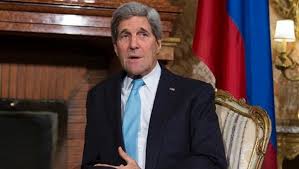
WASHINGTON, Mar 26: US Secretary of State John Kerry has branded Bashar al-Assad “a brutal dictator”, a week after suggesting that it would be necessary to negotiate with the Syrian president to forge peace.
Before heading to Switzerland to try to reach a deal on Iran’s nuclear program, Kerry and his top official for Mideast affairs, Anne Patterson, met Moaz al-Khatib, a leading Syrian opposition figure.
The three discussed “ways to advance a political solution to the crisis in Syria,” said a statement from State Department spokeswoman Jen Psaki.
“Secretary Kerry emphasized that Bashar al-Assad is a brutal dictator with no legitimacy to lead Syria,” Psaki added.
“The secretary reaffirmed our commitment to pursuing all diplomatic avenues to help bring about a political transition based on the Geneva Principles that leads to an inclusive government and a future of freedom, dignity, and security for the Syrian people.”
The United States has said that a transition could take place with elements of the current regime in Syria, but not Assad himself, and has consistently called for him to step down.
But on March 15, Kerry appeared to suggest in a CBS television interview that Washington would have to talk with Assad eventually if peace was to be forged.
Kerry’s comments caused alarm both abroad and among the US-backed opposition as the war entered its fifth year, having claimed some 215,000 lives and with no end in sight after two rounds of failed Geneva peace talks.
Psaki later clarified that Kerry was referring to representatives of the Assad regime, and not Bashar al-Assad himself. (AGENCIES)
Sacked BBC presenter Clarkson may face police action
LONDON, Mar 26: Sacked “Top Gear” presenter Jeremy Clarkson could face a police action into the unprovoked attack that left a colleague bleeding and cost him his job, bringing an end to his 37-year-long BBC career.
BBC Director General Tony Hall said that with a heavy heart and “great regret” he decided not to renew Clarkson’s contract as the controversial star of the motoring show had “crossed a line” which left him with no alternative.
North Yorkshire Police has requested a copy of the BBC probe report that concluded Clarkson (54) was responsible for an “unprovoked physical and verbal attack” on the programme’s producer, Oisin Tymon, who had sought hospital treatment after the attack.
Clarkson, one of the BBC’s most popular stars, had attacked Tymon after he could not have steak and chips following a day’s filming because the hotel where they were staying had stop serving hot food. (PTI)
US military: Bergdahl may face life in prison if convicted
FORT BRAGG (US), Mar 26: The US Army sergeant who abandoned his post in Afghanistan and was held captive by the Taliban could face up to life in prison if convicted of both the charges he is facing, military officials have said.
Sergeant Bowe Bergdahl was charged with misbehavior before the enemy, which carries a maximum sentence of up to life in prison. He was also charged with desertion, which carries a maximum of five years.
Bergdahl could also face a dishonorable discharge, reduction in rank and forfeiture of all his pay if convicted.
The case now goes to an Article 32 hearing to be held at Fort Sam Houston, Texas. That proceeding is similar to an investigating jury. From there, it could be referred to a court-martial and go to trial.
A date for that hearing was not announced.
The charges are the latest development in a long and bitter debate over Bergdahl’s case. They also underscore the military and political ramifications of his decision on June 30, 2009, to leave his post after expressing misgivings about the US military’s role, as well as his own, in the Afghanistan war.
After leaving his post, Bergdahl was captured by the Taliban and held by members of the Haqqani network, an insurgent group tied to the Taliban that operates both in Pakistan and Afghanistan.
Last May 31, Bergdahl was handed over to US special forces in Afghanistan as part of an exchange for five Taliban commanders who were imprisoned at Guantanamo Bay, Cuba.
After spending about two weeks recuperating at a US military hospital in Germany, Bergdahl was sent to Brooke Army Medical Center at Fort Sam Houston in Texas on June 13. He has been doing administrative duties at the base, awaiting the conclusion of the case.
The exchange set off a debate over whether the US should have released the five Taliban members. Little is known about what the five have been doing in Qatar, where they are being monitored by the government. Some lawmakers have predicted that the five would return to the battlefield.
Senator Lindsey Graham has said that he received information that one of the five has been in touch with members of the Haqqani network.
On the flip side, Afghanistan’s peace council in 2011 requested the release of one of the five, Khairullah Khairkhwa, from Guantanamo because it thought he might be able to help foster reconciliation talks with the Taliban. (AGENCIES)
US issues Uganda terror attack warning
KAMPALA, Mar 26: The United States embassy in Uganda has issued an emergency warning to its nationals, saying a terrorist attack may take place soon in the capital Kampala.
“The US embassy has received information of possible terrorist threats to locations where Westerners, including US citizens, congregate in Kampala, and that an attack may take place soon,” the embassy said yesterday.
“Out of an abundance of caution, the US mission has cancelled some non-essential events scheduled at local hotels in the coming days,” it said, telling US citizens they “should expect increased security sweeps and delays when entering or exiting hotel areas.”
The US embassy gave no further specific information on the threat, but the east African nation — a trusted US ally — has been attacked in the past by Somalia’s Al-Qaeda-linked Shebab militants.
Uganda is a key contributor to the African Union’s AMISOM force battling the Shebab inside Somalia.
In 2010 the Islamists carried out twin bombings in Kampala targeting a restaurant and a club where football fans were watching the World Cup final between the Netherlands and Spain, killing 76 people in the region’s worst attacks in more than a decade.
The US embassy in Kampala last issued an emergency warning in September 2014. Ugandan and Western security sources later revealed they had intercepted a transfer of explosive suicide vests by suspected Shebab members and made 19 arrests.
US officials said at the time that the militants were determined to avenge the killing of their leader Ahmed Abdi Godane in a US airstrike carried out earlier that month.
The Islamists were also behind the September 2013 attack on the Westgate shopping mall in neighbouring Kenya’s capital Nairobi which left at least 67 dead, and recently issued a call for fresh attacks against such locations.
The US has continued to strike the militants from the air, and last week announced it had also killed a senior Shebab figure, Adan Garar, who was linked to the planning of the Westgate mall attack.
The Shebab emerged from the Islamic Courts Union that controlled Mogadishu in 2006 before being pushed out by Ethiopian forces.
The group, however, still controls vast rural areas from where they launch regular attacks against AU troops and the country’s internationally-backed government. (AGENCIES)
Syria destroys three chemical weapons sites
UNITED NATIONS, Mar 26: Syria has destroyed three of its 12 chemical weapons production sites but is unable to dismantle three other facilities because of security conditions, the OPCW chemical watchdog said in its latest report.
The report by the Organisation for the Prohibition of Chemical Weapons (OPCW) was released yesterday to the UN Security Council, which is overseeing efforts to dismantle Syria’s chemical weapons program.
Syria has agreed to destroy seven aircraft hangars and five underground structures identified by the OPCW as chemical weapons production sites but there have been delays caused by logistical problems.
In the report obtained by AFP, OPCW director general Ahmet Uzumcu said his team of experts was able to verify that three tunnels have been destroyed and that work on dismantling a fourth underground structure was under way.
“Currently, one underground structure and two hangars are not accessible owing to the security situation near these sites,” he wrote in the report dated March 23.
Despite this hurdle, Uzumcu said he expected the destruction of all five underground tunnels to be completed by June.
Concerning the hangars, work has begun on five sites and explosives are to be delivered soon to begin demolishing the structures.
“The Syrian authorities have continued to extend the necessary cooperation” for the dismantling of the 12 sites, the report added.
The Security Council is due to discuss progress in dismantling Syria’s chemical weapons program at a meeting on April 2.
Syria finished disabling the production sites by October 2013, however the structures that house them still needed to be destroyed.
After an August 2013 sarin attack outside Damascus that much of the international community blamed on President Bashar al-Assad’s government, the regime agreed to turn over its chemical arsenal.
The United States threatened military action against Damascus over the attack, but held off following the chemical disarmament agreement.
A total of 1,300 metric tonnes of chemical weapons have been removed from Syria, with the majority being destroyed aboard the US Navy ship MV Cape Ray. (AGENCIES)
UN moves should not give legitimacy to non-state actors: India
UNITED NATIONS, Mar 26: India has cautioned that the UN should not give “political legitimacy” to non-state actors by bypassing national governments, saying the access to non- state armed groups should be through a cooperation framework between the UN and the concerned government.
“It is important that access of the United Nations to non-state armed groups be through the cooperation framework between the United Nations and the concerned national government,” India’s Deputy Permanent Representative to the UN Bhagwant Bishnoi said here yesterday.
“We must be cautious that the UN’s actions should not be such as to bypass national governments and give political legitimacy to non-state actors. It is this legitimacy that they seek the most and which may also, to some extent, be a motivating factor,” Bishnoi said.
Participating in a Security Council debate on ‘Children and Armed Conflict’, he said that 2014 was reported to be the worst year as far as children and armed conflict is concerned. He said it is “most distressing” that the pattern continues.
“Children are innocent and they should not be victims of what is not of their making,” he said.
Bishnoi said the real solution lies in achieving durable peace and the UNSC’s actions should focus on achieving this.
He said India notes the need for military operations, including peace operations against non-state armed groups, to integrate child protection issues into their operational planning in order to minimise and prevent child casualties.
“Drafting up such an important mandate would require the Council to have the full cooperation of the host government of the peacekeeping operation, as well as the member states not represented in the Council who are contributing troops for such operations,” he said, adding that it is unfortunate that such consultation is not the practice in the Council.
The concept note circulated for the debate referred to the need to encourage states to adopt legal measures to prohibit and criminalize the use of children under the age of 18.
“We are not clear how this would help. Illegal armed groups operate outside the law. They kill, torture and maim the innocent. It seems most doubtful that those who resort to illegal armed conflict and terrorism would be deterred from recruiting children if they were prohibited from doing so merely by the law,” he said.
Bishnoi further said that the possibility of sanctions and questions of accountability should not lead the international community to be “blindsided”.
“There are references in the concept note to putting more pressure on non-state armed groups, to holding commanders of such groups accountable for their actions and of raising the normative and political costs for them. We should not end up in a situation of missing the woods for the trees,” he said.
He stressed that the world community should strive to address the broader issue of the economic and social marginalisation that drives millions of children into a childhood that makes them part of the problem rather than tomorrow’s solution. (PTI)
US should applaud Modi for reform initiatives: Bera
WASHINGTON, Mar 26: An influential American lawmaker feels that the US should applaud Prime Minister Narendra Modi for the series of reforms initiated by his government to improve business climate and attract investments.
“Raising the FDI insurance caps, that is a positive step, you know, something that we’ve talked about for a long time and I think we should applaud the Modi administration for taking that step which will certainly help investment flows,” said Congressman Dr Ami Bera.
“I think tackling issues like introducing a land acquisition bill in India is a positive step, not an easy step, but a positive step. So again, I think we should applaud the Modi administration for that,” he said during a Congressional hearing.
“Looking at some of India’s ascension going from a recipient nation to a donor nation, particularly when I look at some of the work they’re in Africa I think it is something that we should applaud,” he added.
Jonathan Nicholas Stivers, Assistant Administrator of the Bureau of Asia at USIAD, said Modi and President Barack Obama are really taking this relationship to a new level. (PTI)
Bill Clinton to lead US delegation to Lee Kuan Yew funeral
SINGAPORE, Mar 26: Former US President Bill Clinton will lead a high-level White House delegation to attend the State Funeral of Singapore’s founder Prime Minister Lee Kuan Yew on Sunday.
Lee, 91, died on March 23.
He was Singapore’s First Prime Minister. Lee stepped down in 1990, but held influence on local and international political and economic affairs.
The delegation will include US ambassador to Singapore Kirk Wagar, former US ambassador to Singapore Steven Green and former assistant to the president for national security affairs Thomas Donilon, The Straits Times reported.
Notable American statesman Henry Kissinger, who had close friendship with Lee, will also be in the delegation, all members of which have strong ties with Asia.
Donilon was a strong advocate for the Obama administration’s pivot to Asia.
Secretary of State John Kerry had earlier said that the US would be sending a high-level delegation to Singapore because Lee “was deeply pro-American and deeply involved with the US and much of our strategic thinking through that time.”
Deputy Secretary of State Tony Blinken was also at the Singapore embassy to pen a condolence message for Lee.
“He was a great man, a great leader and a great friend to the United States and we will miss his wise counsel, we will miss his voice, we will miss his vision,” he told reporters.
“We are also grateful because thanks to his labour, the foundation between our countries, the relationship between our countries is extraordinarily strong and it will endure forever and that is a wonderful legacy.”
In Beijing, the foreign ministry said a Chinese leader would attend Lee’s funeral service, without giving names.
Japanese Prime Minister Shinzo Abe is also expected at the funeral service.
Many of the world leaders will be in Singapore just for the day, departing promptly after the public ceremony at the University Cultural Centre.
That will require a high measure of coordination and logistics in security terms, traffic control as well as aircraft departure times, said the daily. (PTI)