

NEW YORK, Mar 22: The tightknit Orthodox Jewish New York City community where seven siblings perished in a deadly Sabbath fire was still reeling today as funeral services for the children were being prepared.
“I call this not a tragedy but an absolute disaster,” said state Assemblyman Dov Hikind, who represents the Midwood neighborhood of Brooklyn were the fire broke out early Saturday. The blaze killed three girls and four boys ages 5 to 16, leaving their mother and another child critically injured.
Funeral plans were tentatively set for this afternoon.
Investigators believe a hot plate left on a kitchen counter set off the blaze that sent flames up the stairs, trapping the children in their second-floor bedrooms as they slept.
Many religious Jews who observe the Sabbath refrain from working, in all forms, from sundown Friday to sundown yesterday including using electricity.
Authorities say their father was at a nearby conference at the time of the fire. Neither his name nor those of the survivors were released.
Fire Commissioner Daniel Nigro called it the city’s worst fatal fire in recent memory and Mayor Bill de Blasio, after touring the charred home, called the deadly blaze a tragedy for the family, the community and for the city.
The last residential blaze with a similar death toll happened in 2007, when eight children and an adult were killed in a fire in a 100-year-old building in the Bronx where several African immigrant families lived.
Fire officials said an overheated space heater cord sparked that blaze. (AGENCIES)
^^^^^
Community reels after 7 siblings perish in deadly house fire
Another road tragedy
Another motor vehicle accident on the Jammu Srinagar National Highway has claimed seven precious lives and five other with grievous injuries. Accidents that mostly happen owing to the negligence of either the drivers or the traffic police have become a recurring phenomenon along this Highway. Innumerable meetings among the top ranking police and bureaucratic echelons have been held so far, great discussions carried out and still no useful solution on the ground has been witnessed emanating from these meetings. One feels that this is an incorrigible situation and innocent people are destined to die unnatural death.
In these columns we have raised the issue of laxity on the part of traffic police who are deployed to control traffic along this highway. But there are same mistakes, same type of negligence, same happening and same results. We often said that there was dire need of overhauling the entire traffic police structure. The Government is accustomed to look only on how to safeguard the journey and related matters but it deliberately avoids screening the traffic personnel deployed to maintain vigil on traffic on the treacherous highway.
The case in point is the Tata Sumo that was overloaded and met with an accident at Nasheri Nullah and fell deep into a gorge killing seven of the passengers. The Tata Sumo carrying five passengers beyond its sanctioned capacity hit several bounders before landing in the bottom of the gorge. Whether the driver lost control owing to the overloaded vehicle getting out of control or other reasons will be established by the inquiry that will automatically be installed into the case. The fact remains that the vehicle was overloaded and that is where the focal point. If overloading had taken place at the original point meaning Jammu, then fro Jammu to Nasheri Nullah, the point where the accident happened there are scores of traffic check posts and mobile traffic police deployed with the sole purpose of controlling overloading of vehicles or their rash driving. What happened to these check points and why was not the overloaded vehicle stopped all the way to Nasheri? This is the main question. And any inquiry held in the case will automatically bring the onus to the doorsteps of the traffic police.
Now if the negligence of the concerned police personnel on duty is established, what punishment under law will be given to them? Innumerable traffic accidents have happened so far in the past along this Highway. Innumerable inquiries have been held. But we have never heard exemplary punishment given to a defaulter. Therefore, any attempt that is made to improve the delivery of the Traffic Department should begin with accountability. As long as this condition remains elusive, we don’t think there will be any tangible improvement in the existing situation.
We may remind our readers that the Traffic Department has been intermittently calling expert meetings which include road engineers, environmental experts and of course traffic control officers who have long experience of handling traffic along crucial highways in the country. They have made many important and workable suggestions. The question is whether any of those suggestions have been implemented on the ground and what is the feed back? Let us take one example of providing specially built first aid vehicles that were required to be deployed at vulnerable points along the National Highway -1 and National Highway – II Have these first aid vehicle been provided and are these functional? According to available information, the entire issue of purchasing the vehicles of specific accessories and medical equipment has run into deep controversy and the rumours of favouritism and nepotism had been making rounds. Normally, these special vehicles should have been made available long ago but we don’t find these anywhere. The Governor and the Chief Minister both have conveyed their condolence to the bereaved families. However, the Governor has reminded the Traffic Police Department to ensure that directions issued to it from time to time are implemented. Even the Chief Minister is also reported to have conveyed to the concerned that traffic rules should be implemented meticulously. But the fact remains that previously as well many instructions were given to the department which did not make any difference and it seemed to have no impact. Therefore, the entire matter hangs around the issue of accountability. Even if Transport Department should be held the plea is of mechanical failure then again the accountable as to why it did not check whether the vehicle was roadworthy.
In the meanwhile, Director General of Police has held a meeting with the seniors in the Traffic Police Department and others in which the traffic situation of the cities of Jammu and Srinagar was reviewed. The traffic situation in both the cities is self explanatory. There is unimaginable traffic rush on narrow streets of the cities and these usually result in traffic jams for hours at end. Especially during peak house, it is difficult to drive and arrive at destination on time. As everybody knows, the number of private cars and vehicles has increased manifold in both the cities. But, the streets are narrow and have not been widened to be able to cope with the volume of traffic. Yes some flyovers have been made and these have eased the situation to some extent but to say that it has brought substantial change in the traffic hazards is not true. Much more remains to be done in this behalf.
Finance Minister Dr Haseeb Drabu presenting budget in the Assembly on Sunday. —Excelsior/Rakesh

Finance Minister Dr Haseeb Drabu presenting budget in the Assembly on Sunday. —Excelsior/Rakesh
II
Sir,
Most sacred of all cultures, coalition culture occupies vital significance, especially when political ideologies and regional aspirations vary and don’t coincide with each other. In such situations, acceptance and adherance to the common minimum programme becomes a compulsion for both the parties.Obviously, the coalition formed in the State, due to indecisive verdict in elections, is unique in many respects. The State is faced with numerous problems like corruption, unemployment, and poverty, and the people are expecting both the parties (PDP-BJP) not to indulge in any controversial issues and instead focus entirely on development of the masses. Since a coalition Government can exist only on faith and good will of the parties concerned, any deviation from the coalition norms (Dharma) obviously disturbs the entire phenomenon of peace and tranquility and undermines the objectives for which such coalitions come into existence. Thanks to the framers of the constitution who had kept a provision for such type of Govts, in the event of fractured verdict in the elections.
Yours etc…
Keshwa Nand Sharma
Salehri (Sunder Bani)
Demands of coalition dharma
I
Sir,
This refers to the news item ‘Hurriyat militants, Pak allowed peaceful polls”, Carried by your esteemed daily on 2nd March. Just after holding reign as Chief Minister the comments made by Mufti Mohd Sayeed in the words “that the peaceful elections in the State could be possible due to the conducive atmosphere created by Hurriyat, militants and Pakistan” are against the spirit of coalition dharma and must have been avoided as the entire world knows that the credit for free and fair elections in the J&K State does not go to the Hurriyat, militants and Pakistan but this credit goes to the mightly Election Commission of India, people of the State and the secular and patriotic security forces, enjoying different nomenclatures in India. The coalition for giving good governance in the State shall have to maintain if not further strengthen the mutual trust and respect for each others sentiments.
History suggests that the political parties which join hands in deviation of their ideological stands in a democracy erode their vote banks and if the PDP and BJP have prepared themselves to take that risk for respecting the mandate of the people in that case such statements need to be avoided.
Yours etc..
S K Reskhi (Senior)
Gandhi Nagar
Jammu
J&K students scholarship issue
Sir,
This bears reference to the news report “JK Scholarship issue figures in Rajya Sabha” published in this paper on 17th March. In this context, I as a citizen as well as a parent feel that non-release of scholarship to the J&K students studying in various institutions of the country under Prime Minister’s Special Scholarship Scheme is very much strange and surprising as around Rs 12,000 crores have been earmarked for the said scheme as per said news report.
Not only this, but non-release of Prime Minister’s Special Scholarship to the J&K students will affect the studies of the students and is discouraging for their future.
Needless to mention it here that raising the JK scholarship issue in the Rajya Sabha by member of the Rajya Sabha Nazir Ahmad Lawey is appreciable because it is a vital issue and is for the greater good of J&K students.
Therefore, it is requested to the Prime Minister/concerned officers of the Prime Minister’s Scholarship Scheme authorities and Human Resource Development (HRD) Minister to kindly take early action by way of releasing the scholarship amount to the J&K students under Prime Minister’s Special Scholarship Scheme so that their studies and future does not get affected. Hope an early action in the matter will reduce the grievances of the students and the parents as well.
Yours etc…
Ashok K Koul (Lalpuri)
F/o Isha Koul
B. Tech Civil Engg. Student
Haryana
BJP MLAs raising anti-Pak slogans (L) and NC legislators pressing for discussion on adjournment motion in Legislative Assembly on Sunday. —Excelsior/Rakesh
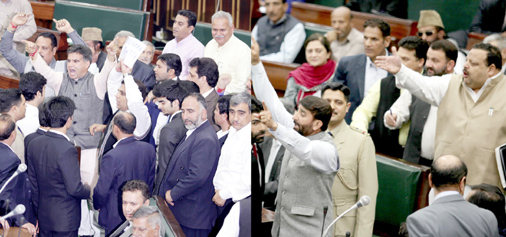
BJP MLAs raising anti-Pak slogans (L) and NC legislators pressing for discussion on adjournment motion in Legislative Assembly on Sunday. —Excelsior/Rakesh
Roadmap for college education in J&K
Prof. Sham Lal Gupta
Whole of the world is in race for bringing an increasing number of higher education institutions in the list of top institutions imparting world class education. Various models and innovative techniques are being followed to introduce best/healthy practices in the system of higher education. When seats of learning like Nalanda could become leader in education why can’t some of the universities imbibe that spirit and create institutions with world class infrastructure, faculty, laboratories, libraries etc. There is much talk on transforming Indian society and its economy. It is widely contested that due to the advantage of demographic dividend India is going to emerge as a global leader. There is no magic in the demographic profile of having large number of population in India in the working age group. In order to get the benefit of this potential age-group of population the society has to create a congenial atmosphere wherein apart from many other initiatives, our educational institutions have to impart world class education. World class infrastructure is not necessarily costly infrastructure, of course, there is a bare minimum of basic infrastructure (adequate infrastructure). A dedicated infrastructure is the prime requisite of imparting quality education.
In the state of J&K there are at present 95 Govt. Degree colleges out of which 46 are in Kashmir division, 04 in Leh/Kargil and 45 in Jammu division out of 95 Govt. Degree Colleges, 61 are functioning from their own permanent structures and 34 are functioning in make – shift arrangements. The Govt. of J&K state is committed to construct permanent structures so that colleges can function in proper manner. Proper infrastructure in the shape of labs, libraries, well-equipped class rooms, sports and games cannot be created in make-shift arrangement. By next year i.e., 2016, all the Govt. Degree Colleges will be eligible for NAAC Accreditation and it is very difficult to create the bare minimum of basic infrastructure to get eligible for NAAC Accreditation. In the very near future the funding of the Colleges under RUSA will be based on NAAC grading Ranking. Therefore, the immediate priority of the new govt. is to ensure that all the present colleges are in their own permanent buildings well equipped with basic, bare minimum, infrastructure alongwith the provision for sports and games.
Qualified faculty is one more challenge. In most of the colleges, particularly, mufassil colleges established in the rural or sub-urban areas, more than 50% of the faculty is ineligible and working on a paltry amount of salary with no accountability. These are the disgruntled lot. For the same work the permanent faculty is getting five times more salary than that of the academic arrangement teachers who are always agitating. The department of higher education has to come out with a policy for the academic arrangement teachers. In some of the states there is a policy of recruiting these teachers through PSC or any other agency for a period of five years and after putting in the required number of years their performance is evaluated on yearly basis in order to confirm them on permanent basis through a well laid down process of selection by the state PSC. The previous govt. has already refered more than 1100 posts of Assistant Professors to the state PSC. The new govt. can year up the process to see that the PSC conducts interviews on a fast track basis so that adhocism in the colleges can be reduced. This will help to improve the teaching-learning process in the colleges.
In the year 2004-2005 during the previous tenure of Mufti Sahib’s govt. an important and innovative initiative was taken with the introduction of skill Development/ Add on courses alongwith the conventional degree courses. The spirit of this initiative was embibed by the previous govt. but in a different mode and now the PM of India Sh. Narendra Modi has laid a great stress on Skill development and Innovation. The Skill Development/ Add on courses designed by the UGC were launched in approximately 16 Govt. Degree Colleges of the state with a lot of fan fare but unfortunately slowly and gradually all these courses have perished and closed. UGC/MHRD and NAAC have been seriously concerned with the continuation of existing Skill Development/ Add on courses and introducing more number of such certificate and Diploma courses on need basis. The present govt. can take the credit of reviving such short-run courses to make the students of J&K employable and global leaders.
Transparent transfer policy is of utmost importance in order to re-establish the faith of the faculty in the system. Most of the energy of the teachers goes waste in manipulating their transfers. There was a lot of scare and uncertainty among college teachers regarding frequent transfers and postings. Instead of devoting in teaching-learning process and research activities the teachers are always seen stressed on account of their frequent transfers. Transfers and postings should be based on some norms and need- based. The right person has to be at the right place. The sub-urban and rural colleges need to provided with atleast 60% permanent faculty so that the students of these are not left to the vagaries of adhocism. This is one of the challenges for the new govt. The department of higher education has to come out with a proper transfer policy in order to re-establish faith and trust of the teaching faculty in the system. In order to make the faculty to work efficiently and devote towards teaching-learning and research, the teachers need to be assured of a stress-free environment. There are well qualified and dedicated team of teachers in the colleges who need a little bit of appreciation and encouragement.
Students are the most important stake holders who are to be always kept in mind while framing policies regarding higher education. We need highly motivated students who are prepared to cooperate in the teaching-learning process and become a part of the whole system. The focus has to be on students-centric activities whether with in the classrooms, labs or playgrounds. Every college must come out with a detailed annual calendar with detailed programme of various curricular as well as extra-curricular activities. The academic calendar of each college provides a framework and a roadmap for the future development of the institution. In fact, academic calendar should form a part of the perspective institutional plan. The academic administrators should make both the perspective institutional plan as well as annual academic plan public to the teaching as well as non-teaching staff and the students. The department of higher education need to have its own perspective plan which should be framed in consultation with the academic administrators of the colleges as well as the administrative authorities of the department. The students aspirations should be kept in mind while framing policies for the future planning and growth of the institutions of higher learning in J&K state.
It is pertinent to place on record that a major Chunk of higher education (particularly the colleges) are run by the government sector reason being the majority of the students are from marginalized sections of the society belonging to the hilly areas who are socially as well as economically backward. The government has the distinction of providing higher education at a subsidized rate in the state. These students cannot be left to the mercy of the private higher education institutions who charge comparatively a higher tuition fee. The GER has also marginally gone up due to the opening up of the college in the backward, hilly and inaccessible areas of the state. Now, the challenge for the new government is to equip these colleges through proper consolidation. The phase of expansion by and large is over and that of consolidation has to be the priority of the new government.
(To be continued)
(The author is former Director Colleges J&K)
Finance Minister Dr Haseeb Drabu and MoS Finance Pawan Gupta on way to present maiden budget in Legislature Assembly on Sunday. —Excelsior/Rakesh
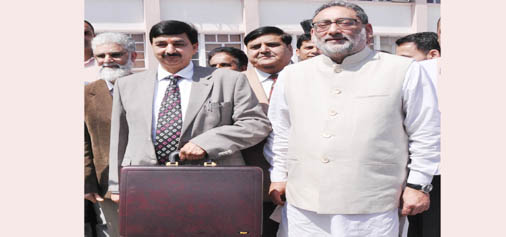
Finance Minister Dr Haseeb Drabu and MoS Finance Pawan Gupta on way to present maiden budget in Legislature Assembly on Sunday. —Excelsior/Rakesh
Following China may prove costly
Dr Bharat Jhunjhunwala
Indian economy remains placid despite a hugely positive sentiment. Policy paralysis is gone. Officials are taking decisions. Corruption is somewhat under control. Businesses do not have to grease the palms of Union Ministers to have their investment plans approved. Yet there is no investment. Reason is that there is no demand in the market. The farmers of Palanpur are not finding buyers for potato at even Rs 5 per kilo. In such a situation provision of a cemented village road, internet connectivity and prompt approval of loan for tractor are of no avail.
Modi is not recognizing that the Chinese economy is slowing precisely because of such a reduction in demand from the developed countries. Cleaning up of corruption has made things worse. It has contributed to the slowdown. President Xi Jinping has hit at corruption at top levels. General Xu Caihou was member of the Politburo of the Communist Party. He is accused of accepting bribes. Chongqing governor Bo Xilai was thrown out. Roughly 182,000 Government servants have been disciplined for corruption. The major focus, however, has been on 45 top-ranking officials, or “tigers,” as they are called, as opposed to the smaller “flies.” According to a report in The Economist, demand brothels, mistresses and casinos has fallen on hard times. Even the demand for condoms has fallen. Five star hotels and other luxury goods suppliers are facing tough times. Government officials are no longer able to spend their ill-begotten monies. Still, corruption is a tiny contributor to the general slowdown. Qinwei Wang of Capital Economics estimates it may have contributed to a reduction of mere 0.1 to 0.2 percent in growth rate.
Why should control of corruption hurt at all? Control of corruption helps when the economy is buoyant but hurts when it is in a recession. Let us say there is demand for potatoes in the market. Farmers are inclined to install a bore well and buy a new tractor. Corruption at the bank hurts in this situation. The farmer is dissuaded from making the investment because the bank manager wants a cut. The impact of corruption is entirely different when the economy is in a recession. There is no demand in the market. Grease money helps in such a situation. Officials create demand for luxury hotels and casinos. Corruption helps create demand in this situation. Reduction in growth rate of China due to control of corruption is due to this underlying lack of demand.
Chinese strategy was to export cheap manufactured goods to the Western countries; and the Government made huge investments in infrastructure for making these possible. The cheap exports, however, led to closure of manufacturing in the developed countries. That led to a general economic slowdown, a decline in wages, and an increase in employment in the developed countries. Slowdown in the developed countries has led to demand for goods from China not expanding. This has led to stagnation in manufacturing in China. In the meanwhile local Governments had borrowed heavily to build highways and townships for factories that were expected to be set up. They had taken huge loans to build this infrastructure. The factories never materialized. So they have empty industrial parks on their hands. Now these Governments are saddled with huge debt. These are the real causes of slowdown of the Chinese economy. Control of corruption had made things worse.
The business interests of Chinese leaders appears to have contributed to the making of this disastrous policy. Zhou Yongkang, China’s security chief and member of the Politburo Standing Committee had strong ties to the oil and energy industries. In October 2012, The New York Times reported that Former Premier Wen Jiabao’s relatives controlled financial assets worth at least US$2.7 billion with interests in mobile services, jewelry and insurance. These financial dealings appears to have prompted the Chinese leadership to embrace the disastrous path of exports of manufactured goods.
Modi story is similar. Stagnation continues after the BJP Government has come to power. There is no demand. Positive sentiments has not helped. Businessmen will invest when they see market for the goods they will produce. Reduction of corruption in top levels has made things worse. A property dealer from Delhi told me that property prices fall whenever BJP comes to power. Corruption money flows smoothly no longer. Yet, the small increase in growth rate seen in the recent months may be due to improved governance generally. That is good news. But precisely here lies the danger. This small increase may prompt us to ignore the basic problems with the developmental model. The “Make in India” campaign seeks to duplicate the same investment-led model that which has landed China into trouble.
It is well known that some important members of Modi’s cabinet have extensive financial dealings-in power sector, in particular. “Make in India” is being pushed, it seems, because there are huge rents to be extracted in manufacturing industries. Coal and natural gas blocks can be allocated, land can be acquired, and river water can be abstracted at throwaway prices by these business interests under the cover of Make in India. Such rent extraction is not possible in services sector hence Modi Government is ambivalent on the same. The Chinese leaders having business interests have pushed that country into the ditch of manufacturing exports. Modi is taking India along that same disastrous path.
There are inherent limits to consumption of manufactured goods by the developed countries. How many bed sheets will the American consumer consume? Therefore, need of the hour is for Modi to place more money in the hands of the poor people who are clamouring for increased consumption. Modi must abolish the various subsides on LPG, food, and fertilizers and pay the amount directly into the bank accounts of all citizens of the country. That will create demand at the grassroots. Positive sentiments will then translate into investment.
I had an occasion to see the play Ghasiram Kotwal sometime ago. A cruel Kotwal accused an innocent trader of theft and ordered that his hand be cut off in punishment. The honest sepoys dutifully carried out the sentence. The poor trader may have possibly saved his arms if the sepoys had been corrupt. Honest Cabinet and Secretaries are, therefore, wonderful if the policies are good. Good Governance can be devastating if the policies are bad. Make in India will be implemented with a gusto and take India down speedily.
Modi must be congratulated for controlling corruption. But that is not adequate. The Mahabharata says the king fortune is like the water bottle made of cloth. A single loose stitch is sufficient to let the water go. Similarly, as single error will bring Modi down. The need is to put in place an aggressive policy to increasing purchasing power in the hands of the common man. That will usher in high growth.
The author was formerly Professor of Economics at IIM Bengaluru)