

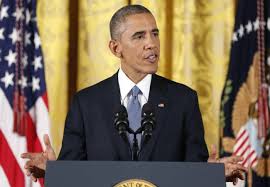
WASHINGTON, Mar 19: US President Barack Obama and German Chancellor Angela Merkel spoke by telephone today on Ukraine, stressing they would keep up sanctions on Russia over its role in the crisis.
“There will be no easing of sanctions imposed on Russia until it has fulfilled all of its Minsk commitments,” the White House said, referring to a recent deal to defuse tensions in eastern Ukraine.
The two leaders said the agreement — which sketched out a ceasefire, called for the withdrawal of weapons from the frontline and opened the door to political dialogue — was necessary for a “lasting and peaceful resolution to the conflict.”
More than 6,000 people have been killed in almost a year of fighting. (AGENCIES)
Obama, Merkel say no easing of Russia sanctions over Ukraine
Package for refugees
Sir,
Unsympathetic attitude, as has been of the successive Govts, to mitigate the sufferings of millions of people got displaced from PoJK under highly unfavourable and fearful situations, during bloody days of 1947, kept these people in most unsettled life conditions till date. The changed political scenario, no doubt, had kindled a ray of hope that something useful for their rehabilitation would be done, also couldn’t shine due to controversy generated by some leaders in the State. Mixing up the compensation issue with other rights of WPRs has derailed the process of whole rehabilitation programme. Both the Govts (State and Centre) ought to act sharply and humanitarianly to address the grievances and problems of these refugees.
Yours etc….
Keshwa Nand Sharma
Salehri (Sunderbani)
Challenges before Government
Sir,
Like all new beginings the beginings of new dispensation is being viewed with hope and optimism. We aspire for a dispensation that not only fulfills our individual and community dreams but also drives us to pride. Pride in our avenues and resources and in our capacity to utilise them to the optimum. Agreed, we have challenges to face. Not withstanding these challenges, we need to move on.
The focus of Govts in past has been undimensional with rebuilding the lost ground, a prime concern. No doubt in a state affected by militancy these concerns will always take a priority, but we need to slightly broaden our focus. In pursuit of reclaiming lost ground, we should not lose new constructions. The New Govt is showing some intent in this direction and talking about health industry and tourism, which is a good begining. The Govt should allow each department under it to follow a vision document established in consultation with various stake holders. The follow up to the vision document will establish the function of a progressive State. We as common citizens of the State of J&K aspire for this only.
Yours etc….
S.N Raina, Jammu
Death row convict accuses MQM chief in a video from jail
KARACHI, Mar 19: A former worker of the Muttahida Qaumi Movement, due to be hanged tomorrow for target killings, in a video from jail today accused party chief Altaf Hussain and other senior members of ordering murders after which his execution was stayed for 72 hours.
“They throw us away like tissue paper after using us and I am not seeking mercy, I just want my execution to be differed so that I can speak the truth,” Saulat Mirza said in a video message from his cell in Machh jail in Balochistan province.
The video message aired by all channels late tonight was expected to cause more tension and fear in the city of Karachi where the Muttahida Qaumi Movement (MQM) has ruled since the last two decades.
Television channels reported late night that President Mamnoon Hussain had postponed Mirza’s execution for 72 hours on a request from the Interior Ministry.
Mirza’s video message came just as the MQM celebrated the 31st anniversary of its formation with thousands of workers thronging to the party headquarters in the Azizabad area of Karachi to listen to their leader’s telephonic address from London.
The celebrations came just a week after the paramilitary rangers raided the MQM headquarters and arrested several target killers from there while recovering a large cache of weapons and ammunition.
Mirza has been on the death sentence since 1999 for the killings of then Karachi Electric Supply Company (KESC) Chief Shahid Hamid, his guard and driver in 1998.
The former MQM worker, who rose quickly in the ranks of the party, has now been disowned by the MQM chief Altaf Hussain who says Mirza was expelled from the party years ago.
“Altaf Hussain ordered the killing of former MQM leader, Azeem Tariq,” Mirza claimed.
“Myself and four others were called to the residence of MQM former Senator, Babar Ghouri where Altaf Hussain told us on telephone that we had to kill the KESC MD. Ghouri used to pass on orders from Altaf Hussain to us,” Mirza said.
“Many of the MQM leaders are involved in criminal activities and the Governor of Sindh provides them protection,” he claimed.
“The Pakistan Peoples Party has also facilitated us in jails,” he said.
Mirza said he wanted to apologise to the nation for his deeds and wanted to tell all MQM supporters to open their eyes to the deeds of Altaf and other leaders.
A political analyst said while the allegations by Mirza were serious and damaging for the MQM, the question arises how and why a death row prisoner was allowed to record a video message which has been aired just hours before his execution.
“One has to see what is the purpose behind releasing this video message now. How did a death row prisoner get permission to record a video message. But the MQM certainly has to come out with a convincing reply to these allegations,” he said. (PTI)
Israeli troops shoot, critically wound Palestinian: officials
RAMALLAH (Palestinian Territories), Mar 19:
Israeli troops shot and critically wounded a Palestinian today near the Jelazoun refugee camp in the occupied West Bank, Palestinian security and medical officials said.
They named him as Ali Mahmud Safi, 20, and said he was hit in the chest in a clash with soldiers near the camp, north of Ramallah.
An army spokeswoman told he was one of about 50 Palestinians who hurled rocks at soldiers, who initially “responded with riot dispersal means” then opened small calibre live fire when the rioters refused to disperse.
“Upon their refusal to vacate the area and refrain from further violence the forces fired a .22 calibre round toward a main instigator and a hit was confirmed,” she said in English. (AGENCIES)
Execution of Shafqat Hussain stayed by Pak President
KARACHI, Mar 19: Pakistan President Mamnoon Hussain tonight indefinitely stayed the hanging of death row convict Shafqat Hussain whose case has attracted global attention with human rights campaigners expressing outrage over what they say was a flawed trial.
Hussain was set to be hanged tomorrow morning in the central jail for the kidnapping and murder of a seven-year-old boy in an apartment building of Karachi where he worked as a security guard.
President Hussain ordered the postponement of Shafqat’s hanging, media reports said.
The President apparently acted after Interior Minister Chaudhry Nisar requested him to halt the execution pending re-examining of Shafqat’s age.
“We have learnt from multiple sources that Shafqat’s execution has been stayed. We have yet to see an official notification but personally handed over his mercy petition to an official of Presidency at 11:30pm (Wednesday),” Communication Specialist for Justice Project Pakistan Shahab Siddiqi said.
The project is fighting for Shafqat’s execution to be stayed. Shafqat was 15 when he was convicted in 2004.
His case has attracted attention as he was awarded the death sentence by the court when he was a juvenile and rights campaigners complain he did not get a fair trial and was only 15 at the time of the killing.
His mother, Makhni Begum, had earlier said in an interview that the police had shown the age of Shafqat as 20 at the time of his sentencing since he did not have any verified documents and the defense lawyer also did not object.
Shafqat’s death warrant was issued earlier this month by an anti-terrorism court and the Sindh High Court also threw out a petition seeking suspension of his fresh execution order.
Makhni Begum this week also filed a mercy petition with the President.
A jail official, who was waiting for official order for staying Shafqat’s execution, said that it had likely been postponed.
But a Sindh government official said they were yet to receive any orders from the Presidency staying the execution. (PTI)
Kalika (Chandigrah) Katra train service
Sir,
Kudos for Jammuites for raising the issue of Kalika-Katra train service through the esteemed columns of this paper.
Last year the Railway Minister made an announcement for providing train service for the above cited destinations. God knows why this burning issue was kept on the back burner and the announcement was not executed by the Railway Ministry as yet. This train service shall prove a boon for pilgrims and patients. India has the largest railway network in the world, but it is quite strange that this train service has been ignored in the Railway map and aged and ailing persons have to suffer from pangs of pain while going to PGI Chandigarh in buses without toilet facilities.
It is once again prayed that the Minister of Pensions and Public Grievances, Dr Jitendra Singh, on whom the people of the State join high hopes, may please raise the issue with the Railway Ministry and start this train service to win blessings from patients of J&K State and pilgrims from Punjab.
Yours etc…
K.L Dhar
Trikuta Lane-1
Durga Nagar, Jammu
The truth unveiled
Prof Javed Mughal
Recently an episode took place in GMC Jammu where a doctor is alleged to have been reprimanded by the Minister of Health and Medical Education. What exactly is the fact of the matter I don’t know but at the same I have no reason to believe in the media reports, the common public, the anguished doctors’ community and the Minister too because to me the common people are always emotional, the media is now-a-days lopsided, the doctors are angry and biased out of professional allegiance and Health Minister is a headstrong and obstinate as is all the range now-a-days but I am not sure since I have never had a chance to meet him or talk to him face to face. Hence none is to be taken for guaranteed. Even then I wish to say that in case the allegations leveled against the Minister are true, his gestures with the doctor can never be appreciated since the Service Rule Book has all the required provisions and procedures envisaged in its gamut to punish any employee without using the disgraceful and abusive language; rather the later is strictly prohibited. In case the doctor was at wrong, she deserved to be stringently punished under rules and if the Minister has displayed an impertinent behaviour towards her, he must also be taken to the books. The point is that one who is at fault must not be spared. But to the best of the common perception of the masses, Chaudhary Lal Singh is a straightforward person and an honest Minister who has always thought and done for the betterment of the patients only -especially the poor ones. Excepting his lingual and communicative harshness, which he actually does not mean, he does everything not for his personal gains but for the people who have always suffered, are suffering and shall continue to suffer even in future, if not checked well in time. When earlier he was the Minister of the same department during the NC-Congress Government, he made an outstanding contribution to the streamlining of the medical department. What to speak of the doctors even the government’s attitude had never been cooperative and encouraging towards Chaudhary Lal Singh simply because he was an upright and honest supremo who cut to the size all the arrogant doctors, running practices during official timings to mint money at the cost of the helplessness of the patients. That is why when he shut all the windows of corruption on the Government during NC-Congress regime, he was, as a part of the planned collusion, sent to the center so that the then Government in complicity with the corrupt system could enjoy at its best in the state. There is of-course, a dissonance between the intentions and the actions of Chaudhary Lal Singh but on the whole his fair and square administration and his commendable style of working can not be called in question. With the adoption of the proper modus operandi avoiding all objectionable postures, he must keep up tightening the nuts and bolts of all those who make a mockery of their profession and neglect their duties or display the signs of arrogance in such a pious and sensitive department where countless lives are at stake round the clock. My heart sinks down in despair when I look at the tenure of some of the other Health Ministers who used this department as a minting machine and nothing else so much so that one of these Health Ministers left a stigma on the face of this portfolio by getting entangled with a lady over a cup of ‘Kashmiri Qahwa’. Do we need such Ministers with love-making habits or with the palms to be greased or we should stand by the people like Chaudhary Lal Singh who is delivering excellently to his people? This point is very important to be considered. Our state is in dire need of the iron men like Mr. Singh so that the needful can be done at the right time.
Can we forget patients dying in the corridors of the hospitals without timely medication and routine negligence of the doctors? Should we forgive those doctors who are seen in their privy clinics minting money during official hours leaving behind many helpless patients looking forward to the pills from the hospitals because they have no money with them? Is Chaudhary Lal Singh doing all this for his own benefits? He is minister and if he wants, he can make a dozen doctors stand at his gate waiting for his orders but let us understand that he is doing nothing of the sort. He is primarily concerned with his patients only. Yes, we can ask him to change the tool of punishment and I personally appeal to him to replace the sword with the pen to punish the culprits since “pen is mightier than sword”. In rural areas the doctors are playing with the life of the people. If we look back to the obnoxious history of this medical department spreading over the last ten years, we must be sure to come across deaths in the labour rooms, deaths for want of timely medication, deaths in the operation theatres and deaths due to over or wrong medication and the point of concern is that none of the culprit doctors have been punished at all. One day I visited Medical College Jammu to see the father of my colleague. The moment I entered into the emergency zone, I saw a patient seemingly from outside the state wriggling and writhing in pains demanding for immediate oxygen. I watched for a little while and, surprised and shocked at the inefficiency of the hospital administration, sneaked into the cabin where a team of young doctors was sitting. I kept on requesting them to come and administer oxygen to the patient but they delayed to the death of the poor one after half an hour just in front of my eyes. It sent across a galvanic shock through my spine and I stopped believing in the fidelity of many of these doctors since then. Similarly I stand witness to the deaths of many patients under the poor and negligent supervision of the doctors in rural hospitals, we cried but none heard. The medicines worth lacs of rupees are either wasted or black marketed but not allowed to reach to the patients at any cost. The sanitary conditions of the hospitals are deplorable and stinking atmosphere is openly allowed to prevail in the medical wards in most of the district and sub-district hospitals. Go and see the unhygienic Super-Specialty Hospital at Jammu and you will find it no better than a cow-shed.
In suburban areas, the poor and innocent patients often fall a prey to the tricky and negligent doctors but nobody bothers because things are settled and the matters are hushed up before coming to the lime light. Innocence, poverty and vulnerability of the patients is exploited and cashed on. The carelessness, the arrogance, the materialistic habits, all combined together, are gripping the entire medical department and most of the doctors have turned out be the traffickers of the Vanity Fair. The matter is very serious and it has to be taken up by the Government very honestly and the current Health Minister has to be supported and encouraged with a little direction to change his style of doing the things. Let Chaudhary Lal Singh continue for the next whole tenure, and we shall all find a positive difference in the functioning of this eroding department.
Of damaged transformers
Er. Vikram Gour
Large scale heavy rains have caused a heavy damage to 11-kv/440v Distribution Transformers (DT) all over the state (especially in Jammu region) resulting in tremendous public inconvenience and heavy loss to the commerce and Industry. In Jammu region alone the damage is around 45-50% of the total (around-16,000) installed DT of various capacities. Even under the normal circumstances the annual rate of damage is around 40% that is very high like T&D losses in our distribution system.
The public unrest and discontent increases when it takes more than 2-3 days to replace a damaged transformer or a replaced transformer gets damaged only after a day or two of its replacement. Public demands immediate replacement of the damaged transformer with a minimum period of power shutdown. The Power Development Department (PDD) has its own inadequacies/problems of not having sufficient number of spare transformers for immediate replacement. It has only one major workshop for repairing the damaged transformers. In addition there are small ill-equipped workshops with each Maintenance Divisional. Bulk of repair work is carried on by private workshops of various transformer manufacturing industrial units in the Industrial sector. The repair work by these units is carried out by paying them directly cash or credit. The damage is so heavy that PDD is unable to pay them the repair charges for years. It is reliably learnt that PDD owes around 35-40 crores to these industrial units and they have now refused to carry out any repair work without the clearance of their outstanding dues.
In a recent meeting with Power Development Department (PDD) top brass the Deputy Chief Minister who holds the Power portfolio impressed upon the engineers to have sufficient number of transformers in stock to provide immediate replacement and the Government also allocated funds to the tune of 18- crores for the purpose without asking the PDD the reasons for such huge number of transformers getting damaged.
In a healthy distribution system where all the transformer-protection accessories are in place and the distribution network is laid according the book the ‘transformer damage’ is hardly around 3-5%. In any scientifically (as per the approved electrical standards) laid distribution system care is taken to save the DT by installation of (starting from the High Tension side):-
* A Lightening Arresters.
* High Voltage fuses through a link set.
* Providing solid/effective Earth Connection.
* Moisture Free transformer oil.
* Silica gel for preventing moisture sneaking into the oil.
* Providing Low Tension (LT) Switches of proper capacity.
* A healthy Earth Wire running all along the LT distribution network.
* Properly strung LT conductors with suitable tension (as laid down in the Electricity Rules) without undue sag to prevent short-circuiting of the conductors.
* All joints properly made with parallel grooves (PG) clamps to prevent sparking.
* A balanced power supply through all the three phases of the transformer.
* Adequate safety and protection around the Sub-station area to prevent any unwanted interference by unauthorized persons.
These are 11-basic minimum requirements of any distribution network as per the laid down standards. Added to this there must be periodic checking and preventive maintenance of the distribution network and the transformer. If this procedure is followed transformer damage cannot be more than 3-4% that too due to unavoidable circumstances.
Unfortunately, 90% of these safety precautions are not taken care of by PDD with the result that there is tremendous financial loss coupled with public’s inconvenience. There can be many reasons for not following this practice including non-availability of adequate funds, trained/ skilled man power, proper training to the workers and above all casual approach of those handling the whole system not excluding the ‘political will’ to set the system on the right track.
It is the most opportune time for the new political setup to efficiently govern, guide and channel the most important power-sector (that is responsible for all round growth and development) of the state in the right direction.
(The author is President Consumer Welfare Association)
Jt Session of Parliament Of provision & practice
Dr S Saraswathi,
A united front of 14 Opposition parties took out a march to Rashtrapati Bhavan and presented a memorandum to President Pranab Mukherjee against the Land Bill, passed by the Lok Sabha. It is intended to stall the passing of the bill in the Rajya Sabha.
The incident is noteworthy more for its political significance than for the Bill’s contents. Opposition parties are not inclined to debate and improve the bill. They want to see it defeated in the Rajya Sabha, where they have a majority and score a political victory or force consideration of the bill by a Select Committee. This may force the Government to seek a constitutional method of pushing the bill.
In its enthusiasm to march fast in economic reforms that are considered absolutely necessary, the NDA Government has proclaimed a number of ordinances. It is now facing the problem of regularizing these by duly passing these in the two Houses of Parliament else these will lapse at end of Budget session.
The Constitution provides that except Money Bills, all others can originate in either Houses, but have to be passed by both. Any amendment should also be passed by both. In the present Parliament, the NDA has 395 members (including the Speaker) in the total of 543 in the Lok Sabha, and 59 out of 243 in the Rajya Sabha. Its numerical weakness in the latter is a big obstacle to its legislative ambitions. Winning Lok Sabha election is not enough for a party or alliance to carry out its policies, it needs Rajya Sabha support.
Among the ordinances considered most important for the next stage of economic reforms, the one on amending the Land Law passed by the previous Government is facing bitter opposition from many parties and by the public directly.
This law pertains to compulsory acquisition of land by Central or State Governments for Government projects, PPP projects, and private projects taken up for a “public purpose”. When the Land Law was passed in 2013 to replace the outmoded Act of 1894 – a relic of the British Raj – Congress and the BJP were able to cooperate. Perhaps, both had to assume people-oriented posture on the eve of election. Once the elections were over, they have reverted to normal time non-election politics.
The Bill was passed with nine amendments by the Lok Sabha on 10th March. Even an ally of the NDA, Shiv Sena abstained from voting, scared of opposition by farmers in Maharashtra and by Anna Hazare movement. Members of SAD & LJP, allies of BJP, had some misgivings, but finally extended support. The BJD MPs did not participate in voting. A total of 52 amendments were defeated or were not pressed.
Both the supporters and the opponents stick to their stand while neither is able to convince the other the validity of their stand. Opposition parties appear to have more faith in playing street-level politics than in debating issues in the Parliament.
In the cases of Mines Development & Regulation Bill and the Coal Mines (Special Provisions) Bill passed by the Lok Sabha, the Government had to concede to the demand of the Rajya Sabha to constitute Select Committees for “detailed scrutiny” of the bills, which would lapse by 5th April, if not passed by the Houses.
In the case of amendment to the Land Law, the Government may consider re-promulgation of the ordinance so that it gets another six months to obtain the support. It can convene a Joint Session of Parliament to pass the Bill after its rejection in the Rajya Sabha. True, the Constitution has deliberately provided for a joint session. It is a legitimate procedure.
All bicameral Constitutions face the problem of differences between the two Houses in their legislative work. A way out is devised in a provision for a joint session, but it is rarely used as an instrument for enacting a law.
A reference to the Australian Constitution is unavoidable in discussing about “Joint Session” which provides for joint sitting of the Senate and the House of Representatives to overcome their differences. A deadlock is declared if a bill is rejected twice by the Senate at an interval of at least three months after which what is called “double dissolution election” can be held. If the new Parliament is also unable to pass the bill, a joint sitting of the two Houses may be convened and the bill is declared passed if voted by a majority of the total members.
In 1974, the Australian Parliament adopted the Health Insurance Bill providing for universal healthcare at a joint session. It also voted for Commonwealth Electoral Bill introducing the principle of “one vote, one value”. Thereafter, this parliamentary instrument has never been used.
In the UK, if a bill passed by the House of Commons is blocked in the House of Lords, it can be passed again in the Lower House and sent to Royal assent.
In France, Joint Committee, a device used often to resolve differences between the two Houses, can be formed to consider any bill other than constitutional bills. The bill should have been considered three times or twice if classified as “urgent” before a Joint Committee is formed. If this committee also fails to arrive at a compromise, the lower House has the final say.
So also, in Germany, Joint Committee has been instrumental in passing many bills. In matters relating to federal units, the upper House has the power of veto. In Canada, there is no provision for a joint session.
The Indian Constitution authorizes the President to call a joint meeting of the two Houses if a bill passed by one House is rejected by the other, or the two Houses don’t agree on the amendments proposed, or the Bill lies with the other House without being passed for more than six months. The fate of the bill is decided by majority of the members of the two Houses present and voting. No fresh amendments can be brought in the joint sitting. Constitutional amendments are beyond its purview.
In the history of the Indian Parliament, three legislations have been passed by Joint Session of Lok Sabha and Rajya Sabha – law prohibiting dowry in 1961, Banking Commission Act in 1978, and the POTA in 2002.
The Constituent Assembly did not regard joint session as an ideal solution to resolve conflict between the two Houses on any legislation. It did consider other alternatives like providing for passage in the Lok Sabha a second time, or allowing lapse of a prescribed time and thereafter approval by the Speaker, but rejected them.
In the present political scenario, when party animosities overtake public interest, legislations depend purely on the strength of numbers and not on the concept of national interest or public good. Sadly, the members of the Rajya Sabha today represent their parties and not the States. Hence, we face a situation not anticipated by the authors of the Constitution. Law making has become a political contest. The merits and de-merits of the legislations are lost in the race for mustering support. People don’t know the real import of proposed legislations, for there is no serious debate on the contents. The intention behind the provision for Joint Session is erased in practice.—INFA