

Dr S S Verma
When comfort and laziness styles of living beat tolerant and austerity life styles then human fails to cope up with the existing/prevailing environmental/seasonal changes all around and thus, technology remains the only answer for the wrong boos of changing lifestyle. Summer and winters seasons always concern people more than other seasons and they get serious to cope up with these severities of climate using technology. In winter people can make use of more clothes but summer can be overcome by using electrical driven cooling appliances like
Cool Building
Fans, Coolers,ACs and Fridges etc. But with the summers getting hotter (due to global warming) and growing electricity demand, people are forced to think about some future innovations which can be useful to beat the summer heat in more economical and effective way. A warming world needs cooling technologies that don’t require power. Cosmic fridge is such a new technique to design buildings with high-tech mirror which can beams heat away from buildings into space. Such a technology can prove to be a boon for people living in very hot zones of the country like Punjab, Haryana, Rajasthan, parts of Bihar & UP, Madhya Pradesh, Odissa, West Bengal, Jharkhand and Gujarat. Across the developing world, photonic radiative cooling makes off-grid cooling a possibility in rural regions, in addition to meeting skyrocketing demand for air conditioning in urban areas.
Summer heating
Much of the human population on Earth lives in sun-drenched regions huddled around the equator. Electrical demand to drive air conditioners is skyrocketing in these places, presenting an economic and an environmental challenge. These areas tend to be poor and the power necessary to drive cooling usually means fossil-fuel power plants that compound the greenhouse gas problem. In addition to these regions, we can foresee applications for radiative cooling in off-the-grid areas of the developing world where air conditioning is not even possible at this time. There are large numbers of people who could benefit from such systems. Forty-fifty percent of the total consumption of energy takes place in buildings, so reducing this consumption is becoming increasingly important. Integrating renewables into the energy supply for buildings is a further step towards moving towards this aim. People usually see space as a source of heat from the sun, but away from the sun outer space is really a cold, cold place. A new type of structure reflects the vast majority of sunlight, while at the same time it sends heat into that coldness, which cools human made structures even in the day time. Such a panel could vastly improve the daylight cooling of buildings, cars and other structures by radiating sunlight back into the chilly vacuum of space. First, the reflector has to reflect as much of the sunlight as possible. The second challenge is that the structure must efficiently radiate heat back into space. Thus, the structure must emit thermal radiation very efficiently within a specific wavelength range in which the atmosphere is nearly transparent. Outside this range, Earth’s atmosphere simply reflects the light back down. The new structure accomplishes both goals. It is an effective a broadband mirror for solar light — it reflects most of the sunlight. It also emits thermal radiation very efficiently within the crucial wavelength range needed to escape Earth’s atmosphere.
Technology
Engineers have invented a material designed to help cool buildings. The material reflects incoming sunlight on sunny days and sends heat from inside the structure directly into space as infrared radiation. A new ultrathin multilayered material can cool buildings without air conditioning by radiating warmth from inside the buildings into space while also reflecting sunlight to reduce incoming heat. The heart of the invention is an ultrathin, multilayered material that deals with light, both invisible and visible, in a new way. Invisible light in the form of infrared radiation is one of the ways that all objects and living things throw off heat. When we stand in front of a closed oven without touching it, the heat we feel is infrared light. This invisible, heat-bearing light is what the Stanford invention shunts away from buildings and sends into space. The new material, in addition to dealing with infrared light, is also a stunningly efficient mirror that reflects virtually all of the incoming sunlight that strikes it. The results will cooler buildings that require less air conditioning. The researchers say they designed the material to be cost-effective for large-scale deployment on building rooftops. Though it’s still a young technology, they believe it could one day reduce demand for electricity. In practice the researchers think the coating might be sprayed on a more solid material to make it suitable for withstanding the elements.
The research team has succeeded by turning to nano structured photonic materials. The material is made of quartz and silicon carbide, both very weak absorbers of sunlight.
These materials can be engineered to enhance or suppress light reflection in certain wavelengths. The thermal emitter and solar reflector are combined into one device, making it both higher performance and much more robust and practically relevant and this design makes viable both industrial-scale and off-grid applications. But transmitting heat into space is not enough on its own. This multilayered coating also acts as a highly efficient mirror, preventing 97 percent of sunlight from striking the building and heating it up. Together, the radiation and reflection make the photonic radiative cooler nearly 9 degrees Fahrenheit cooler than the surrounding air during the day. The multilayered material is just 1.8 microns thick, thinner than the thinnest aluminum foil. It is made of seven layers of silicon dioxide and hafnium oxide on top of a thin layer of silver. These layers are not a uniform thickness, but are instead engineered to create a new material. Its internal structure is tuned to radiate infrared rays at a frequency that lets them pass into space without warming the air near the building. Radiative cooling has another profound advantage over all other cooling strategy such as air-conditioner. It is a passive technology. It requires no energy. It has no moving parts. It is easy to maintain. Put it on the roof or the sides of buildings and it starts working immediately.
Cool Roofing

Governor N N Vohra on way to shrine of Shri Mata Vaishno Devi on Saturday.
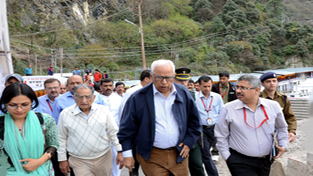
Governor N N Vohra on way to shrine of Shri Mata Vaishno Devi on Saturday.
Idea ensures service continuity by winning spectrum
NEW DELHI, Mar 28: Leading telecom operator, Idea Cellular today said by winning spectrum in 900 MHz and additional frequency in the 1800 MHz and 2100 MHz, the company has ensured business continuity and service for over 106 million subscribers.
It has ensured spectrum availability for areas covering 73 per cent of the company’s revenues. Out of 79.40 MHz spectrum won by the company, the maximum was secured in Maharashtra and Goa (9.00), Madhya Pradesh and Chattisgarh (7.40), Tamil Nadu (6.40), Haryana(6.00) and Punjab (5.60).
“Idea’s participation in the auction was necessitated due to the renewal of its licenses due in December 2015/April 2016 across nine key markets namely Andhra Pradesh & Telengana, Gujarat, Haryana, Karnataka, Kerala, Madhya Pradesh & Chattisgarh, Maharashtra & Goa, Punjab and UP West, where it held the most efficient spectrum band of 900 MHz,” the company said in a statement. It said these markets collectively represent nearly 70 per cent of Idea’s subscriber base and contribute 73 per cent of the company revenues.
The spectrum win in these circles will ensure business continuity for another 20 years and help Idea strengthen its leadership in these markets. With the acquisition of 79.40 MHz across three spectrum bands of 900, 1800 & 2100 MHz in the recent auction, Idea now has a total of 270.7 MHz of spectrum on a pan-India level, it said.
(UNI)
Shobha yatra being taken out in Jammu on the occasion of Ramnavmi on Saturday. -Excelsior/Rakesh

Shobha yatra being taken out in Jammu on the occasion of Ramnavmi on Saturday.
-Excelsior/Rakesh
Union Minister Dr Jitendra Singh delivering inaugural address at the Annual Conference of Diabetes in Pregnancy (DIPSI 2015) at Ooty in Tamil Nadu.
Union Minister Dr Jitendra Singh delivering inaugural address at the Annual Conference of Diabetes in Pregnancy (DIPSI 2015) at Ooty in Tamil Nadu.

Xi says shuns fixation on GDP as Chinese economy slows
BEIJING, Mar 28: With the slowing Chinese economy causing ripples at home and abroad, President Xi Jinping today said focus should not be fixated on growth rates alone but on the quality of growth.
Playing down the economic slowdown of the world’s second largest economy, Xi told the Boao Forum for Asia in Boao town in south China’s Hainan island today that the Chinese economy is highly resilient and has enough room to leverage a host of policy tools.
“When looking at China’s economy, one should not focus on growth rate only,” Xi said.
“We will focus on improving quality and efficiency, and give even greater priority to shifting the growth model and adjusting the structure of development,” he said.
“As the economy continues to grow in size, around 7 per cent growth would be quite impressive, and the momentum it generates would be larger than growth at double digits in previous years,” Xi said.
China is shifting gear from high speed to medium-to-high speed growth, from an extensive model that emphasised scale and speed to a more intensive one emphasising quality and efficiency, and from being driven by investment in production factors to being driven by innovation, he said.
The Chinese economy grew 7.4 per cent last year, the lowest pace in 24 years and this year its growth rate was expected to go below 7 per cent.
Despite the slowdown, Xi said China’s labour productivity increased 7 per cent and its energy intensity declined 4.8 per cent on a year-on-year basis.
The share of domestic consumption in GDP rose, the services sector expanded at a faster pace, and the economy’s efficiency and quality continued to improve, Xi said.
China will import more than USD 10 trillion of goods in the coming five years, marking continued opportunities brought to the world, he said.
“Chinese economy will continue to bring more opportunities of trade, growth, investment and cooperation for other countries in Asia and beyond,” he said.
In the coming five years, Chinese investment abroad will exceed USD 500 billion and more than USD 500 million outbound visits will be made by Chinese tourists, he said.
“China will stick to its basic state policy of opening up, improve its investment climate, and protect the lawful rights and interests of investors,” Xi said. (PTI)
‘India can attract significant FDI if it sorts out tax issues’
SINGAPORE, Mar 28: Japanese investors remain “very positive” on India, saying there is a big opportunity for placing “significant” FDI if the country can sort out some of its tax issues, a top official of Japan’s financial services major Nomura has said.
Alastair Newton, Managing Director for global market research and Senior Political Analyst at Nomura International Inc., also highlighted investors’ concerns about retrospective taxes such as the Vodafone case, and among other, the General Anti Avoidance Rule (GAAR), which has been postponed for now.
“I do think there is a big opportunity in India (but) if it can get some of the tax issues sorted out to attract significant Foreign Direct Investment (FDI) investment from Japan,” he said at a media briefing here yesterday.
The Japanese also view India more positively as compared to other investment-seeking Asian markets, Newton said, citing the political instability in Thailand, economic growth slowing down in China and people’s reaction to some of the foreign- invested plant and factories in Vietnam as the reason for it.
“If you look at the offering of other nations in Asia, it is not any more attractive as it used to be. I think India has great opportunities to take on some of that investment if you can get it right,” he said.
Newton said the Japanese investors have confidence in the current dispensation.
“Senior management in major Japanese corporations, who already know (Prime Minister Narendra) Modi well and have invested in Gujarat, remain very positive over prospects in India over time,” he said.
“Headline grabbing retrospective tax bills slammed on big companies is a big disincentive to investment in India,” Newton said.
He also shared his observation and comments from other investors, including fund managers who said they would like to do more business in India but the bureaucracy is making it tough.
He, however, said he was hopeful that there would be legislations passed to settle these issues. (PTI)
Beyond the Bounds of ‘Body Beautiful’

Manjinder Kaur Wratch
George Sand, a nineteenth century French novelist asserted way back in 1872: “Art for art’s sake is an empty phrase. Art for the sake of truth, art for the sake of the good and the beautiful, that is the faith I am searching for.” Chinua Achebe, a postcolonial African writer in a trenchant way, goes to the extent of hailing ‘art for art’s sake’ as “just another piece of deodorised dog shit.”
Art demands a lot of ingenuity whilst being assertively alert to socio-cultural maladies. Truly it is an artiste’s prerogative to conceive cutting-edge expressions to voice it to as many souls as possible- a multitude of emotions that abode a human heart; and the prejudices of the degenerate society. A gargantuan task indeed- which engages the artists’ in commingling a variety of techniques : concocting newer crafts to laundry the system’s rot and affiliating it with aesthetically tailored recital of events, aimed at enchanting the senses of the viewers in sync.
The winning dialogue of The Dirty Picture (2011) – “Filmein sirf teen cheezo ke wajah se chalti hain… entertainment, entertainment …” garnered a lot of applause in the contextual framework of the movie but falls deflated and dispirited when assessed scholastically beyond the precincts of the movie. Not only it puts at risk the wisdom of the cinegoers, who are no more infatuated with Bollywood masala movies but instead prefer to judiciously spend their time and money on issue based cinema. It also confines the critical acclaim and commercial success of a movie to its ‘entertainment quotient’ only brushing aside the thematic concerns and social relevance of ‘substance cinema.’
The Dirty Picture triumphed in ‘stirring the souls’ of its audiences by inviting them to view in all nakedness; and live outrightly through the oculus of cinema – an assortment of splendour and pathos in the lives of the so called ‘sex-symbols’ of the film industry, be it Silk Smitha of Kollywood – the Tamil language film industry or Marilyn Monroe of Hollywood. The fictionalised biopic initiated newer debates pivoted around many a feministic discourses. Borrowing words of Rajat Aroraa- the dialogue writer of the movie, the film dared to raise questions on how in a patriarchal society: “women are held up to judgement more easily in roles men have gotten away for ages.”
In the recent past Bollywood is engaged in churning out with élan and finesse, a banquet of issue based cinema. The list is long but a few references like Chak de India, Taare Zameen Par, 3 Idiots, Fashion, Queen, Mary Kom, Mardani, Haider and PK are suffice to define the canon. Dum Laga Ke Haisha (2015) is the latest entrant to the bandwagon. The romantic comedy under the production aegis of Yash Raj Films and adroit and foxy direction of sophomore director, Sharat Kataria; zip codes a number of termini in one go, to name a few: the Indian obsession with English language, the topsyturviness of youth under overreaching patriarchal authority, and the issue of envisioning female bodies as erotic objects only.
The plot of the movie introduces us to Prem Prakash Tiwari (Ayushmann Khurrana) – as a 25 years old, school dropout, courtesy his disabling lack of talent to qualify his tenth-standard English exam. Viewed as a loser by his family especially his father, Prem is invariably exposed to his father’s ridicule and bullying. Marooned in his father’s audio cassette-repair shop, hearing to Kumar Sanu’s timeless melodies comes as a refreshing breather for Prem. A dialogue from the movie pertinently describes his state of mind and his status quo too:
“Teen Cheez hai koi kuch karle meri aankhon se assu tapakne se na rok sake. Ek to angrezi ka prashn patra, dusri Kumar Sanu ki awaaj, teesri papaji ki chappal.”
Undeterred by his dilapidated realities; Prem -doused and sodden in the film world, would not happily settle down with a bride, having even a speck less than the sculpted look of a cinestar- lithe, taut, and svelte. Film critic Laura Mulvey’s treatise of ‘cinematic spectatorship’ is quite plausible in stating ‘the standard operative procedures’ adopted by conventional film makers. Conventional cinema pitches men as ’emissaries of voyeuristic gaze’ in both the story and the audience while the female characters hold an “appearance coded for strong visual and erotic impact.”
Waylaid and entrapped in this psyche, Prem’s inflated male ego is shattered to smithereens when his family takes a utilitarian decision of marrying him off to the twenty -two years old, amply qualified, (aspiring teacher) plus- size but fun-loving and confident Sandhya Verma (Bhumi Penderkar).
After an inaugural pandemonium Prem and Sandhya’s ‘marriage of unequals’ mutates into a mushy, lovey-dovey affair. ‘Love comes in all sizes’ as the tagline of the movie comes alive when Prem gazes at the true worth of Sandhya. He starts taking pride in consorting- the educated and intelligent Sandhya. Not only the ‘couple compatible’ dares to participate in “Dum Laga Ke Haisha” contest which entails the male partner of the duo to shoulder his female chum and run a race. The joie de vivre of Sandhya goads Prem to backpack his 85 kilos damsel like a trophy. Celebrating his newly-found love, Prem stretches the race way beyond the winning post by blithely and buoyantly taking Sandhya around the entire town in the same posture.
The film manages to denounce and deconstruct unrealistic images of women’s beauty assuaging both men and women out of its constrictive tutelage to live wholesome lives. The movie echoes- bereft of all sermonising and in all subtlety, the eternal feminine tiding- “Look at us beyond our bodies.”
(The article writer is an academician-turned- research scholar)
MLA Devender Singh Rana addressing public meeting in Nagrota Assembly segment on Saturday.

MLA Devender Singh Rana addressing public meeting in Nagrota Assembly segment on Saturday.
JKNPP leaders and workers during a sit-in-protest in front of Press Club, Jammu on Saturday. -Excelsior/Rakesh

JKNPP leaders and workers during a sit-in-protest in front of Press Club, Jammu on Saturday. -Excelsior/Rakesh