

Residents of Nikki Tawi & Mandal areas during protest at Satwari on Monday. -Excelsior/Rakesh
Residents of Nikki Tawi & Mandal areas during protest at Satwari on Monday. -Excelsior/Rakesh

Collected works of Ambedkar
Sir,
In this connection, I am to intimate that many years back, it was declared by the Jammu and Kashmir State Government that the writings and speeches of Dr Babasahib B R Ambedkar would be translated into Dogri and into other main local languages by the Cultural Academy Jewel Chowk Jammu but it seems that nothing has been done by the said Academy till date.
Now collected works in Hindi and in Marathi are being translated into Hindi,Punjabi, Urdu, Oriya, Gujarati and Malayalam by Dr B R Ambedkar Foundation, Ministry of Social Justice and Empowerment, Govt of India 15-Janpath, New Delhi and are being published. A large number of books in above languages are available with the above foundation on the nominal rates.
Mother tongue is Dogri and Ambedkar Foundation should get the Dr Ambedkar ‘s works translated and published into Dogri.
And Govt of Jammu and Kashmir State should direct the Sahitya Academy, (Cultural Academy) Jewel Chowk Jammu to purchase the books in Hindi, Urdu, English and Punjabi available with the above foundation on sale on nominal rates and put them in the Academy sale point outside the Academy in the Jewel Market opposite to Science College play ground Jammu.
It is long pending desire of the Jammu Ambedkartire Community and lovers of Progressive literature.
Yours etc….
T. R Azad
The Buddhist Society of India (Regd) Jammu
R O Ranjit Pur PO Gole Gujral Jammu
CGM State Bank of India, Lingaraj Mahapatra presenting a cheque to Chief Minister, Mufti Mohd Sayeed on Monday.
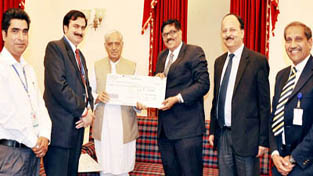
CGM State Bank of India, Lingaraj Mahapatra presenting a cheque to Chief Minister, Mufti Mohd Sayeed on Monday.
Swachh Bharat
K R Sudhaman
In tune with Prime Minister Narendra Modi’s clean India campaign, ‘Swachh Bharat’, the 2015-16 budget has stepped up allocation for this idea. But measures to improving air quality in Indian cities, perhaps among the worst in the world are absent in the budget.
Swatch Bharat campaign serves little purpose if measures to tackle poor air quality in cities do not become a major component of this clean India campaign.
Air pollution is a ‘silent killer’ and according to a WHO study 13 of the top 19 polluted cities are in India. The national capital region is the most air polluted city in the world and Beijing considered among one of the worst world capitals is only 13th in the list.
This WHO study is an eye-opener. The people in India seem to have oblivious of this fact and it is unfortunate that no provision has been made in the budget to improving the air quality around cities, which may take a heavy toll on quality of life, efficiency and productivity in the coming years.
There are simple and cheap solutions available but Government appears to be unmindful of this gigantic problem. Experts fear that the reason for India with vast 1.2 billion population, not able to produce quality fast bowlers and top class athletes is because Indians are born with 30 per cent less stamina due inferior lungs than people living elsewhere because of poor air quality.
This is not a genetic issue, nor is it a problem of nutrition but due to poor air quality in urban India. Sadly not much is being paid to tackle this major problem that goes unattended year after year. The diesel vehicles are one of major causes and part of the diesel cess should in fact be utilized to switch over to Euro VI standards that would check emission of harmful ozone from vehicles.
The efficiency of working population in urban India, particularly in Delhi is less by 15 per cent because of air pollution, studies show implying the output is that much less. Reduced lung power causes frequent headache, drastically reducing concentration power.
That apart poor air quality causes nausea, irritation to eyes and various health problems. Living in Delhi is as bad as smoking 40 cigarettes a day. As the problem is not visible to naked eye, no one seems to be bothered
There may not be acid rains in most parts of the country but studies suggest that first rains in India is becoming increasingly acidic, which is harmful to skin, crops, animals, buildings and so on. Acid rains are those, when rain water reacts with sulphur dioxide in the atmosphere to form sulphuric acid. Emission from diesel cars results in let out of sulphur dioxide in atmosphere. Euro VI standards can help in reducing this emission as well.
Industrialist Kamal Meattle, President of Parharper Business Centre, who purifies air with simple and easy to maintain plants including money plants at his six storied building in Nehru place had recently written letter to all the MLA aspirants during the Delhi assembly elections to highlight this problem.
But it fell on deaf ears and no politician seems to be bothered. A lung patient himself, Meattle has overcome his ailment by improving air quality in his residence and office through these simple solutions and wearing medicated mask while being outdoor.
Delhi cops at traffic junctions have one of the worst lungs, the studies show. One American company came to India a few months back to sell 10,000 medicated masks in India but to its surprise it has sole 9,000 masks in Delhi alone and very shortly it proposed to start manufacturing in the country to produce over six lakhs masks a year despite it being not very cheap. Air purifiers for indoors too is becoming popular particularly in Delhi.
Delhi has become unfit to live between Deepavali and Holi with high levels of particulate matter (PM) 2.5 in addition to presence of dust particles PM 10 and Ozone emission from diesel vehicles. Areas like Lodhi gardens, Chanakyapuri and green areas in Lutyen’s Delhi including Prime Minister’s residence is one of the worst as pollutants particular Ozone from diesel vehicles settle down in cooler places. So having walk in such areas do not serve any purpose.
The prescribed standard for PM 2.5 air quality index is 60 and PM10 is 100. But certain parts of Delhi has PM2.5 as high as 380 and the average is around 170, which is considered very high making it unliveable. In case of Kolkata the average is around 200. South Indian cities are comparatively better, particularly coastal towns due moisture in the atmosphere.
Chennai is lowest at around 60, while Mumbai, Bengaluru and Pune, the index is around 100 and Hyderabad, around 85. These figures are released by Central Pollution Control Board, which have stations in various parts to measure harmful pollutants including PM 2.5, PM 10, Ozone, Benzene, Sulphur dioxide and Carbon monoxide. Beijing, which has PM 2.5 level of around 60, has come out with a five year plan to bring it down to permissible levels. Indian authorities still believe index of 60 is moderate.
To find resources for Swachh Bharat campaign of Modi proposes to add one per cent extra in service tax in five-star bills and a few other services. It would be worthwhile for Government to consider some small cess to fund clean air campaign. It is not to late.
Even now Finance Minister Arun Jaitley can move necessary amendments during the passage of finance bill for cess to find the resources for this.
Wearing masks could be an option, Indoor plants are another. Planting more trees particularly pipal trees, which has the capacity to convert carbon dioxide into oxygen even during night, can help in reducing outdoor pollution.
Though conversion of diesel vehicle to CNG may help partly now there are studies to show it is not a total solution as CNG emission too contribute to air pollution but much less than diesel. Advanced nations have started issuing advisory to its embassy staff and tourists about dangers of air pollution in Delhi and other Indian cities, particularly after U S President Barrack Obama’s recent visit.
There were reports to suggest that his short stay in Delhi has reduced his life by six hours due to pollution. The indoor air pollution is 10 times more than outdoor pollution in India. Swachh Bharat is more bothered about improving water quality and providing more toilets but least bothered to tackle this silent killer.
One drinks only 2-3 litres of water a day yet people are very conscious of its quality but we take 23,000 breaths in a day and inhale 12,000 litres of air a day and yet not bothered as it is not visible. It is high time due attention is paid to this issue and necessary awareness is created nation-wide before it is too late.
Union Minister Dr Jitendra Singh at a media get-together hosted by him at New Delhi on Monday.

Union Minister Dr Jitendra Singh at a media get-together hosted by him at New Delhi on Monday.
Re-orientation in agricultural extension approach
Dr. Banarsi Lal and Dr. Shahid Ahamad
Agriculture is an engine of growth and development and acts as an important contributor in national economy. The agricultural globalisation and revolution in information and communication technology have brought tremendous changes in world economic growth. The Indian agriculture is passing through an era of transition. The agricultural situation has become more competitive, knowledge based and market-led. Presently agricultural growth has not gone to the extent that it was targeted. The matter should be contemplated on imbalance of total production, national food security, rural-urban divide etc. The agricultural strategy is making strenuous efforts to increase the crop productivity, improving rural income, creating employment opportunities and making environmental security. There is a great focus on promotion of sustainable agriculture through a regionally differentiated approach, transfer of technology, increase in input use efficiency, incentives for agriculture, strengthening of infrastructure and management reforms. There is a need to develop an approach not only to develop ecologically sound technologies for different areas but also to facilitate their utilization at gross root level.
There are certain questions which should be discussed:
* What problems have arisen in agricultural system?
* What have been achieved in agriculture?
* What should we do so that agriculture can be made more commercially viable to increase the additional income and employment?
* How the research and extension systems should be integrated?
* What should be the ideal extension system to deal with the agricultural problems?
Over the years, the country has tried many extension and development strategies that helped to increase the agricultural production, productivity and improved the quality of life of human beings. Community Development approach was developed after independence. The programme assured cooperative credits, land reforms, made marketing facilities, large scale irrigation projects and efficient use of resources with the help of National Extension Service agency. The main objective of Community Development programme was to bring the overall development of the rural community participation but not many good results were observed due to lack of commitment, expertise, conviction and the compelling situation of food shortages. In sixties, the agricultural production in the country was very poor and the high yielding varieties need was greatly felt and agricultural development became the only objective for rural development. Many programmes like Intensive Agricultural District Programme, Intensive Agriculture Area Programme, National Demonstration and High Yielding Varieties Programme made a progress. At that time, the only objective to increase the agricultural production by modern means such as fertilisers, assured irrigation and high yielding varieties of crops. This strategy was found unsuitable due to diverse, risk prone and complex agriculture. Although these approaches paid so good dividends but failed especially for the poor farmers. During seventies, various other programmes like Small Farmers Development Agency, Marginal Farmers and Agricultural Labour Development Agency, Drought Prone Area Programme, Integrated Rural Development Programme, Training and Visit Programme etc. were launched. The main focus was on income and employment generation in agriculture and allied sectors. Various other programmes like Operational Research Project, Krishi Vigyan Kendra and Lab to Land Programme were also launched. These entire programmes along with National Demonstration were later on merged under Krishi Vigyan Kendra (KVK) programme. The location specific research and extension programmes were started through KVK. The KVK system is successful in dissemination of agricultural information. It has been observed that generally modern technologies did not match with the poor farmers need and resources and therefore farmers’ participation is lacking. So, farmers’ need-based and problem oriented programme was needed with the active participation of the farmers. Institution Village Linkages Programme was launched based on participatory methodology. Also National Watershed Development Programme for rainfed areas was also launched by Govt. of India with basic consideration of people’s participation. After that Agriculture Technology Management Agency using bottom-up planning was launched.
At present agricultural scenario is more confused and there is no proper extension direction and approach. Although these programmes and approaches have helped to increase the agricultural production in India but the impact of different programmes in terms of people’s participation has not been so satisfactory. All these programmes considered farming problems as individual concern and not as collective issue. The individual-oriented extension strategy has ignored the poor farmers and concentrated mainly on rich farmers. The development efforts did not trickle down to most of the farmers at the bottom level of development. Govt of India is striving hard to find fresh extension approaches to carry the agricultural development at bottom up planning. A large number of private players have entered in agricultural research and extension work. The farmer is in a state of utter confusion about how to generate more income from their small land holdings in this fastly changing competitive era. There is serious concern to work out an integrated extension approach so as to safeguard the interests of the farmers. There is need to extend agricultural gains in integrated manner to the rainfed and dry areas where the modern technology has made a limited impact. Also there is need to develop eco-friendly technologies and increase emphasis on post-harvest management, processing, value addition and entrepreneurship development on area basis to make agriculture as internationally competitive. Rural societies are complex in nature. They are mostly heterogenous and their caste, religion, gender, economic status etc. define people. This complex stratification is prohibiting factor for receiving communication and process of development. The communication methods which are designed without considering the specific interest of the various segments of heterogeneity of the rural area do not reach many sections of the rural society. The communication plan must take into account socio-economic conditions in heterogeneous rural societies for ushering change. The Community Development extension system should be adequately equipped with human power on gender basis, transport facilities, computers etc. The roles of private and public players should be delineated that which one player with what role. Krishi Vigyan Kendras should have close links with Community Development extension systems to support in agricultural development and training of extension officers. The extension system should take whole village as a unit for agricultural development. In order to correct the public and private extension system regular monitoring and evaluation should be an integral component of Community Development extension system.
VRS employees staging protest dharna in front of Press Club Jammu on Monday. -Excelsior/Rakesh
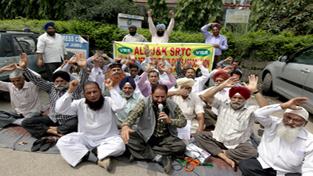
VRS employees staging protest dharna in front of Press Club Jammu on Monday. -Excelsior/Rakesh
Antithesis to investment and growth
Shiban Khaibri
To give bad name to the animal and to hang it, as the saying goes, underlines the motive , the intent and the purposes of some opposition Parties to oppose the Land Acquisition (amendment) Bill just because an opportunity has arisen to corner, oppose and criticize the BJP led NDA Government. Let the words be not minced , the fear is what if 2019 general elections too are lost by the “secular” Parties, hence to preempt that scenario, the ground work for that needs to be done right from now when an issue has come handy in the form of the Land Bill. Employing much more than the conventional “Saam, Dhand , Bedh” into the elections to Delhi Assembly by the Aa Aa Party right from the moment of miserably losing the General Elections and employing all tricks under the sky, has widened the prospects of coming true the dreams of the “secular” brigade to form a kichadi sarkar in 2019 even if the premise was to be quite unmindful of the dormancy of the economy, growth and employment but being “committed to secularism”.
Hence the old Janata Parivar coming out of its political hibernation as a joint entity and Sharad Yadav of JD(U), Lallu Yadav of RJD, Mulayam Singh of the SP and of course Nitish Kumar all set to forge a unity for what they say “to keep the BJP at bay”. The big question, however, is why to keep the BJP “at bay”? It is quite ludicrous on the part of Mulayam Singh to say that “Modi ko chain say baithney nahin dengay” or “we won’t let Modi sit at any ease”. So the issue is explicit, Land Bill is just an alibi. It is intriguing that the Lok Sabha adopting necessary amendments as desired by the opposition in the said bill passes the same but the opposition stalls it in the Rajya Sabha. More than a quarter and a century old obsolete, anti farmer, anti poor land laws attempted to be belatedly changed by the UPA2 Government was fully supported by the present dispensation in 2013 and further improved upon as regards compensation and acceptability clauses. How can the same be termed as anti farmer, anti poor and pro corporate. The point at issue is the rural development first through the Land Acquisition followed by other options but the most important one being a conducive climate for generating investment to generate employment, one of the main challenges faced by our economy.
Parliamentary Affairs Minister Venkaiah Naidu recently made a frantic appeal to all opposition Parties to see the reason and not oppose the bill just blindly and instead come out with constructive suggestions, the Government being there with an open mind. He made it clear that the NDA government did not do it in any haste but held wide discussions with 32 states and union territories on the matter. As many as 28 states invited, expressed the apprehensions that acquiring land under the statute of 2013 was quite impossible. Since there were j4 lac crore worth projects getting mired in various litigations for various reasons and clauses, the NDA government brought the ordinance. These projects are critical to employment generation, rural infrastructure, manufacturing and industrial growth. As far as the question of compensation was concerned, the Minister assured that the Bill envisaged compensation as many as four times the prevailing market price of the land. Then, why this opposition?
This is sheer stubbornness on the part of Congress thinking to somehow better its lot of relevance in the changed political firmament if it stresses upon the 2013 version to replace the present NDA ordinance on the Land Acquisition, refined and widened in its scope and acceptability. The political stand of the Congress Party is unacceptable that come what may, in no circumstances whatsoever, was it going to accept or support the Land Bill. Is Congress Party conscious of the lacunae in its 2013 version whereby even for a minor irrigation project for rural agricultural purposes, land could not be acquired? The present Government has made it clear that even for schools, hospitals etc in the private sector, no land would be acquired excepting only for government institutions and bodies. Those engaged in agricultural labour and activities, their active participation in the developmental process was an integral part of the land acquisition and one member each from the affected family was going to be absorbed in the government job. The ambiguities about the industrial corridors too have been removed and only up to 1 km of land on both sides of the rail or road ways would be acquired. The Congress should instead look into the shortcomings in its 2013 bill where many vital issues were ignored to be incorporated in the Land Bill and not considered at all which were much more important for development and growth. Some of them are Coal Areas, mines, National Highways, Atomic Energy, Indian Tramways and Railways, Monuments and old heritages, Petroleum and mineral pipelines, Electricity, immovable Properties, Metro Railways and host other issues very vital to the economic growth. These were left out by the Congress Party. How can it and other Parties take up the plea that the bill in question was anti farmer?
The main issue before the Congress Party is how to make its proposed “Kissan Rally” turn into repairing its sagging morale with 44 in the Lok Sabha. All efforts are underway to see it becoming an event to embarrass the Modi government but the fear that farmers in expected number cannot turn up for the rally being busy with harvesting is going to upset Congress’s apple cart of a bid to pave a small way to stage some come back. However, in the mean time, through the proposed rally, it wants to divert the attention of the people, especially those of the ground level workers who question and are sore about Rahul Gandhi’s absence and his proceeding on unearned but granted “as a special case” long sabbatical for reasons known to him only. Is he the only future hope of the Congress Party who as an MP proved to be least enthusiastic about attending and actively participating in the budget session of the Parliament? The message went across the country that once out of power, Congress leadership is found in deep disarray and the “concern” about their conventional “Aam Aadmi and the poor” gets waned, withered and weary. Doubts and discontent are simmering and getting deep and delved about who can steer the old Party out of the present state of affairs and opposing Land Acquisition Bill for achieving any such objective may prove therapeutically as no cure.
Let us now break the vicious circle of retrograde red tape, obsolete policies, non performance, snail’s speed reforms, economic dormancy and anti – investment scenario. Let those opposing the Land Bill not make a joke of the peoples’ will as they see in Modi a harbinger of economic take off . We have wasted enough time in discussing and draining our energies on non- issues while other countries made long leaps of progress. The unemployed youth of our country who swell by nearly 10 crores every year have to be given work and for that investment on a vast scale is needed, nothing can happen without land. If the proposed Law needs certain changes, let through discussions and healthy debates be those changes and amendments be brought about but making an issue out of it to keep “at bay” the ruling Party shall prove counterproductive. Compulsions of Janta Parivar and the left supported by the Congress to forge some sort of unity is purely on the fear of losing 2019 as well, opposing Land Bill perhaps won’t help in that.
Protestors raising slogans during demonstration at Jammu on Monday .-Excelsior/Rakesh

Protestors raising slogans during demonstration at Jammu on Monday .-Excelsior/Rakesh
Arvind R Vohra, Country CEO & MD, Gionee India with William Lu, president of Gionee unveling the Gionee ELIFE S7 in India.

Arvind R Vohra, Country CEO & MD, Gionee India with William Lu, president of Gionee unveling the Gionee ELIFE S7 in India.