

Excelsior Correspondent
RAMBAN, May 6: Police here today detained an alleged hardcore criminal under the stringent Public Safety Act (PSA) for his continued involvement in organised criminal activities.
The accused, identified as Tufail Ahmed, son of Ali Mohammad, resident of Kabbi Jagir Gandhri in Ramban, had been repeatedly booked in multiple FIRs across various Police Stations in Jammu division.
According to cops, despite several arrests, he continued to engage in unlawful activities, posing a serious threat to public peace and order, particularly in Dharamkund area.
Sources informed that the existing legal measures proved insufficient to deter his activities, prompting authorities to invoke preventive detention under PSA. Acting on the dossier prepared by the Police, District Magistrate Ramban issued formal detention orders.
The operation was carried out by cops from Police Station Dharamkund, led by SHO, Inspector Joginder Singh Chib under the supervision of SDPO Gool and overall supervision of SSP Ramban, Arun Gupta.
Criminal detained under PSA

Power shutdown

Excelsior Correspondent
JAMMU, May 6: Superintending Engineer (Distribution) JPDCL O&M Circle Kathua has informed that the power supply to Jatwal and adjoining areas will remain affected on May 07 and 09 from 7 am to 1 pm.
Conquering Zojila Barrier
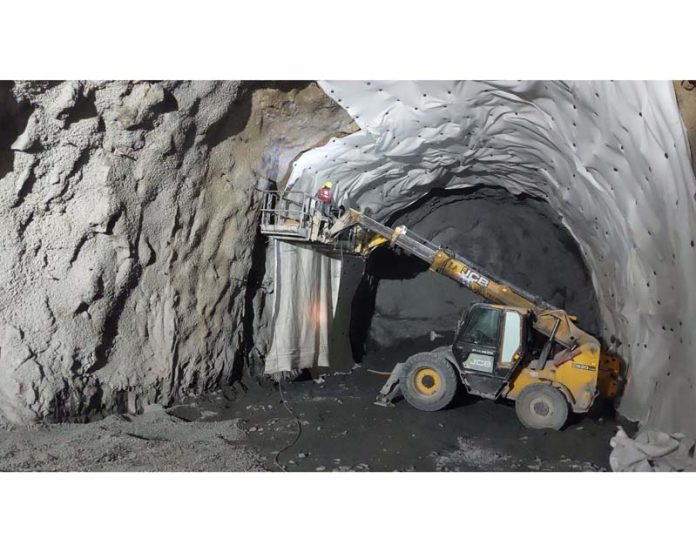
For most of the world, distance has become an abstraction. Motorways, high-speed rail, and modern logistics have compressed geography into irrelevance. Yet for the people of Ladakh, the tyranny of distance – and more acutely, of altitude – has persisted well into the twenty-first century. Each winter, when snow seals the Zojila Pass for five to six gruelling months, an entire region is effectively cut off from the nation it belongs to. Medical emergencies become life-or-death gambles. Supply chains collapse. Families are separated. For Ladakh, the calendar has long been divided not into seasons but into connected and disconnected. That reality is now on the cusp of change. At 13.15 kilometres, the Zojila Tunnel – soon to achieve its breakthrough with a mere 210 metres remaining – will become Asia’s longest bi-directional road tunnel. It is not merely an engineering milestone; it is a promise, long overdue, finally being kept. The socio-economic implications are profound. Drass and Kargil, historically among India’s most isolated communities, stand to benefit most immediately. Reliable, year-round connectivity means a dependable flow of essential goods, medicines, and commercial traffic. Tourism, a sector brimming with untapped potential across Ladakh’s breathtaking landscape, will no longer be hostage to seasonal accessibility. Entrepreneurs, healthcare workers, and students will find in this tunnel not just a road, but opportunity itself.
One must also acknowledge the sheer human endeavour behind this achievement. Over 1,400 personnel – the overwhelming majority drawn from local communities-have laboured ceaselessly in temperatures plunging to -45 Degree Celsius. Avalanches have struck without mercy; lives have been lost. That construction has pressed forward despite such adversity is a testament to the extraordinary resolve of engineers, contractors, and the executing agency alike. Credit where it is most certainly due.
The strategic dimension, too, cannot be understated. Recent tensions along India’s northern borders have underscored what military planners have long understood: rapid, all-weather access to Ladakh is a matter of national security, not merely regional convenience. The tunnel will enable swift deployment of troops and heavy equipment – a capability that geography has historically denied. Yes, the completion date has slipped to 2028. But when that final metre is broken through, and the two ends finally meet, Ladakh will not simply gain a tunnel. It will gain the future. Waiting has been too long, but the end result will change the dynamics altogether.
Secretary, PWD Ladakh Reviews Progress of Leh and Kargil Bhawans in New Delhi
Excelsior correspondent
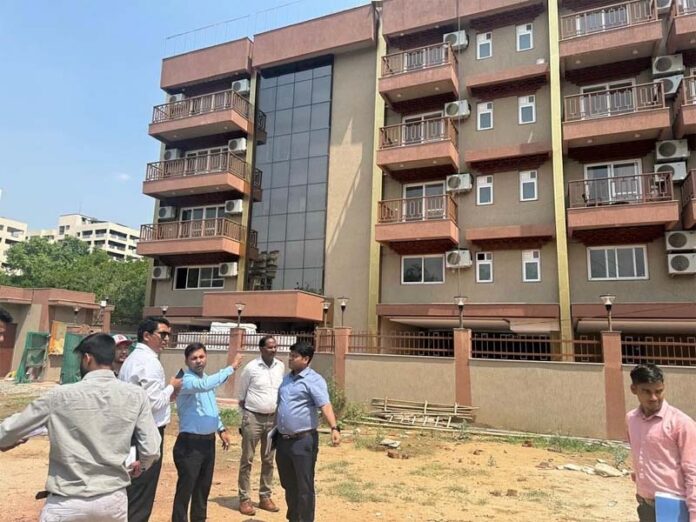
NEW DELHI, May 06 : Baseer Ul Haq Choudhary, Secretary, Public Works Department (PWD), Union Territory of Ladakh, conducted a comprehensive review of the ongoing construction of Leh Bhawan and Kargil Bhawan in New Delhi—projects of significant public importance for the Union Territory.
A detailed review meeting was convened at the Conference Hall of Ladakh Bhawan, New Delhi, wherein the Secretary undertook a thorough assessment of all ongoing works. Project-wise progress was examined in both financial and physical terms.
Executing agencies presented detailed status reports, outlining achievements, constraints and projected timelines for completion.
During the meeting, Choudhary critically reviewed each component of the projects and emphasized the need for enhanced inter-agency coordination, strict adherence to approved timelines and proactive resolution of issues impeding progress.
He underscored that timely execution is essential given the public significance of these infrastructure assets.
Subsequently, the Secretary carried out on-site inspections of the Leh and Kargil Bhawan project sites at Dwarka, New Delhi.
During the inspections, he reviewed the progress of civil, electrical, and allied works, and interacted with the Superintending Engineer, CPWD, Executive Engineers of CPWD, and officers of PWD Ladakh present at the sites.
Choudhary stressed that such prestigious projects must be completed within the stipulated timelines. He issued on-the-spot directions to concerned officials to expedite pending works, remove bottlenecks on priority, and ensure close and continuous monitoring of progress.
The review meeting and inspections were attended by the Chief Engineer, PWD Ladakh; Superintending Engineers of PWD Leh and Kargil; Executive Engineers of the Construction Divisions Leh and Kargil; and other concerned officials from CPWD and PWD Ladakh.
Rising Temperatures in Jammu: Ignored Climate Warning?
Sonia Kashyap
soniakashyap928@gmail.com
The mercury is rising and so is the alarm.
Jammu, the winter capital of Jammu & Kashmir, is sweltering under one of its most intense
April heat spells in recent memory. Over the past fortnight, the city has transitioned sharply
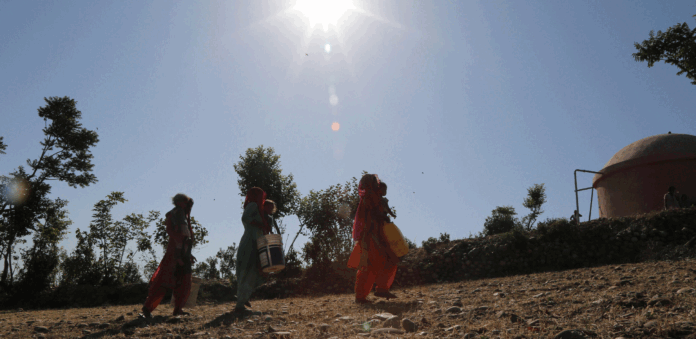
from merely warm to outright scorching, with daytime temperatures regularly breaching 39°C and peaking at a punishing 40.2°C between April 22–26. To put that in perspective, these readings are 5 to 7 degrees Celsius above the seasonal average, a staggering deviation that meteorologists say cannot be brushed aside as routine summer heat.
On April 27, the India Meteorological Department (IMD) issued a formal heatwave alert for
five districts in the Jammu division Jammu, Samba, Kathua, Reasi, and Udhampur
signalling that this is no ordinary warm spell.
A Fortnight of FireThe numbers tell a troubling story. In mid-April (April 13 -19), temperatures hovered in the warm-but-manageable range. But the second half of the month brought a dramatic shift. By April 20, the heat began climbing aggressively. Nighttime lows, which previously offered some relief, also crept upward through late April. The city recorded almost no significant
rainfall during this period, leaving conditions hot, dry, and relentless.
For residents of Jammu, a city that sits at the edge of the plains and is no stranger to
summer heat even this level of intensity has raised eyebrows. Daily life has been disrupted,
with health authorities urging people to stay indoors during peak afternoon hours, drink fluids like ORS and lassi, and avoid outdoor work when the sun is highest.
Science vs. Social Media As skies blistered above the city, something else caught public attention white streaks
criss-crossing the blue. Social media erupted with speculation: chemtrails, secret government spraying programmes, even theories involving Bill Gates. The claims spread
quickly. Scientists, however, were unequivocal. The IMD and independent meteorological bodies clarified that what people were seeing were simply contrails of condensation trails left by high-altitude aircraft as water vapour freezes behind jet engines. Increased air traffic over the Jammu region made these trails more visible than usual. No credible evidence exists of any chemical spraying, and the claims have been categorically debunked.
Extreme Events Stack Up
The chemtrail distraction, however, should not divert attention from genuinely unusual
weather events that have rattled the region. On April 11, a rare tornado struck Akhnoor, just outside Jammu city. Intense hailstorms have also battered parts of the region in recent
weeks. Meteorologists attribute these events to natural but increasingly volatile atmospheric conditions Western Disturbances interacting with pre-monsoon convective storms in ways that are growing more unpredictable.
Western Disturbances, the extratropical storm systems that sweep in from the
Mediterranean, have long shaped Jammu’s winters and springs. They typically bring
life-giving rain to the plains and snow to the higher reaches of the Pir Panjal range and
Chenab Valley. But climate scientists note that as global temperatures rise, the interactions
between these systems and local heat are producing wilder, more erratic outcomes.
Temporary Relief, Lasting Concern
As of April 28, clouds have begun gathering over Jammu, and the Met Department has
forecast light rain, thundershowers, and gusty winds a brief respite that residents are
welcoming with relief. But meteorologists warn this is no permanent solution. Temperatures
are expected to surge again in the first week of May, potentially triggering fresh heatwave
conditions.
The bigger question looming over this spring’s extremes is one that policymakers and
citizens have been slow to confront: Is Jammu’s climate shifting in ways that demand a
serious, long-term response?
The data from April 2026 suggests the answer may be yes. A city recording temperatures
5–7°C above its seasonal average, with hailstorms, tornadoes, and formal heatwave alerts
all landing within the same month, is not experiencing a blip. It is experiencing a pattern one
that demands attention far beyond what any cloud-seeding conspiracy theory can explain.
The skies above Jammu are sending a message. The real question is whether anyone is
listening.
Around 10,000 devotees pay homage on 5th day of sacred exposition of holy relics of Tathagata
Excelsior Correspondent
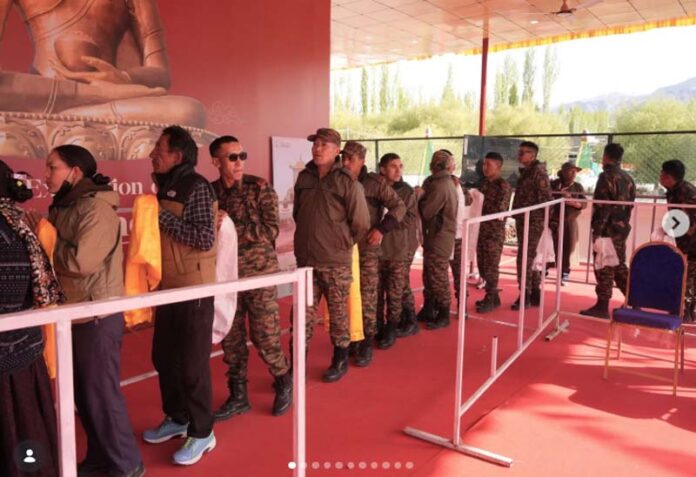
LEH, May 6 : Around 10,000 devotees visited Jivetsal on Thursday as the fifth day of the Buddha relics veneration brought in people from Leh Phudo, Gangles to Skara, alongside government employees and personnel from the Army, paramilitary forces and the Ladakh Police.
From the early morning hours, queues stretched across the approach to the site, moving steadily as visitors waited their turn for a brief moment before the relics.
Organisers noted that the day saw one of the more diverse gatherings so far, with uniformed personnel and civilians arriving in equal measure under the ongoing village-wise schedule.
Prayer ceremonies were led by monks from Chemday Monastery as part of the 15-day programme organised under the Ladakh Gonpa Association, with 16 monasteries taking turns to conduct the rituals each day.
On the ground, volunteers of the Ladakh Buddhist Association Youth Wing managed crowd movement, assisted elderly visitors and coordinated basic arrangements, ensuring that the large turnout was handled without disruption.
The Ladakh Buddhist Association said the phased schedule is aimed at enabling access across regions while maintaining order at the venue.
The veneration will continue tomorrow, with residents of New Settlement scheduled to visit.
The sacred relics will remain at Jivetsal until May 11, following which they will be taken to Zanskar as part of the continuing exposition.
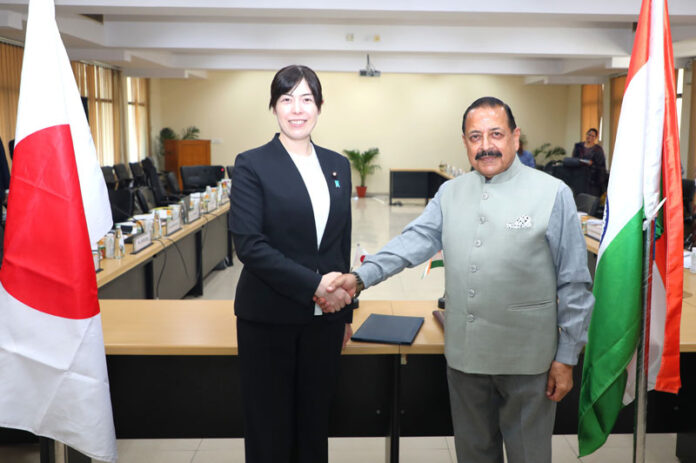
Japan Minister meets Dr Jitendra, discusses collaboration in health, medical devices
Excelsior Correspondent
NEW DELHI, May 6: Japan Minister for Science & Technology Policy and Minister of State for Space Policy, ONODA Kimi, accompanied by a high level official delegation, called on Union Minister of State (Independent Charge) for Science & Technology, Earth Sciences, and Minister of State for PMO, Personnel, Public Grievances, Pensions, Atomic Energy and Space, Dr. Jitendra Singh, to discuss collaboration across different domains, particularly in the field of health and medical devices.
India and Japan advanced their strategic partnership in science, technology and innovation during the high-level bilateral engagement with a strong focus on emerging and critical technologies.
The meeting marked the exchange of a Memorandum of Cooperation (MoC) in the field of health and medical devices among the Japan Agency for Medical Research and Development (AMED), the Indian Council of Medical Research (ICMR) and the Department of Science and Technology (DST).
A Letter of Intent (LoI) on cooperation in Quantum Science and Technology was also signed between the Cabinet Office of Japan and DST, opening new avenues for collaboration in next-generation technologies.
Addressing the gathering, Dr. Jitendra Singh said- India and Japan share a natural synergy in science and technology. While Japan brings advanced technological capabilities, India offers a vast pool of talented human resources. Together, we can accelerate innovation in frontier areas and translate research into impactful societal outcomes.
The Minister added that India’s expanding national missions in Quantum Technologies, Cyber-Physical Systems, Electric Mobility, Clean Energy and Advanced Computing reflect the country’s strong push towards deep-tech sectors, creating new opportunities for joint research, co-development and industrial partnerships.
Speaking on the occasion, Ms. ONODA Kimi appreciated India’s rapid economic growth and its strong commitment to innovation, particularly the large-scale adoption of artificial intelligence across sectors. She shared that her visit to India, including interactions with academic institutions, reflected a strong culture of resilience among young researchers, with the ability to learn from failure and continue pursuing innovation.
ONADO Kimi highlighted that Japan’s strengths in advanced manufacturing and computational technologies, including quantum and AI, align closely with India’s expanding technology ecosystem. She expressed confidence that the agreements exchanged during the meeting, particularly in quantum technologies and health research, will promote deeper collaboration spanning research, application and industrial deployment.
During the discussions, both sides exchanged detailed views on strengthening cooperation under India’s National Quantum Mission, which is advancing an integrated approach across quantum computing, communication, sensing and materials, along with progress in long-distance quantum secure communication networks.
From the Indian side, key participants included Prof. Abhay Karandikar, Secretary, Department of Science and Technology, and Prof. Rajiv Bahl, Director General, Indian Council of Medical Research, along with senior officials associated with international cooperation and quantum initiatives.
The Japanese delegation included senior officials such as Fukunaga Tetsuro, Director-General, Secretariat of Science, Technology and Innovation Policy; Mr. Hayashi Teiji, Ambassador for Global Health, and representatives from AMED and the Embassy of Japan in India.
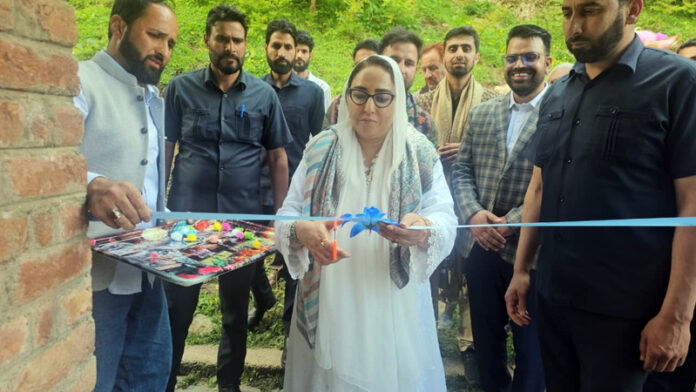
Dr Darakhshan inaugurates beautification project at Sarbal
*Lays foundation for works at Aishmuqam
Excelsior Correspondent
SRINAGAR, May 6: The Jammu and Kashmir Waqf Board Chairperson, Dr Syed Darakhshan Andrabi today visited the Ziyarat of Sakhi Zainuddin Wali (RA) at Aishmuqam and paid obeisance there.
She inspected the whole complex and took stock of the management and other facilities there.
Waqf Board’s Executive Magistrate- Ishtiyaq Mohiuddin, Executive Engineer of the Board Qazi Mushtaq and other officers accompanied Dr Andrabi.
Waqf Chairperson laid the foundation for the construction of the retaining wall in the shrine. Later, Dr Andrabi inaugurated multiple developmental works including the reconstruction and beautification project of the shrine of Sakhi Zainshah Wali at Sarbal shrine. She also unveiled the developmental plaque at the shrine complex.
Waqf Chairperson spoke to media after these events and assured that Board will continue its journey for excellence through transparent developmental projects throughout Jammu & Kashmir.
“Sakhi Zainuddin Wali (RA) is the beacon of our spiritual Rishi tradition. The Board has done massive developmental works at both these shrines and also improved the facilities for the devotees visiting the shrines. The developmental journey continues”, said Andrabi.
She thanked her critics for making her to mobilize more vigorously towards selfless service and also convincing her that great work is the real answer to the criticism around. “We have a clear roadmap, a broad vision and hence no distraction stops us from going ahead. Glorifying our spiritual centres with required infrastructural developmental and ensuring a befitting environment through proper management of our shrines is our resolve and we enforce all our energies into this mission”, Dr Darakhshan said.
Waqf Chairperson also interacted with many public delegations at both places after the events.
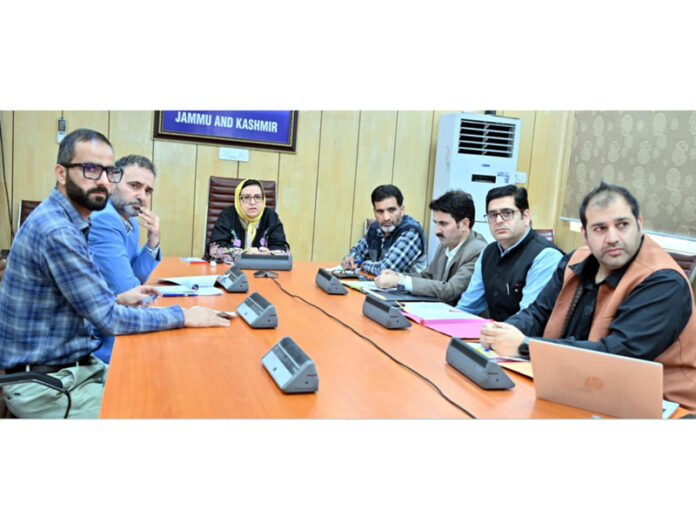
Sakeena reviews recruitment process of various departments, SKIMS
Excelsior Correspondent
SRINAGAR, May 6: Minister for Health and Medical Education, Social Welfare and Education, Sakeena Itoo today chaired a high-level review meeting to assess the recruitment process undertaken by the Jammu and Kashmir Services Selection Board (JKSSB) in various departments like Health and Medical Education, Social Welfare, Education Departments and Sher-e-Kashmir Institute of Medical Sciences (SKIMS) Soura.
The meeting was attended by Chairman, JKSSB, Vikas Kundal; Secretary JKSSB, Khurshid Ahmad Sanai; Additional Director SKIMS, Zahoor Ahmad Mir; Controller of Examinations JKSSB, Director Finance, Health and Medical Education Department, representatives of various departments and other officers.
During the meeting, the Minister conducted a comprehensive evaluation of the progress made in filling vacancies of different categories in various departments. The review meeting also focused on expediting transparent, merit-based recruitment to address critical manpower requirements across healthcare institutions and allied departments.
Addressing the officers, the Minister emphasized on the Government’s commitment towards ensuring efficiency, accountability and fairness in the selection process. She stressed on maintaining transparency and adhering to timelines during the recruitment process.
The Minister directed the concerned authorities to accelerate the recruitment process, particularly in Health and Education Departments as well as SKIMS. She also stressed on maintaining coordination between the departments and recruiting agency to ensure vacant positions are filled promptly and selected candidates are deployed without unnecessary delays.
“Human resource, particularly in Health Department, is vital for improving healthcare access and outcomes, particularly in underserved and remote areas”, Sakeena said.
Emphasizing on the importance of timely recruitment, Sakeena Itoo directed the concerned authorities to expedite the ongoing selection processes while strictly adhering to merit, transparency, and fairness. She expressed satisfaction over the pace of recruitment and stressed that there should be no complacency in meeting future targets.
Regarding SKIMS Soura, the Minister directed the Additional Director to maintain constant coordination with JKSSB administration so that the recruitment process of pending posts is finalized timely. She highlighted that SKIMS is a premiere health institution and the government is determined to ensure sufficient manpower in it for constant service delivery of public.
While reviewing various aspects of JKSSB related to recruitment processes, Sakeena Itoo asked the JKSSB administration to explore the possibilities of reducing the application fee for the advertised posts. She directed them to study the fee structure of Government recruiting agencies of other States and UTs, and examine the growing demand of candidates calling for reduction in application fees.
During the meeting, Chairman JKSSB briefed the Minister on department-wise recruitment status, upcoming examinations and measures being implemented to streamline the selection process.
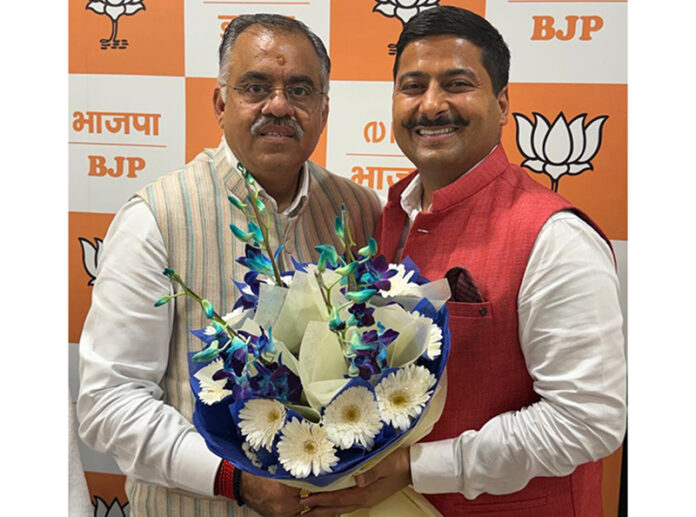
Gaurav meets Tarun Chugh, discusses key political issues
Excelsior Correspondent
JAMMU, May 6: J&K BJP spokesperson and convenor, International Affairs, Gaurav Gupta today called on National general secretary of the party Tarun Chugh in New Delhi and held detailed discussions on key organizational and political developments, particularly in the context of Jammu & Kashmir.
During the meeting, Gaurav Gupta said that the BJP’s strong performance in the recently concluded Assembly elections in Bengal reflects the growing trust of citizens in the leadership of Prime Minister Narendra Modi and the BJP’s commitment to development, good governance, and national unity.
The discussions also focused on strengthening the party’s outreach in J&K, with emphasis on youth engagement, grassroot expansion, and further consolidating public support across regions. Gaurav highlighted the positive transformation taking place in J&K in recent years, including improved infrastructure, enhanced connectivity, and increased investment opportunities.
Tarun Chugh reiterated the BJP’s commitment to ensuring peace, progress, and prosperity in the Union Territory. He stressed the importance of continued public outreach and organizational strengthening at the booth level to further expand the party’s base.
Gaurav also discussed various issues concerning the people of J&K, including employment generation, promotion of tourism, and empowerment of youth and women. He reaffirmed the party’s resolve to work tirelessly for the welfare of all sections of society and to take forward the vision of a developed and peaceful J&K.
The meeting concluded with a renewed commitment to intensify organizational activities and ensure that the benefits of Government schemes reach every household in the region.