

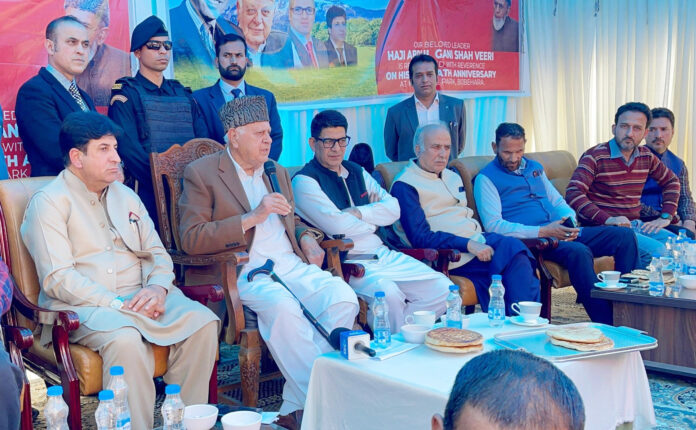
Srinagar, Apr 21: Former Jammu and Kashmir chief minister Farooq Abdullah on Tuesday termed the Pahalgam terror attack a major setback for Jammu and Kashmir as he paid tributes to those who lost their lives in the incident last year.
Speaking to reporters, Abdullah said he wishes to pay homage to all those who were killed, particularly those who stood up against terrorism.
Commenting on the proposed second round of US-Iran talks, he expressed optimism that continued dialogue would eventually lead to peace, stating that there is no alternative to peaceful resolution.
“Multiple rounds of talks may take place, but peace will ultimately prevail. The world can only be saved through peace,” he said.
On the Women Reservation Bill, the NC president said his party is not opposed to reservation, recalling that the bill, when introduced in 2023, was passed with a majority. (KNC)
“Pahalgam Attack Was A Major Setback To J&K: Farooq Abdullah
Acai Theory raises Rs 4 crore in pre-seed funding

PNB Housing Finance shares jump 11 pc post Q4 earnings

Welspun One leases 2.10 lakh sq ft of warehousing space at JNPA SEZ to Indev Infra

Pak receives second tranche of USD 1 bn loan from Saudi Arabia

Renewable energies overtook global electricity demand last year, led by solar growth in China, India

LG unveils Statue Of Renowned Social Worker Shri Vijay Bahadur Singh In Ghazipur
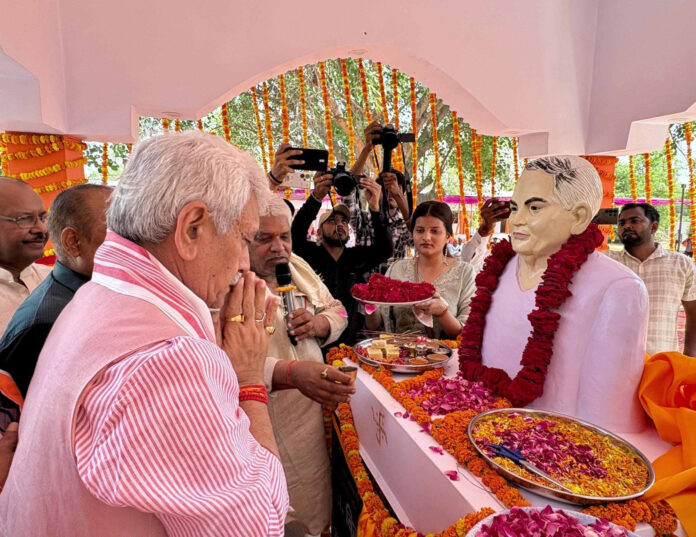
Jammu, Apr 21: Lieutenant Governor Manoj Sinha on Tuesday called for building India which our freedom fighters once dreamed of and in which every section and every individual is part of the mainstream of progress.
“India is moving decisively towards becoming a developed nation. The goal of 2047 is not merely a date; it is a national resolve,” the Lieutenant Governor said.
The Lieutenant Governor was speaking at the statue unveiling ceremony of Shri Vijay Bahadur Singh, a well‑known social worker and the founder of Mahamandaleshwar Shri Bal Krishna Yati Inter College at Ghazipur, Uttar Pradesh.
Paying homage to Shri Vijay Bahadur Singh, the Lieutenant Governor that he discharged his duties without any expectation, served without any desire for fame, and built not for himself but for the coming generations.
The Lieutenant Governor emphasized that we must carry the ideals of Shri Vijay Bahadur Singh Ji, a true karma‑yogi, to every segment of society.
“I feel particularly proud that Shri Vijay Bahadur Singh Ji did not ask what Bindravan could do for him; instead, he showed what Bindravan and the Jakhania region could do for themselves. This Inter College, born of a people’s movement, is just a small symbol of his transformative work.
Shri Vijay Bahadur Singh Ji did not merely establish a college; he made a pledge, a promise to the future. In 1974, when he laid the foundation of this institution, there was no major financial support and no assurance of success. All he had was an unshakeable belief that education is the power which can change society,” the Lieutenant Governor said.
In his address, the Lieutenant Governor spoke about service, sacrifice and nation‑building.
He highlighted that under the leadership of Hon’ble Prime Minister Shri Narendra Modi, India has taken development beyond mere statistics and carried it to every doorstep.
The Lieutenant Governor said that Crores of families who once had no roof over their heads now have their own homes, and this has brought them dignity and security in society.
“Roads have reached every village, the number of airports has doubled, the digital revolution has connected every section of society. Today the marginalised section have bank accounts, they have an identity, they hold smart mobile phones for financial transactions, and in my view this is not merely technological progress but social empowerment
In far‑flung regions of the country, new schools, new universities and a new education policy together have begun to build an India in which the hands of the youth hold the reins of the future. The facilities now available particularly for girls are unprecedented in our history, and the purpose of education through innovation and research is no longer merely to pass exams but to create an aware and responsible citizen,” he further said.
J&K | Unseasonal Snow Adds To Hardship Of Gujjar, Bakerwal Tribes’ Seasonal Migration
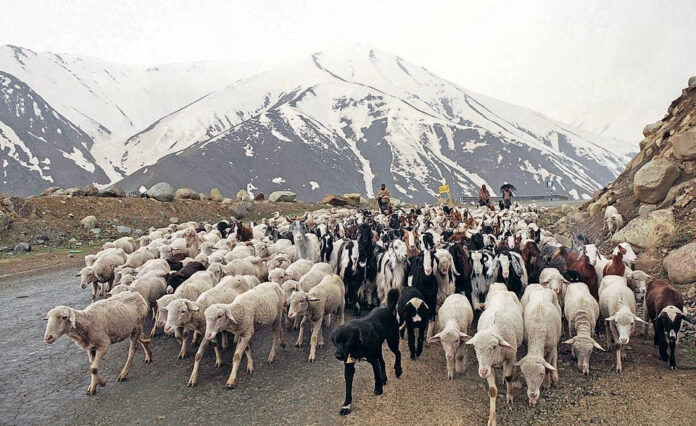
BHADERWAH, Apr 21: Amid unseasonal snowfall, hundreds of Gujjar and Bakerwal tribes have begun their centuries-old biannual migration to the highland pastures of Jammu and Kashmir’s Chenab Valley, braving harsh conditions.
The nomads and their livestock embarked on their traditional routes last week, signalling the start of the seasonal transhumance. The movement comes notwithstanding fresh, or rather unusual, snowfall in several higher-altitude areas, which has made the passage particularly risky.
Hundreds of families have been traversing through the plains of Kathua, Samba and Jammu districts towards the high-altitude meadows of the Chenab Valley, a journey that would take at least a month to reach the summer pastures.
According to official figures, in the past 10 days, 250 nomadic families have crossed the 10,500-foot-high snow-bound Chattergalla check post, connecting Bhaderwah in Doda district with Basohli in Kathua district.
Accompanied by herds of sheep, goats, and horses, the families have been navigating steep mountain trails, swollen streams, and slippery tracks, exposing themselves to significant challenges.
Officials said the migration is crucial for the sustenance of these communities, as they depend on highland grazing grounds during the summer months. Each year, as winter recedes and spring sets in across the Jammu region, the Gujjar and Bakerwal tribes embark on their centuries-old migration, revitalising the highland pastures of Doda, Kishtwar and Ramban districts in the Chenab Valley.
“Though we face numerous life-threatening challenges during migration, we have been in this profession since time immemorial. We have no option but to continue this extremely difficult way of life, which has been passed down by our forefathers,” Abdul Majeed (85), a resident of Basholi in Kathua who is leading his group to Paddar in Kishtwar, said.
Majeed said that every year, the community loses livestock, including goats and horses, during the arduous journey due to harsh weather conditions, adding that even children and the elderly have, at times, lost their lives. He also said that there have been little to no government assistance.
“Due to snowstorms along the 15-km route between Sarthal and Guldanda, several of our goats died. Food was also scarce for three consecutive days (last week). We now hope to reach our destination in Machail safely,” Nishata Begum (63) said.
She said what was once a time of joy during migration has now turned into a period marked by the loss of hard-earned livestock, compounded by instances of hostility and discrimination from locals.
Begum said despite her two sons being graduates and belonging to the Scheduled Tribe category, they were unable to secure government jobs and were ultimately compelled to continue the centuries-old occupation of their forefathers.
Saddam Chohan (14) said the journey to the high-altitude meadows brought him face-to-face with harsh realities at Chattergalla, where several goats perished in a snowstorm before his eyes, leaving him helpless.
He said the family has little choice but to continue the profession practised by his father and grandfather.
Bhaderwah Divisional Forest Officer Devinder Kumar has formed a team of officials, led by Range Officer Sameer Rishu, to ensure that the nomads do not face any hostility from anyone while passing through forest areas.
“Several hundred families have entered the Bhaderwah forest range over the past fortnight, and our team is there to receive them round the clock, as many continue their journey even during night hours,” Rishu said.
The officer urged locals not to view the nomadic tribes as trespassers but to welcome them as guests, emphasising that they are an integral part of the forest ecosystem.
He said the communities share a centuries-old, symbiotic relationship with the forests — relying on them for food, shelter and livelihoods while also conserving biodiversity through sustainable practices.
“Their culture, beliefs and traditional knowledge are deeply rooted in nature, making them custodians of the forests rather than mere users,” Rishu said.
Tribal nomads traditionally move with their livestock to the upper slopes of the northern Himalayas during the summer, and return to the plains in winter after covering hundreds of miles on foot along serpentine tracks. (Agencies)
Security Of Key Installations Reviewed In J&K’s Reasi
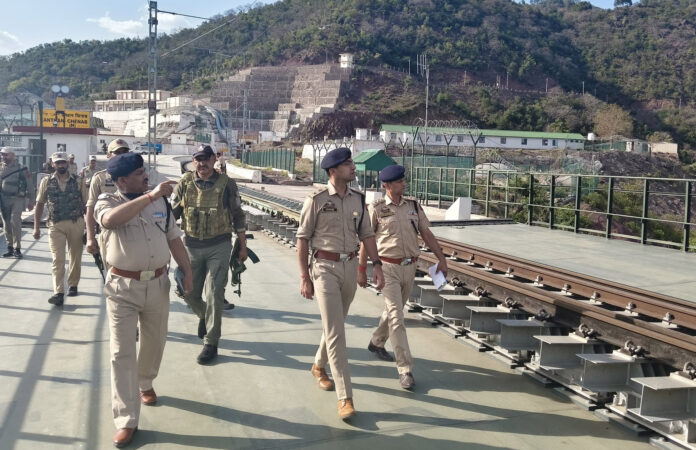
JAMMU, Apr 21: Security of several vital installations, including the world’s highest railway arch bridge over Chenab, was reviewed during a high-level inspection in Jammu and Kashmir’s Reasi district on Tuesday, police said.
Senior Superintendent of Police, Reasi, Mukund Tibrewal conducted the comprehensive security review of Chenab bridge, Dugga railway station and Sawalakote hydro-electric project in Arnas sub-division, a police spokesman said.
At Chenab bridge connecting Kouri and Bakal, the SSP interacted with CRPF and Government Railway Police (GRP) deployed for security of the bridge and adjoining areas, emphasising the need for strong inter-agency coordination to ensure effective joint area domination of nearby villages and forest belts.
Tibrewal also sought strict access control measures and the use of modern surveillance systems to prevent any untoward incidents, the spokesman said. At Dugga station and Sawalakote, the officer interacted with deployed security personnel and members of the Village Defence Groups.
He directed that all area domination exercises be documented daily and stressed the importance of regular engagement and training, including firing practice for Village Defence Guards.
The SSP also visited the Dhansal police post and Arnas police station. At the Arnas police station, he issued directions to improve the maintenance of police records and ensure cleanliness of the premises. Investigating Officers were instructed to focus on expediting inquests, tracing missing persons, and apprehending absconders to reduce pendency, the spokesman said. The SSP said the security of vital installations, including religious sites, remains the top priority for the district. (Agencies)
Two PCCF-Rank Officers To Continue In J&K After Promotion

JAMMU, Apr 21: The Ministry of Environment, Forest and Climate Change has ordered the promotion and posting of three Indian Forest Service (IFS) officers in the AGMUT cadre, with two of them set to continue in the Union Territory of Jammu and Kashmir.
As per the order, Sandeep Kujur (1995 batch) and Chaturbhuj Behera (1996 batch) have been promoted to the rank of Principal Chief Conservator of Forests (PCCF) and will continue their postings in Jammu and Kashmir.
Meanwhile, Ravi Horo (1996 batch) has been transferred from Mizoram to Andaman and Nicobar Islands.