

List of Tehsildar (T) Jammu Approved Case Residential and Commercial
US says it stands with India in efforts to defend its sovereignty; two countries ink key defence pact BECA
NEW DELHI, Oct 27: China’s military belligerence in eastern Ladakh and Indo-Pacific region figured prominently during the third edition of the 2+2 strategic dialogue between India and the US with Washington strongly affirming that it stands firmly with New Delhi in its efforts to defend sovereignty as the two sides vowed to ramp up their security ties, and inked the strategic defence pact, BECA.
During the high-level dialogue, which was led by Defence Minister Rajnath Singh and External Affairs Minister S Jaishankar from the Indian side and US Secretary of State Mike Pompeo and Defence Secretary Mark T Esper from the US side, the two countries also denounced the use of terrorist proxies and asked Pakistan to expeditiously bring to justice the perpetrators of all terror attacks, including 26/11 Mumbai, Uri, and Pathankot. Both sides were assisted by their top military and security officials.
In a blunt criticism of China, Pompeo, cited killing of 20 Indian Army personnel in the Galwan Valley in eastern Ladakh in a clash with the Chinese military, and asserted that both India and the US are taking steps to strengthen cooperation against all threats and not just those posed by the Chinese Communist Party (CCP).
Top government sources said China’s “expansionist behaviour” in eastern Ladakh and in various parts of the world was a major talking point during the meeting with both sides vowing to firmly confront the challenges in the region and beyond as part of their common vision and shared interests.
“This morning we visited the national war memorial to honour the brave men and women of the Indian Armed forces who sacrificed for the world’s largest democracy including the 20 soldiers who were killed by the PLA forces in Galwan Valley in June,” Pompeo said at a joint media briefing with Jaishankar, Singh and Esper.
“The US will stand with people of India to confront threats to their sovereignty and their liberty,” he added.
In the talks, which were held just a week before the US presidential elections, the two countries inked a total of five agreements including the long-negotiated Basic Exchange and Cooperation Agreement (BECA) that will allow sharing of high-end military technology, classified satellite data and critical information between their militaries.
The US Secretary of State also said that the challenge of defeating the coronavirus pandemic that came from Wuhan figured in the “robust discussions” about the Chinese Community Party.
“Our leaders and our citizens see with increasing clarity that the CCP is no friend to democracy, the rule of law transparency…I am glad to say that the US and India are taking steps to strengthen our cooperation against all manner of threats and not just those posed by the Chinese communist party,” Pompeo said.
A joint statement issued after the talks said the two sides also denounced the use of terrorist proxies and asked Pakistan to take immediate, sustained and irreversible action to ensure that no territory under its control is used for terrorist attacks, and to expeditiously bring to justice the perpetrators of all such attacks, including 26/11 Mumbai, Uri, and Pathankot.
“They emphasised the need for concerted action against all terrorist networks, including al-Qaeda, ISIS/Daesh, Lashkar-e-Tayyiba (LeT), Jaish-e-Mohammad (JeM) and Hizb-ul-Mujahideen,” it said.
At the press conference, US Defence Esper said the US stands “shoulder-to-shoulder” in support of a free and open Indo-Pacific for all, particularly in view of “increasing aggression and destabilising activities” by China, and noted that the bilateral defence cooperation is continuing to grow.
“I am pleased to report that today we made substantial progress in further strengthening our relationship,” he said.
Esper said the US reaffirmed its commitment to a comprehensive and forward looking defence partnership with India which includes bilateral defence cooperation in the Indian Ocean Region, South East Asia and in the broader Indo-Pacific.
In his remarks, Defence Minister Singh said both sides shared assessment of the security situation across the Indo-Pacific, and reaffirmed commitment to peace, stability and prosperity of all countries in this region.
“We also agreed that upholding the rules-based international order, respecting the rule of law and freedom of navigation in the international seas and upholding the territorial integrity and sovereignty of all states are essential,” Singh said.
On his part, External Affairs Minister Jaishankar said the Indo-Pacific region was a “particular focus of our talks”, adding a “multi-polar world must have a multi-polar Asia as its basis”, comments seen as a clear articulation of India’s position that China’s dominance is not acceptable to it.
“We reiterated the importance of peace, stability and prosperity for all countries in this region. As Raksha Mantri stated, this is possible only by upholding the rules-based international order, ensuring the freedom of navigation in the international seas, promoting open connectivity and respecting the territorial integrity and sovereignty of all states,” Jaishankar said.
The external affairs minister said the discussions also covered developments in India’s neighbouring countries.
“We made clear that cross-border terrorism is completely unacceptable. In Afghanistan, India’s stakes in its security and stability are evident, as is our willingness to contribute to international efforts to that end,” he said.
In the talks, the two sides discussed cooperation in a range of sectors including nuclear energy, oil and gas, space, healthcare, cyber security, defence trade and people-to-people contact.
The two sides noted ongoing discussions by the United States Trade Representative and India’s Ministry of Commerce and Industry to reach an understanding on improving market access, removing barriers to trade, and improving the business environment.
“The ministers noted with satisfaction the significant strides made under the four pillars of the strategic energy partnership (SEP) covering oil and gas, power and energy efficiency, renewables and sustainable growth. They also appreciated the progress made under the India-US Gas Task Force and the launch of industry-led projects,” the joint statement said.
Recalling the historic India-US civil nuclear agreement, the ministers welcomed the project initiatives between Nuclear Power Corporation of India Limited (NPCIL) and Westinghouse Electric Company (WEC) for the construction of six nuclear reactors at Kovvada.
On the Indo-Pacific, both sides reiterated commitment to maintaining a free, open, inclusive, peaceful, and prosperous Indo-Pacific built on a rules-based international order, underpinned by ASEAN centrality, rule of law, sustainable and transparent infrastructure investment.
“Highlighting the importance of securing the economic and security interests of all stakeholders having a legitimate interest in the region, the ministers welcomed the growing understanding on the Indo-Pacific among like-minded countries,” the joint statement said.
It said they reaffirmed that closer India-US cooperation will support shared interests in promoting security and prosperity in the Indo-Pacific region and beyond.
“They also emphasised that the Code of Conduct in the South China Sea should not prejudice the legitimate rights and interests of any nation in accordance with international law,” it said.
After the 2+2 talks, Pompeo and Esper called on Prime Minister Narendra Modi and discussed several issues of regional and global concern.
“The Secretary and the Prime Minister pledged to further strengthen the US-India Comprehensive Global Strategic Partnership to better ensure the security and prosperity of both countries, the Indo-Pacific region, and the world,” the US State Department said in a brief statement. (PTI)
CSB Bank, IIFL Finance join hands to offer gold loans in untapped locations
New Delhi, Oct 27: Private sector lender CSB Bank has tied up with IIFL Finance to offer gold loans in untapped locations, including rural areas.
Under the partnership, IIFL, a non-banking financial company, will act as a business correspondent of CSB Bank and will source new business from markets where CSB Bank does not have adequate branch network.
IIFL, with its vast branch network, would help CSB Bank penetrate the lower strata of customers and rural areas, where the bank currently does not have adequate reach. This arrangement would result in scaling up of the customer base, a joint statement said.
“CSB Bank endeavours to serve individuals who are either under-banked or un-banked. Gold loan is the core business driver for the bank. IIFL Finance with its extensive branch network, robust technology…To help the bank penetrate the under-served segments of the customers in under covered geographies of the country,” said CVR Rajendran, Managing Director & CEO of CSB Bank.
CSB Bank is one of the oldest private sector banks in India, with a strong presence in Kerala, Tamil Nadu, Karnataka, and Maharashtra through 432 branches and an overall customer base of 15 lakh in SME, retail, and NRI segments.
“This is a win-win partnership, which combines the strengths of the bank’s balance sheet and NBFC’s last mile connect with the customers, to help financial inclusion of the under privileged customers in need of credit on reasonable terms,” said Nirmal Jain, Chairman of IIFL Finance.
CSB Bank has reported a three-fold jump in September quarter net profit helped by a surge in gold loan business, where assets grew 47 per cent.
The asset under management (AUM) of IIFL Finance is over Rs 38,300 crore and it has over 2,300 branches across India, catering to about 40 lakh customers . Gold loan accounts for about 25 per cent of IIFL’s loan AUM. (PTI)
RBI notifies Government’s interest waiver scheme
Mumbai, Oct 27: Reserve Bank of India (RBI) on Tuesday notified the government’s scheme of interest waiver during the moratorium period and asked all lending institutions to take necessary action within the stipulated timeline.
The RBI said in a release, “The Government of India has announced the scheme for grant of ex-gratia payment of the difference between compound interest and simple interest for six months to borrowers in specified loan accounts (1.3.2020 to 31.8.2020) on October 23, 2020, which mandates ex-gratia payment to certain categories of borrowers by way of crediting the difference between simple interest and compound interest for the period between March 1, 2020, to August 31, 2020, by respective lending institutions.”
According to the scheme, the government will pay the difference between compound interest and simple interest. The ex-gratia payment of ‘interest on interest’ will be applicable for six months and only for selective specified loans.
The Central Government had submitted an affidavit in the Supreme Court earlier this month which supported the waiver of compound interest for loans under a moratorium for certain categories.
The Supreme Court on October 14 had asked the government to implement the decision soon.
(UNI)
NDA is national destruction alliance : Brinda Karat
PATNA, Oct 27: Senior CPI-M leader Brinda Karat Tuesday termed the BJP-led NDA as the national destruction alliance and said that migrant workers from Bihar have been the worst victims of its policies.
Addressing a press conference here, Karat asserted that the opposition Grand Alliance in Bihar, which her party joined less than two months ago, is headed for a landslide win in the state assembly polls whose first phase is slated for Wednesday.
The public mood towards the ruling JD(U)-BJP alliance in the state is loud and clear bas ab aur nahin (we have had enough), she claimed.
The NDA should be called national destruction alliance
One which has dealt a body blow to the peoples right to live with dignity and earn a living, Karat said referring to the crisis triggered by the nationwide lockdown clamped earlier this year to prevent the spread of COVID-19.
She charged the Nitish Kumar government in Bihar with being heartless when millions of people from the state rendered jobless and homeless in far flung cities and towns of the country due to the lockdown, walked hundreds of miles or travelled thousands of kilometers with their families, hitching rides on trucks and cargo vehicles to return to their homes.
First, the government turned a deaf ear to their cries. Later, it fooled them with the promise of jobs on their home soil. Ultimately the poor have again been compelled to move out of their homes to keep body and soul together, she alleged.
The public response towards the Grand Alliance suggests we are headed for a huge win. Their sentiment is loud and clear bas ab aur nahin. They are not going to be swayed by the attempts of Prime Minister Narendra Modi and Chief Minister Nitish Kumar to divert public discourse, the CPI(M) Politburo member said.
We are looking forward to the Bihar assembly poll results, which will not just be a victory for the Left, including CPI(M), but will usher in an era of alternative politics in which policies will be framed keeping in mind the welfare of the common people, she added.
Headed by Lalu Prasads RJD, the Grand Alliance includes the CPI(M), Congress, the CPI and the CPI(ML). (PTI)
Sharing best practices, knowledge among SCO members to help startups: Goyal
NEW DELHI, Oct 27: Sharing best practices, knowledge and engaging investors from the Shanghai Cooperation Organisation member nations will help strengthen startup ecosystem, Commerce and Industry Minister Piyush Goyal said on Tuesday.
Launching the India-SCO Startup Forum, he said creativity, innovation and disruption will be the new mandate in the emerging future.
The Minister said the new unique concepts that startups come up with will get a much larger engagement through this forum. “Sharing our best practices, knowledge, engaging corporates and investors from all the member nations, monetising and mobilising capital, setting up incubators, providing exposure and scale with market access will certainly help the worthy ideas of our startups’ innovations,” Goyal said. SCO (Shanghai Cooperation Organisation) members are China, India, Kazakhstan, Kyrgyzstan, Russia, Pakistan, Tajikistan and Uzbekistan. He added that this forum is an opportunity for all the member nations to share and learn from their experiences.
Speaking at the event, Secretary in the Department for Promotion of Industry and Internal Trade (DPIIT) Guruprasad Mohapatra said that since the launch of the startup India initiative in 2016, over 35,500 startups are recognised by the government, and they are in 590 districts of 28 states and 8 UTs. He said the forum will lay the foundation for multinational cooperations and engagement among the member states to develop and strengthen their startup ecosystem collectively.
The forum would help in empowering the local startup ecosystem, and enable access to investors and corporates in startups. The forum was jointly launched by industry body CII and DPIIT. (PTI)
Poor now linked to banking system, have access to loans: PM
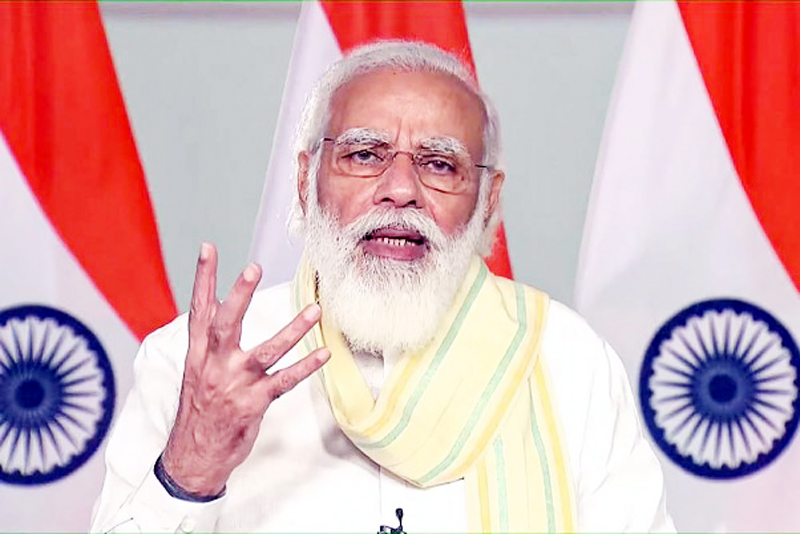
LUCKNOW, Oct 27: Prime Minister Narendra Modi on Tuesday said his Government has acknowledged the honesty and hard work of street vendors by offering them loans that were inaccessible to the poor in the past.
Addressing beneficiaries of the PM Street Vendor’s Atma Nirbhar Nidhi (PM SVANidhi) Scheme in Uttar Pradesh via video conferencing, he said, “Those doing politics in the name of the poor had created an atmosphere that if a loan is given to the poor it would not be returned”.
Modi said today the poor have been linked to the banking system and loans have been given to street vendors who are repaying them in time.
“Those who had themselves been involved in scams had always put the blame of all dishonest things on the poor, but I have always been saying that the poor of the country have never compromised with honesty and self respect,” he said.
“Through the PM Svanidhi Yojna the poor have once again presented the example of their honesty before the country. The street vendors of UP are repaying loans through their hard work besides earning their livelihood. This is the will power and hard work and honesty,” he said.
The Prime Minister interacted with three beneficiaries of the scheme hailing from Agra, Varanasi and Lucknow and enquired about how it has helped them. He said they have all presented an example which should be replicated by all.
Modi, who explained the scheme in detail, also took the opportunity to attack those who had questioned the government’s move of linking the poor with the banking system.
“The doors of the banks which have today been opened for you have not happened in a day. It is the result of the ‘sabka saath, sabka vikas and sabka vishwas’ policy,” he said.
The PM said the scheme was a reply to those who were sceptical about linking the poor with the banking system.
He claimed that when the jan-dhan accounts were opened, many people had questioned and laughed but now those accounts had come to the help of the poor.
“The street vendors are helping in taking the poor forward, they are getting connected to banks, the mainstream of the economy. In such a global pandemic which forced big nations to bow before it, the common man of the country bravely did it,” he said.
The PM SVANidhi scheme was launched on June 1 this year to help poor street vendors, impacted by economic distress due to the COVID-19 pandemic, in resuming livelihood activities. Around 25 lakh applications have been received of which 12 lakh have been sanctioned.
Modi said almost 6.50 lakh applications had been received from UP of which 3.75 lakh were sanctioned. He lauded the banks and their employees in making an important contribution in achieving this target. (PTI)
Govt announces current guidelines on reopening of activities to be applicable till Nov 30
NEW DELHI, Oct 27: The Centre on Tuesday said the current guidelines allowing various activities like opening of cinemas, theatres and multiplexes with up to 50 percent of their seating capacity will continue to be applicable till November 30 in areas outside the containment zones.
Earlier, the guidelines for reopening activities issued on September 30 were to be in force till October 31.
The Ministry of Home Affairs issued an order today to extend this period till November 30, an MHA spokesperson said.
The guidelines said that international travel, except those permitted by the Centre, would remain shut while state and UT governments were given the flexibility to decide on reopening of schools and coaching institutions in a graded manner.
The decision is to be taken in consultation with the respective school and institution management, based on their assessment of the situation, and subject to certain conditions, according to the guidelines.
The activities permitted in areas outside the containment zones were — cinemas, theatres and multiplexes with up to 50 percent of their seating capacity, Business to Business (B2B) exhibitions, swimming pools used for training of sportspersons, entertainment parks and similar places.
Various ministries and departments have issued standard operating procedures for the reopening of activities.
Political gatherings in poll-bound Bihar and those constituencies where by-elections will be held were allowed with attendance of a maximum of 200 people in a closed space or hall and in an open space depending on its size.
The political gatherings can be held only outside the containment zones.
The lockdown shall continue to be implemented strictly in the containment zones during the period.
The coronavirus induced country-wide lockdown was first announced by Prime Minister Narendra Modi from March 25 and it was extended in phases till May 31.
The Unlock process in the country had begun on June 1 with the graded reopening of commercial, social, religious and other activities.
Since the issuance of the first order on lockdown measures by the home ministry on March 24, almost all activities have been gradually opened up in areas outside the containment zones, a home ministry statement said.
While most of the activities have been permitted, some activities involving large number of people have been allowed with some restrictions and subject to SOPs being followed regarding health and safety precautions.
These activities include metro rail, shopping malls, hotel, restaurants and hospitality services, religious places, yoga and training institutes, gymnasiums, cinemas, entertainment park etc.
In respect of certain activities, having relatively higher degree of risk of COVID infection, state and UT governments have been permitted to take decisions for their re-opening, based on the assessment of the situation and subject to SOPs.
These activities include schools and coaching institutes, state and private universities for research scholars and allowing gatherings above the limit of 100 etc.
The home ministry said the essence behind graded re-opening and progressive resumption of activities is to move ahead.
However, it does not mean the end of the pandemic and there is a need to exercise abundant caution by adopting COVID-19 appropriate behaviour by every citizen in their daily routine.
A ‘Jan Andolan’ was launched by the Prime Minister Narendra Modi on October 8 on COVID-19 appropriate behaviour to follow three mantras, namely: wear mask properly, wash hands frequently; and maintain safe distance of six feet, the statement said.
The home ministry said where schools are conducting online classes, and some students prefer to attend online classes rather than physically attend school, they may be permitted to do so.
Students may attend schools and institutions only with the written consent of parents.
Attendance must not be enforced, and must depend entirely on parental consent, the home ministry said.
The Department of Higher Education under the Ministry of Education may take a decision on the timing of the opening of colleges and higher education institutions, in consultation with the home ministry, based on the assessment of the situation.
Online and distance learning shall continue to be the preferred mode of teaching and shall be encouraged.
However, higher education institutions only for research scholars (Ph.D) and post-graduate students in science and technology stream requiring laboratory and experimental works will be permitted to open under some conditions.
For centrally funded higher education institutions, the head of institution will satisfy herself or himself that there is a genuine requirement of research scholars (Ph.D) and post-graduate students in science and technology stream for laboratory and experimental works, the ministry said.
All other higher education institutions e.g State universities, private universities etc may open only for research scholars (Ph.D) and postgraduate students in science and technology stream requiring laboratory and experimental works as per decision to be taken by the respective State and UT governments.
The home ministry again said that the states will not impose any local lockdown outside containment zones without prior consultation with the central government.
There will be no restriction on inter-state and intra-state movement.
The number of coronavirus cases reported in India in a span of 24 hours dropped to below 40,000 after over three months, while the new fatalities registered during the same period remained under 500 for the second consecutive day, according to the Union Health Ministry data updated on Tuesday.
India’s COVID-19 tally mounted to 79,46,429, with 36,470 new infections being reported in a day, while the death toll climbed to 1,19,502 with 488 new fatalities, the data updated at 8 am showed.
A total of 72,01,070 people have recuperated from COVID-19 so far, pushing the national recovery rate to 90.62 per cent while the case fatality rate stands at 1.50 per cent. (PTI)
US court sets first hearing on Google antitrust lawsuit
Washington, Oct 27: US District Judge Amit Mehta on Monday announced that the first pretrial hearing on the Department of Justice (DOJ)’s antitrust lawsuit against search giant Google will be held on Friday.
The judge from the US District Court for the District of Columbia said lawyers for both the DOJ and Google must appear at the telephone hearing at 1400 hrs (GMT) and the hearing will be open to the public and media.
The DOJ filed an antitrust lawsuit against Google on October 20, accusing the tech giant of maintaining its status as “gatekeeper” to the Internet by illegally using its muscle to prevent the rise of competitors.
The lawsuit alleged that the Alphabet Inc unit has spent billions of US dollars to smart phone manufacturers like Apple in making its search service the default in browsers.
Google has issued its public response to the lawsuit, calling it “deeply flawed” as users chose, instead of being forced, to use Google.
“People use Google because they choose to, not because they’re forced to, or because they can’t find alternatives,” Google SVP of Global Affairs Kent Walker wrote in a blog post. “This lawsuit would do nothing to help consumers,” he added.
(UNI)