

NEW DELHI, Oct 24: Russia’s largest lender Sberbank will hold its next Artificial Intelligence Journey, an annual global conference of AI and data science, in December and expects large-scale Indian participation including for an online AI contest for students and others.
The event, which was previously scheduled for November, will now be held from December 3-5, 2020, Sberbank said in a statement.
Officials said the bank is expecting large-scale participation from India for the contest as well as for the conference.
The bank has billed AI Journey as the largest platform about artificial intelligence and its application in Russia and abroad and the event is being organised in cooperation with leading Russian and foreign technology companies.
In 2019, AI Journey was held offline and attracted more than 150 leading industry experts as speakers. This year, about 200 leading Russian and international experts are expected as speakers.
Sberbank said the 2020 event will consist of an online AI contest — AI Journey Junior, an online conference for middle and high school students who are interested in AI and DS; and a three-day online conference on solutions in machine learning, computer vision, natural language processing, neuromorphic and heterogeneous computing, to name a few.
AI online contest winners will split the prize pool of RUB 6.8 million (about Rs 66 lakh). The first prize for adults and schoolchildren is RUB one million (about Rs 10 lakh). Creators of the best solutions will be awarded during the Artificial Intelligence Journey conference (AI Journey).
The 179-year-old bank, which commands a market valuation of USD 67 billion and is majority-owned by the Russian government, is present in 17 other countries, including in India through branches, subsidiary banks and representative offices.
Recently, it announced a major makeover to transform itself into a technology giant with the launch of a host of products and services in the digital space which will be first rolled out in its home market and taken abroad later, including to India. (PTI)
Russia’s Sberbank to host 2020 AI contest in Dec; expects large-scale Indian participation

Safety of women
Sharda Lal
In recent times the incidents of crime against women, including minor and teenage girls, in the society have become so rampant that sometimes one feels that each one of them needs to be ‘officially’ armed like Durga and trained in martial arts and use of arms for self-defence. Though we take pride in claiming that women in India enjoyed equal status with men in all walks of life during the Vedic period and for thousands of years later, but it is unfortunate that we are a hapless witness to the circumstances leading to painful and gory deaths of women and girls like Disha Salian (in Mumbai), the daughters of Hathras & Balrampur, and so many others. They are mercilessly falling victims to the most inhuman (heinous and brutal) violence, crimes and unnatural deaths. What a tragedy!
During the Sharad (or Autumn) Navratra festival as well as the Vasanti (Spring) Navratras, the devout traditionally recite Durga Saptashati (700 verses), keep fasts and sing prayers dedicated to the glory of Goddess Durga, but we see that most of the followers of the tradition recite these just to perform the ritual and nothing more. The message and the essence of the scriptures which is to inculcate morality, strength and other positive attributes of Durga amongst the contemporary generation, including the girl child, are generally seen being simply glossed over and ignored. The following episode of immense historical and religious significance becomes especially relevant here.
‘Even after the conclusion of a six month long Shat Chandi Yagya ceremony, starting from Autumn Durga Ashtami (October 1698) and concluding on Spring Durga Ashtami day (28 March 1699) when all the ghee and incense had been burnt in the havan and the Goddess Chandi had yet not appeared physically, that Shri Guru Govind Singh Ji came forward before a big congregation of his followers at the hill of Naina Devi temple with a naked sword and, flashing it before the assembly declared: “This is the goddess of power!” Earlier, in his divine composition the Chandi Charitra, the Tenth Guru says that in the past God had deputed goddess Durga to destroy evil doers. That duty was now assigned to him. He had thus invited Pandit Kesho from Kashi to conduct the ceremony at the hill of Naina Devi.
Guru Ji asked the congregation to move to Anandpur, where on the New Year Day of 1st Baisakh, 1699, he would create a new race. On 30 March 1699, at Anandpur Sahib, Guru Govind Singh ji gave a stirring speech to the assembly about the need to protect their spiritual and temporal rights. He then asked if anyone would offer his head in the services of God, Truth and Religion. The five who came forward were Dayaram a Khatri from Lahore, Dharamdas a Jat from Hastinapur near Delhi, Sahib Chand a barber from Bidar in Karnataka, Himmat Chand Kahar, a water carrier from Puri in Odisha and Mohkam Chand Chihimba from Dwarka in Gujarat. They were designated the Five “Beloved Ones” and termed “Khalsa” (ie Purified). Gradually the number of Khalsa swelled to become a force to uphold dharma. The men folk amongst the followers were given the suffix Singh (meaning the lion) to their names and the girls and the women were given the suffix word Kour (meaning the queen).’
Through such ancient scriptures as the Durga Saptashati we learn that morality is as much the panacea for boys as a girl. We also learn from these scriptures that though the Supreme God or the Virat Swaroop or the Parmatma or the Ishwar with His other manifestations like Brahma, Vishnu, Mahesh and other Gods (who may be called the Lords) have been described in masculine terms, but His or Their powers (Shakti) to create, sustain and destroy are all feminine in character. In the Saptashati, Durga or Mahamaya is the all-powerful incarnation in His creation with a combined power of all the divine beings thereby indicating that the masculine gender has no strength without the feminine. Therefore, to identify the evil and fight the demonic tendencies all should get together and put the ‘house to order’.
Durga, described as having emerged as a spirit from the waters of the Holy Ganga and given a physical form by coming together of the Lords Brahma, Vishnu, Shiva, Indra, Chandra, Bhudevi, Varuna and Agni who blessed her with the attractive and powerful features and power of the thunderbolt, the Moon, the Earth, the Sea Water and the Fire. Durga must have acquired her features and power not just by asking, but after undertaking a severe penance (what we call training and practice of subtle as well as martial arts in modern times) under the guidance of different powerful divine beings. She could thus wield her power and authority to protect herself & her righteous devotees and fight against evil beings such as Mahishasura in all the ten directions symbolized by her ten hands. Her three symbolic eyes represent the desire for peace and calmness of the moon, the power of the sun that symbolizes the fire of meditation.
Similar is the story of the God incarnate Vaishno Devi who when still a young girl child, was intimidated by a famous but arrogant and mischievous “tantric” Bhairavnath, the disciple of Guru Gorakhnath whose guru was Matsyendranath, Bhairavnath possessed supernatural powers, but misused them. The girl child took the form of Kali (Mata Vaishno Devi) and beheaded him. Bhairavnath realized Vaishno Devi’s spiritual and divine powers and appeared before her in his true form asking for forgiveness. The Goddess being compassionate and knowing well that though he was a “tamasic” (full of negativity by nature), but having attacked her with the sole intention to achieve his personal salvation, she not only granted Bhairavnath liberation from the cycle of life and death, but also granted him a boon, whereby every devotee, in order to ensure completion of the pilgrimage of Vaishno Devi at Katra, Jammu, shall also have to visit Bhairavnath’s temple near the Holy cave on the return journey.
It is reported by the National Resource Center for Women and by R.C. Mishra (2006) that the conquest by invaders from the West in the Indian subcontinent brought changes to Indian society. The position of women in Indian society deteriorated during this period. Jauhar became a custom among Rajputs of Sindh and Chittorgarh, etc. to save honour. Other vices gained strength over time throughout the medieval history of India. The emergence of official and unofficial discrimination amongst people on basis of caste, region and religion through favours, neglect and oppression created enough scope for unabated strife in the society. Even now, one doesn’t hesitate to shield a proven criminal and someone else may venture to deliberately implicate the projected rivals (political or otherwise) in fabricated cases. The worst affected are obviously the weak; of any gender, demography, religion caste or creed or those who have no access to the powers that be.
It is a herculean task these days to bring the society out of this state of degradation. In the present times of ‘liberalism’ and ‘unbridled freedom’ discussing about morality particularly in the context of gender related issues in the society have in general, started inviting sarcasm. The influx of drugs and ‘vulgarity combined with violent cinema culture’ in the society is diverting not only the children and the youth, but also many amongst the elders from the morality aspects, little understanding that it is eventually the morality that sustains a society. Those against such an exhortation immediately come up with a counter as to what is morality & who defines it. For them the answer is clear; a society knows its moral principles. They could be different for different societies, but the underlying principle is generally the same. It is like “Dharma – not as in religion” which can have different connotations in differing situations but the underlying principle is the same.
The first step must be taken by the governments by introducing moral education at every level as a compulsory subject through schools and colleges and also generating awareness by involving the panchayats, other local bodies and print/electronic media. Moral education can be religion neutral too. For example, speaking the truth is religion neutral and Dharma in the real sense. So is helping someone in distress. Ensuring that womenfolk are respected & protected is again a Dharma and saying no to drugs is Dharma too.
The other step to be taken must be that the perpetrators of crimes like physical assault, whether against a child, man, woman or a teenager of any religion, caste, creed or orientation must be immediately and adequately punished through summary or fast track trial within the legal framework of the country. Instead of giving political and caste/region/religion colour to such crimes, these must be resolved as pure criminal acts demanding immediate delivery of justice. The police in-charge of the locality must be made answerable and accountable in these matters.
It is only when girls (children or teenagers) & women of our country are safe that we can be rest assured that our prayers to Goddess Durga shall be answered.
feedbackexcelsior@gmail.com
Muck dumping destroying Chenab, Devika !

Dr Raja Muzaffar Bhat
In its recent order the National Green Tribunal (NGT) has once again lambasted the National Highways Authority of India (NHAI) and the company which is executing the road widening work on NH-44 around Ramban area. NGT pulled up NHAI and the executing agency for dumping large quantities of muck into the Chenab river as the work on the 4- laning of Udhampur – Banihal national highway (NH-44) is in progress for the last several years. NGT even directed the J&J Pollution Control Board (PCB) to take stringent measures in this regard as in past the PCB has shown a lukewarm attitude towards NHAI and the executing agency. NGT bench comprising chairperson Justice Adarsh Kumar Goel in his order said that J&K Pollution Control Board (PCB) may proceed with the recovery of compensation for the damage and initiate prosecution against the violators of environmental norms following the due process of law. The case has now been listed on March 31st 2021.
Background of case
NGT’s recent order comes on two inspection reports dated July 31st and September 17th 2020 filed by the J&K Pollution Control Board (PCB). The report stated that the dumping in almost all sites was found done in an unscientific manner and without proper compaction and terracing. On the consideration of the inspection reports, the monitoring committee, headed by a former Judge of the High Court, observed that there was a failure in preparing and maintaining designated dumping sites. The dumping sites were overflowing and not properly maintained. The NHAI failed to exercise supervisory control,” the committee noticed. The report filed by PCB recommended that the project director of the NHAI, Ramban, project managers of Gammon Engineers and Contractors Private Limited, Hindustan Construction Company Limited and Choudhary Power Projects Private Limited be prosecuted under the Environment (Protection) Act for the non-compliance of conditions of environmental clearance and directly dumping muck in the Chenab. During the case hearing, the counsel for the NHAI did not dispute the report of the monitoring committee, but submitted that on its part, the NHAI had instructed the contractors for taking remedial action which they failed.
The lawyers representing the construction companies argued before the NGT that the area was prone to landslides and there was default on part of the government in not giving additional space. To this, the NGT Chairperson Justice Goel pulled up the NHAI and said :
“It cannot rest content by simply saying that it has asked the contractors to take remedial action. The responsibility of the NHAI to maintain environmental norms remains”
Pertinently around 2019, NGT had directed Gammon India Limited and Hindustan Construction Corporation Limited (HCC) to pay interim compensation for damage to the extent of Rs 1 crore each. The same was affirmed by the Supreme Court. The Green Tribunal had also directed Gammon India Limited and Hindustan Construction Corporation Limited to furnish performance guarantee of Rs 2 crore each and NHAI to furnish performance guarantee of Rs 1 crore for remedying the situation.
Destruction of Devika
Around January 2019 the Chairman State Pollution Control Board (SPCB) was asked to intervene into the alleged river land grab by one of the construction companies involved in 4 laning of NH-44 around Udhampur. I had been following this case after seeking information under RTI from DC office Udhampur and following the case at State Information Commission (SIC) until it was shut down post article 370 abrogation. One of the construction companies that was penalized by NGT for dumping muck into Chenab river had allegedly encroached a huge forest land that includes the river bed of Devika river. Commissioner Secretary Forests & Environment had in past communicated with the Chairman State Pollution Control Board (SPBC) to send a team of officers to the site and give a factual report. The then State Information Commission (SIC) had sought a complete report from Deputy Commissioner (DC) Udhampur within a month’s time on the alleged land grab near Devika river at village Moudh. SIC in addition to other issues had sought a detailed report from the DC office about the encroachment of 45 kanals of land by a private construction company for setting up a mega stone crushing unit in the area. SIC had asked Additional Deputy Commissioner (ADC) Udhampur how 45 kanals of land were occupied by the company while only 10 marlas of land were allotted to the company by the Government ? As per the interim order issued by State Information Commission (SIC) Jammu vide file No: SIC/J/C/27/2018 Dated: 19.12.2018, the commission had posed following questions before the DC office Udhampur through is Additional DC (ADC) who is also the designated Public Information Officer (PIO) under J&K RTI Act 2009:
a) How the Gammon India Ltd. has occupied 45 kanals and 16 marlas of land for establishing Mobile Stone Crusher Plant when only 10 marlas of private land has been taken on rent basis by the agency ?
b) What is the nature of the land occupied by the agency i.e. whether it is private land or state land ?
c) Has the District Administration permitted the agency to occupy the said land and if not, what action has been taken or is proposed to be taken by the District Administration for vacating the unauthorized encroachment on the said land?
d) How much of the river bed has been filled up by the agency for use of setting up of the machinery, equipment etc ?
e) Has the agency sought permission from Water Resource Authorities or Industries and Commerce Department for filling up the river bed ?
f) Is the filling up of the river bed permissible under the provisions of the J&K Water Resources (Regulation and Management) Act, 2010 and if not what action has been taken or is being taken against the agency for contravention of the provisions of J&K Water Resources (Regulation and Management) Act, 2010 or any other law governing the field? The Additional Deputy Commissioner (ADC) Udhampur who is also the designated Public Information Officer (PIO) in the office of Deputy Commissioner was summoned by the State Information Commission (SIC) in Jammu a few years back . The officer attended the hearing before SIC as this author had filed a complaint against him for violating the RTI law as he didn’t provide correct information vis a vis land grab on banks of Devika a tributary of Tawiriver by a private construction company.
Conclusion
The report submitted by J&K Pollution Control Board (PCB) before the National Green Tribunal mentions that some of the landslides that brought construction activity to a halt could have occurred because of the construction activity itself. Pertinently an environmental audit of the National Highway-44 conducted by a team of experts in July 2019 aftermath of an order by NGT order says that that hillside slopes on Jammu – Srinagar area especially around Ramban Banihal area have “become unstable due to cutting during widening” and that the dumping of muck consisting of stones and boulders are threatening the survival of vegetation and biodiversity in the concerned sites. From this inference one can clearly make-out how dangerous the situation is as Chenab continues to be on the threshold of destruction along with Devika…
(The author is Founder & Chairman of JK RTI Movement.)
feedbackexcelsior@gmail.com
GI tags for Jammu Products
Kaladi Mahajan
Culture forms an essential, rock solid pedestal for every society on which stands the major beliefs and value systems guiding a particular civilization towards their respective meaningful ends. The same stands true for the Dogra Civilization as well, which has been reeling under intense crisis for far too long now. The cultural heritage and traditional motifs have been relegated to reach a level of all but insignificance. Neither do the masses care and nor the government. This has brought us quite closer to what I call an existential crisis, the very threat which can endanger our language in particular and culture in general. This rugged apathy towards Jammu region is perhaps the last straw that can break the camel’s back. Everything pertaining to Jammu is either ignored or bundled within the larger Kashmiri narrative which essentially undermines the existence of Jammu region and raises questions over the administrative functionaries who let it happen right under their noses.
Recently, the Kashmiri Saffron was granted a GI tag, thus including it within a gamut of items from Kashmir to get a such a place in a nationally recognized registry. Now, a question arises as to why a variety grown from Kashmir was chosen over the Kishtwari one (Kung/Lohit), especially when the latter is considered to be superior in quality, fragrance and usefulness than the one found in Kashmir. It’s seriously bewildering that except for one, all the GI Tags from Jammu and Kashmir are from the Kashmir Valley. The one exception is of Basmati rice of Jammu belt but that too has been included in the registry in a non-exclusive manner along with the rice grown in Himachal Pradesh, Punjab Haryana, Delhi and western UP. This has been another major issue and, a rather crippling one for the people of Jammu region just because of the plain fact that by such insidious inclusions the culture and heritage of Jammu region is being ignored, scuttled and being pushed to the wall. This has also led to the development of false consciousness among other Indians vis-a-vis J and K as they have been led to believe that everything emanating and originating from Jammu and Kashmir is having an overbearing Kashmiri character, which, of course, comes as a blatant posturing to promote a common overarching agenda of a monolithic Kashmiri hegemony.
Let’s understand this by taking an example of Basohli Pashmina. Once, the Basohli Pashmina was as famous as the one coming from Kashmir. However, lately, this industry witnessed ‘apartheid’ by the Kashmir centric governments. As narrated by Shiv Kumar Padha, this led to the mass scale unemployment among the man power involved in the manufacturing of Pashmina Shawls at Basohli as the successive governments of this state stopped the supply of the raw Pashmina to the Pashmina industry at Basohli. He further explains that Jammu and Kashmir Governments have been supplying raw pashmina wool of good quality to the Kashmiri units from the government depots at subsidized rates, whereas the units in Basohli (Jammu province) are compelled to purchase second rate pashmina from the open markets of Himachal Pradesh at high rates. This highhandedness by the Kashmir centric governments have ruined the household based Basohli industries, majority of whom were having hand to mouth existence.
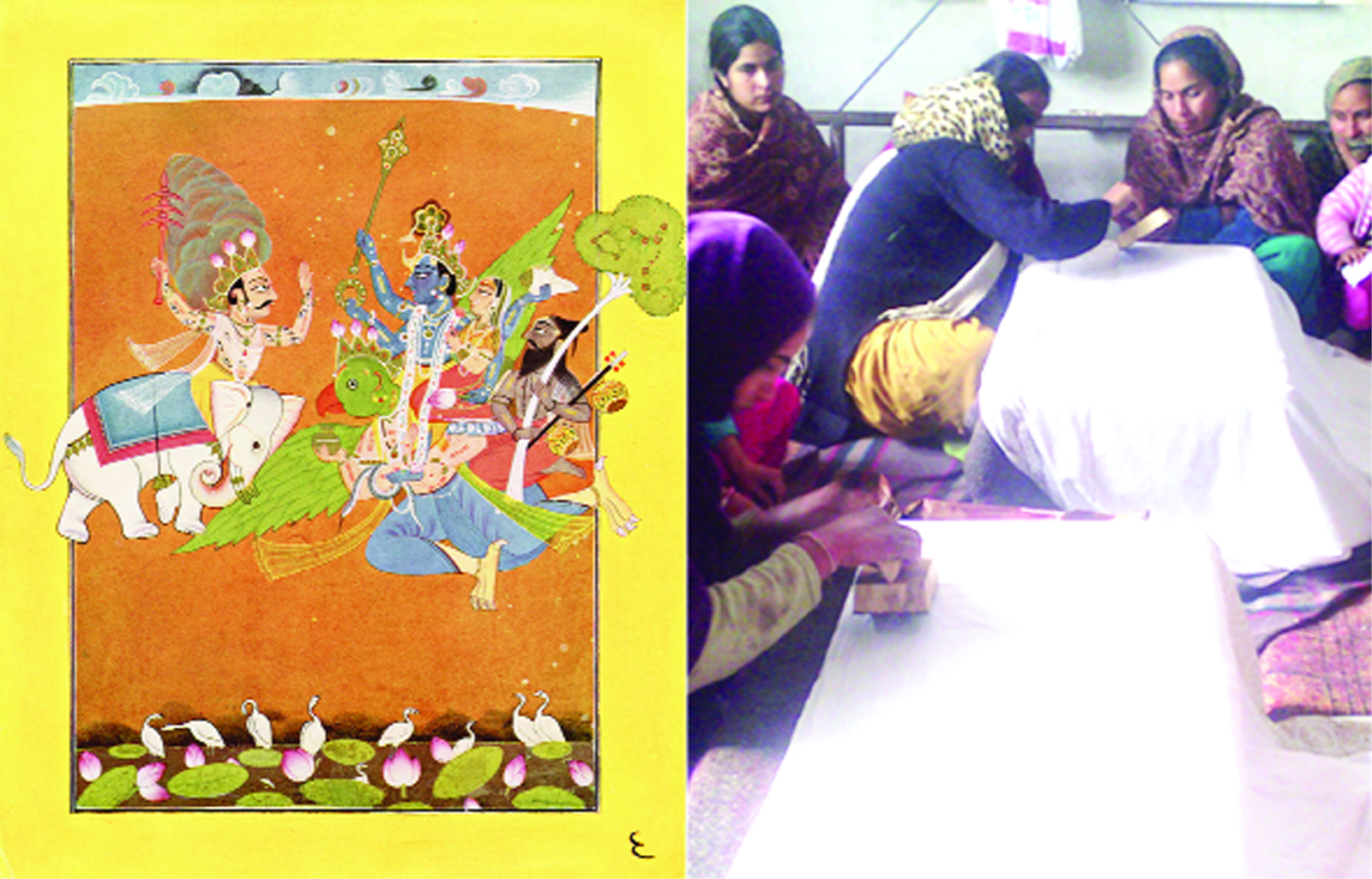
Sadly, this is not an isolated case, the successive apathy of the state apparatus has rendered other native industries of Jammu to go into packing. For instance, the Calico Printing of Samba, which gave the town a special moniker as ‘Shitawala Shehr’, has been ignored and today, only a handful of people are associated with this craft. Though some attempts have been undertaken lately viz to reskill people, provide quality wooden blocks but most of these efforts are but half hearted. This rueful treatment meted out to Jammu based skilled enterprises which are unique in their content, style and character have made us ponder about the inherent priorities of the erstwhile state government.
It’s therefore, necessary that we reclaim our heritage and further our efforts to reinvigorate it in a sustainable manner. This shall happen only when an enabling environment is provided by the government to all the stakeholders involved. Hence, providing GI Tags should be the very first effort in the reclamation of our material culture in order to provide them a legal protection while granting them a geographical specificity underlining their quality and authenticity.
For instance, the Pahari Paintings of Basohli, Chickri Woodcraft of Rajouri, Jeera of Padar, Rajma of Marwah/Bhaderwah, Kalari Cheese of Udhampur, Binna making craft of Kishtwar, Jammu Phulkari ,Basohli Rumals, Desi Barfi of Thandi Khui etc deserve protection under such a registry. Not only this shall allow our local producers to expand their reach but also promote the Jammu region at the national horizon, thus establishing itself as an independent centre of craft and trade, different from Kashmir. Apart from that, it can also boost tourism, stabilize prices, streamline supply chains and lead to the preservation of the traditional knowledge and expertise.
Politically also, this shall pass a symbolic message of Jammu being an equal partner in this UT, which otherwise is not true at all. The Kashmir’s apparent dominance has already made the crafts of Jammu to vanish in the thin air, but this can’t go on till eternity. Jammu, therefore, must rise to the occasion and demand for the inclusion of its heritage in this registry. Not too long ago, JKNC’s Provincial President Davinder Singh Rana raised a pitch for including some products from Jammu into GI Registry but such an isolated attempt hasn’t ruffled many feathers .
If one has to really work in this direction, then all the political functionaries and stakeholders from Jammu must come on a common platform, devoid of any political shenanigans. Ladakh has already provided the leaders of Jammu with a template to replicate upon. If Ladakh can do it for the safety of its culture and language, Jammu too can, if only a mature and sophisticated political consensus is evolved. Unmindful of what they’ve lost, Jammu civil society, in particular and the residents, in general have also not been proactive in their demands. Hence, to bring back the lost sheen and vibrancy to our culture, it’s essential that a unanimous demand is raised from Jammu to revive its stultified industries, empower its degenerate masses and develop a unique identity.
Base year revision for CPI-industrial workers suspicious: AITUC

New Delhi, Oct 24: The All India Trade Union Congress (AITUC) on Saturday said the labour ministry’s move to revise base year for consumer price index for industrial workers (CPI-IW) is “suspicious”.
The AITUC further siad that it is of the view that the move will lead to “depression” in dearness allowance (DA) paid to workers.
The labour ministry has recently revised the base year for CPI-IW to 2016 from 2001.
The retail inflation measured in terms of CPI-IW is the single most important price statistics with financial implications.
The CPI-IW is primarily used to regulate the dearness allowance of government employees and the workers in the industrial sectors.
It is also used in the fixation and revision of minimum wages in scheduled employments besides measuring the inflation in retail prices.
In a statement issued on Saturday, the AITUC said that “the Centre’s move to shift base year for calculating DA is suspicious”.
The Labour Bureau of the Ministry of Labour sent out emails announcing revision of base year for calculating CPI-IW from 2001 to 2016, on October 22, 2020, it claimed.
This decision follows the earlier pattern practiced by the labour ministry: making a show of consulting stakeholders at the eleventh hour and then completely ignoring the responses received, it alleged.
The entire lot of central trade unions had opposed through a written, signed communication, the recommendations of the Labour Bureau point by point, only to discover that they have simply been brushed aside, the AITUC said.
The so-called consultations on labour codes, including recommendations of the Parliamentary Committee on Labour, met the same fate, it added.
“Since the present decision of shifting the base year to 2016, linking factor of 2.88, proportions of items of household expenditures, points of data collections, all are going to result in depression of dearness allowance payable to industrial workers, the employers stand to gain that much as their profits,” it opined.
The AITUC therefore condemns “this robbery in broad daylight by the central government”, it said. (PTI)
Tata Motors crosses 40 lakh cumulative production milestone
New Delhi, Oct 24: Auto major Tata Motors on Saturday said its passenger vehicle vertical has crossed 40 lakh cumulative production milestone, nearly three decades after it rolled out its first model in the segment — Tata Sierra SUV in 1991.
The company, which over the years has produced models like the Indica, Sierra, Sumo, Safari and the Nano, had achieved the 10 lakh production mark for passenger vehicles in 2005-06 and 30 lakh milestone in 2015.
“This is a very significant milestone for Tata Motors. Very few players in the industry have reached such a milestone. This has been a long journey since we rolled out Tata Sierra in 1991,” Tata Motors President Passenger Vehicles Business Unit (PVBU) Shailesh Chandra told PTI.
Over the years, the company always challenged the conventions and brought in many path breaking products, many times first in the market, like Sierra, Estate, Safari, Indica and the Nano, he added.
With Sierra, the company took its first shot at the SUV segment in the country. The company consolidated it further with Safari.
Further in honour of the legacy of Sumant Moolgaonkar, Tata Motors introduced the first ever multi purpose vehicle in Tata Sumo. With Indica, the company changed the customer perception in terms of how a passenger vehicle is received.
The company set up the PVBU vertical in 1998 and the first product to roll out under its aegis was Indica.
“It was the first indigenously developed car and since then we have always challenged conventions and have strived to bring in technologies which are supportive of the cause of the nation, whether it is safety or things related to sustainability,” Chandra noted.
The company has been focussing not only on the safety aspect of its vehicles but has also been leading the electric vehicle space in the country, he said.
“We have brought a paradigm shift to the industry that safety is also important otherwise it was not taken that seriously and to ensure that we were also the first company to commission crash safety testing in the country,” Chandra said.
The company’s compact SUV Nexon was the first model in the country to receive a 5-star rating from Global Ncap. Tata Motors is also the country’s largest electric vehicle manufacturer with 67 per cent market share.
It currently sells Nexon EV and two trims of Tigor, with different range, in the electric vehicle segment. The company also has ambitious plans to launch further electrified models in the future, with an electric version of its premium hatchback Altroz next in the line.
Chandra said with greater acceptance of its current model line up, the company would be able to reach the next 10 lakh production mark in much lesser time.
“It will take us a shorter time to achieve the next one million production mark. This should be on the back of the Indian growth story as well.
“So the industry should also reach higher peaks. It has been growing, barring last year and this year as well due to the pandemic, but the underlined fundamentals of the passenger vehicle industry remain intact whether it is from penetration perspective or buying capacity of people,” Chandra said.
From all the angles the growth story should come back as the economy also stabilises post pandemic, he added.
“So on the back of that growth and certain actions that we are taking to strengthen our product portfolio and the traction we are already seeing, I am sure the next one million should be faster then three to four million mark,” Chandra said.
The company now sells five BSVI compliant models — Tiago, Tigor, Nexon, Harrier and the Altroz.
Tata Motors has manufacturing facilities at Chikhali, Pune; Sanand in Gujarat; and a joint venture plant with Fiat at Ranjangaon in Pune. (PTI)
Same prescription, same treatment for Pakistan
Financial Action Task Force (FATF) has put Pakistan on the same ”therapeutic treatment” that is the penal ”grey list ” for another four months till February 2021 as it has failed to take any action on six vital points related to terror financing. Turkey, which pleaded its cause could make no impact on the global watchdog on terror financing and money laundering to dilute or alter its decision. Pakistan had to take action against India’s most wanted terrorists Masood Azhar and Hafiz Saeed.
The decision has been taken after weighing in the relevant variables and a thorough review of how Pakistan performed in fulfilling the global commitments and the standards against money laundering and terror financing. India’s stand has throughout remained to put that country on more stringent category of Black List as that country is continuing unabated with its state policy of promoting terrorism , particularly against this country. Let Pakistan stop at least from now, providing safe haven to terrorists and put a halt to promoting and sustaining terrorism to come up like a civilized nation to be cleared from the penal ”Grey List” by the FATF.
SVC Bank launches rewards programme

Mumbai, Oct 24: SVC Bank (SVC Co-operative Bank) on Saturday said it has tied up with National Payments Corporation of India (NPCI) for a rewards programme.
The SVC Rewards programme is designed to make banking experience more rewarding for its customers in the form of points earned upon use of SVC Bank Cards and digital solutions, the bank said in a statement.
These points can be then redeemed to purchase products and services across leading brands in electronics, home decor, fashion, lifestyle, sports and fitness and health and beauty, it said.
“We are now metamorphosing into an innovative phase of full-circle banking solutions, stepping into newer pastures. To realise this vision, we have partnered with NPCI and built a loyalty management program,” SVC Bank DGM – Retail Distribution, Sanjay Rajoria added. (PTI)
Trump says virus spike ‘gone’ in Texas while El Paso surges

Washington, Oct 24:President Donald Trump downplayed the toll of the coronavirus during Thursday’s final debate with Joe Biden, and specifically mentioned tamping down the surge in Texas.
“There was a very big spike in Texas, it’s now gone,” Trump said.
But in the border city of El Paso, COVID-19 is the worst it’s been since the pandemic began.
Health officials in the El Paso-area reported 969 new coronavirus cases Friday, leading to more than 10,000 active cases in the region as figures soared over the past week to record highs. Hospitalisations increased by 107 over Thursday, bringing the total to 678 total, with 195 of those people in intensive care.
At least 571 people in the area have died since the pandemic began. Local officials have tightened virus restrictions, cutting back capacity at non-essential businesses to 50 per cent, stopping visitations at facilities that care for the elderly, and banning home gatherings — the first major county in Texas to scale back since Gov. Greg Abbott loosened rules in September.
The virus is taking a toll on the mostly Hispanic area in more ways than one, according to Salvador Perches, CEO of Perches Funeral Homes, which does business in El Paso and neighbouring Juarez, Mexico.
Families are asking for bodies to be transferred across the border as the death tolls rise in the U.S. And Mexico, Perches added, noting that he has added a refrigeration unit inside one of his chapels to accommodate the growing number of bodies.
Over the last two to three weeks, Perches said he has seen an increase in requests for funeral services, not only due to COVID-19 deaths, but also untreated health conditions and suicides because of depression from isolation and job loss.
“People can’t celebrate their loves ones, we can’t mourn,” Perches said.
Dr. Hector Ocaranza, the city and county health authority, called the situation critical. An additional 500 medical personnel plus medical equipment sent by Abbott helps, but he said it is necessary for El Paso residents to “realize we are in a dire situation” and take personal responsibility to stop the spread.
“The spike in El Paso has continued,” Ocaranza said, noting that other Texas metropolitan areas aren’t seeing the same surge. “El Paso, we are in a different situation and we continue to see the rise.”
El Paso County Judge Ricardo Samaniego said because the county is isolated from other metropolitan areas, it is easy for the rest of the Texas to be blind to El Paso. He added that they have reached out to neighboring cities in Texas and New Mexico in addition to coordinating with the Mexican embassy and Juarez mayor Armando Cabada, who recently tested positive for COVID-19, to mitigate the spread together.
Samaniego said he will work with state leaders to revisit increasing restrictions in the county in two weeks if the latest restrictions don’t help as much as they hope.
COVID-19’s resurgence throughout the U.S. Is again pushing some hospitals to the limit, and the nation is approaching a record for the number of new daily coronavirus cases.
The seven-day rolling average for new daily COVID-19 cases in the U.S. Surpassed 61,140 Thursday, compared with 44,647 two weeks ago. The record was reached July 22 when the rolling average was 67,293 in the midst of a summer outbreak driven largely by surges of the virus in Florida, Arizona, California and Texas.
More than 17,000 people have died in Texas since the start of the pandemic. Cecilia Sobalvarro, 57, lives in El Paso and said it was difficult for her to not be with her brother and nephews when her sister-in-law died of cancer on Monday.
“Us not being able to be there for her and to say goodbye over the phone, it is heart-wrenching and it takes a toll on you because we want to be there for her,” Sobalvarro added. “But of course we couldn’t.” (Agencies)
Quad countries interested in strengthening rules-based order in Indo-Pacific: US official
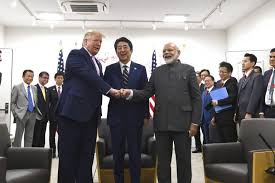
Washington, Oct 24: Quad – comprising Japan, India, Australia and the United States – is not an alliance but a grouping of countries driven by shared interests and values and interested in strengthening a rules-based order in the strategically-important Indo-Pacific region, a senior Trump administration official has said.
The four countries had in 2017 given shape to the long-pending proposal of setting up the “Quad” or the Quadrilateral coalition to counter China’s aggressive behaviour in the Indo-Pacific region.
“There’s nothing about the Quad that it is an alliance. It is not formalised. There’s no reciprocal obligation among the countries who are involved. It’s not an organisation that solicits membership,” a senior administration official said during a conference call with reporters ahead of the next week’s 2+2 Ministerial Dialogue between India and the US.
US Secretary of State Mike Pompeo and Defence Secretary Mark Esper are travelling to India to hold talks with External Affairs Minister S Jaishankar and Defence Minister Rajnath Singh. The visiting American officials would also be meeting Prime Minister Narendra Modi.
To a query, the official said, the Quad ministerial meeting that they had in Tokyo in October just demonstrated the strong ties among the Indo-Pacific democracies.
“I would say it’s a grouping of countries who are interested in strengthening a rules-based order in which all nations are sovereign, strong, and prosperous. It’s an opportunity for us to carry out continued dialogue and to work towards mutually agreed-upon outcomes.
“It’s a grouping of countries that’s driven by shared interests and values rather than binding obligations. That’s an example of effective multilateralism at its best,” the official said, requesting anonymity.
As the US, Japan, Australia, and India are getting together to cooperate on one issue or another, if there are other countries that want to participate in those discussions or those activities, the door is always open, the official said.
The cooperation of the US and India on the Quad along with Australia and Japan really reflect a convergence of common values and interests in the region, the official said.
“We’re the two largest democracies in the Indo-Pacific region, and we have shared values and interests with all four countries. It’s not an exclusive grouping by any means. All four countries are interested and eager in welcoming other countries to the table for individual elements of cooperation that we do, some of them under the Quad framework but not all of them. That’s for sure,” the official said.
“It is something that’s flexible and reflects our common values and interests, and I think is really for the long term,” the official said.
In November 2017, India, Japan, the US and Australia gave shape to the long-pending proposal of setting up the “Quad” to develop a new strategy to keep the critical sea routes in the Indo-Pacific free of any influence.
In the midst of growing global concern over China”s expansionist behaviour, the foreign ministers of the Quad member nations met in Tokyo on October 6 and reaffirmed their collective vision for a free, open and inclusive Indo-Pacific.
The foreign minister of the four countries held their first meeting under the ”Quad” framework in New York in September 2019.
The evolving situation in the Indo-Pacific region in the wake of China’s increasing military muscle flexing has become a major talking point among leading global powers. The US has been favouring making Quad a security architecture to check China”s growing assertiveness.
China is engaged in hotly contested territorial disputes in the South and East China Seas. Beijing has also made substantial progress in militarising its man-made islands in the past few years.
Beijing claims sovereignty over all of the South China Sea. But Vietnam, Malaysia, the Philippines, Brunei and Taiwan have counterclaims. In the East China Sea, China has territorial disputes with Japan.
The South China Sea and the East China Sea are stated to be rich in minerals, oil and other natural resources. They are also vital to global trade. Although the US lays no claims to the disputed waters, it has challenged China’s growing territorial claims in the South China Sea by deploying warships and fighter jets to assert freedom of navigation and overflight patrols in the strategically vital region. (PTI)