

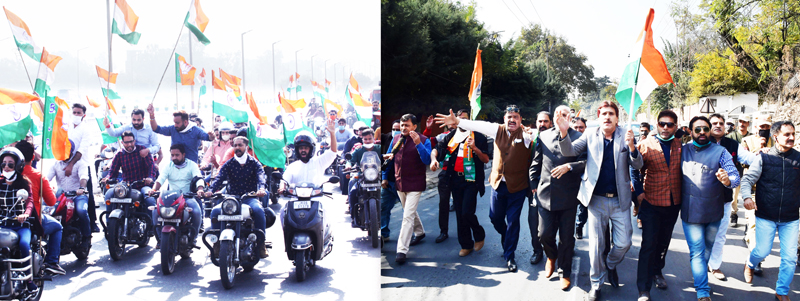
BJYM activists taking out bike rally in Jammu (left) and BJP rally in Srinagar (right) to celebrate Accession Day on Monday.
-Excelsior Pics by Rakesh & Shakeel
BJYM activists taking out bike rally in Jammu (left) and BJP rally in Srinagar (right) to celebrate Accession Day on Monday. -Excelsior Pics by Rakesh & Shakeel
A candidate gets victory certificate in Leh on Monday.
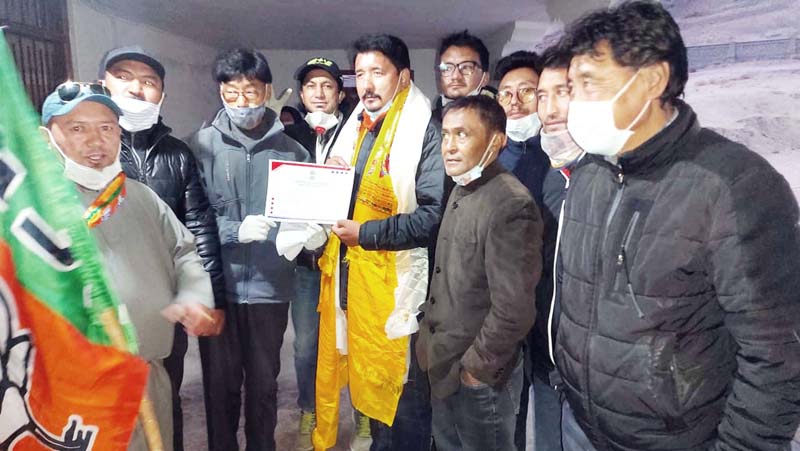
A candidate gets victory certificate in Leh on Monday.
Indian scientists develop novel drug delivery method to cut side effects of arthritis drug
NEW DELHI, Oct 26: Indian scientists have given a new lease of life to the arthritis medicine sulfapyridine by employing an innovative drug delivery method to remove its side effects.
Sulfapyridine is the third oldest drug still in use in the treatment of rheumatoid arthritis, an autoimmune inflammatory joint disease, according to the researchers from Lovely Professional University (LPU) in Punjab.
However, long term use of the drug results in side effects such as nausea or vomiting, rashes, dizziness, anxiety and abdominal pain, they said.
“As the molecule has side effect due to its higher dose, we developed a formulation which can be delivered directly to the site of action and thus is safe,” said Bhupinder Kapoor, Associate Professor, School of Pharmaceutical Sciences, LPU, said.
In their study published in the peer-reviewed journal ‘Materials Science and Engineering C’, the researchers reported developing a prodrug of sulfapyridine and then incorporated it into an innovative delivery system.
The prodrug exhibited better retention in liposomes, as compared to the drug, thus reducing the symptoms of inflammation.
Liposomes are spherical vesicles having at least one lipid bilayer which are used as a vehicle for administration of pharmaceutical drugs.
The prodrug treatment is administered by injecting the affected area of the patient, and not through oral consumption, according to the researchers.
This means that the medication only remains in the affected area, without spreading to the rest of the body, they said.
The research team, including Kapoor, Monica Gulati and Sachin K. Singh from LPU, successfully conducted the pre-clinical trials as well as the testing of the drug delivery mechanism.
“We conducted a study to understand the efficacy of sulfapyridine-derived liposomes. In arthritic rats, prodrug liposomes were found to reverse the symptoms of inflammation, including the levels of biochemical markers,” Kapoor explained.
“Therefore, liposomes of bio-responsive prodrugs offer a revolutionary approach in the treatment of rheumatoid arthritis,” he said.
The study was carried in collaboration with researchers at Fortis Hospital, Ludhiana & JSS College of Pharmacy, Ooty, Tamil Nadu.
Calling the results of the study as “promising”, Dr. Arup Kumar Banerjee from North Bengal Medical College and Hospital in Siliguri, West Bengal noted that prodrugs are compounds, or a derivative of a drug, that themselves are pharmacologically inactive but after administration get metabolised in the body into its active form.
“Prodrug form increases the bioavailability of the actual drug by defying metabolism in site other than the intended one and also decreases the adverse side effect by selective absorption or metabolism at the target cells or organs,” Banerjee, who was not involved in the study, told PTI.
Around 10 per cent of all drugs being used today are administered in the body in prodrug form, he added.
At present sulfapyridine is used in the form of sulfasalazine which is recommended orally in high dose and has few side effects due to exposure to nontarget sites, the researchers said.
For the successful retention of the drug at the injection site, they synthesised its lipophilic prodrug which is retained in the injection site for a longer time period and required in very low dose, therefore has no side effects and dosing frequency is also very less.
As sulfapyridine is not a suitable molecule due to poor solubility, the researchers synthesised its prodrug which can be retained in injection site for a longer time period, and therefore is effective in very low dose and without any side effect.
The researchers said their prodrug will need approval for sales and marketing from India’s drug regulatory body.
The team has filed for a patent, and the pre-evaluation phase is now complete. They are also applying for an international patent for this new drug delivery method. (PTI)
Jumbotail raises $11 mn in funding from Heron Rock, Nexus Venture, others

NEW DELHI, Oct 26: Jumbotail, a B2B marketplace for food and grocery products, on Monday said it has closed USD 11 million (about Rs 81.2 crore) funding round led by Heron Rock.
The series B2 round also saw participation from Jumbofund, Nexus Venture Partners, Siddhi Capital, Reaction Fund, Pimpernel Holdings and a group of HNIs as well as industry leaders, a statement said.
“Jumbotail will use the funds to scale its core B2B marketplace to new geographies across India, expand its network of J24 stores, grow its private label product portfolio and to extend its Go-To-Market services to more FMCG brands seeking entry into Kirana stores and standalone supermarkets across the country,” it added.
Jumbotail serves 30,000 Kirana stores via its full-stack e-commerce model consisting of its B2B marketplace platform, warehousing and last-mile delivery supply chain network, and a fintech platform for payment as well as credit solutions to Kirana store owners.
Jumbotail’s new retail platform transforms Kirana stores into modern omni-channel convenience grocery stores under the ‘J24’ brand. Jumbotail was founded by S Karthik Venkateswaran and Ashish Jhina.
“Our J24 store network is emerging as the ecosystem of choice for Kirana store owners looking to seamlessly transform their Kiranas into modern grocery stores, and to compete better in an increasingly technology-driven retail world,” Jumbotail co-founder Ashish Jhina said. (PTI)
Officer suspended for blaring ‘Trump 2020’ from NYPD vehicle

New York, Oct 26: The New York Police Department said Sunday it has suspended an officer without pay a day after he was seen on video saying “Trump 2020” over a patrol vehicle’s loudspeaker, a violation of department rules.
The suspension is effective immediately and the incident remains under investigation, the police department said.
Commissioner Dermot Shea tweeted that the behavior of the officer, whose name was not immediately made public, was “One hundred percent unacceptable. Period.” Officers must remain apolitical, he said.
Mayor Bill de Blasio promised swift action, tweeting: “ANY NYPD Officer pushing ANY political agenda while on duty will face consequences.
The department, in its Patrol Guide, prohibits officers from “endorsing political candidates or publicly expressing personal views and opinions” about candidates while on duty or in uniform.
A message seeking comment was left with the union representing patrol officers. Videos posted on social media captured the officer bellowing his support of President Donald Trump from a marked police department SUV just before 10 pm Saturday.
The vehicle was parked in a crosswalk with lights flashing in Brooklyn’s Flatbush neighbourhood.
“Trump 2020,” the officer is heard saying, taunting someone on the street who was recording him. “Put it on YouTube. Put it on Facebook. Trump 2020.”
The incident happened days after NYPD officials downplayed concerns that Trump’s support among law enforcement personnel, including a city police union’s endorsement, would impact how officers do their jobs — particularly when dealing with people voting or protesting against the president.
“When we put on this uniform, we are apolitical,” Chief of Department Terence Monahan said.
“We have no stance in one way or another.” The Police Benevolent Association, the city’s largest police union, threw its support behind Trump in August.
Trump, a Republican, has campaigned for reelection on a law-and-order agenda, portraying himself as a counterweight to the police reform protests that erupted across the US in recent months.
Many police officers also support Trump, viewing him as more of an ally to their pro-police “Blue Lives Matter” and “Back the Blue” movements than his Democratic rival, former Vice President Joe Biden.
A Miami police officer could face suspension after he was photographed last week at an early voting site wearing a blue, white and red Trump 2020 mask while in uniform.
De Blasio, a Democrat, said last week that he didn’t think New York City police officers would let their personal political views bleed into their professional responsibilities.
“You’re going to have police officers that have views across the spectrum, but I also think we’ve seen overwhelmingly officers leave their politics at home and they go and do what has to be done to keep people safe and to respect peaceful protest,” de Blasio said at a news briefing last Tuesday.
“Any officer who can’t or won’t do that we have to discipline and we have to address, but I don’t get an indication that that is a widespread challenge.” (AGENCIES)
Myth of tribal attack in J&K
Dr Ganesh Malhotra
Pakistan never had love for people of J&K. It required this territory to sustain it’s Punjabi dominated economy dependent on water and resources of this region. Pakistan had entered into a Standstill Agreement with the Maharaja of Jammu and Kashmir on August 12, 1947. Right from August 1947 itself Pakistan had started disruptive activities in J&K which took shape of final attack on October 22, 1947 when Pakistan unilaterally broke the Agreement and launched an invasion to forcibly capture Jammu and Kashmir using tribal raiders.
The date was October 22, 1947. It would go down in history as the Black Day – the day Pakistan decided to put into operation the nefarious ‘Operation Gulmarg’ to invade Jammu and Kashmir and capture it by force. Over the next few days, the bloody campaign spearheaded by tribal invaders but backed and operationalized by the Pakistan Army saw thousands of innocent people of Jammu and Kashmir being killed. Countless women were raped and numerous towns and villages were plundered and pillaged. Operation Gulmarg was a well-thought out operation, planned and implemented by the Pakistani military and political establishments to train and arm tribal groups who would go on to invade Kashmir. Pakistan wanted to present this invasion to the world as a local uprising against Maharaja Hari Singh’s ruling dispensation.
Pakistan managed to forward a narrative that concealed its role in the 1947 invasion calling it a ‘spontaneous’ attack by the tribals in response to the communal killings in J&K. Majority of intellectuals and expert on J&K bought this narrative and promoted it with ferocity.
There are documentary evidences in terms of eyewitness accounts of the tribal invasion that demolishes its case. One such is of Pakistani army officer Maj Gen Akbar Khan whose book ‘Raiders in Kashmir’ leaves no doubt about how Pakistan planned the invasion and was directly involved in it.
Akbar Khan attended a meeting chaired by Prime Minister former Liaquat Ali. Others who attended were Finance Minister Ghulam Mohd., Mian Iftikharuddin, a Muslim League leader, Zaman Kiani, Khurshid Anwar, Shaukat Hayat. According to his book, several army and air force officers as also the Commissioner Rawalpindi were involved.
Akbar Khan mentions detailed account of Pakistani army together with tribal forces intrusion in Kashmir and the way they were involved in loot, rape and mayhem. He also mentions that in September 1947 he was told to chalk out a plan so that Kashmir can be captured forcibly. At that time, he was serving as Director of Weapons and Equipment (DW&E) in GHQ hence he had complete details of the arms and ammunition available in Pakistan and how much can be spared for Kashmiri invaders. However, the problem was firstly most of the weapons were lying in Delhi and secondly officially the weapons had to come through British Commander-in-Chief, and he will never allow to distribute the weapons of Pakistan army to Kashmiri raiders. However, Akbar khan diverted 4000 rifles of Punjab police to Kashmiri raiders. Besides these rifles other weapons were taken from illegal weapon market of FATA area. Maj Gen Akbar khan also gives details of the condemned weapons were given to raiders of Kashmir. Lieutenant Colonel Masud of the Cavalry also agreed to give condemned ammunition to Zaman Kiani and Khursid Anwar for distribution to raiders of Kashmir. Air Commodore Janjua gave winter clothing, ammunition and weapons from the stock of Air Force to Kashmir raiders. Kashmiri raiders included Pakistan army serving personnel also. Khwaja Abdul Rahim, Commissioner Rawalpindi collected weapons, ration, money and even volunteers for attacking Kashmir. Prime Minister Liaqat Ali imported Light Machine Guns from Italy.
As trained army personnel were required Pakistan army enrolled Ex-Army officers of the I.N.A. (Indian National Army). The book also mentions that though Maj Gen Khan captioned his plan as “Armed Revolt inside Kashmir” but makes it clear that “open interference or aggression by Pakistan was obviously undesirable.
Another book is of Humayun Mirza who revealed in ‘From Plassey to Pakistan’ that his father Iskander Mirza (later Governor-General of Pakistan) was tasked by Jinnah to raise a tribal Lashkar in February 1947 to wage a jihad against the British if they did not concede Pakistan. The tribesmen from Waziristan, Tirah and the Mohmand country for this purpose. He asked for a sum of Rs 1 crore (or Pounds 750,000 at the then exchange rate) to achieve this objective. Jinnah gave him Rs 20,000 for immediate expenses and told him that the Nawab of Bhopal would provide the rest.
Finally India sent forces in J&K on October 27, 1947 after signing of instrument of accession and J&K was saved from Pakistani invasion. Although lot of territory of J&K was taken away by Pakistan.
Thus the attack on Kashmir in the year 1947 was not just an attack by the tribals, but the Pakistani army was fully involved. It was fully at the behest of the Pakistani army, the tribals fiercely massacred the people of Kashmir. Children and women were also not spared. Had Indian Army not reached Srinagar on October 27, 1947, Kashmir would have gone out of India’s hand. Lost area of J&K was result of indecisiveness and personal agenda of political master not because of any lapse on the part of Indian forces.
(The author is J&K based Strategic and Political analyst)
feedbackexcelsior@gmail.com
‘Gupkar Declaration’ a catalyst for Jammu Statehood
Anil Anand
In a recent interview to leading news channel Home Minister, Amit Shah stated that the statehood to the newly created Union Territory (UT) of Jammu and Kashmir would be restored soon. There is nothing new he said as he along with some other senior BJP leaders had given this expression earlier on also. However, Mr Shah’s reiteration has rekindled the hope among the denizens of Jammu and Kashmir and particularly Jammu region about their honour being restored.
How is Mr Shah’s latest statement on Jammu and Kashmir different from his earlier similar observations? While making this observation Mr Shah this time was more circumspect, measured in words and gave an impression that he meant business. It is another matter that he did not specify any time frame for restoration of Statehood status to the new UT but still his words cannot be simply dismissed.
In the interregnum between Mr Shah’s latest statement and his earlier similar observations the public mood in J&K has gradually got consolidated in favour of the statehood. There might be difference of perception in Jammu and Kashmir regions particularly over restoration of controversial Articles 370 and 35A, the political parties and people on two sides of the Jawahar Tunnel concur so far as restoration of statehood is concerned.
In this backdrop and consolidation of public mood, the UT status is being strongly viewed as a demotion, Mr Shah’s latest statement in this connection makes sense as some thought seems to have gone before he made these observations. Keeping the reverting to statehood issue alive in consonance with current public mood is understandable. Under the prevailing circumstances particularly when the Narendra Modi Government has committed itself to holding assembly elections in the UT and backed its intent with setting up of a delimitation commission for reframing the constituencies, over seven months back, the ruling party but natural has to adopt a posture accordingly. It is another matter that the commission is still to pay its first visit to Jammu and Kashmir.
Nevertheless, coming from Union Home Minister the observation has to be kept in mind and cannot be ignored. It might sound bizarre but his observation has also to be seen in conjunction with ‘Gupkar Declaration’ adopted by six Kashmir-centric political parties. Question may arise as to what is the inter-connection between Mr Shah’s statement and the Declaration?
Firstly, the ‘Gupkar Declaration also demands back the Statehood though its focus is on total restoration of status quo ante as it existed on August 5, 2019 thereby meaning that Articles 370 and 35A should also be fully restored. Secondly, the Kashmiri political Diaspora has rightly committed itself to struggle for the achievement of this goal within the parameters of the Indian Constitution.
Contrary to an impression being created about the ‘Gupkar Declaration’ having some kind of anti-national intent, notwithstanding certain other contentious issues or the manner in which the issues have been flagged by them, the Declaration has only sought restoration of an earlier existent Constitutional provision. In no way can this be considered as anti-national act.
The serious concern is about the arbitrary manner in which the Kashmiri leadership adopted the ‘Gupkar Declaration’ demanding restoration of statehood and contentious Articles 370 and 35A in the name of Jammu and Kashmir. They have gone ahead without consulting or taking Jammu region into confidence. It has led to a fresh clamour for separate statehood for Jammu as had been promised to the region from time to time by successive Govern-ments at the Centre.
How could the Kashmiri leadership act on behalf of Jammu while demanding status quo? This question has gained currency in the winter zone of the erstwhile State with firming of the view that Jammu could no more be subjugated by Kashmiri leadership and that the former have every right to carve out their own destiny.
It is where the linkage between Mr Shah’s statement and ‘Gupkar Declaration’ comes on the statehood issue. It has given a strong hope to people of Jammu whereas the ‘Gupkar Declaration’ has the strong potential to act as a catalyst to strengthen Jammu’s demand for a separate state altogether.
It would have been in the fitness of things that the Kashmiri leadership should have shed its colonial mindset and desisted from taking Jammu for-granted. Intrigui-ngly, the Kashmiri leadership over the past seven decades has been persistently complaining about Kashmir being the victim of colonial attitude of the British, Dogra, Sikhs and Afghans variety which was true to a great extent. The ‘Gupkar Declaration’s’ arbitrariness towards Jammu has weakened the colonial theory of the Kashmiri leadership.
An opportunity has been lost for which Kashmiri leadership must accept responsibility, to bring the two regions, with varied perception, together on at least the statehood issue. This attitude has strengthened demand and viability of separate Statehood for Jammu.
Although there is dire need for setting up of second States Reorganisation Commission (SRC), given the sensitivity of Jammu and Kashmir and its strategic geo-political importance it cannot wait the cumbersome process of appointment of a new panel and it’s long drawn process to finally arrive at conclusions for fresh reorganisation of states. The issue should be dealt with same alacrity that the Union Government showed in converting Jammu and Kashmir into a Union Territory and partially abrogating Articles 370 and 35A.
The first SRC was constituted way back in 1953. On the basis of its recommendations submitted in 1955 state boundaries were reorganised to form 14 States and 6 Union Territories. Subsequently, new States such as Uttrakhand, Jharkhand, Chhattisgarh and Telangana were carved out on the recommendations of their parent States and through act of the Parliament and without a second SRC coming into being. The further reorganisation of Jammu and Kashmir should be taken over in the same vein.
Separate State for Jammu with some areas of Himachal Pradesh and Punjab and Union Territory for Ladakh was an old demand. Whereas the August 5, 2019 changes granted UT to Ladakh to meet their long standing demand, Jammu issue was again kept in limbo by the ruling dispensation despite Jammu region having overwhelmingly supported the BJP in last three elections- two Lok Sabha and an Assembly poll.
It is time to resolve the dispute once for all and the decisive Centre must come forward.
feedbackexcelsior@gmail.com
27 October 1947 Not just another date in the Calendar
Colonel Ajay K Raina, SM
October 27, 1947 is a date that holds a gigantic import in the history of J&K State. With the Pakistan army-backed invasion already in progress since October 22, the situation in Kashmir Valley had been turning grim with every passing moment. Among the developments that had happened between the moment of invasion and the midnight on the intervening night of October 26/27 the most important one had been the signing of the Instrument of Accession by Maharaja Hari Singh.
It was during the wee hours of October 27, 1947 when the Chief of Staff of the State Forces, Brigadier Rajendra Singh, having scripted a saga an unmatched determination and dedication, had begun to slip into a restful, unending sleep. Having slogged for almost 100 hours, he and his band of braves from the State forces had successively foiled invaders’ attempts to have a free run to Srinagar. Ill-equipped and heavily outnumbered, the small force under him had been fighting literally without a wink of sleep, proper food and in the absence of any medical aid for the past four days and nights. Just an hour or so back, Brigadier Rajendra had been shot in his limbs when his force had been ambushed while the last of his men were trying to fall back to one more blocking position between Baramulla and the invaders. Uri bridge that the defenders had been able to blow up on October 24, had prevented the enemy from bringing in his lorries and men in full strength. They were, however, now closing in rapidly. Brigadier Rajendra had refused to get evacuated and had ordered Captain Jwala Singh to move on to fight the enemy at another place without wasting time carrying him on the shoulder. A blood-stained tie was all that was ever found of the brave-heart who, through his personal example, had done something really unprecedented! His act remains unparalleled to the day.
As the first light was coming on, two injured soldiers of the State forces were spotted in Baramulla. They were possibly the remnants of 100-odd men who had laid down their lives as a mark of unflinching loyalty and dedication to the land they had belonged to. A few moments later, an open car entered the town with a man in a bastardized uniform. He summoned the small crowd that had gathered in the street, anticipating some developments post breakdown of electricity supply from Mahura power station just a day before. There were hardliners from the Muslim Conference, nationalists from National Conference as also many with no political leanings but with loads of apprehension on their minds. Many residents of the 15,000-odd town had already moved out. The man in the car, without bothering to indulge in the usual formalities, ordered all Muslim households to tie a green cloth outside their houses. The carnage of Baramulla was about to begin.
Captain Prabhat Singh of ‘B’ Company of 4 JAK Infantry, having received orders to move to Baramulla from his location at Kupwara, was met by Captain Jwala Singh who, along with a few wounded survivors, was on his way to Srinagar. After a short exchange of information, Captain Prabhat Singh deployed his two platoons to the East of Baramulla. Baramulla had already fallen and the officer had decided to fight another battle between Baramulla and Srinagar even though with 50 of his men pitched against more than 6000 frenzied zealots, he was well aware as to how the next contact was to likely to end. Captain Jwala Singh then moved off to Srinagar with his lot of wounded soldiers.
Far away, at the Palam Airport in Delhi, the Commanding Officer of 1 SIKH, Lieutenant Colonel Dewan Ranjith Rai had been handed over an operational order about a couple of hours back. At around the time when the convertible had been entering Baramulla, the first flight of six Dakotas was taxing out to get airborne, carrying the valiant Sikh soldiers, both from 1 SIKH and 13 Field Regiment (the latter as part of 1 SIKH so as to make up the strength), on their mission to save the Valley. It was the power of a young democracy being unleashed as the civilian Dakotas and their pilots pitched in. The orders for the leading aircraft were to do a circle over the rough airstrip at Srinagar to ascertain the status before landing. The order, itself, was illustrative of the amount of fog that prevailed at that moment.
The first Dakota with Lieutenant Colonel Dewan Ranjith Rai on board and being flown by Wing Commander KL Bhatia, entered the airspace beyond Pir Panjal at about 0820h. Having made a circle over the airfield and having made successful radio contact with the civil aviation wireless station, the first Dakota touched down at 0830h. Lieutenant Colonel Rai’s first message to Delhi through the aviation wireless station came as a big relief back at Delhi. With three companies, including the composite company of 13 Field Regiment, on the ground, Lieutenant Colonel Dewan Ranjith Rai had to take a decision even though there was no concrete information available about the enemy beyond the input that said that there were tribesmen in thousands. There were two choices: either sit tight at the airfield (that being the primary task assigned to his battalion) and await the arrival of the enemy and then fight him close to the airfield; or move ahead, seek the enemy and give him a fight away from Srinagar! Being the soldier that he was, he opted for the second option.
A semblance of a squadron of the State’s Bodyguard Cavalry was available at Srinagar and the same was sent ahead to reinforce the two platoons of 4 JAK Infantry near Baramulla by Lieutenant Colonel Rai. One company of 1 Sikh also went along with the Cavalry. His message to Delhi at 1200h, read,” About 500 enemy and 2000 locals near Baramulla cannot be held by State forces. So will undertake task 1 and reinforce State troops to prevent break-through. Build-up must be expedited.” Obviously, till then, no one had an idea about an extra ‘0’ that was warranted in the figures for the enemy.
Wing Commander KL Bhatia, instead of flying back to Delhi, took off for Baramulla for aerial reconnaissance. Soon, he was back with the report that while the road Srinagar-Baramulla was virtually empty, Baramulla had been burning. During the reconnaissance from a low altitude, his aircraft had been hit by a bullet of .303 rifle but he was able to land back at Srinagar. After in-situ repairs by a team from Delhi, he flew back to Delhi later.
Leaving one company at the airfield, he proceeded ahead towards Baramulla with the remaining company. Between Pattan and Baramulla, he came across the last of State troops deployed alongside the main road. Captain Prabhat Singh, pleasantly surprised to see Indian Army, briefed him about the enemy even though he, himself, had not been in contact with the enemy till then. The CO deployed a major chunk of his force alongside 4 JAK Infantry company and then moved ahead with a strong escort. Once closer to Baramulla, at 1500h, he sent another message to Delhi and it read, “Baramulla fallen and in flames. In all some 700 men available. Not enough to prevent enemy from bypassing during the night; need at least two companies to patrol and protect flanks.”
Meanwhile, inside Baramulla, the tribesmen were busy looting and raping and setting buildings on fire. The regulars of the Pakistan army, however, had moved ahead towards the Eastern edge of the town by the afternoon. Both the groups, i.e., Indian Army troops and raiders, were actually surprised to see each other. The firefight started immediately and many raiders from the town joined those on the outskirts. Lieutenant Colonel Rai was taken aback to see the kind of weaponry the so-called tribesmen were holding and the kind of conventional tactics that were being followed. Contrary to what he had heard till then, the enemy was better equipped, was being led by regulars and was far too superior in numbers. Pakistan regulars and the tribesmen, on their part, were equally surprised to see the Indian troops so early into the action. Their belief that the highway to Srinagar stood open for them, was immediately shattered.
Sensing his weakness as the enemy started outflanking the Sikhs, the CO ordered the withdrawal and the small force broke contact and fell back by about two miles. The enemy, however, didn’t follow up that night, probably, shaken up by the sudden appearance of the Indian troops and awaiting instructions from the controllers in Pakistan. It was decided by the CO to halt the enemy there and then chase him out of Baramulla. The enemy, however, didn’t show up. The patrols operating on the flanks too didn’t report any enemy activity during the night.
Army HQ replied to Lieutenant Colonel Rai at 2305h, informing him that the air strafing would be carried out on 28 October and a Tac HQ of the brigade, one additional battalion, followed by another battalion, would be flown in over the next two days. Little did the Sikhs know that their Centre Commandant, Colonel Dykes (on leave) and his wife had been murdered at Baramulla earlier that day.
The Indian Government had been keeping the Pakistan government posted about the movement of Indian troops into J&K. The unexpected landing of the Indian Army had upset the plan to annex Kashmir by force and many in Pakistan had been surprised. At this juncture, the Governor-General of Pakistan, Mohd Ali Jinnah, decided to send in regular army into Kashmir to out-manoeuvre Indian forces and take over Kashmir. When he called up General Gracey, Chief of Pakistan Army, to convey his decision, he was advised by General Gracey against such a move. As he was briefed, while it might have been possible to rush two or three units to Srinagar to secure the Valley but such a move would have left Lahore undefended in the face of a likely Indian reposte. General Gracey, then tactfully explained a technical difficulty wherein he couldn’t issue such an order without informing and taking permission from the Supreme Commander of both the forces, Field Marshal Auchinleck.
With a small force of Dogras and Sikhs standing holding the fort between Srinagar and Baramulla, the residents of Kashmir Valley had a reason to thanks the Almighty for his kindness on the day of Eid.
Notes:-
1. The assertion by many historians that Baramulla was plundered and looted for three days between October 24& 27 is factually wrong.
2. Brigadier Rajendra Singh was awarded the first Maha Vir Chakra of the nation posthumously.
3. Lieutenant Colonel DR Rai laid down his life on October 28, and was awarded MVC posthumously.
4. Wing Commander KL Bhatia was awarded Vir Chakra for his numerous acts of valor during the conflict. He died of complications arising out of a splinter injury sustained during the operations but after a few years.
(The author is an Army veteran and has authored eight books. He is the founder member of the Military History Research Society of India)
feedbackexcelsior@gmail.com
Turkish president dares US to impose economic sanctions
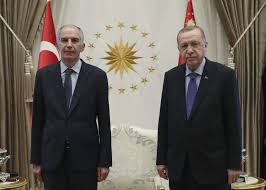
Ankara (Turkey), Oct 26: Turkish President Recep Tayyip Erdogan challenged the United States to impose sanctions against his country while also launching a second personal attack Sunday on French President Emmanuel Macron.
Speaking a day after he suggested Macron needed mental health treatment because of his views on Islam and radical Muslims, Erdogan expanded his range to take aim at foreign critics.
“Whatever your sanctions are, don’t be late,” Erdogan said, referring to U.S. Warnings for Turkey not to get directly involved in the conflict over Nagorno-Karabakh, where Ankara supports Azerbaijan against ethnic Armenian forces.
The Turkish leader also mentioned Washington’s threat of sanctions after Turkey tested the Russian-made S-400 air defense system. The purchase has already seen Turkey kicked off the F-35 stealth fighter program.
“We stepped in for the F-35, you threatened us,” Erdogan told a televised ruling party congress in the eastern city of Malatya. “You said, ‘Send the S-400s back to Russia.’ We are not a tribal state. We are Turkey.”
The dispute over the S-400s, which NATO says pose a threat to the military alliance and particularly endanger the technical secrets of the F-35, is among a number of recent disputes between Turkey and some of its NATO allies.
These include gas exploration in the eastern Mediterranean that has threatened a confrontation with Greece, as well as Turkey’s stance in Syria, where it has targeted America’s Kurdish allies.
For months, the U.S. Warned Ankara that it risked sanctions under the Countering America’s Adversaries Through Sanctions Act if the S-400 system were activated. President Donald Trump, however, has held back on implementing the sanctions amid hopes Erdogan will not go ahead with activating the missiles.
Erdogan also returned to personal insults of Macron, who has been a vocal critic of Turkish foreign policy in recent months.
“The person in charge of France has lost his way,” Erdogan said. “He goes on about Erdogan while in bed and while awake. Look at yourself first and where you’re going. I said yesterday in Kayseri, he is a case and he really must be examined.” Erdogan also turned his ire to Dutch anti-Islam lawmaker Geert Wilders, whose tweet describing Erdogan as a “terrorist” was given prominence by several senior members of Turkey’s government and ruling party on Sunday.
The president said Turks had been made “targets for uncovering rising racism in Europe.”
He added: “Fascism is not in our book, it is in your book. Nazism happened in your countries.”
Three years ago, Erdogan sparked controversy when he called the Dutch government “Nazi remnants and fascists” over blocks on campaigning among the Netherlands’ Turkish diaspora ahead of a Turkish referendum on enlarging his powers. (AGENCIES)