

NEW DELHI, Jan 4:
Delhi’s air quality improved significantly to the “moderate” category on Monday morning owing to rain and strong winds.
A Government forecasting agency said the air quality is likely to improve further to the “satisfactory” category.
The national capital’s air quality index (AQI) was 148 at 10 am. The 24-hour average AQI was 354 on Sunday and 443 on Saturday.
An AQI between zero and 50 is considered “good”, 51 and 100 “satisfactory”, 101 and 200 “moderate”, 201 and 300 “poor”, 301 and 400 “very poor”, and 401 and 500 “severe”.
Officials at the India Meteorological Department (IMD) said intense rains lashed Delhi and winds gusting up to 30 kmph swept the city on Sunday under the influence of a strong Western Disturbance affecting northwest India, dispersing pollutants.
The Safdarjung Observatory recorded 39.9 mm rainfall between 8:30 am on Saturday to 2:30 pm on Sunday.
More rain is likely on Monday. The maximum wind speed will be around 30 kmph, the IMD said.
The central government’s Air Quality Early Warning System for Delhi said the AQI is likely to remain “moderate” to “satisfactory” on Monday and Tuesday.
It said the city’s ventilation index — a product of mixing depth and average wind speed — would be 5,000 m2/s on Monday and Tuesday.
Mixing depth is the vertical height at which pollutants are suspended in the air. It reduces on cold days with calm wind speed.
A ventilation index lower than 6,000 sqm/second, with the average wind speed less than 10 kmph, is unfavourable for the dispersal of pollutants. (PTI)
Rain, strong winds improve Delhi’s air quality to ‘moderate’ category
Anil Jain flags off ‘High Performance Training Camp’ for junior boys
NEW DELHI, Jan 4:The All India Tennis Association (AITA) President Anil Jain on Monday flagged off the ‘High Performance Training Camp’ for junior boys at the R K Khanna Tennis Stadium here.
A total of 21 AITA-ranked junior players have joined the three-day camp, which will end on Wednesday. They will go through mental and physical conditioning apart from fine-tuning of tennis skills.
The camp will be headed by national coach Zeeshan Ali, who will be assisted by former players Ashutosh Singh and Saurabh Singh.
“The AITA endeavours to bring life back into tennis through a ‘Return to Tennis’ styled project which includes ‘High-Performance Training Camps’ for top-ranked players on the AITA Junior circuit,” AITA said in a media release.
Also present at the event were AITA Vice President Anil Khanna and Delhi Lawn Tennis Association (DLTA) President Rohit Rajpal.
“It is a new year and a fresh start of Tennis activities in the country under the ‘New Normal’ environment during the COVID-19 pandemic,” said Jain.
“It is our vision to conduct more camps in future and eventually select the talented tennis players to join the ‘National Tennis Centre’ where we would try to further improve their different aspects of the sport like skills, game strategy, strength, conditioning, diet and nutrition along with sports science and psychology,” he added.
Jain said the goal of these camps is to develop “Super 30s” in each category.
“The goal is to develop the Super 30s in each category and make our presence felt strongly on the International tennis arena,” he added. (PTI)
69 pc parents want schools to reopen from new academic session in April: Survey
NEW DELHI, Jan 4:
At least 69 per cent parents are in favour of schools reopening in April, when the new academic session begins, according to a survey.
The survey, in which over 19,000 parents across the country were interviewed, also found that only 26 per cent of them approve of their children receiving the COVID-19 vaccine by April if it is made available by then.
“Sixty-nine per cent parents said given the current trends and situation with COVID, schools in India should start from April 2021 or after, when the next academic year begins, as many feared to send their children to school amid the outbreak. Further, 23 per cent said it should start from January,” the survey conducted by online platform Localcircles said.
“Only 26 per cent Indian parents approve of their children receiving the COVID-19 vaccine if it is made available by April 2021 or before the school session. Further, 56 per cent parents said they will wait for three months or more and then consider, based on data or findings,” it added.
Schools across the country were closed in March last year to contain the spread of COVID-19 and were partially reopened in some states on October 15. However, a few states have decided to keep them closed in view of a spike in the number of coronavirus cases there.
Bihar, Assam, Kerala, Uttar Pradesh, Punjab, Haryana, Jharkhand, Rajasthan, Madhya Pradesh and Sikkim are among the states that have reopened schools from this month for the students of Classes 9 to 12.
Delhi has already announced that the schools in the national capital will not reopen till a vaccine for the viral disease is available.
The Council for the Indian School Certificate Examinations (CISCE) had requested for the reopening of its affiliated schools in various states from January 4 owing to the upcoming ICSE board examinations, though no decision has been taken in this regard. (PTI)
Team India, support staff negative in latest COVID-19 tests: BCCI
MELBOURNE, Jan 4: The Indian cricket team and its support staff have returned negative in the latest COVID-19 tests conducted here ahead of the third Test against Australia in Sydney, the BCCI said on Monday.
The game is due to start on January 7 and The Indian team landed in Sydney on Monday as scheduled.
“Playing members of the Indian Cricket Team and support staff underwent an RT-PCR Test for COVID-19 on January 3, 2021. All tests have returned negative results,” the BCCI said in a short statement.
The statement came a couple of days after five Indian players — vice-captain Rohit Sharma, opener Shubman Gill, stumper Rishabh Pant, pacer Navdeep Saini and batsman Prithvi Shaw — were placed in isolation when a video of them at an indoor restaurant was posted by a fan on Twitter.
Cricket Australia had announced that a joint investigation with the BCCI was on to determine whether it amounted to a breach of bio-security protocol for the series.
The five were, however, allowed to train and travel with the team for the match in Sydney. According to sources in the Indian contingent, they have been cleared to play in the third Test at the Sydney Cricket Ground.
All the players and support staff returning negative for COVID-19 is welcome news for the Indian team amid the controversy around the alleged breach of bio-security protocols.
Despite the announcement of a joint investigation by BCCI and Cricket Australia on the alleged breach, there has been no word on it from either of the two boards in the last two days.
According to the bio-security protocols set by CA, players are allowed to sit outside but not allowed to dine inside restaurants. The players, according to team sources, have maintained that they went in to escape a drizzle.
It is understood that the controversy has not gone down well with the travelling team and it is not amused with how CA has so far handled the issue.
The latest development is preceded by Australian media reports that the fourth Test in Brisbane has been jeopardised as the tourists are reluctant to travel there in view of stricter quarantine rules.
But the final Test, starting at the Gabba from Janauary 15, is on as of now.
The four-match series is currently locked 1-1 after India fought back with an eight-wicket triumph in the Melbourne Test following a humiliating loss in the opener in Adelaide. (PTI)
India’s tax pie gets altered because of pandemic
NEW DELHI, Jan 4: India’s tax pie seems to have undergone a subtle change with a sharp drop in direct tax collections resulting from a disproportionate impact of the COVID-19 carnage on incomes.
The share of indirect taxes, which mainly comprise of levy on goods and services as well as import duty, has risen while that of direct taxes – made up of corporate and personal income tax – has gone down in 2020.
In an interview with PTI, Finance Secretary Ajay Bhushan Pandey said in a pandemic like this where the economy has been impacted, any large scale changes impact direct taxes more severely, whereas indirect tax collection is mostly proportional to business turnover and compliance.
“In a situation like this where the economy has been impacted and we are on the recovery path, the direct taxes are impacted more severely because the profitability of a company is not directly proportional to the turnover always. If your turnover reduces below a certain benchmark then the profit will not merely reduce, but it may get into a negative zone and therefore the company may not pay any income tax as it will be into a loss.
“Similarly, when we are in a recovery phase, the companies will take a longer time to come into the profitable zone to pay income tax. In the case of indirect tax, it is more or less proportional to the business volume and turnover and compliance,” he said.
While the government has officially not released direct and indirect tax collections, industry sources said the share of indirect taxes in overall tax collections rose to about 56 per cent, the highest in over a decade for the period. This follows a sharp 26-27 per cent decline in direct tax collections.
Direct taxes are a direct outcome of income levels while indirect taxes are mostly driven by consumption as demand for some goods is inelastic either because of they being essential in nature or not substitutable like petrol and diesel.
Excise collections rose in 2020 after the government raised the tax on petrol and diesel by Rs 13 and Rs 10 per litre, respectively. Customs collections, which reflect duty paid on goods imported, grew substantially in November and December. While the revenue in December was up 94 per cent to Rs 16,157 crore, in November it was up 43 per cent to Rs 11,598 crore.
Pandey said this buoyancy in Customs collection would be due to many factors, including the introduction of faceless assessment.
“We are doing the analysis as to what kinds of goods are getting imported and customs duty on those items,” he said. “We have also brought in CAROTAR rules wherein the import from FTA countries are also being subjected to greater scrutiny and we are ensuring that goods which have undergone requisite value addition in exporting countries only they are given the benefit of FTA. So these measures, along with an uptick in the economy, are yielding results.”
The havoc wrecked by the pandemic on tax collections – that is a reflection of the economic well-being of a nation – led to the first major showdown between the Centre and the states since the implementation of the GST regime three years ago.
Sharply split on political lines, states demanded Centre to compensate them – through borrowing or from its own coffers – for the loss of revenue in a year that saw 69-days of complete lockdown and gradual easing thereafter.
The sharp decline in GST collections has led to Rs 1.80 lakh crore shortfall in GST revenues on states. This includes Rs 1.10 lakh crore revenue loss on account of GST implementation and Rs 70,000 crore on account of the pandemic.
The Centre initially opposed the demand made by non-BJP ruled states, insisting that states should borrow against future accruals of GST. For days and weeks, it gave all kinds of reasons why states should borrow but one fine day it agreed to borrow and pass on the loans to states.
GST collections, which along with excise and customs duties form part of indirect tax kitty, seemed to have stabilised over Rs 1 lakh crore mark towards the end of the year as the economy reflated and touched an all-time high of over Rs 1.15 lakh crore in December. (PTI)
Bajaj Auto sales up 11 pc in December at 3,72,532 units
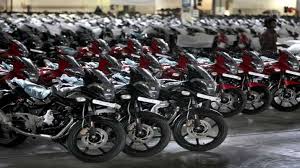
New Delhi, Jan 4: Bajaj Auto on Monday reported an 11 per cent increase in total sales at 3,72,532 units in December 2020.
The firm had sold a total of 3,36,055 units in December 2019, Bajaj Auto said in a statement.
Domestic sales were down 9 per cent at 1,39,606 units as compared to 1,53,163 units in the year-ago month, it added.
Total motorcycle sales were at 3,38,584 units last month as against 284,802 units in December 2019, up 19 per cent, it added.
Exports jumped 27 per cent to 2,32,926 units as compared to 1,82,892 units in the same month a year ago, Bajaj Auto said. (PTI)
UK Judge to rule on Assange extradition to US

London, Jan 4: UK district judge Vanessa Baraitser will deliver on Monday her verdict on whether WikiLeaks founder Julian Assange can be extradited to the United States or not.
In the US Assange could face up to 175 years in jail for the publication of classified information on the US wars in Iraq and Afghanistan as well as thousands of US diplomatic cables between 2010 and 2011.
Assange’s extradition trial ended at London’s Old Bailey court on October 1, 2020 after his defense team spent weeks trying to prove that Assange was being indicted for political reasons.
Although the judge presiding the hearing will hand over her verdict on his extradition on Monday morning at London’s Old Bailey courthouse, UK Home Office Minister Priti Patel will have the final say in case Baraitser rules in favor of the extradition.
It is almost certain that the losing side will file for an appeal, so the extradition hearings will probably continue for months, even for years to come.
The US Department of Justice is seeking the extradition of Assange on 17 espionage charges and on one count of computer misuse.
The whistleblower has been held in a UK maximum security prison since he was arrested at the Ecuadorean embassy in London in April 2019, and sentenced to 50 weeks in prison for jumping bail back in 2012. Although he served the whole sentence a long time ago, the UK court has refused to release him until the extradition case is over.
(UNI)
People cover themselves under umbrellas as Srinagar experiences fresh snowfall on Monday. (UNI)
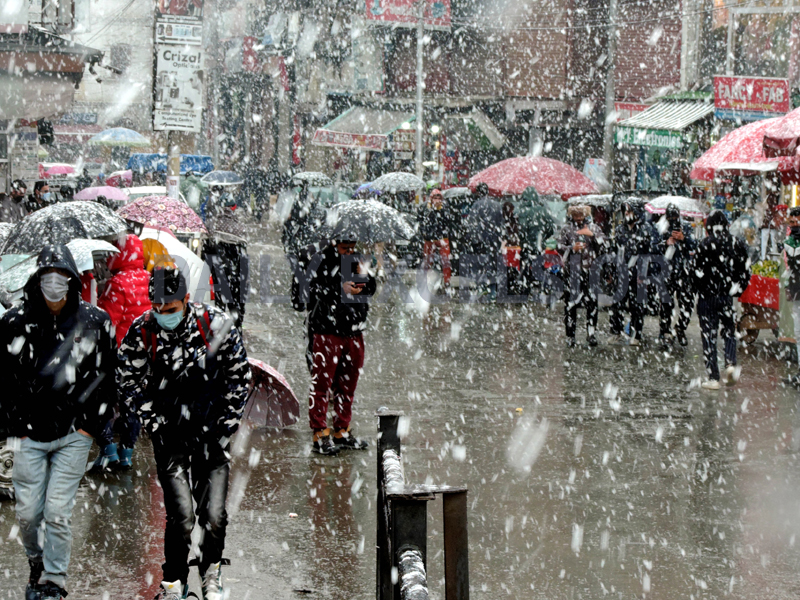
People cover themselves under umbrellas as Srinagar experiences fresh snowfall on Monday. (UNI)
Corona continues to wreak havoc
Dr. Pradeep Kumar Singh
The infectious corona pandemic has affected entire humanity. This disease appeared about 1-year ago and covered the entire world within 3-months. Different countries have been struggling with the disease in their own way. In India too, a 40-day lockdown was imposed from 25-March. But, as the disease is not expected to leave quickly, the conditions are being gradually relaxed, to let the system run.
The pandemic has affected almost every aspect of human life. It is said that, “the first happiness is to have a healthy body, and second happiness is to have sufficient money”. That is, both physical health and financial condition should be good for a happy life. But even with the continuous efforts of the government and administration in the pandemic period, both have got badly affected. In fact, the nature is almighty, and the human efforts have limitations. In this disaster, both physical health and economic condition had a very close relationship, if the effort is made to save one, the chances of getting the other affected increase. It is said, “if there is life, there is the world”. Also, “if wealth is lost, nothing is lost, but if health is lost, something is lost”. That is, the health should be given priority over money. Thus, most of the countries including India imposed lockdown to save physical health, which is showing a huge impact on the economy. But theories also have practical limits. Other activities of life cannot be suspended for a long time. Therefore, according to the Prime Minister’s time-tested principle “Jaan bhi, Jahan bhi”, the activities are being taken forward in a phased manner. Still, it will take time to restore normalcy in every sphere of life.
So far, more than 8-crore people have got infected with corona, of which about 18-lakh have died, and more than 5.7- crore have recovered. The average mortality in the world is about 3%. Death rate was more than 20% in the month of April, which is gradually decreasing. The death rate in this pandemic may have been low, but the situation remains appalling due to high infection rate and lack of treatment for the disease. The maximum number of daily cases of infection 7,36,117 was detected on 17-December, while the maximum number of deaths 13,783 occurred on 16-December. Global data suggest that the three months October-November-December indicate the third wave of the corona pandemic. This wave appears to be more contagious and deadly, and is still continuing. The United States ranks first in total infected cases (about 1.98 crore), and India in second place (1.02-crore). The US ranks first in pandemic deaths (around 3.43 lakh), and India in third place (about 1.48 lakh). Brazil faced more deaths than India (about 1.91 lakh). Brazil, Russia and France rank third, fourth and fifth respectively in total infected cases. While Brazil, Mexico and Italy are in the second, fourth and fifth position in terms of total deaths.
Among other affected countries, Andorra ranks first with 101,842 infected cases per million population, while Montenegro and Luxembourg are second and third, respectively. Similarly, San Marino ranks first with 1678 pandemic deaths per million population. The situation is similar for the Belgium. Slovenia, Bosnia and Italy rank third, fourth and fifth respectively. There have been approximately 1200 or more deaths per million in these three countries. The data is constantly changing. It is very interesting to see here that although all these countries have been badly affected by the pandemic, yet only a few of these could attract focus of media coverage. Probably because the total number of infected people and the deaths in these countries has been much less than that in the countries which have been in media focus, due to very small population of most of them. The highest population among these countries is in Italy, 6.04 crore. The population in other countries is very small, even the population of San Marino is just 34-thousand. Perhaps that’s why Italy remained in focus of media. Anyway, there is more focus on developed, rich and powerful countries, because they are more relevant in the world order.
Given the global scenario, the corona pandemic situation in India, with a population of about 138-crore, can be considered more or less controlled. The total number of infected people has reached about 1.02 crore so far, and about 1.48 lakh deaths have also been reported. It is a matter of satisfaction that about 98.07 lakh people have got recovered and the average death rate is less than 1.5%, which is half of the global death rate. The average death rate in April was more than 28%. In the last 8-9 months, various aspects of the corona pandemic have been discussed in the media. Also, there has been significant development in healthcare facilities in the country in this duration. Society has undoubtedly benefited from the advisories on pandemic prevention and health care. In the early stages pandemic, lack of specific knowledge about the symptoms and prevention of the disease, or lack of facilities in the healthcare system, could have also been the cause of high mortality.
Currently, the US is passing through the third wave of the Corona pandemic, while Brazil, Russia and France all suffer from the second wave. Although a second wave of the pandemic was observed in some parts of India also, the overall rate of spread is decreasing in the country. The peak of the pandemic wave has passed in September. The maximum daily number of infected people 97,859 was observed on 16-September, and the maximum daily deaths 1,283 was reported on 15-September during the peak days. However, the maximum daily deaths in the country 2,006 was reported on 16-June, when spread of the pandemic was on the rise.
The pandemic continues to wreak havoc. The country is still facing 20-25 thousand new infected cases and 200-400 deaths daily. Despite precautions, there are reports of infection among people working in different areas. The recent news of a relatively more infectious new strain B1.1.7 of the corona virus in Britain is frightening. It takes time to understand the impact of new strains, and by then the infection spreads in society. Vaccination has begun in a few countries. Some side effects of the vaccination have also come to light. Usefulness of the vaccine on the new strain of corona is yet to be explored. The vaccination of 138-crore population with very limited trained manpower (in proportion to population) in the country is extremely challenging, and cannot be possible without public support. Overall uncertainty continues. Precaution is the only protection, that is, maintaining and enhancing the body’s immunity along with “2-yard distance and mask” is very important.
(The author is Former Dean (Research & Consultancy) Sant Longowal Institute of Engineering & Technology, Longowal)
feedbackexcelsior@gmail.com
Lieutenant Governor Manoj Sinha administering oath of office to Justice Pankaj Mithal as new CJ of J&K and Ladakh HC. -Excelsior/Rakesh
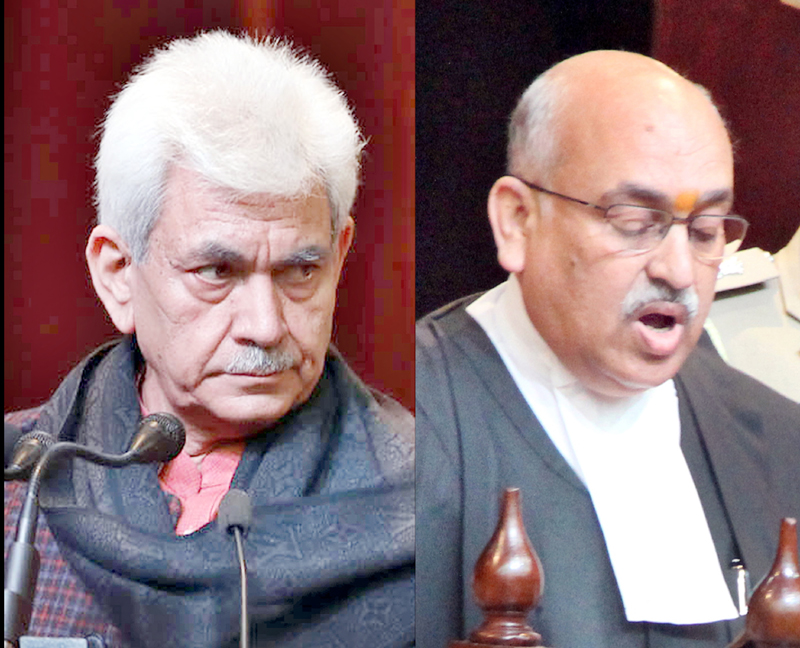
Lieutenant Governor Manoj Sinha administering oath of office to Justice Pankaj Mithal as new CJ of J&K and Ladakh HC.
-Excelsior/Rakesh