

Tuesday, April 21, 2026
E-Paper
Home Blog Page 3

Kharge Accuses PM Modi Of Terrorising Political Parties, People By Misusing Govt Machinery
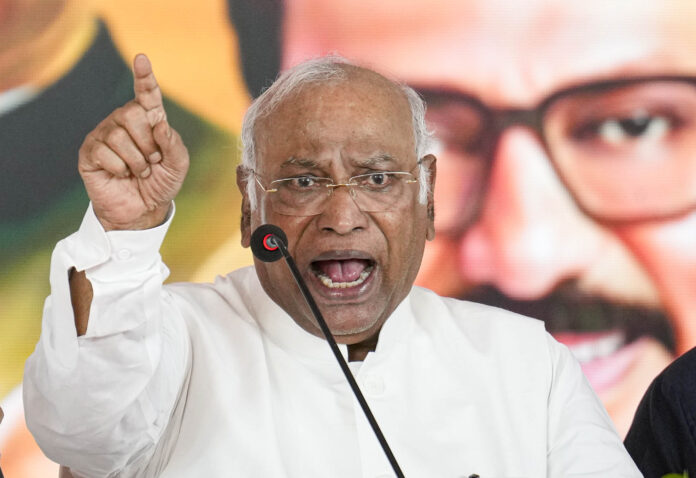
CHENNAI, Apr 21: Congress President Mallikarjun Kharge on Tuesday stepped up his attack on Prime Minister Narendra Modi, accusing him of “terrorising” political parties and people by misusing government machinery and central agencies to stifle the opposition.
Addressing a press conference in Chennai alongside AICC General Secretary (Organisation) KC Venugopal, Kharge initially referred to the Prime Minister as a “terrorist” while criticising the AIADMK’s alliance with the BJP.
However, when pressed by reporters to clarify the context of the remark, the Congress chief stated he meant the Prime Minister was “terrorising” the democratic fabric of the country.
“He is terrorising people and political parties. I never said he is a terrorist (in the literal sense). Terrorising this… he is misusing his power and government machinery and abusing, malingering opposition parties,” Kharge said.
The Congress chief alleged that the Election Commission has become an “extension of the BJP office” and accused the Prime Minister of violating the Model Code of Conduct in the final stages of the election campaign. He further claimed that central agencies like the CBI, ED, and Income Tax department were being deployed as tools of intimidation against political workers.
Kharge also hit out at the Centre over the Constitution Amendment Bill that sought to facilitate women’s reservation by expanding the Lok Sabha and linking delimitation with it. He accused the Prime Minister of misleading the public by claiming the opposition defeated the Women’s Reservation Bill, noting that it was passed in 2023 with unanimous support.
“If he truly intends to implement it, he can provide 33 per cent reservation to women within the existing 543 Lok Sabha seats. Why is he not giving it?” Kharge argued.
He warned that the government’s plan for delimitation would “punish” progressive states, particularly in South India, for their success in population control. “They intended to deny the democratic rights of South Indian states, North Eastern states, and progressive states. Modi and Shah want to punish these states for their progress,” he said.
Reaffirming the strength of the DMK-Congress alliance, both Kharge and Venugopal dismissed reports of a rift between Rahul Gandhi and Tamil Nadu CM MK Stalin, describing them as “like brothers.” Kharge reiterated the alliance’s “key commitments” for the state, including Rs 2,000 monthly assistance for women and senior citizens, Rs 2,500 monthly for families for food security, and a promise to fill all government vacancies within 300 days.
He also criticised the Election Commission, alleging it was acting “like an extension of the BJP office” by failing to take note of what he termed the Prime Minister’s “violation of the model code of conduct”. (Agencies)

Two ISI Operatives Arrested For Planning Grenade Attacks, Target Killings In Delhi-NCR
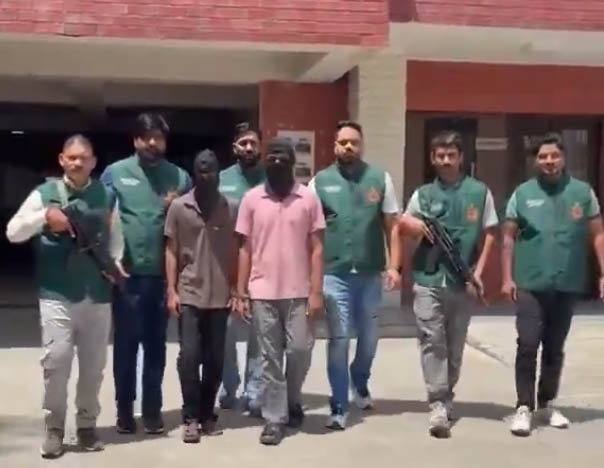
NEW DELHI, Apr 21:  The Special Cell of Delhi Police has arrested two operatives allegedly working at the behest of Pakistan-based gangster and ISI proxy Shahzad Bhatti, with the police unearthing a criminal conspiracy to carry out firing, grenade attacks and target killings in the Delhi-NCR region, an official said on Tuesday.
The accused, identified as Rajveer (21) and Vivek Banjara (19), both natives of Madhya Pradesh’s Gwalior, were apprehended by the Special Cell.
“Their arrest foiled planned attacks in the national capital and adjoining areas. The arrests exposed a larger conspiracy orchestrated by Bhatti, who, along with other ISI-linked handlers, was recruiting young people through social media platforms and deploying them for targeted acts of violence in Delhi-NCR,” Deputy Commissioner of Police (Special Cell) Praveen Kumar Tripathi said in a statement.
The officer said that a case in this regard was registered on March 31 following inputs about a plan to execute grenade attacks and targeted killings in the region.
“Vivek Banjara was first traced and arrested from Dabra in Gwalior on April 16. During interrogation, he disclosed details about his associate Rajveer, leading to the arrest of Rajveer from the Sarai Kale Khan area of Delhi on April 18,” the officer added.
The police said Rajveer was allegedly preparing to target a prominent hotel in Delhi-NCR on the directions of his handler Shahzad Bhatti, when he was apprehended. One pistol and six live cartridges were allegedly recovered from his possession. Additionally, two mobile phones containing incriminating videos and voice notes linked to the conspiracy were seized.
Sharing profiles of the accused, the police said Rajveer, a resident of Dabra in the Gwalior district, is a young recruit who came in contact with Bhatti’s network through social media.
“He was directly handled by an associate of Bhatti, identified as “Rana Bhai”, and was assigned key operational responsibilities. He allegedly played a central role in coordinating movements, collecting weapons and executing planned attacks,” the officer said.
He further said that Vivek Banjara, also from the Gwalior district, was introduced to the network by Rajveer. Investigators said he assisted in logistics and reconnaissance and was actively involved in facilitating travel, receiving weapons and documenting criminal acts on the instructions from handlers.
Both accused were lured with the promises of easy money and were gradually drawn deeper into the criminal network. “In March, Rajveer was instructed to send an associate to Ahmedabad to collect weapons. Accordingly, Vivek travelled there, though the delivery could not materialise. Bhatti had arranged Rs 5,000 for his stay,” the officer said.
Subsequently, on April 9, the duo travelled to Amritsar, where they allegedly received a pistol, 15-20 live rounds and Rs 20,000. They were tasked with opening fire at a club in Zirakpur in Punjab, which had allegedly received extortion threats from Bhatti.
On April 11, Rajveer allegedly attempted to carry out the firing but failed due to a mechanical issue in the weapon. Vivek recorded a video of the incident to send to their handler. Rajveer later concealed the weapon while returning to Delhi and shared its location with Bhatti, the police said.
“After spending a few days in Delhi-NCR, he travelled to Punjab again, where he collected another pistol and ammunition before returning to the capital. Further investigation is underway to identify other members,” the officer said. (Agencies)

Adityanath’s ‘padyatra’ a practice to sit in Opposition: Akhilesh

LUCKNOW, Apr 21:  Samajwadi Party president Akhilesh Yadav on Tuesday said Uttar Pradesh Chief Minister Yogi Adityanath’s ‘padyatra’ against the defeat of a constitution amendment bill for the implementation of women’s reservation in legislatures is “practice” for the BJP to sit in the Opposition.
Addressing a press conference here, Yadav said, “This ‘padyatra’ was practice. It shows that they will have to agitate like this when they sit in the Opposition. This is the first government which, while being in power, is practising how to function as the Opposition.”
The ‘Jan Aakrosh Mahila Padyatra’ earlier in the day began from Adityanath’s official residence here on Kalidas Marg and culminated at the UP Assembly.
He took a swipe at the BJP, saying never before had a ruling dispensation struggled so much for a law it had itself enacted. “Perhaps in history no government has fought so much for its own law as this one is doing. This is unprecedented,” he said.
Projecting his party’s political plank, the SP chief invoked the “PDA” (Pichhda, Dalit, Alpsankhyak) grouping, asserting that it would decisively challenge the BJP in the upcoming elections.
“For the first time in history, one social bloc is going to defeat them (BJP)… This bloc is PDA – the PDA family. People united by shared pain and issues will come together as one and defeat the BJP,” he said.
Yadav said the alliance of backward classes, Dalits and minorities would work towards establishing a government based on social justice.
“In the coming time, we are moving towards forming a PDA government to establish a state based on social justice,” he added.
Referring to the defeat of the government’s Constitution (131st Amendment) Bill to implement women’s quota and increase the number of Lok Sabha seats to 816, Yadav described it as a “historic democratic victory” and thanked voters and leaders of the opposition alliance.
“We express gratitude to the people and all leaders of the INDIA alliance who supported this effort. This is not just a democratic victory but also a defeat of the BJP,” he said.
Reiterating his party’s stand on women’s reservation, Yadav said, “Samajwadis have always supported reservation for women, both inside and outside the House. If anyone is trying to stall reservation, it is the BJP. We will not allow their intentions to succeed.”
He also accused the ruling party of avoiding a caste census, alleging it feared demands for rights and reservations that could follow.
“Those who do not want counting know that once a census happens, people will demand caste enumeration. And when the caste census is done, people will ask for their rights and reservations,” he said.
Drawing a comparison with Hitler’s propaganda machinery, Yadav alleged that the BJP was attempting to “mislead” people.
“Historians say that during Hitler’s time there was a minister for propaganda. But here, not just the government, many people in constitutional positions are involved. However, the people have understood the truth,” he said.
Asserting confidence in the Opposition’s prospects, he said, “In the coming time, we will not only remove the BJP but ensure it is removed for good.”
Yadav also welcomed new entrants into his party at the press conference. (PTI)

CM Omar Flags Off Ambulances, Medical Equipment To Boost Healthcare Access In J&K
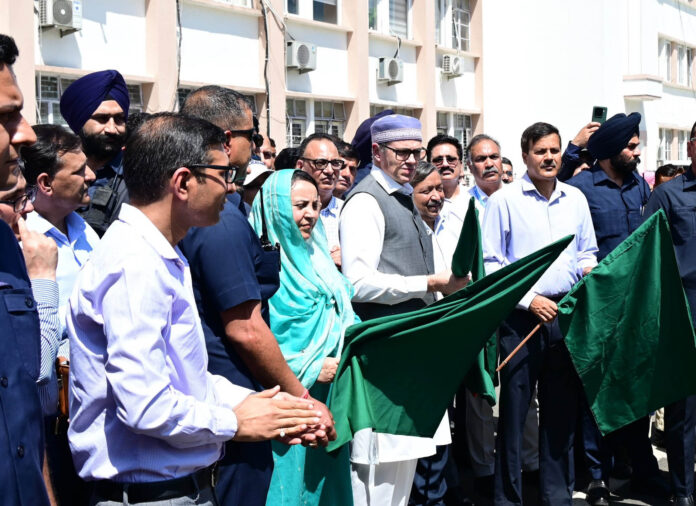
Jammu, Apr 21: Jammu and Kashmir Chief Minister Omar Abdullah on Tuesday flagged off ambulances and healthcare equipment for various districts, saying the move is aimed at strengthening emergency healthcare access in underserved areas of the Union Territory.
“Chief Minister (Abdullah) today flagged off seven ambulances and healthcare equipment from Civil Secretariat, Jammu for various districts across J&K under J&K SPDC’s CSR initiative,” the Office of the Chief Minister said in a post on X.
He said the initiative is intended to enhance emergency medical response, particularly in remote and underserved regions.
Health and Medical Education Minister Sakina Itoo was also present on the occasion.

Pakistan Extends Airspace Closure For Indian Planes Till May 24

New Delhi, Apr 21: Pakistan on Tuesday extended the closure of its airspace for Indian planes till May 24 as the curbs will now remain in place for more than a year.
In the wake of the terror attack in Pahalgam, Kashmir, that killed 26 people on April 22 last year, India and Pakistan have closed their respective airspaces for each other’s planes. While Pakistan airspace has been closed for Indian aircraft since April 24, 2025, Pakistan planes are not permitted to use the Indian airspace since April 30 last year.
According to a NOTAM (Notice to Airmen), Pakistan airspace is not available for Indian registered aircraft and aircraft operated/owned or leased by Indian airlines/ operators, including military flights.
The ban will be applicable from April 21 till 2359 hours (UTC) on May 23, which translates to 0530 hrs (IST) on May 24, as per the NOTAM issued by the Pakistan Airport Authority (PAA).
It is now nearly a year since the Pakistan airspace ban came into force that has also resulted in Indian carriers taking longer routes for various international destinations.
Meanwhile, India has barred Pakistan aircraft from using its airspace till 0530 hrs on April 24, and the restriction is expected to be extended.
The ban, part of various measures taken by the Indian government against Pakistan in the wake of the Pahalgam terror attack, was initially till May 24, 2025 and has been subsequently extended every month.
Generally, a NOTAM is a notice containing information that is essential for personnel involved in flight operations. (Agencies)

Driven by the pressures of war, Iran gives its  field commanders more power over militias in Iraq
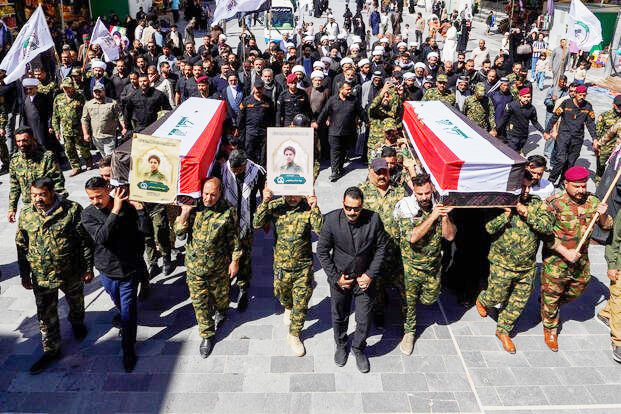
BAGHDAD, Apr 21:  Iran has granted its commanders greater autonomy over militias in Iraq, allowing some groups to carry out operations without Tehran’s approval, a shift driven by the pressures of the war, three militia members and two other officials told The Associated Press.
Many Iran-backed militias are funded through the Iraqi state budget and embedded within the security apparatus, drawing criticism from the United States and other countries that have borne the brunt of their attacks and say Baghdad has failed to take a tougher stance.
Despite mounting pressure from the US, Baghdad has struggled to contain or deter the groups. The most hard-line factions now operate under Iranian advisers using a decentralized command structure, the five officials told AP, each on condition of anonymity to speak freely about sensitive matters.
“The various forces have been granted the authority to operate according to their own field assessments without referring back to a central command,” said one militia official, who didn’t have permission to speak publicly.
The war in the Middle East has exposed the fragility of Iraq’s state institutions and their limited ability to restrain these groups. A parallel confrontation between Washington and the militias has deepened the crisis, with factions acting as an extension of Iran’s regional campaign and escalating attacks on US assets in Iraq before a tenuous ceasefire deal was reached in April.
Even if the ceasefire agreement holds, Washington is expected to intensify efforts against the groups militarily and politically, particularly as they gain latitude to operate more independently, officials and experts said. On Friday, the US imposed sanctions on seven commanders and senior members of four hard-line Iran-backed Iraqi militia groups.
“The US is still going to feel it has the freedom of action to hit Iraqi militias,” said Michael Knights, head of research for Horizon Engage, a geopolitical risk consulting firm, and an adjunct fellow at the Washington Institute for Near East Policy. “That may well play out into an effort to try and guide a less militia-dominated government formation.”
For Iran-backed militias in Iraq, a move to decentralized control
——————————————————————–
Days into the war sparked by US and Israeli strikes on Iran on Feb. 28, an Iranian delegation arrived in Iraq’s Kurdish region and delivered a blunt message: If militia attacks escalated near US military bases, commercial interests and diplomatic missions, Iraqi Kurdish authorities should not come to Tehran with complaints, as there was little they could do about it.
“They said they’ve devolved authority to regional Iranian commanders,” a senior Iraqi Kurdish government official said on condition of anonymity, citing the subject’s sensitivity.
In the past, Kurdish leaders in Iraq would call Iranian officials after attacks to ask why they had been targeted. “This time, they wanted to preempt that by saying, We can’t help you with the groups in the south right now,'” the official said.
This shift reflects lessons drawn from the 12-day war in June, the official said. Militia officials corroborated the claim. During that war, operations were tightly centralized. In its aftermath, greater autonomy was granted in the field.
A spokesperson for Harakat Hezbollah al-Nujaba, among the Iran-backed militia groups that have attacked the US in Iraq, said there was “coordination” with Iran in launching attacks but didn’t give details.
“Since we are allies of the Islamic Republic, we have coordination with our brothers in the Islamic Republic,” Mahdi al-Kaabi said.
In the recent war, key Iraqi militia leaders appeared to step back from the latest phase and didn’t appear to be directly involved in operations, Knights said. US strikes largely killed mid-level commanders, according to militia officials.
“None of the first-line leaders have been killed,” said a second militia official, who wasn’t authorized to brief reporters.
Rather than targeting top figures, the US also focused on Iranian Revolutionary Guard advisory cells, said Knights, who tracked the attacks. In one strike in Baghdad’s upscale Jadriya neighborhood, three Guard advisers were killed at a house used as their headquarters during a meeting, according to the second militia official.
Pressure on Iraq is intensifying
——————————–
At the heart of government efforts to rein in militia groups lies a paradox: The factions the government says it cannot control are tied to political parties that brought it to power.
The Coordination Framework, an alliance of influential pro-Iran Shiite factions, helped install Mohammed Shia al-Sudani as prime minister in 2022. He now serves as caretaker premier amid a prolonged political deadlock.
Militia forces carrying out attacks on US targets aren’t rogue actors; they’re part of the state’s Popular Mobilization Forces, created after the fall of Mosul in 2014 to formalize volunteer units that were critical in defeating the Islamic State.
The PMF has evolved into a powerful force that surpasses the Iraqi army, with fighters receiving state salaries and access to government resources, including weapons and intelligence. The result, critics say, is a deep contradiction: Certain state-funded groups operate in line with Iranian priorities, even when doing so undermines Iraq’s national interests.
Al-Sudani’s office didn’t respond to the AP’s requests for comment on the decentralized control of militia groups.
The US is focused on curbing the power of these groups in Iraq, the senior Iraqi Kurdish official and a Western diplomat said, which will put increasing pressure on the government, still functioning in caretaker status. The diplomat also spoke on condition of anonymity because they weren’t permitted to brief reporters.
Last week, Iraq’s ambassador to the US was summoned to Washington to hear US condemnation of attacks by Iran-backed factions on American personnel and diplomatic missions, according to State Department deputy spokesperson Tommy Bigot.
“The Deputy Secretary affirmed that the United States will not tolerate any attacks targeting its interests and expects the Iraqi Government to take all necessary measures immediately to dismantle Iran-aligned militia groups,” Bigot said in a statement.
Militias resist steps from Iraq’s government
———————————————–
Al-Sudani has taken limited steps to curb militia influence, including further institutionalizing the PMF and occasionally removing commanders who act outside state authority. The efforts have met significant resistance from militia groups.
Further institutionalizing them has deepened their entrenchment within the state. The US may seek to isolate the most hard-line factions – including Kataib Hezbollah, Harakat al-Nujaba, and Kataib Sayyid al-Shuhada – from others more embedded in Iraq’s political system. “The bad militias from the worse militias,” the senior Iraqi Kurdish official said.
Harakat al-Nujaba spokesperson al-Kaabi offered a dual framing of the group’s position, stressing both its alignment with Iran and its claim to Iraqi state legitimacy.
“To put it bluntly, we are allies of the Islamic Republic,” he said. He described the group as part of Iran’s regional “axis” alongside Hezbollah in Lebanon and Ansar Allah in Yemen.
At the same time, he insisted the group operates within Iraq’s political order, supporting the state and government when they serve national interests.
“It’s true we’re not affiliated with the government or the prime minister, but we respect the law and the constitution,” he said. (AP)

Indian national arrested in  Sri Lanka for carrying drugs

COLOMBO, Apr 21:  A 35-year-old Indian national was arrested in Sri Lanka on Tuesday for carrying narcotics weighing over one kilogramme, police said.
The Indian national, who has not been identified, was arrested at the Bandaranaike International Airport (BIA) in Katunayaka, Adaderana.lk reported.
A foreign national has been arrested at the Bandaranaike International Airport (BIA) in Katunayaka with a consignment of ‘Kush’ narcotics weighing over one kilogramme, the report said.
The arrested individual has been identified as an Indian national, according to police.
“The suspect was taken into custody during a joint operation carried out by officers of Sri Lanka Customs and the Police Narcotics Bureau (PNB),” police were quoted as saying by the report.
The Police Narcotics Bureau is conducting further investigations into the incident. (PTI)

Pak further extends airspace  ban on Indian airlines till May 24

ISLAMABAD, Apr 21:  Pakistan on Tuesday further extended the ban on Indian aircraft from using its airspace for another month.
Pakistan has kept its airspace shut to Indian flights since April 24, 2025, a move that reportedly caused a loss of billions of rupees to the Indian airlines.
The Pakistan Airports Authority said in the Notice to Airmen (NOTAM) that “all Indian-registered, leased, commercial and military aircraft will remain barred from Pakistani airspace until 5 am on May 24, 2026”.
The notice was issued days before the previous one was set to expire on April 24.
Pakistan closed its airspace for Indian airlines following tension in the wake of the Pahalgam terror attack, for which New Delhi blamed Islamabad.
Pakistan, however, rejected the allegations and also called for a transparent inquiry.
India, in response, also closed its airspace to Pakistani airlines. Pakistan has imposed such restrictions on India for the first time.
The ban has hit commercial Indian airlines badly as they used Pakistani airspace to operate most of their flights to and from different Indian cities to Gulf countries in particular.
Airspace closures were previously enacted during the 1999 Kargil conflict and the 2019 Pulwama crisis. (PTI)

Canada court sentences killer of Ghaziabad  student Kartik Vasudev to life imprisonment

TORONTO/GHAZIABAD, Apr 21:  A court in Toronto has sentenced a man to life imprisonment after rejecting his plea of not being criminally responsible due to a mental disorder in the killing of Indian student Kartik Vasudev, his family said on Tuesday.
The Superior Court of Toronto, presided over by Justice Jane Kelly, on Monday found Richard Edwin guilty on two counts of first-degree murder for the killings of two strangers on April 7 and April 9, 2022, according to the Global News Toronto.
While Edwin admitted to shooting the 21-year-old Vasudev, a resident of Ghaziabad and a student of Seneca College, his defence argued that he should be declared not criminally responsible (NCR) as he was suffering from a mental disorder and could not distinguish right from wrong.
The court acknowledged that Edwin was suffering from schizophrenia at the time of the incident but rejected the NCR plea and awarded him life imprisonment without the possibility of parole.
The judgment, published in the Global News Toronto and shared with PTI by the victim’s father, detailed the sequence of events leading to the killing. It stated that Vasudev was walking past Sherbourne station towards the Bloor Street East staircase when Edwin rushed past him, turned back and fired multiple shots at his back.
Speaking to PTI from Toronto, the victim’s father Jitesh Vasudev said he and his wife had remained in Canada to attend the final hearing.
“After a legal battle of four years, we have finally received justice,” he said.
Vasudev had moved to Toronto in January 2022 to pursue management studies but was killed within months. His body was later repatriated to Ghaziabad and cremated on the banks of the Hindan river, where his younger brother performed the last rites.
Earlier, speaking to PTI, Jitesh Vasudev had expressed concern over the lack of official assistance during the transportation of the body from the Indira Gandhi International Airport and the absence of district officials at the time of cremation.
The family resides in Rajendra Nagar in the Trans-Hindan area, and Vasudev was an alumnus of DAV School in the locality. (PTI)

India should aim to achieve  100 pc ethanol blending: Nitin Gadkari
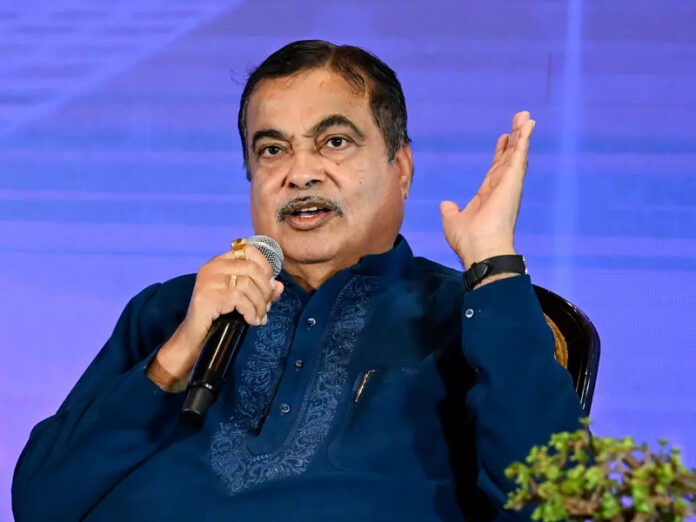
NEW DELHI, Apr 21:  Road Transport and Highways Minister Nitin Gadkari on Tuesday said India should aspire to achieve 100 per cent ethanol blending in the near future, as vulnerabilities in oil exports amid the West Asia crisis have made it necessary for the country to become self-reliant in the energy sector.
Gadkari further said the Corporate Average Fuel Efficiency III standards, which will be implemented from April 1 next year, will have little impact on electric and flex-fuel vehicles.
“In the near future, India should aspire to achieve 100 per cent ethanol blending… Today, we are facing an energy crisis due to the war in West Asia, so it is necessary for us to become self-reliant in the energy sector,” he said, while addressing the Indian Federation of Green Energy’s Green Transport Conclave.
In 2023, Prime Minister Narendra Modi launched petrol blended with 20 per cent ethanol.
Currently, Indian vehicles can run on E20 petrol with minor changes to the engine to prevent corrosion and other issues.
Countries like Brazil have 100 per cent ethanol blending.
Gadkari said India relies on imports to meet 87 per cent of its oil requirement.
“We import fossil fuels worth Rs 22 lakh crore, which is also causing pollution… so we need to work on increasing production of alternative fuel and bio-fuel,” he said.
Noting that green hydrogen is the fuel of the future, Gadkari said there is a need to reduce the cost of running a hydrogen fuel station to make it financially viable.
“Transport of hydrogen fuel is a problem. Also, we need to produce 1 kg of hydrogen at USD 1 dollar, to make India an exporter of energy,” he said.
The minister said that there is a need to produce hydrogen from waste.
He also pointed out that by focusing on the circular economy, India can create more employment opportunities.
While observing that there is a need to discourage the use of petrol and diesel vehicles, Gadkari said, “But we can not force people to stop buying petrol and diesel vehicles.”
On growing concern on social media about E20, Gadkari said the petroleum sector is lobbying against this move.
He asked automobile companies to focus on quality, not on cost, as it would help them penetrate new markets. (PTI)