

‘Constitution of India fully implemented in J&K now’
*Mookerjee rejected provision of two PMs, Emblems, Constitutions
Sanjeev Pargal
JAMMU, Dec 25: Prime Minister Narendra Modi today said that even after independence, the arrangement in Jammu and Kashmir posed a major challenge to India’s integrity and that his Government had the opportunity to bring down the wall of Article 370 which granted special status to erstwhile State.
Follow the Daily Excelsior channel on WhatsApp
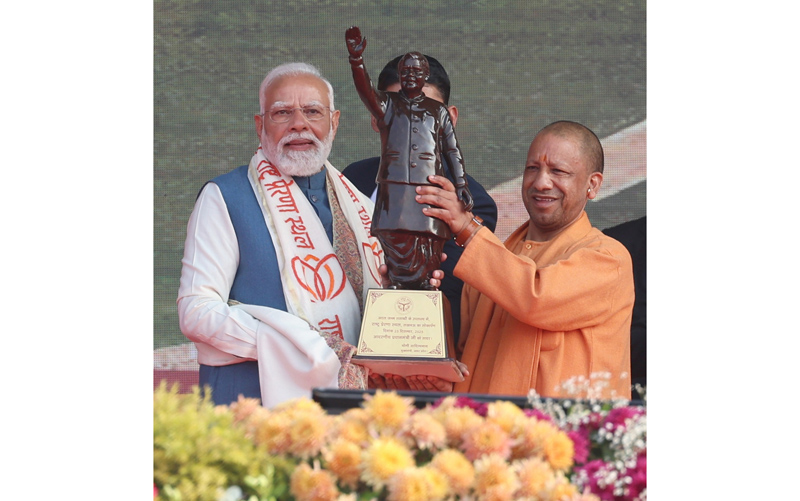
He said this after inaugurating the Rashtra Prerna Sthal in Lucknow (Uttar Pradesh) on 101st birth anniversary of former Prime Minister Atal Bihari Vajpayee. The Prerna Sthal features 65-foot bronze statues of Atal Bihari Vajpayee, Syama Prasad Mookerjee and Pt Deendayal Upadhyaya, and a lotus-shaped museum spread over 98,000 square feet.
“The BJP is proud that our Government had the opportunity to bring down the wall of Article 370 and today the Constitution of India is fully implemented in Jammu and Kashmir,” the Prime Minister said.
Asserting that Dr Syama Prasad Mookerjee played a decisive role in giving direction to the nation, Modi recalled that it was Dr Mookerjee who rejected the provision of two Constitutions, two Emblems and two Prime Ministers in India.
Syama Prasad Mookerjee sacrificed his life on June 23, 1953 in Jammu and Kashmir while protesting against `Do Vidhan, Do Pradhan, Do Nishan’. The Narendra Modi Government abrogated Article 370 granting special status to erstwhile State of Jammu and Kashmir on August 5, 2019.
He said as the first Industry Minister of independent India, Dr Mookerjee laid the foundation of economic self-reliance and gave the country its first Industrial Policy, thereby establishing the basis of industrialization in India.
“Today, the same mantra of self-reliance is being taken to new heights, with Made in India products reaching across the world. The BrahMos missile, whose power the world witnessed during Operation Sindoor, is now being manufactured in Lucknow,” the Prime Minister said.
He said we must not forget how after Independence, a tendency developed to attribute every positive achievement to a single family.
Modi was accompanied by Defence Minister Rajnath Singh, UP Governor Anandiben Patel, Chief Minister Yogi Adityanath and other senior leaders.
He was warmly welcomed by people who waved the tricolour and raised slogans in his honour.
The PM said the Rashtra Prerna Sthal symbolises the ideals that have guided India on the path of self-respect, unity and service, and called for collective efforts towards nation-building.
Addressing the gathering, Modi said December 25 marks the birth anniversaries of Bharat Ratna Atal Bihari Vajpayee and Bharat Ratna Mahamana Madan Mohan Malaviya, adding that both leaders “protected India’s identity, unity and pride and left an indelible mark on nation-building”.
PTI adds: The PM said the newly inaugurated Rashtra Prerna Sthal reflects the ideals guiding India on the path of self-respect, unity and service, and called for collective efforts in nation-building.
He noted that Vajpayee and Malaviya protected India’s identity, unity and pride and left an indelible mark on nation-building.
He added that the Rashtra Prerna Sthal reflects India’s path of self-respect, unity and service. Referring to the statues of Mookerjee, Upadhyaya and Vajpayee, he said, “Their statues may be tall but the inspiration we receive from them is even higher.” On Upadhyaya, Modi said his Antyodaya vision measured progress by the smile of the last person in the queue. “We have expanded Antyodaya through saturation, covering every needy person without discrimination. This is good governance, true social justice and true secularism,” he said, noting that crores have benefited from housing, utilities, food and medical schemes.
Calling December 25 “a day of good governance”, Modi credited Vajpayee with laying the foundation for digital identity, telecom reforms, road connectivity and metro rail projects.
He said Vajpayee would have been pleased to see India emerge as the world’s second-largest mobile phone manufacturer, with Uttar Pradesh becoming the top mobile manufacturing State.
Aiming at dynasty-driven politics, Modi said several national leaders were ignored or their legacies diluted. He cited the renaming of the Andaman island where Netaji Subhas Chandra Bose hoisted the tricolour and recalled “attempts to erase the legacy of B R Ambedkar”.
He alleged that the “Congress’ royal family” and the Samajwadi Party had done so but said the BJP ensured Ambedkar’s legacy was protected.
Modi said Sardar Vallabhbhai Patel, who united hundreds of princely States, was also undermined after Independence, and claimed it was the BJP that restored his stature through initiatives such as the Statue of Unity and Ekta Nagar.
He described dynastic politics as “driven by insecurity” and said it promoted “political untouchability”, alleging that Congress and its allies treated the BJP in this manner.
He said the NDA honoured leaders across party lines, noting Bharat Ratna awards to P V Narasimha Rao and Pranab Mukherjee and national honours for Mulayam Singh Yadav and Tarun Gogoi. Modi said the NDA “corrected historical neglect” of former Prime Ministers through the Pradhanmantri Sangrahalaya.
 Follow our WhatsApp channel
