

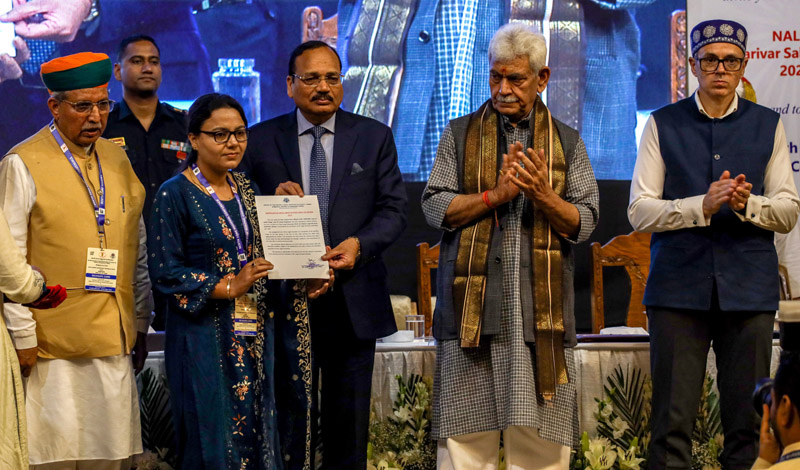
Justice Kant launches ‘Veer Parivar Sahayata Yojana’
Fayaz Bukhari
Srinagar, July 26 : Union Law Minister Arjun Ram Meghwal today praised the armed forces for their unwavering commitment to the nation and lauded their growing stature following the success of Operation Sindoor which he described as a symbol of India’s decisive military response.
Follow the Daily Excelsior channel on WhatsApp
“This is the first event of its kind after Operation Sindoor, which demonstrated India’s might to the world,” the Minister told North Zone Regional Conference of Legal Services Authorities at SKICC here while describing “Operation Sindoor” as a symbol of India’s decisive military response.
Meghwal lauded the Indian Army’s swift and strategic action during “Operation Sindoor,” launched in response to the April 22 Pahalgam terror attack that claimed the lives of 26 civilians.
“The operation, which destroyed nine terror camps deep inside Pakistan and Pakistan occupied Jammu Kashmir (PoJK) within 22 minutes sent as a bold message to the world that India has zero tolerance towards terrorism,” he added.
The Minister narrated a few lines of a song being sung in Rajasthan in the honour of the Armed Forces after the success of ‘Operation Sindoor.’ Click here to watch video
Talking to reporters on the side-lines of the event, Meghwal said that three major legal initiatives have been taken in Jammu and Kashmir to ensure ease of justice delivery to members of the Armed Forces and tribal communities.
“We are committed to providing legal aid to the tribal population and ensuring timely legal assistance to our jawans. Legal support is essential for those who defend our borders and for the tribal communities who often face systemic barriers,” he said.
Meghwal urged the State Legal Services Authorities (SLSAs) to play an active role in ensuring that legal aid is not just a formality, but a tool to empower the deprived and vulnerable sections of society. He emphasized that such efforts are essential for protecting constitutional rights and upholding the spirit of inclusive justice.
“The Constitution guarantees justice to all, and it is our duty to ensure that the most marginalized, whether they are soldiers in remote postings or tribals in far-flung areas, receive timely and effective legal support,” he added.
On the occasion, Supreme Court of India and Executive Chairman National Legal Services Authority, Justice Surya Kant launched the ‘Veer Parivar Sahayata Yojana 2025’ in Srinagar today.
The scheme is designed to provide proactive and accessible legal assistance to families of armed forces personnel serving in remote and conflict-prone areas of the country.
For the first time in Indian history, a comprehensive nationwide effort will ensure that legal burdens at home do not distract soldiers from their duties. Under the scheme, legal aid clinics staffed by trained paralegal volunteers and lawyers will be established at every district and state sainik board. Retired soldiers, Veer Naris (war widows), and ex-servicemen with legal backgrounds will be given preference for these roles.
Addressing North Zone Regional Conference of Legal Services Authorities here, Justice Kant said, “You (soldiers) serve the nation at the borders. We will stand guard at your homes.”
He described Srinagar as a site rich with symbolism and sentiment for launching the program.
Justice Kant began his speech with an emotional explanation for choosing Kashmir as the location for this historic initiative. Quoting Kashmiri poet Peerzada Ghulam Ahmad Mehjoor, he recited: “Come, O Gardener, create the glory of a new spring. Let flowers bloom in clusters and make the nightingales sing again.”
“These verses capture the spirit of our scheme, which aims to bring dignity, peace, and legal security to the families of those who defend the nation’s borders. Our jawans are stationed in these mountains, always alert to safeguard the nation. It is only right that our commitment to their families also begins here,” he said.
Justice Kant recounted his own experiences as a Supreme Court judge, recalling cases where families of soldiers suffered legal harassment while their loved ones were away serving the nation. “Issues ranged from illegal encroachments on property, tenant disputes, forged ownership claims, to hurdles in accessing pensions or educational benefits,” he said.
“Even a stranger with no connection to the soldier can file a false case, and unfortunately, that happens. It should not be the soldier’s responsibility to take leave from duty to appear in court back home. From today it is our responsibility,” he said.
Justice Kant said that NALSA has completed all necessary coordination with the Ministry of Defence, and legal aid clinics will become functional at all sainik boards, including in remote villages. Preference will be given to ex-servicemen and Veer Naris for the roles of paralegal volunteers and legal aid counsels, especially those with legal training.
“We have invited retired army personnel and Veer Naris to become paralegal volunteers. Their lived experience makes them uniquely suited for this work,” he said.
The scheme further addresses calls from legal aid communities in Ladakh and the Northeast by revising the honorarium for volunteers and legal aid counsels, sometimes doubling previous amounts. State legal services authorities may increase these payments further, depending on available funds.
”This is not charity. This is the nation’s obligation. Legal aid must not be seen as mere litigation support—it is our social commitment,” he added.
Marking NALSA’s 30th year, Justice Kant briefed on the organization’s journey and impact, particularly in rural and tribal areas, and hinted at a new legal empowerment initiative for tribal communities in Kashmir and Ladakh to be announced later in the day.
Justice Kant also highlighted the judiciary’s role as a public service while executing the Legal Services Authorities Act: “We are not acting as judges here. We are public servants carrying out a statutory duty given by Parliament. If you are serving the country at Siachen, the judiciary must serve your family back home.”
The two day event was graced by Justice Surya Kant; Union Minister of State for Law and Justice, Arjun Ram Meghwal; Chief Justice High Court of Jammu Kashmir and Ladakh, Justice Arun Palli; Chief Minister, Omar Abdullah; Judge High Court of J&K and Ladakh and Executive Chairman J&K Legal Services Authority, Justice Sanjeev Kumar; Judge High Court J&K and Ladakh and Executive Chairperson Ladakh Legal Services Authority, Justice Sindhu Sharma; General Officer Commanding-in-Chief, Northern Command, Lt. General Pratik Sharma; Judges of Supreme Court of India and Chief Justice of various States and UTs.
Justice Sindhu Sharma, Judge, High Court of J&K and Ladakh and Executive Chairperson, Ladakh Legal Services Authority, in her welcome address introduced the twin objectives of the conference – justice for the defence families and tribal communities as moral and constitutional imperatives. She described the Veer Parivar Sahayata Yojana as a symbol of national gratitude and empathy, designed to provide legal support through legal clinics operated by trained ex-servicemen acting as Nyaya Mitras.
Chief Justice Arun Kumar Palli, in his keynote address, highlighted the neglect of protective provisions under the Army, Navy, and Air Force Acts, calling for their urgent revival and institutional implementation. He announced the development of a digital case management system (DTCMS) tailored to address the needs of defence personnel.
Lt Gen Pratik Sharma, General Officer Commanding-in-Chief, Northern Command, delivered an emotionally resonant address highlighting the practical and psychological burden borne by soldiers due to legal proceedings during deployment. He praised the judiciary’s move as a transformative and morale-boosting reform. Justice Sanjeev Kumar, Executive Chairman, J&K Legal Services Authority, emphasized the constitutional imperative of tribal inclusion and access to justice. He announced the establishment of 22 Samvad Units under Samvad Scheme – 2025, a NALSA initiative to ensure legal services reach Scheduled Tribes and other nomadic groups. Innovations under the scheme include mobile legal vans, tribal paralegal volunteers, and mobile hospital partnerships.
 Follow our WhatsApp channel
