

Dr. D.K. Giri
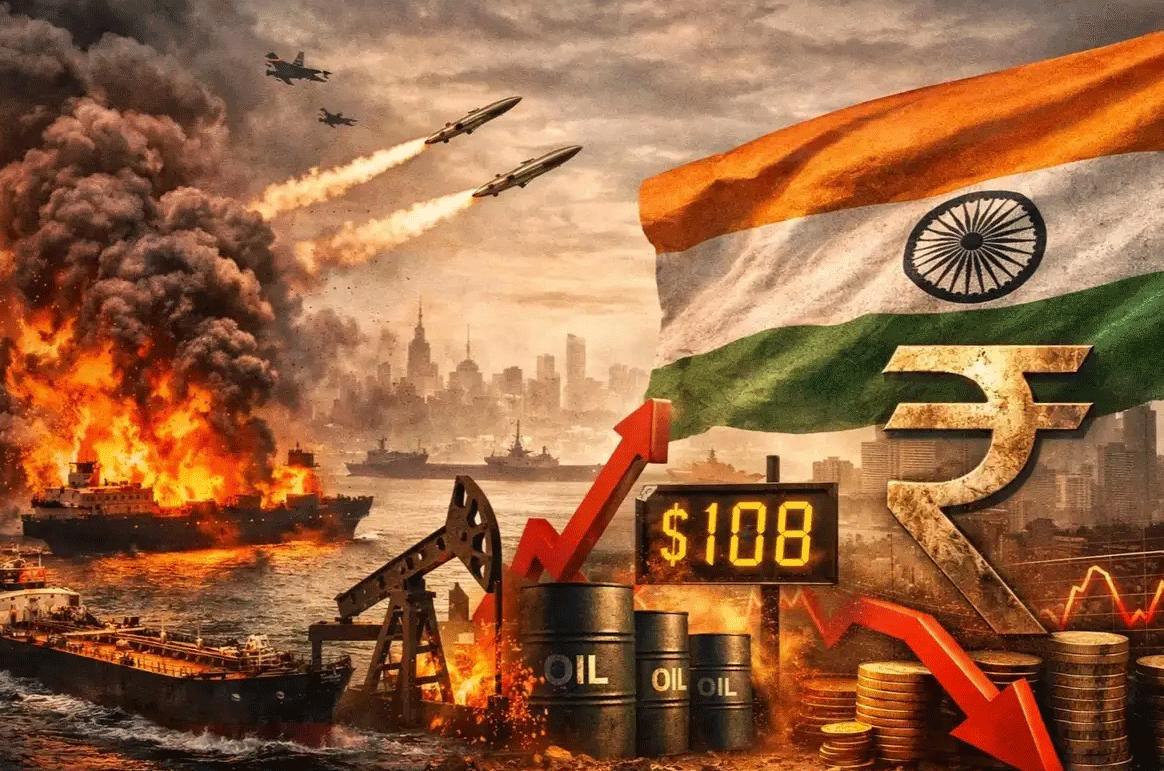
The Iran war is an ongoing conflict with serious consequences for the global security and economy. Unlike the Ukrainian war, which is somewhat confined to Europe, the war in Iran will affect the whole world. It will disrupt the energy supply as Iran has considerable oil reserve and Tehran controls the sea route, the Strait of Hormuz which passes 20 per cent of world’s oil. Due to historical links between India and Iran, mainly on trade, and Iran potentially providing the connection for India to Central Asia, the impact of the war on India is going to be substantial.
The US and Israel launched series of strikes on Iran, targeting military and nuclear-related sites. The US hit the military capabilities of Iran – the navy and the missile and drone production infrastructure while Israel hit everything that IDF could reach. The indiscriminate bombarding, particularly on the school building killing about 176 small children stirred the conscience of the world, including the allies of the United States. Iran retaliated with missile and drone attacks on US bases in the region and by firing randomly at Israel.
What was perhaps strategically conceived and presented to the world as a pre-emptive, prompt and a short-term strike is still going on without immediate sight of an end. It is like the war in Ukraine which Russian President Putin called ‘Special Military Operation’ that was to end in days and weeks. Horrifyingly, the war is still continuing after four years. US President Donald Trump who initially hinted that the war will end in four to six weeks, now claims there is “practically nothing left to target in Iran”. But Iran’s supreme leader’s advisor warns of a “war of attrition that will destroy the world economy”. He also claims that the end of the war will be decided by Iran.
On a strategic note, Iran had supposedly anticipated this attack by the US and Israel. Iranian leadership had made strategic provisions for the event of decapitation of top leadership. That is what happened within hours of the strike, the Supreme Leader along with the top officials of Iran was eliminated. Observers attribute this quick assassination of top leadership to a mole in the Supreme Leader’s inner circle. Be that as it may, Iranian leadership had set up decentralised command system which meant that several military units could independently retaliate the invading forces in case the Central Command becomes inactive after such assassination. So, the war can continue from multiple sources. This is exactly what seems to be happening at the moment.
On 28 February 2026, US-Israel began bombing Iran. In retaliation, Iran sent missiles to the Gulf states which had American bases. A few days ago, the UN Security Council passed a resolution (2817) condemning Iran’s ‘egregious attacks on Gulf states’ with 13 votes in favour and 2 abstentions (China and Russia). The Resolution demanded Iran stop attacks on Bahrain, Kuwait, Qatar, Saudi Arabia, UAE and Jordan and refrain from interfering with maritime trade.
The expansion of the war into the other states in the Gulf region will heavily affect India. The supply of energy will be interrupted as well as India’s exports to the world. India was using countries like UAE to export elsewhere to the world. That will be hit. India imports substantial oil from the Gulf region. If the war continued for a few weeks, India could use its strategic reserves of oil. But if it lasted longer like it did in Iraq and Afghanistan, India’s economy will be badly hit.
Some oil exporters are exploring other routes through Africa, as the Strait of Hormuz remains vulnerable. That will shoot up the transport costs. From available reports, hundreds of ships are stranded in and around the Strait of Hormuz. If ships passing through Hormuz are sunk, passage through the Strait may remain closed for a long time.
So, the rise on energy price will have a cascading effect on all other prices. Reportedly, prices are already rising and shortages are appearing, resulting in black marketing. Agriculture, textiles, tiles, glass, plastics, hotels, restaurants, airlines and energy-intensive products are already impacted. More the war protracts the worse will be the impact. The ‘balance of payment’ will be upset. Iran may not support India on the Chahbahar Port which was gateway for India to the Central Asia.
Furthermore, since Iran has attacked airports and critical infrastructure in the Gulf region, the oil-producing countries have curtailed production and their crude is stuck. It is assumed that even after the war ends, they may not be able to immediately ramp-up production. So, energy deficits in many countries will persist for some time.
As the air and sea routes are disrupted, trade and travel through and around the Gulf – a critical geographical space that connects the West with the East – have virtually stopped. Difficulties in travel will impact hotels, tourism and the entertainment industry. According to Government of India, there are about 1 crore Indians working in the Gulf region. Remittances from them into NRI accounts are substantial. These will decline, weakening the capital flows. Many NRIs are wanting to return to India due to the conflict and decline in production in West Asia. This will hurt the employment situation in India.
How is India coping with the impact of the war? First, India is seeking to diversify its energy sources and is exploring alternative suppliers. The government has reportedly held discussions with major oil producers like Russia, Saudi Arabia and UAE to ensure stable energy supplies. The US seems to have reconciled to the disruption of oil supply and therefore has agreed to waive tariffs if India decides to purchase oil from Russia which is already in the sea.
Admittedly, India will experience price rise and some temporary inflation although GOI is assuring its citizens not to panic. To mitigate the price shocks, the Government is considering temporary relief measures such as LPG subsidies and fuel tax adjustments.
Some observers argue that India’s economy and security will be negatively impacted as New Delhi chose to stay in the US-Israel camp. This was evident from Prime Minister Modi’s visit to Israel 48 hours before the war started. But India’s economy would have been hit as it is now irrespective of which side it was on. The fallout of the war has to be faced in any case.
As I said in this column last week, New Delhi has made a conscious choice of aligning with the democratic world while maintaining friendly relations with other powers. This is a right choice as so-called neutrality in a war has its costs. India was already paying some of it because of its non-committal approach to the war in Ukraine. Prime Minister Modi made quick corrections in case of Iran which has been a bigger friend than even Ukraine.—INFA
 Follow our WhatsApp channel
