

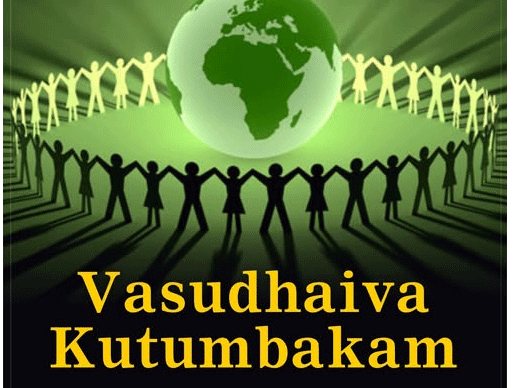
Vasudhaiva Kutumbakam
Dr Jaipal Singh
jaipalranial@gmail.com
We live in a time where information is easily available, yet true understanding often feels distant. People frequently speak about unity, equality, peace, and harmony but in reality divisions continue to exist across societies. Human beings are separated by caste, religion, nationality, gender, language, and beliefs. These differences are natural and form an essential part of human diversity-reflected in our cultures, traditions and ways of thinking. Rather than being weaknesses these differences enrich our world and make it more vibrant and meaningful.
When we begin to see every individual as part of one global family: “Vasudhaiva Kutumbakam” our perspective changes-we become more compassionate, supportive, and willing to live in harmony with others.
Vasudhaiva Kutumbakam meaning ” the whole world is one family.” is a beautiful idea taken from ancient texts like the Mahopanishad. This thought not only connects us with one but also encourages every individual to rise above self centered goals and objectives, divisions and see every human being as part of one universal family.
In today’s world, where conflicts and differences often separate people, this philosophy reminds us of unity, compassion, mutual respect, kindness, understanding, care and support for one another beyond boundaries. Problems arise when people misuse differences for their own benefit, creating a false sense of superiority and weakening human unity. This breaks trust and builds barriers between people who are actually connected. Instead of bringing us together, these differences are used to divide us. Even though we share many similarities, people focus more on what sets them apart. This often comes from ego and the habit of forcing one’s views on others. Ego makes people feel their identity is better, leading some to spread hate and conflict for personal or political gains, harming harmony over time.
Though it is well understood that human beings come from a single source. Though they are under the different umbrella of religion naming almighty as God, Allah, Bhagwan or Waheguru, the essence of ONE yet remains the same. This idea can be gracefully understood through the example of rivers flowing through different paths yet ultimately merging into the same ocean. It beautifully expresses the idea of “one truth, many paths, one humanity.”
Human life itself reflects this interconnectedness. We all depend on the same resources-sunlight, air, water, land and food. Every person breathes the same air and lives on the same planet. Even global events show how connected we are. A conflict in one region can affect economies and societies across the world. This highlights the importance of collective responsibility and peaceful cooperation.
The need of the hour is to strengthen the sacred fabric of global unity. When we truly see others as members of one family, our actions reflect care, respect, and cooperation. Humanity has no real borders-only connections. However, such transformation cannot happen instantly; it must begin within each individual.
Education plays a key role in this process. True education is not limited to exams or degrees; it teaches critical thinking, helps us question wrong beliefs and understand diverse perspectives. It builds empathy and makes us aware of our interconnected world. Today’s global challenges-such as climate change, poverty, health crises, and inequality-affect everyone. No single nation or community can solve them alone. Cooperation, mutual understanding and shared responsibility are essential. These must be supported by strong and responsible leadership.
Good leaders promote fairness, equality and compassion. They bring people together, encourage dialogue, and build trust among communities. However, unity cannot depend only on leaders. Every individual has a responsibility to maintain harmony in daily life. Real and lasting change happens when both individuals and society move forward together.
Spiritual values further strengthen unity. When people follow values like love, kindness, humility, and forgiveness, they begin to see others as equals. They understand that all human beings share common needs such as happiness, respect and belonging. This understanding removes barriers and builds stronger connections. The idea of “one truth, many paths” shows that differences in belief are not causes of conflict but reflections of human diversity.
In today’s interconnected world, technology has brought people closer than ever before. It allows instant communication and sharing of ideas. While it creates opportunities for learning and growth, it also brings challenges. Misinformation and negativity can spread quickly in no time, if not used responsibly. Therefore, mindful use of technology is essential to preserve unity.
Global conflicts further highlight the dangers of division. Wars cause destruction, suffering and loss of life. History has shown that violence never brings lasting peace. Ultimately, True peace comes from dialogue, understanding, and cooperation.
Young people hold great potential in shaping the future. They are open to new ideas and have access to education and technology. They can challenge outdated beliefs and promote equality and understanding. By respecting diversity and rejecting discrimination, they can build a more inclusive and harmonious world. In the end, one truth remains clear: we are all part of one human family. Our paths may differ and our beliefs may vary but our existence is deeply interconnected. What truly matters is not our identity but our actions, that is how we treat others and how we contribute to the world. The journey toward unity may not be easy but it is necessary and necessity of the time to create a peaceful world for our next generation(s).
(The author is Principal GDCW-Kathua)
 Follow our WhatsApp channel
