

Vijay Hashia
Politics in Bihar has once again turned into a boiling cauldron, an arena where ballots and barbs collide with ferocity. What should have been a basic bureaucratic exercise of revising electoral rolls, has instead metamorphosed into a logomachies of politics, polemics, and power, a rhetorical duel where every word has become a weapon, every accusation a salvo, and every rebuttal a counterstrike in the struggle for electoral dominance.
On the one side stand opposition, hurling thunderous charges of “vote chori” (vote theft) portraying the exercise as nothing less than a sacrilegious assault on Bharat Mata. On the other side, the Election Commission and ruling party retaliate with equal force, branding these allegations as manufactured hysteria designed to tarnish democratic institutions. In this theatre of democracy, press briefings, affidavits and social media videos have transformed into ammunition that shows no sign of abating.
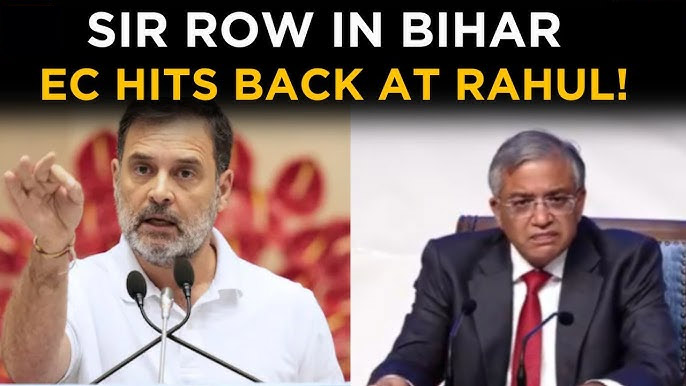
The polemics have reached a boiling point. Escalating his fusillade against the Election Commission, Congress leader Rahul Gandhi recently thundered a dire warning, declaring that stern and unforgiving action awaits the Chief Election Commissioner and his colleagues when the INDIA bloc ascends to power. His words rattled the guardians of the electoral machinery, who fear that their credibility built over decades, is being undermined in the public mind.
For the Election Commission and the ruling BJP-NDA combine, the Special Intensive Revision (SIR) is a constitutional exercise designed to cleanse voter lists and restore electoral integrity. For the opposition, however, it is nothing short of a political weapon, engineered to disenfranchise the vulnerable, tilt the scales, and entrench the incumbents.
The Congress-RJD bloc, backed by INDIA alliance partners, has positioned itself firmly against the SIR. Their accusation: the revision, initiated just months before the Bihar Assembly elections, is less about cleansing rolls and more about strategic excision, targeting Muslims, Dalits, and migrant workers, groups that form the backbone of opposition support. To them, the timing is proof of conspiracy; the intent, they argue, is nakedly partisan.
Rahul Gandhi has spearheaded the campaign with his rhetoric. Branding the exercise a conspiracy to “steal” elections, he coined the phrase “Vote Chori” as his political battle cry. He warned that Bihar could witness an “NRC-like situation.”
Gandhi highlighted stories of alleged disenfranchisement as 100% proof of fraud, such as Ranju Devi, who initially claimed her family’s names had vanished from the rolls. However, the Election Commission countered by releasing a video where she admitted her family’s names were intact and that she had been misled by political operatives. This dented the opposition narrative. For the ruling NDA, this episode was termed as opposition’s strategy to manufactured victimhood lacking credible evidence.
In yet another fiery intervention, Gandhi released a video featuring Subodh Kumar, claiming is name was deleted from the rolls and declared it proof of “vote theft” and an assault on Bharat Mata. The Election Commission retaliated swiftly, revealing that Kumar was not an ordinary voter but an RJD Booth Level Agent whose name never existed in the rolls. With deletion lists corroborated by Supreme Court guidelines, the Commission dismissed the episode as a manufactured farce, pointing out that Kumar had never filed the requisite Form-6 or objections.
On August 19, psephologist Sanjay Kumar, affiliated with Lokniti-CSDS, publicly apologized for his posts on the Maharashtra elections. He had claimed two assembly constituencies saw a sharp voter decline compared to the recent Lok Sabha polls, sparking debate and raising concerns about electoral integrity. Later, Kumar admitted his interpretation was flawed, based on misreading official data, and clarified he never intended to mislead or question the Election Commission. For the Election Commission, the apology reinforced its stance that allegations of irregularities put forth before the public are out of hasty or erroneous analysis.
Legally, the Election Commission stands on firm ground. Invoking Article 324 of the Constitution and Section 21 of the Representation of the People Act, 1950, it insists it has both mandate and duty to revise rolls. Its objective, it asserts, is “purification,” weeding out deceased, migrated, or duplicate entries to uphold the principle of one person, one vote. The Commission emphasized that the 65 lakh deletions were the product of cross-verification, not arbitrariness, and that the process included multi-layered checks, including scrutiny by polling agents from all parties. However, the Supreme Court’s intervention, directed the Commission to publish, district-wise, the names of all 65 lakh deleted voters along with explicit reasons for their removal.
In the unprecedented press briefing, Chief Election Commissioner Gyanesh Kumar demanded Gandhi’s sworn affidavit substantiating his allegations within seven days, which ends on this Sunday, or apologize to the nation. The ruling BJP and its allies have launched a counter-offensive too. Leaders like Tarun Chugh and Ajay Alok have gone further, accusing Gandhi of undermining institutions for petty mileage and even hinting at foreign influence. For the NDA, the opposition’s campaign is not about democracy’s defense but about delegitimizing the system itself.
Opposition leaders fear that millions who work outside the state, yet remain registered in their native villages, could lose their votes under the Commission’s strict insistence on “ordinary residence.” Since migrants are a crucial base for RJD-Congress, their exclusion could dramatically reshape Bihar’s electoral landscape. The ruling alliance, however, argues this is essential to prevent double voting and ensure territorial accuracy.
As this battle intensifies, the stakes transcend Bihar. The confrontation between Rahul Gandhi and the Election Commission has crystallized into a test of political rhetoric versus constitutional authority. Gandhi refuses to retreat, warning darkly that the “thief has been caught” and that the Commission must itself stand accountable before the people. The Commission, equally resolute, insists it will not permit institutional erosion through what it deems reckless demagoguery.
The logomachy of politics, polemics, and power is more than a clash; it is a mirror of India’s democratic turbulence, where rhetoric sometimes, eclipses reason, logic and rationale. Yet, beneath this cacophony lies the strength of democracy. However, the weapon of falsehood must never be allowed to corrode the sanctity of this democratic institution, the Election Commission of India. Let this democratic exercise affirm the triumph of truth.
 Follow our WhatsApp channel
