

Dr Saurabh Dixit
The word ‘shiksha’ means ‘the act of teaching and learning’. Education is a word with a wide meaning, but generally we try to understand it through formal and informal education. Formal education is provided for a fixed duration through a fixed curriculum, joint efforts of teacher and institute, whereas informal education can be obtained anytime, anywhere and from anyone. In other words, it can be said that education is the best divine gift received by any person, which helps in separating him from animals and giving him a respectable place. Education is a construction process going on from birth to death, whose main function is to develop and reveal the inner powers inherent in man. Education makes a person skilled. One important part of education is curriculum, i.e. education is a three-pronged process, whose three main parts are teacher, student, and curriculum. Education lies in the interaction of all three. In ancient times, education was provided in a healthy environment. Students were made to memorize the literature of the time by their teachers. One important part of education is the teacher. Teacher means a reliable hand which saves us from drowning in depression. Teacher means one whose word becomes a lamp of hope in moments of despair. Teacher means a personality who shows the right path for our benefit. Teacher means one who takes us from ignorance to knowledge and from darkness to light. Teacher means one who not only provides us with literacy but also guides us in every step of life.
The Guru-Shishya tradition is an important and sacred part of Indian culture. Parents are the first to be worshipped because they bring us into this colourful and beautiful world. Mother and father are called the first Guru of children. But parents, society, friends, relatives provide us informal education which helps us in our practical life. But the path to live life is obtained from the continuous guidance of teachers. Teachers tirelessly make continuous efforts to provide quality education to the education system. Teachers consider their students as their own and impart education and work hard. As a student, when we need inspiration and encouragement, then these teachers teach us to come out of any unpleasant situation through the knowledge of patience. In the history of India, through examples like Maharshi-Vashishtha Shri Ram, Sandipani- Shri Krishna, Shri Parashuram-Bhishma, Ramanand-Kabir Das, Narharidas-Tulsidas, Shri Ramakrishna Paramhans-Swami Vivekananda, Vallabhacharya- Surdas, Samarth Guru Ramdas- Chhatrapati Shivaji, Gopal Krishna Gokhale-Mahatma Gandhi, Matsyendranath-Gorakhnath, Raidas-Mirabai, Chanakya-Chandragupta Maurya, Govind Bhagwatpad Ji-Adi Shankaracharya, Shri Krishna-Abhimanyu, Aalar Kalam-Gautam Buddha, it can be understood that Gurus are also special to prepare a good disciple. Kabir Das has expressed the glory of a teacher in this way-
I will make all the earth a paper, all the forest opinions to write. I will make ink from seven seas, but Guru’s virtues cannot be written.
The teacher has always reformed the society and given it a new direction. Teachers awaken the feeling of social welfare in us. From making an ordinary person a great warrior to a knowledgeable, idealistic person, the teacher has an important role to play. Providing education is the biggest religion because only due to education can a society develop and prosper. Hence, man should share knowledge with the society like a teacher so that the society can be benefited. Goswami Tulsidas says that God is present in every particle, thus everyone is each other’s Guru and disciple.
There are many such examples which tell that the tradition of Guru and disciple was sacred in ancient and medieval times. Today Guru-disciple are painted in the color of modernity. The identity of a real Guru is not self-respect. Imparting education is becoming a business. Though teachers are a mine of qualities, it is very important for a teacher to have ideal personality, all-round qualities, a sense of equality, interesting teaching, sharing experiences, being punctual about time and discipline, self-respect, and other such basic qualities. Disciples have always respected their Gurus and followed their instructions. Be it Shri Ram killing demons on the orders of Guru Vishwamitra and choosing Sita while participating in Sita Swayamvar, Shri Krishna bringing back his Guru Sandipani’s dead child Punardatta from Yamraj, Eklavya cutting off his right hand’s thumb on the orders of Guru Dronacharya, Bhishma fighting with his Guru Shri Parashuram on his orders, Chhatrapati Shivaji bringing the milk of a lioness on the orders of Samarth Guru Ramdas, our civilization is full of such incidents.
Why only in honor of Radhakrishnan?
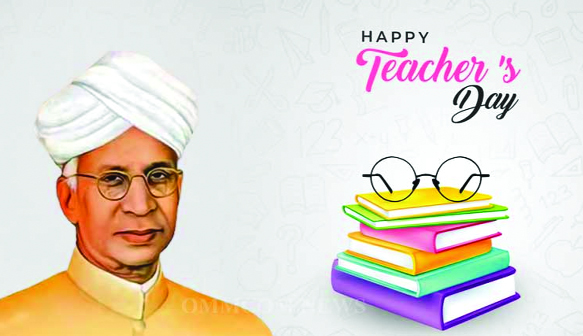
Dr Sarvepalli Radhakrishnan was born in a Brahmin family in Thiruttani village of Tamil Nadu on 5 September 1888. Radhakrishnan was always blessed with extraordinary talent and the spirit of nationalism was deeply embedded in him. Being a brilliant student, Radhakrishnan always received scholarships. He later adorned the post of Vice Chancellor of the college from which he did his M.A. After getting education, as a professor in Madras Presidency College, Mysore University, Kolkata University, Oxford University and Banaras Hindu University, when he used to teach fluently in Hindi and English wearing a turban and dhoti on his head, the students used to listen to him with fascination. It is also said that even the teachers used to be eager to teach his class. Radhakrishnan himself was highly influenced by Swami Vivekananda and Veer Savarkar, who were great men of extraordinary talent. In 1962, when Radhakrishnan became the second President of the country, many of his disciples requested him to celebrate his birthday.
After a lot of persuasion, he said that if you all want to celebrate my birthday, then celebrate it as Teachers’ Day. In the same year, to show respect to teachers in India, Teachers’ Day started being celebrated every year on 5 September. Radhakrishnan was one of the most famous writers of contemporary India. He wrote articles on theoretical, religious, moral, educational and informative subjects. His major books are Indian Philosophy, The Bhagavad Gita, Satya Ki Khoj, Philosophy of Hinduism, Our He is a heritage. He was nominated 16 times for the Nobel Prize for Literature and 11 times for the Nobel Peace Prize. In 1975, the American government awarded him the Templeton Prize for his unforgettable work in the field of religion. He was the first non-Christian to receive this award. He was also the first guest to reach the “White House” of America by helicopter. He had an unprecedented contribution in preparing the education system of modern India. Radhakrishnan was the first chairman of the University Grants Commission and the second Vice Chancellor of Kashi Hindu University. He was also the first person from India to be awarded the Bharat Ratna. Dr. Radhakrishnan’s life character establishes a coordination with an ideal teacher. These institutions are the result of his foresight. Many educational institutions of today are the result of his foresight.
He had said, “Only those people should be made teachers who are the most intelligent. A teacher should not be satisfied only by teaching well but he should earn the love and respect of his students.”
(The author is Principal, Gandhi Smarak Higher Secondary School Mohammadi Road, Gola Gokarannath (Kheri), Uttar Pradesh)
 Follow our WhatsApp channel
