

Dr Rakesh Bharti
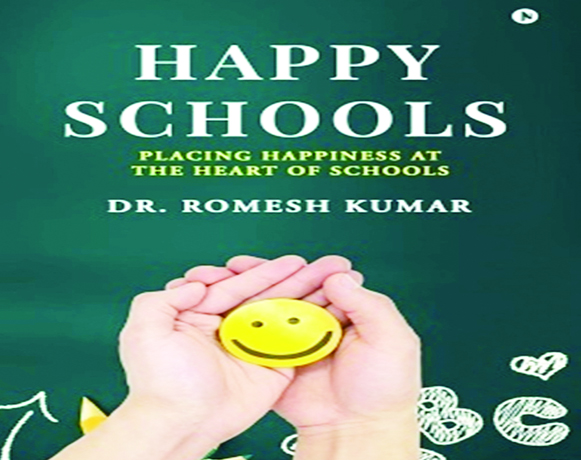
Title: Happy Schools: Placing
Happiness at the Heart of Schools
Author: Dr. Romesh Kumar
“The purpose of education must be to make children not just better learners, but better human beings.” – Dr. Romesh Kumar
In an era when the school bell often tolls more for pressure than play, and classrooms echo with performance anxiety instead of joy, Happy Schools: Placing Happiness at the Heart of Schoolsby Dr. Romesh Kumar emerges not just as a book, but as a moral compass-pointing towards a more humane, holistic, and hopeful direction for education. It’s a timely offering in a world facing what many experts now term a “mental health pandemic” among children and adolescents. This book dares to ask the difficult question-what is the purpose of education if it doesn’t make our children happier human beings?
Structured into four comprehensive parts, the book begins with Part I: Understanding the Need for Happy Schools. Here, Dr. Kumar provides a candid and evidence-based critique of current schooling practices. Drawing from empirical research, global data, and his extensive experience as a psychologist and policy advisor, he underscores the urgent need to reform the educational landscape. Chapter 2 introduces the “Happy School” model-not as an abstract ideal, but as a pragmatic, actionable framework grounded in psychological principles and policy considerations.
Part II: Building the Foundations delves into the core components of happy learning environments: Social-Emotional Learning (SEL), inclusive education, and the cultivation of positive relationships. Dr. Kumar compellingly argues that SEL is not a peripheral skill, but the central axis upon which sustainable education must revolve. Notably, Chapter 5 articulates the interconnection between inclusive practices and emotional well-being, demonstrating how embracing diversity promotes collective happiness and resilience.
Part III offers a rich synthesis of global best practices and indigenous Indian pedagogical wisdom. Referencing educational models from Finland, Bhutan, and Japan, alongside Indian spiritual traditions-such as those practiced in Ramakrishna Mission Schools, ChinmayaVidyalayas, and the Bihar School of Yoga-the author bridges ancient philosophies with contemporary neuroscientific and psychological insights. The inclusion of mindfulness, meditation, chanting, and the Yamas and Niyamas of Yoga illustrates how these time-honored practices enhance classroom dynamics, empathy, and emotional regulation.
In Part IV: Implementation and Practice, the book transitions from vision to action. Dr. Kumar outlines concrete strategies for embedding well-being into school culture-empowering teachers as “Happiness Ambassadors,” involving families as partners, and redesigning school ecosystems to prioritize mental health. The final chapter serves as both a reflective summation and a practical guide, reinforcing the idea that happiness is not an isolated initiative, but an ongoing commitment.
What distinguishes Happy Schools is its seamless integration with contemporary Indian educational policies, including the National Education Policy (NEP 2020), Manodarpan, the National Commission for Protection of Child Rights (NCPCR), and the proposed National Council for Higher Education and Research (NCHER). Rather than treating these policies as peripheral references, Dr. Kumar positions them as foundational pillars supporting the Happy Schools framework. His extensive professional experience-as the Head of the Counselling Cell at the Directorate of School Education, Jammu, and as a national-level resource person-adds depth, credibility, and authenticity to the discourse.
This book is not merely a pedagogical treatise; it is a visionary manifesto. For parents, it offers assurance and direction. For educators, it provides affirmation and tools for transformation. For policymakers, it bridges ancient wisdom with modern psychological science. And for students, it affirms that joy is not a detour from learning-it is the essence of learning itself.
Thus, in a world fractured by stress, competition, and disconnection, Happy Schools offers not just an alternative-but an imperative. This book is a wake-up call to every education system: if we want to build peaceful, productive, and purposeful societies, we must start by making our schools joyful.
In conclusion, Happy Schools is a must-read for educators, parents, school leaders, and policymakers alike. It is more than a review-it is an endorsement of a movement. If India aspires to reclaim its role as a Vishwa Guru, the journey must begin with nurturing happiness within its schools. Dr. Kumar’s work offers a compelling roadmap for realizing that vision.
(The reviewer is an Assistant Professor of Education at Govt. College of Education, Canal Road Jammu)
 Follow our WhatsApp channel
