

Excelsior Correspondent
JAMMU, Jan 7: J&K BJP president and MP Rajya Sabha, Sat Sharma CA today termed the de-recognition of medical colleges by National Medical Council (NMC) which do not come up to the norms framed by it as a routine process and the cancellation of registration of Mata Vaishno Devi Medical College was result of its failure to fulfil minimum mandatory criteria.
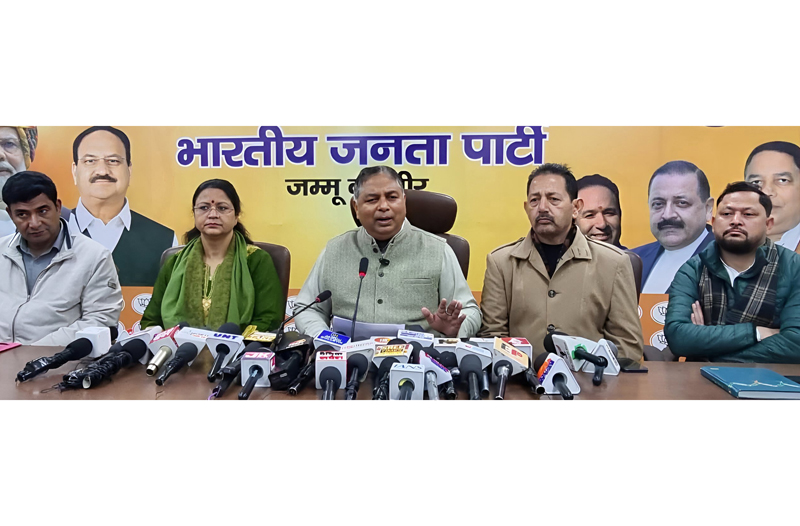
Sat Sharma along with J&K BJP general secretaries, Sanjita Dogra, Baldev Singh Billawaria, Mohammad Anwar Khan, and Gopal Mahajan, while talking to reporters here, today said many medical institutions across the country are routinely de-recognized by the NMC as part of its regular regulatory process but the issue gained prominence because the institution is run by the Shrine Board.
Click here to watch video
He reiterated that the NMC acted purely in a professional and objective manner after receiving complaints and identifying serious irregularities, ensuring that standards in medical education and patient care are not compromised.
Sat Sharma stated that Jammu has been witnessing continuous protests for the past several days over the admissions and functioning of the SMVD Institute of Medical Excellence. He noted that majority of social organizations from Jammu had raised the issue strongly. He emphasized that the institution is marked by the faith of one religion and is sustained by donations contributed by people from the Hindu religion. Serious concerns were raised regarding the induction of students from other faiths, which intensified public unrest, he added.
Sat Sharma welcomed and hailed the decisive action taken by the National Medical Commission (NMC), under which a Committee of assessors from the Medical Assessment and Rating Board (MARB) visited the Medical College on 2 January 2026. He informed that the NMC had received numerous complaints alleging that the Medical College (Shri Mata Vaishno Devi Institute of Medical Excellence) lacked essential facilities required for proper medical education and training.
He revealed that the Assessors’ Committee found grave shortcomings in the institution, including severe deficiencies in infrastructure and clinical exposure. According to the assessment report, there was a 39% deficiency in teaching faculty, 65% shortage of demonstrators, tutors, and senior residents, OPD attendance of only 182 patients against the mandated 400, bed occupancy at 45% instead of the required 80%, average ICU occupancy of 50%, and delivery cases well below prescribed norms, among several other critical deficiencies. He said that virtually all basic requirements essential for the smooth and proper functioning of a medical college were found lacking.
 Follow our WhatsApp channel
