

Dr. Gyan Pathak
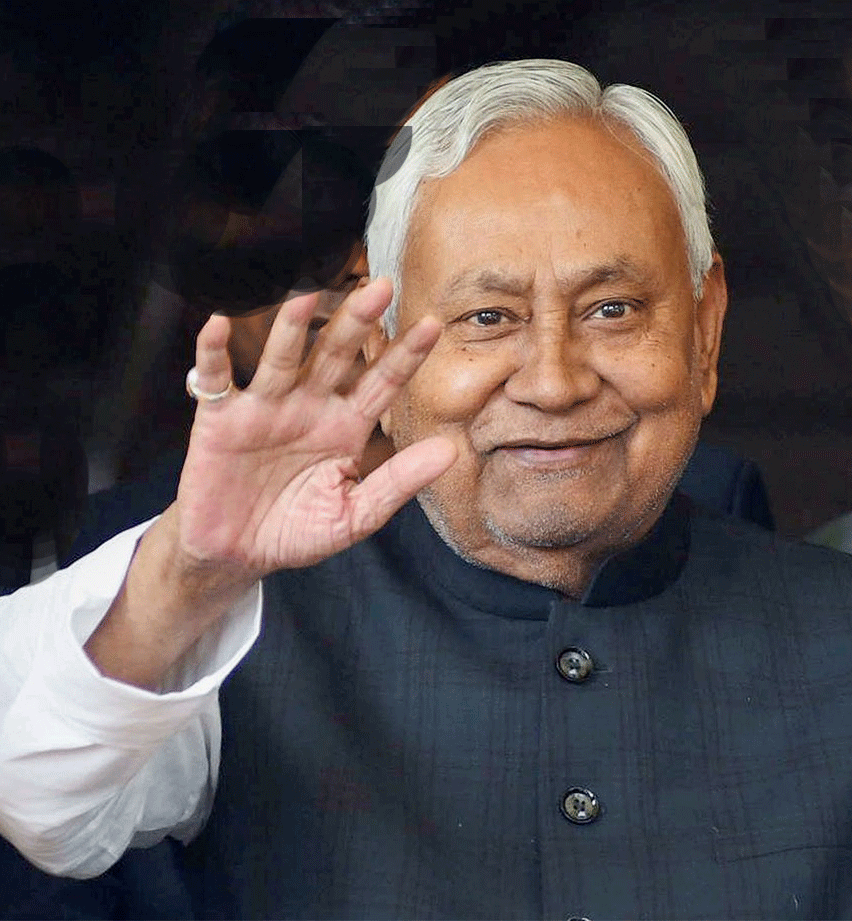
Chief Minister Nitish Kumar’s exit from Bihar politics not only marks the most consequential political transition in Bihar but also has greater implications on BJP’s national strategy and realization of its dream that it may appear at first glance. With negotiated removal of the CM Nitish Kumar, a significant regional political force has been cleared out of the way of the BJP.
Nitish Kumar has already filed his nomination papers for the Rajya Sabha election scheduled on March 16. This implies he will soon step down as Bihar Chief Minister and transition to the Upper House of Parliament.
Though CM Nitish Kumar has said that becoming Rajya Sabha MP was his long-held wish, but the opposition has called it “leadership coup” and “political abduction” orchestrated by the BJP betraying the people’s mandate given in the Bihar election just held about 5 months ago. At that time, it was said that BJP will make him chief minister as against it has done in Maharashtra where it did not allow its ally and Shiv Sena leader Eknath Shinde to remain chief minister. Nevertheless, it kept Nitish on the CM, and now Nitish is leaving Bihar politics, though he says that he would be supporting the new government and expressed his “resolve to work together to build a developed Bihar will remain steadfast”.
Before assessing about the detail, it should be recalled that BJP has suffered a great setback in the 9 Hindi heartland states in Lok Sabha Election 2024. BJP had won 203 seats out of 225 in 2019 elections, but had lost 55 seats in 2024. To form government in the country, 272 seats are required. It has made the BJP to recalibrate its political strategy in the Hindi belt, and if possible, complete delimitation exercise to substantially increase the Lok Sabha seats to establish its control over the governance in the country for many years.
For years, Bihar has been one of the few large Hindi-belt states where BJP was powerful but not the primary face of governance. With Nitish’s exit from Bihar, BJP gains effective control of the state government. Then it would be easy for the party to strengthens its hold in the eastern corridor (UP–Bihar–Jharkhand belt). It would reduce the party’s dependence on strong regional satraps. Bihar will then be aligned more directly with central leadership’s narratives. This will support BJP’s long-term strategy of expanding from western/northern strongholds into eastern India, and will be able to convert its alliance states into BJP-led states.
BJP will also be able to rebalance the NDA structure. Within the National Democratic Alliance, Nitish’s exit from Bihar politics will weaken JD(U)’s bargaining power.BJP will become even more structurally dominant, which will result in shift of coalition politics from “negotiated equality” to “centralized leadership.”
It matters the most for BJP’s national design, because it minimizes unpredictability from regional allies. It should be noted here that CM Nitish Kumar is nicknamed as “Palatu Ram” since he has been known for shifting his political loyalties and breaking or making alliances. Therefore, Nitish’s exit reduces the risk of alliance instability in Bihar. It gives a clear message that BJP is the permanent anchor of NDA. This strengthens BJP’s long-term coalition management model.
Nitish in Patna has been an autonomous regional power centre. Nitish in Rajya Sabha though will be influential, but not administratively autonomous. He will be dependent on parliamentary space rather than executive control. For BJP’s national dream of centralized ideological and organizational coherence, this shift weakens alternative regional power poles and reinforces Delhi-centric decision-making. This fits BJP’s structural evolution under strong central leadership.
Back in Bihar, it is most likely BJP will be in full charge of governance, and can take full credit for governance. The shift can change the caste-politics in Bihar, and BJP will have more chance to consolidate its support base among the OBCs and EBCs under its own banner than under the banner of Nitish Kumar., the JD(U) supremo.
What will happen to the Bihar politics is now only in the domain of speculation. It should be noted that Nitish has successfully managed EBC coalitions, Mahadalit outreach, and minority balancing. Here lies the BJP’s risks, and if BJP fails in performing successfully in this space, opposition forces could take advantage of that.
There is no denying the fact that JD(U) may erode sharply, and it could lose a moderate-secular ally image in the state. People will take the party as controlled ally, controlled by the BJP leadership. BJP has already given a symbolic national message that BJP has risen from a junior partner in several states to a dominant partner in coalition politics. Nitish’s exit has again confirmed this, which marks a decline of a regional “kingmaker” era. It is a clear transition from coalition era federal balancing to centralized party hegemony. This is a structural advantage for BJP for its long-term national ambition – to be a default governing party across most of India, especially, in the Hindi Belt.
It is already known that many JD(U) leaders have been working with the BJP, because they are not happy with Nitish Kumar. However, the genuine Nitish support would have to struggle in keeping its flock together. JD(U) is likely to weaken considerably in this scenario. With Nitish’s exit, an era of politics has just ended in Bihar, giving way to a new era of politics in the state.
This new era of politics is likely to be dominated by BJP, but it will also make Bihar a more open terrain for the opposition politics in absence of the regional satrap like Nitish Kumar. Cast coalition politics may re-fragment further, and it is uncertain if BJP will able to take advantage of it. Bihar politics will undergo a restructuring. (IPA Service)
 Follow our WhatsApp channel
