

NGT expresses concern over rising GLOF risk
*NIH directed to suggest remedial measures
Mohinder Verma
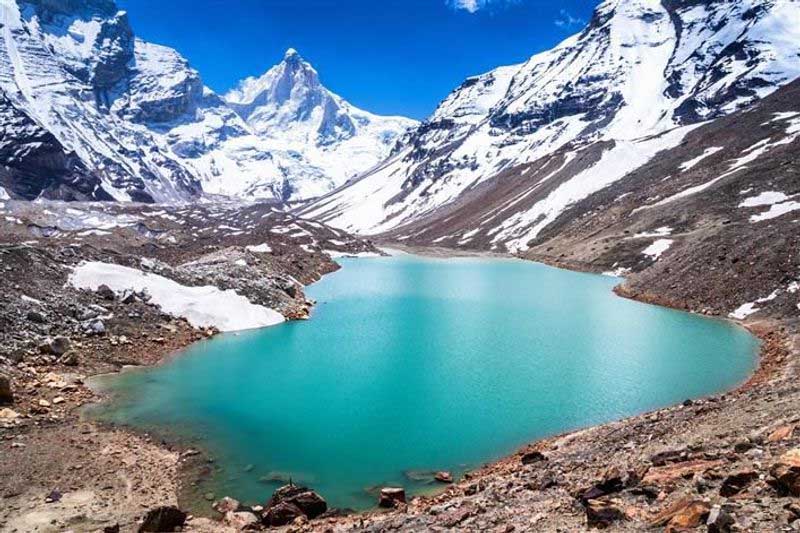
JAMMU, July 15: Nine Glacial Lakes in the Union Territories of Jammu & Kashmir and Ladakh are showing an increasing trend in size raising serious concerns about the growing threat of Glacial Lake Outburst Floods (GLOFs) in these Himalayan regions.
Follow the Daily Excelsior channel on WhatsApp
These findings have been submitted by the Central Water Commission (CWC) to the National Green Tribunal (NGT), which is considering the issue of melting glaciers resulting in increase in the size of Glacial Lakes and danger of their over-flowing or bursting and consequential effects.
Vide order dated April 23, 2025, the National Green Tribunal had impleaded the Union Ministry of Jal Shakti as respondent, which has now filed the response affidavit disclosing the trend analysis on water spread area of glacier’s lakes located in India of size greater than 10 hectares conducted by the Central Water Commission.
In the affidavit, it has been mentioned that the Central Water Commission has been carrying out trend analysis on water spread area of 100 Glacial Lakes located in India of size greater than 10 hectares using the available monthly monitoring data since 2011 with a view to prioritize lakes.
“The Glacial Lakes depicting increasing trend, no change trend and decreasing trend have been identified State/UT-wise. The flow path of these 100 Glacial Lakes has been prepared and locations of major water resource projects and existing CWC Hydrological Observation stations in the vicinity have been mapped to facilitate visualization of the potential impact in the event of GLOF”, the affidavit said.
Of the total 100 Glacial Lakes, 15 each are in the Union Territory of Jammu & Kashmir and Union Territory of Ladakh while rest are in Himachal Pradesh, Uttarakhand, Sikkim and Arunachal Pradesh. In J&K, five Glacial Lakes are showing an increasing trend in size raising serious concerns about the growing threat of Glacial Lake Outburst Floods. There are 10 dams along the flow path of these Glacial Lakes placing significant infrastructural potential risk in the event of outburst.
However, four Glacial Lakes are showing decreasing trend while as no change has been observed in respect of six Glacial Lakes in J&K.
In the Union Territory of Ladakh, four Glacial Lakes are expanding and one dam has been identified along the flow path of these lakes. Four other Glacial Lakes are showing decreasing trend while as no change has been witnessed in respect of seven lakes.
It has also been mentioned that CWC has finalized the criteria for risk indexing of Glacial Lakes offering a structured approach for identifying and ranking Glacial Lakes based on their likelihood of failure and the potential damage they could cause in the event of GLOF. This has been done by evaluating key factors such as the Glacial Lake’s rise, change in size of Glacial Lake, stability of side slope, proximity to other Glacial Lakes as well as considering downstream vulnerabilities like habitation, infrastructure like dams, bridges etc.
As per risk indexing, in J&K, eight lakes fall under Moderate Risk Category while as two lakes in Ladakh fall under this category. However, the NGT has stressed that even Moderate Risk Category lakes require close monitoring and advance warning mechanism.
With these submissions, the Union Ministry of Jal Shakti informed that National Institute of Hydrology is the Secretary in the Monitoring Committee as such Institute’s suggestions are necessary. Accordingly, the Principal Bench of NGT comprising Justice Prakash Shrivastava (Chairperson), Justice Sudhir Agarwal, Justice Arun Kumar Tyagi (Judicial Members) and Dr A Senthil Vel (Expert Member) has impleaded National Institute of Hydrology (NIH) as respondent and granted four weeks time for filing reply along with suggestions and remedial measures.
The matter will now be heard again on October 16, 2025, when further technical input and compliance updates will be assessed by the National Green Tribunal.
 Follow our WhatsApp channel
