

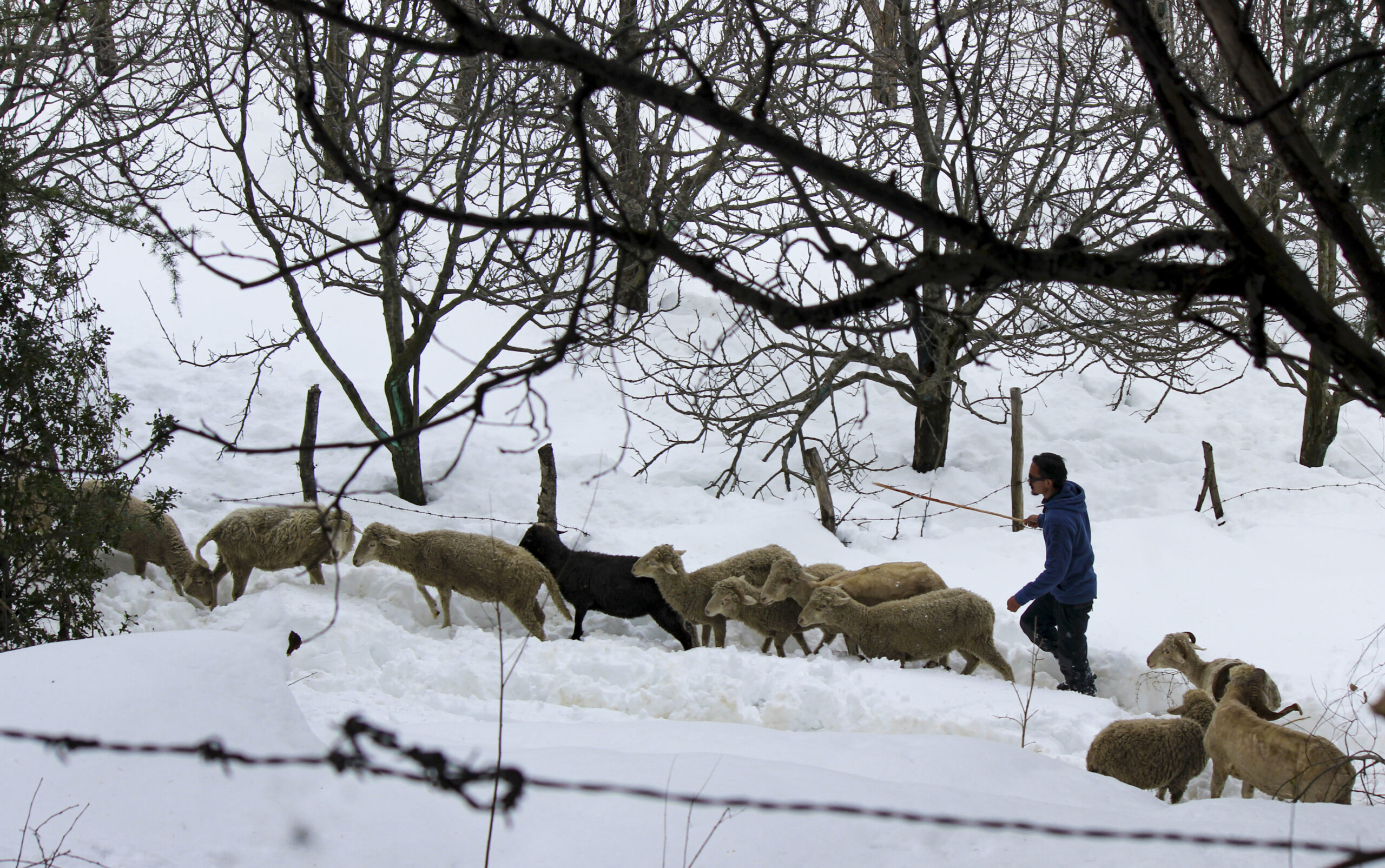
New Delhi, Jan 31: Night temperatures settled below the freezing point across Kashmir on Friday, but rose in most areas, while a ‘yellow’ weather warning for thunderstorms has been issued for Himachal Pradesh.
Saturday marked the beginning of ‘Chillai Khurd’ in Kashmir and the end of the harshest winter period.
The Meteorological Department has forecast light to moderate rain or snow, especially in the higher reaches, they said. The minimum temperature in Srinagar city settled at minus 0.1 degrees Celsius on Friday night, down from the previous night’s 1.3 degrees Celsius.
Meanwhile, the Border Roads Organisation (BRO) on Saturday restored road connectivity along the 112-kilometre stretch, reconnecting Jammu and Kashmir’s Doda-Kishtwar belt with Himachal Pradesh after intensive snow clearance operations carried out under extreme weather conditions last week.
The Kishtwar-Sansari road, where the work was completed, links the Union territory with the Lahaul-Spiti region of Himachal Pradesh.
The MeT Department has predicted heavy snowfall and rain in Himachal Pradesh for February 1. Also, a ‘yellow’ weather warning has been issued for all the 12 districts of the state for thunderstorms accompanied by lightning and gusty winds up to 60 kmph at isolated places.
While snowfall and rain are expected to continue in the middle and high hills of the state till February 3, the weather during this period will remain dry in the plains and lower hills. The weather is expected to remain dry across the state from February 4 onwards.
The national capital on Saturday recorded a minimum temperature of 6.7 degrees Celsius, which was 1.7 notches below the season’s average, according to the India Meteorological Department (IMD).
Station-wise data showed that the minimum temperature at Palam recorded 8.1 degrees Celsius, Lodi Road reported 7.1 degrees Celsius, the Ridge station registered 7.7 degrees Celsius, while Ayanagar recorded 6.6 degrees Celsius.
The night temperature at Safdarjung, the city’s base weather station, recorded 6.7 degrees Celsius.
The air quality was recorded in the ‘poor’ category at 9 am on Saturday, with an Air Quality Index (AQI) reading of 278, the Central Pollution Control Board (CPCB) data showed.
The weather department has forecast above-normal minimum and maximum temperatures during February, indicating fewer cold nights and warmer afternoons as winter conditions weaken earlier than usual.
Cold wave days over parts of northwest India, including Delhi, are also expected to remain below normal, a pattern meteorologists attribute to weakening La Nina conditions.
In Punjab, Faridkot was the coldest place on Saturday with a minimum temperature of 3.8 degrees Celsius, as the state, along with neighbouring Haryana, reeled under intense cold conditions.
Chandigarh, the common capital of the two states, where residents woke up to a thick blanket of fog, recorded a minimum temperature of 7.7 degrees Celsius.
A weather official here said that fog was also observed at many places in Punjab, including Amritsar, Patiala and Ludhiana, and in Ambala, Karnal and Hisar in Haryana.
It was very cold in Bathinda, which recorded a minimum temperature of 4 degrees Celsius. Ludhiana recorded a minimum temperature of 5.4 degrees Celsius while Patiala recorded a low of 5.6 degrees Celsius.
Punjab and Haryana received more rains that expected in January, the weather office said on Saturday.
Cold conditions have persisted in most parts of the states, even as fog reduced visibility in some areas.
According to the Met data, both Punjab and Haryana received excess rain in January. Punjab received 34.4 mm rainfall, which is 69 per cent more than the normal precipitation.
In Rajasthan, several parts of the state are likely to experience cloudy weather and rainfall from Saturday due to the impact of a new western disturbance, the Meteorological Department said.
A cyclonic circulation has been formed over the state. As a result, light to moderate rain with occasional lightning is expected in Jaipur, Bharatpur, Kota, Ajmer and Udaipur divisions, along with the Shekhawati belt, on January 31 and February 1. Hailstorms may also occur at isolated places, the department said.
Another western disturbance is expected to become active on February 2, continuing light to moderate rainfall in eastern Rajasthan, including Kota, Jaipur, Ajmer and Bharatpur divisions on February 3 and 4. (AGENCIES)
 Follow our WhatsApp channel
