

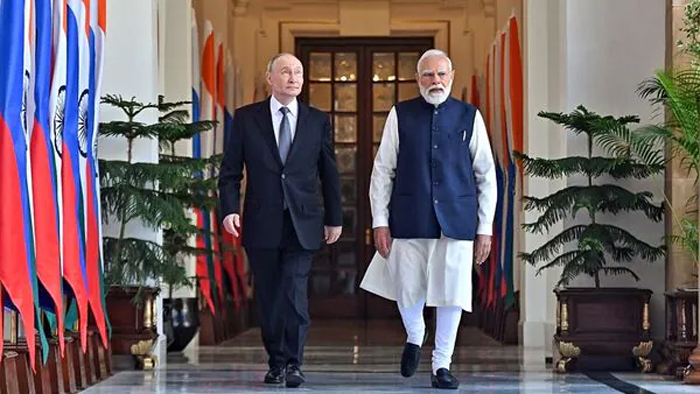
The 23rd India-Russia Annual Summit in New Delhi was far more than a diplomatic routine. It was a reaffirmation of a time-tested friendship that has weathered wars, shifting global alliances, ideological differences, and a rapidly mutating geopolitical landscape. President Vladimir Putin’s visit-rare in recent years-carried unmistakable symbolism: in a world splintered by conflict and mistrust, the Indo-Russian relationship remains anchored in trust, warmth, and strategic depth. For India, Russia continues to be a reliable partner; for Russia, India remains a stabilising global force and an indispensable economic and geopolitical ally.
Since India’s independence, Russia has stood by New Delhi at critical historical junctures-political, military, economic, and diplomatic. The phrase “all-weather ally” has often been used loosely in international relations, but in the India-Russia context, it has been validated repeatedly through actions, not rhetoric. For decades, the backbone of India’s defence capability has been Russian-origin equipment. The Indian Air Force soared on wings provided by MiG-21s, MiG-29s, and, later, the formidable Sukhoi-30MKI fleet. The Indian Army’s armoured formations have relied heavily on Russian T-72 and T-90 main battle tanks. Even India’s aspiring defence manufacturing ecosystem-embodied today in the LCA Tejas and homegrown MBTs-owes much to technology transfers and industrial cooperation extended by Moscow. The partnership has not been transactional; it has been transformational.
Today, India’s operational aircraft carrier, INS Vikramaditya, too, is a Russian gift of friendship. And more recently, the delivery of cutting-edge S-400 air defence systems and Russian drone technology played a pivotal role in safeguarding Indian airspace during Operation Sindoor. Few nations have so consistently enabled India’s security, sovereignty, and technological evolution.
Carrying this relationship forward, the Modi-Putin talks focused heavily on security cooperation, condemning the terror attacks in Pahalgam and at Moscow’s Crocus City Hall. Their call for an “uncompromising” global fight against terrorism without hidden agendas or selective standards reflects a shared frustration with global hypocrisy on the issue. Russia’s support for India against cross-border terrorism and its consistent backing of India’s bid for permanent membership at the UN Security Council underscore a convergence of strategic narratives. In a world where terrorism is increasingly aided by digital tools, unmanned systems, and opaque financial pathways, the Delhi Declaration on countering the misuse of new technologies has given India and Russia a new frontier for cooperation. As both countries face threats emerging from the Afghanistan-Pakistan borderlands, their joint emphasis on preventing radicalisation and curbing extremist ideological spread online is timely and necessary.
Despite facing heavy tariffs and sanctions from the USA for importing discounted Russian crude, India has not hesitated to honour its energy needs and maintain its sovereign economic choices. In return, Russia-long isolated by the NATO-EU sanctions regime-has benefited enormously from India’s vast and stable oil purchases. At a time when Moscow’s assets are frozen abroad, New Delhi became one of its most significant economic lifelines. Yet the relationship is not one-sided. India’s ability to secure affordable energy during the post-COVID inflation spiral was critical to stabilising domestic prices and shielding millions from economic shocks.
The summit’s biggest promise lies in the new five-year roadmap for trade and investment and in accelerating negotiations for a free trade agreement with the Eurasian Economic Union. For India, a partnership with Russia opens doors to Eurasian markets that remain underserved and ripe for expansion. For Russia, India offers one of the world’s largest consumer markets and a dependable, depoliticised trading partner. Despite a current trade deficit of nearly USD 59 billion-skewed due to massive oil imports-Putin’s visit signals new sectors of opportunity: energy collaboration, technology transfer, advanced drones, mobility agreements, investment protection frameworks, and the push for greater Indian exports to the Russian market.
The world order is undergoing tectonic shifts. The continuing Russia-Ukraine conflict, the Israel-Iran flashpoints, instability in Afghanistan, and the recalibrated US-Pakistan dynamics have created new uncertainties. In such turbulent times, nations are seeking dependable partners, not fair-weather alliances. For both India and Russia, the relationship today is driven by realism and mutual need. Russia is looking for reliable partners beyond Europe and the United States, and India is looking for long-term technological and strategic allies who do not impose political preconditions. Moscow’s growing military expertise in drones, electronic warfare, and battlefield technology-honed in the Ukraine conflict-could be critical for India as it faces similar asymmetric threats from Pakistan-based terror proxies.
Equally significant is Russia’s unique influence over China. While Moscow’s proximity to Beijing has increased, Putin’s personal rapport with Indian leadership and Russia’s long-standing respect for India’s strategic autonomy act as valuable moderating factors. Moscow remains one of the few powers capable of nudging Beijing toward a calibrated approach vis-à-vis India. In a volatile Indo-Pacific region, this quiet leverage is indispensable.
President Putin’s limited foreign engagements have made his New Delhi trip especially meaningful. It signals that India occupies a privileged place in Russia’s diplomatic priorities. The warmth of the welcome-Prime Minister Modi personally receiving him at the airport and hosting him for a private dinner-echoed a friendship rooted not merely in agreements, but in an emotional and historical connection. The symbolic gifts exchanged-Assam tea, Murshidabad silver, Kashmiri saffron, an ornate chess set, and a Russian edition of the Bhagavad Gita-celebrated shared civilisations, artistry, and cultural bonds. They reflected a partnership that goes beyond transactional diplomacy.
The Indo-Russian relationship today blends nostalgia with renewed strategic purpose. From defence manufacturing to energy security, from terrorism to geopolitics, from digital threats to humanitarian concerns in Afghanistan-the partnership spans a vast terrain. As the world fragments into competing blocs, India’s balanced but assertive diplomacy and Russia’s search for stable partnerships create a perfect alignment. This visit was not routine; it was a strategic milestone. It deepened trust, opened new avenues, and reminded the world that the Indo-Russian axis continues to be a pillar of stability in an increasingly unstable world. For both nations, it is indeed a win-win partnership-rooted in history, relevant in the present, and poised to shape the geopolitics of the future.
 Follow our WhatsApp channel
