

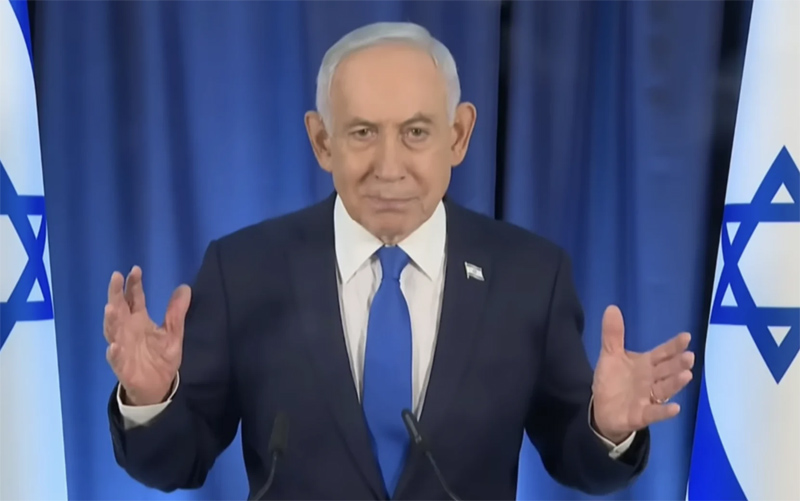
TEL AVIV, March 20: Israeli Prime Minister Benjamin Netanyahu said on Friday that while Israel and the United States are striking at Iran’s ballistic missile and nuclear programme from the air, meaningful regime change will ultimately require a “ground component.”
“You don’t want to replace one ayatollah with another,” Netanyahu said at a press conference. “You don’t want to replace Hitler with Hitler. The Iranian people must rise to the moment.”
Netanyahu stressed that aerial operations, while critical, cannot achieve a revolution on their own. “We can create the conditions, but they have to exploit those conditions at a certain point,” he said. “A revolution cannot come only from the air there has to be a ground component as well.”
He left open what such on-the-ground action might entail. “There are many possibilities for this ground component, and I take the liberty of not sharing with you all those possibilities,” Netanyahu added.
The prime minister pointed to uncertainty in Iran following the death of Supreme Leader Ali Khamenei. “I’m not sure who is running Iran right now,” he said, noting that successor Mojtaba Khamenei “has not shown his face.”
“There is a lot of tension within the regime,” Netanyahu said. “It does not matter who replaces them, we are making sure that the shifts in the Revolutionary Guards will be very short.”
Israel is reportedly already seeing cracks within Iran’s leadership. “We’re seeing cracks in the regime It’s sort of like a hollowed-out, rotten piece of wood there’s a lot of rot inside. We’re seeing some defections,” Netanyahu said.
He emphasized that regime change remains possible but is ultimately in the hands of the Iranian people. “Yes, the regime could change but it is up to the Iranian people in the final accounting,” he said.
Netanyahu addressed reports of disagreement with President Donald Trump regarding strikes on Iran’s South Pars gas field. “Fact number one, Israel acted alone. Fact number two, President Trump asked us to hold off on future attacks, and we’re holding off,” he said.
Rejecting criticism that he had pushed the U.S. into the conflict, Netanyahu added: “Does anyone really think that someone can tell President Trump what to do Come on. I misled no one He understood the need to prevent Iran from developing its nuclear program.”
The conflict has escalated across the region, with Iran launching missile and drone attacks on energy infrastructure in Gulf countries. Disruptions in the Strait of Hormuz have raised global energy concerns.
Netanyahu suggested long-term solutions to bypass vulnerable chokepoints. “Alternative energy corridors are needed – pipelines through the Arabian Peninsula to Mediterranean ports could provide a more secure route,” he said.
Benjamin Netanyahu said Iran has lost its ability to enrich uranium and produce ballistic missiles, asserting that Israel is “continuing to crush these capabilities” as the war entered its 19th day.
“After 20 days, I can tell you, Iran today has no ability to enrich uranium, and no ability to produce ballistic missiles,” Netanyahu said during a press conference in Jerusalem – his first in-person briefing since the launch of the US-Israel campaign against Iran on February 28.
“We are continuing to crush these capabilities. We will crush them to dust, to ashes,” he said, adding that Iran “is weaker than ever,” while Israel is a regional power “and some would say a world power.”
Hours after his remarks, Iran launched fresh missile attacks, triggering sirens in Jerusalem and other parts of Israel.
Netanyahu said Israel had moved beyond earlier operations. Referring to “Operation Rising Lion,” he said: “We destroyed missiles and we destroyed a lot of the nuclear infrastructure. But what we’re destroying now are the factories that produce the components We’re wiping out their industrial base in a way that we didn’t do before.”
(UNI(
 Follow our WhatsApp channel
