

‘Only then peace can be sustainable’
BENGALURU, Nov 9:
RSS chief Mohan Bhagwat on Sunday said that for lasting peace with Pakistan, India must “speak in a language Pakistan understands,” combining strength, self-reliance, and the ability to respond effectively.
Follow the Daily Excelsior channel on WhatsApp
He outlined a practical approach for achieving stability in bilateral ties within the next decade, emphasising preparedness, deterrence, and constructive engagement.
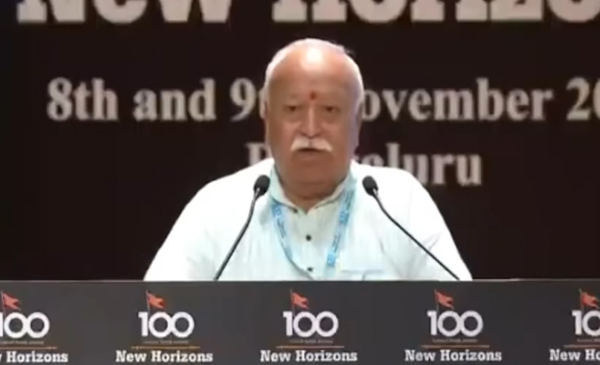
In a interaction at the lecture series of 100 Years of Sangh Journey, Bhagwat said India can maintain peace from its side, but enduring stability will depend on Pakistan’s willingness to reciprocate.
“As long as Pakistan continues actions that harm India, it will persist in doing so. Therefore, any approach to peace must combine readiness, firmness, and cooperation,” he said.
Referring to historical lessons, he recalled the 1971 war, noting how repeated military setbacks taught Pakistan the consequences of aggression.
“We need to speak in a language Pakistan understands: strength, self-reliance, and the ability to respond effectively. Only then can peace be sustainable,” Bhagwat emphasised.
He also stressed that India should remain an honest and cooperative neighbour, supporting Pakistan’s progress while safeguarding its own interests.
“Over time, this approach can encourage Pakistan to become a peaceful neighbour aligned with India’s progress, rather than a source of conflict,” he added.
Bhagwat described the overall strategy as a combination of maintaining peace from India’s side, being prepared to counter any breach of trust, and engaging constructively to foster mutual understanding.
Bhagwat also emphasised the urgent need to secure India’s porous borders, highlighting historical, administrative, and societal challenges that allow illegal infiltration, including by Rohingyas.
Addressing a question on border security, Bhagwat said that many of India’s present borders are “unnatural” and were drawn arbitrarily during colonial rule, dividing what was once a single country.
He pointed out the absurdities in such demarcations, noting that in some areas a kitchen could be in Bangladesh while the bathroom remains in India. “Such divisions make complete closure complicated,” he said.
Bhagwat stressed that the Government must ensure borders are fully protected and well-guarded to prevent illegal migration and exploitation by organised rackets that take advantage of administrative loopholes. While acknowledging corruption and societal complicity, he said that correcting these issues requires both firm Government action and heightened awareness among citizens.
He highlighted local challenges as well, noting that even when the government attempts to secure borders, differing local opinions can impede full enforcement.
“Borders cannot be fixed instantly-the process is gradual, but consistent effort is essential,” he said.
Bhagwat underlined that securing borders is vital for national security, preserving India’s culture, and maintaining unity. He called for combined action by the Government and society to safeguard the country against infiltration and exploitation.
In a veiled remark against the Congress leaders criticising RSS for operating without registration, Bhagwat said his organisation is recognised as a body of individuals.
“RSS was established in 1925, so do you expect us to have registered with the British Government?” Bhagwat asked while replying to a question.
He added that after the independence, Government of India did not make registration compulsory.
“We are categorised as body of individuals, and we are a recognised organisation,” Bhagwat explained.
According to him, IT department and courts have termed RSS as a body of individuals and the organisation was exempted from income tax.
“We were banned thrice. So Government has recognised us. If we were not there, whom did they ban,” the RSS chief asked.
Bhagwat added there are many things, which are not registered. “Even Hindu Dharma is not registered,” he remarked.
On the issue of RSS respecting only the saffron flags and not recognising the Indian tri-colour, Bhagwat said while saffron is treated as a Guru in RSS it has high respect for the Indian tri-colour.
“We always respect, offer tribute and protect our tricolour,” the RSS chief said.
Bhagwat’s remarks came as Congress chief Mallikarjun Kharge recently said RSS should be banned.
His son and Karnataka Minister Priyank Kharge demanded ban on RSS activities in Government institutions and public places. He even questioned the registration number of RSS and their source of funding.
Bhagwat clarified that RSS does not support any political party.
“We do not participate in vote politics, current politics, election politics, etc. Sangh’s work is uniting the society and politics, by nature, is divisive, so we keep out of politics,” he stated.
The RSS chief said the organisation supports policies.
“We support policies. We will exert our force to support the right policy, not an individual, not a party, but policy,” he explained.
Citing example of movement to build Ram Mandir in Ayodhya, Bhagwat said the Sangh volunteers supported it, the organisation stood by its construction.
“So BJP was there (to support it). If Congress or any other party had supported we would have supported them as well,” he explained.
“We don’t have special affinity towards one party. There is no Sangh party. No party is ours and all parties are ours because they are Bharatiya parties,” he stated.
Bhagwat said RSS wants to organise entire society without keeping anybody out and believes in “‘Sabka Saath, Sabka Vikas’ without giving a slogan”. (Agencies)
 Follow our WhatsApp channel
