

Excelsior Correspondent
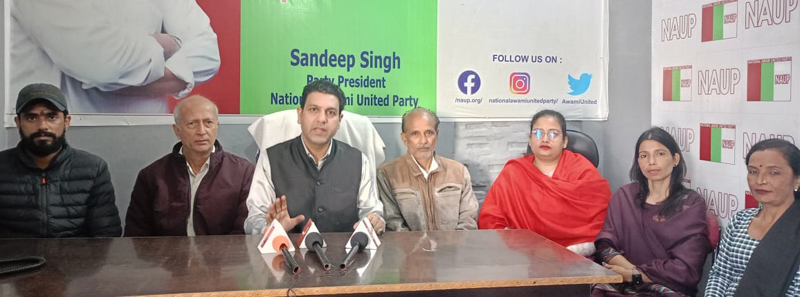
JAMMU, Dec 14: President of the National Awami United Party (NAUP), Sandeep Singh has raised serious concerns over the absence of vacancies for Hindi and Sanskrit lecturers in the latest recruitment drive by the Jammu and Kashmir Public Service Commission (JKPSC) for the school education sector.
Addressing a press conference here today, Sandeep Singh criticized the exclusion of these Indian languages, emphasizing their crucial role in preserving the linguistic and cultural heritage of the region. He pointed out that despite Hindi being India’s most widely spoken language and Sanskrit enjoying global recognition as a scientific language, no positions have been advertised for these subjects.
According to him, this oversight undermines their growth and survival and is a direct contradiction to the principles of the National Education Policy (NEP) 2020, which stresses mother-tongue-based education and the promotion of Indian languages to strengthen cultural roots. He noted that this neglect not only affects Hindi and Sanskrit but also regional languages like Dogri, whose scholars have been similarly ignored in recruitment processes. Singh warned that such disregard threatens the future of regional languages, leaving their survival uncertain and disheartening their advocates.
Sandeep Singh called on the Government to immediately rectify the issue by creating academic posts for Hindi, Sanskrit, and regional languages. He emphasized that fostering linguistic diversity is critical for preserving India’s cultural identity and ensuring fair representation in academia. He stressed that Indian languages must be given due respect and representation, not just in education but also in broader policy frameworks.
Several prominent NAUP leaders, including Shikha Bandral, Shakti Uppal, Sushil Kumar Bhola, Pinki Devi, Bodhraj, Anita Devi, and Parveen Kumar, were also present during the press conference and echoed the concerns raised by Sandeep Singh. Together, they made a strong appeal to the Government to prioritize Indian and regional languages in recruitment and policymaking, stressing that their preservation is essential to maintaining the country’s rich cultural and linguistic diversity.
 Follow our WhatsApp channel
