

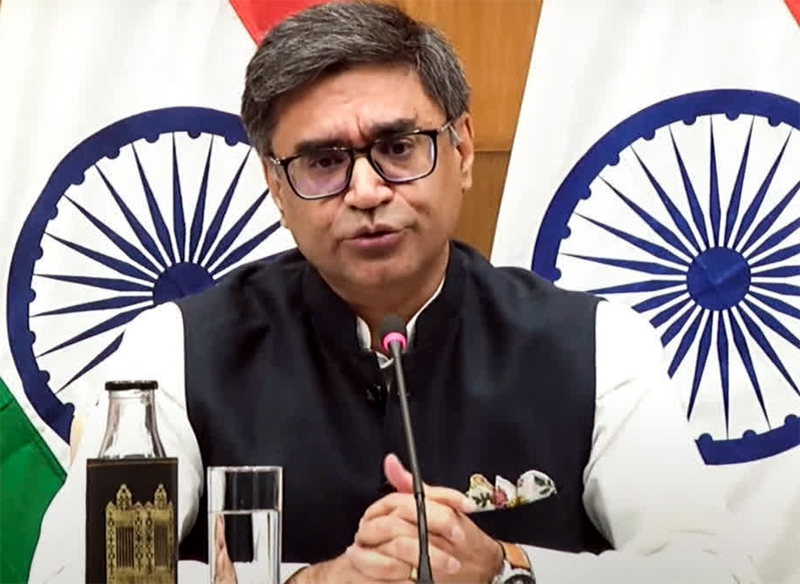
NEW DELHI, Feb 9: India will maintain multiple sources for crude oil purchases and diversify them to ensure stability in the supply chain with national interests remaining the “guiding factor” for the procurement, Foreign Secretary Vikram Misri said on Monday amid a swirling controversy over Washington’s claim that New Delhi has agreed to stop importing Russian oil.
Misri said the key drivers of the procurement policy are adequate availability, fair pricing, and reliability of supply, remarks seen as an indication that New Delhi is unlikely to snap its energy ties with Moscow.
“National interests will be the guiding factor for us in our choices for energy procurement,” he said.
The foreign secretary said India’s “foremost priority” is to safeguard the interests of Indian consumers and to really ensure that they receive adequate energy at the right price and through reliable and secure supplies.
“Our import policy insofar as energy is concerned is therefore driven entirely by these objectives,” he said at a press conference while replying to a question on whether India will stop buying Russian crude oil.
“We are neither dependent on any single source for this, nor do we intend to be. And it is natural for the mix of sources to vary from time to time, depending on objective market conditions,” he said.
“Our approach is to maintain multiple sources of supply and diversify them as appropriate to ensure stability. Therefore, I would say that the more diversified we are in this area, the more secure we are,” he said.
US President Donald Trump, while announcing a trade deal with New Delhi last week, claimed India has agreed to not procure crude oil from Russia. In an executive order, Trump rolled back an additional 25 per cent tariffs on India that he imposed in August last for India’s procurement of crude oil from Russia.
In the order, the US said it would monitor whether India resumed Russian oil purchases directly or indirectly and that would determine whether a 25 per cent tariff would again be re-imposed.
“The global economy has faced significant uncertainties which have had a major impact on the stability of global energy markets. India certainly — and I would imagine a lot of countries around the world, if not every country — have a shared and common interest in ensuring stable energy prices and secure supplies,” Misri said.
“In fact I would underline that India is not just one of the largest consumers of energy, but it also plays an important role as a stabilising factor in global energy markets.
“And that’s one reason why we import energy from multiple sources. The key drivers of our energy policy are adequate availability, fair pricing, and reliability of supply,” he said.
Misri said that is the reason India imports crude oil from dozens of countries.
“Insofar as actual sourcing of energy is concerned — again, all of you follow this closely, so you know that the actual sourcing is done by oil companies. And they make decisions based on market conditions,” he said.
Misri said the oil companies assess availability of crude oil at any given point in time, assess risks and costs in this process and take their decisions.
“And obviously, all of these companies also have their own internal accountability-related processes to look at and certain fiduciary responsibilities in the market,” he said.
“So, at any given time, there is a rather complex matrix of issues that these companies have to take into account, which — not to disregard it — also includes very, very important financial and logistical aspects,” he said.
“I expect that what you will continue to see in this sector, in this area, is business choices being made based on these considerations that I have outlined.
“So, what I can firmly and confidently say is that whether it is the government or indeed our business, at the end of the day, national interests will be the guiding factor for us in our choices,” Misri said.
Elaborating on India’s approach on energy procurement, Misri said the country is a net importer in the oil and gas sector and as a developing economy, it has to be conscious about its resource availability.
“Naturally, when you are dependent to the extent of 80-85 per cent on an imported resource, you have to have concerns about the possibility of inflation driven by energy costs,” he said.
“So, it’s not surprising therefore that our foremost priority is to safeguard the interests of Indian consumers,” he added.
The relations between New Delhi and Washington saw a major downturn after Trump imposed 50 per cent tariffs on Indian goods, including a 25 per cent levies for New Delhi’s procurement of Russian oil.
Following the conversation between Trump and Prime Minister Narendra Modi, both sides recently announced reduction of US tariffs on Indian goods to 18 per cent from 50 per cent. (PTI)
 Follow our WhatsApp channel
