

By Poonam I Kaushish
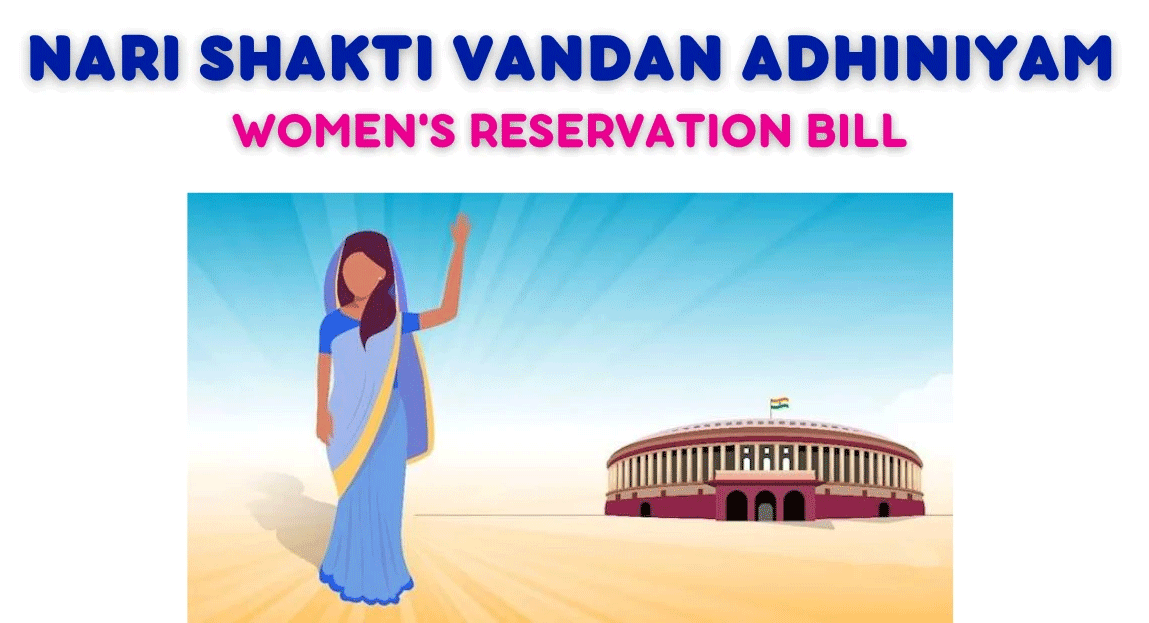
The countdown for an amended Women Reservation Bill Nari Shakti Vandan Adhiniyam Bill 2023 mandating 33% reservation for women in legislatures in time for the 2029 general election has begun. The Government intends bringing it in the ongoing Parliament session before it is adjourned sine die. Yippee!
The Bill proposes to delink it from the ongoing Census and delimitation exercise which would have followed. As under terms of the existing law, which lists Census and delimitation as pre-requisites, implementing the quota ahead of the 2029 Lok Sabha election would have been difficult, if not impossible.
The Government plans to increase Assemblies and Lok Sabha size by 50% whereby the expanded House would have 816 seats from 543 now, of which 273 would be reserved for women. If passed five States: UP, Punjab, Uttarakhand, Goa and Manipur which go to polls early 2027 could include women reservation in enlarged Assemblies.
Alongside, it would keep proportional representation of States untouched in an enlarged House and use lottery to identify seats reserved for the fair sex. However, this would require changing the terms of the Delimitation Commission which would use the 2011 Census figures as its base — not 2027 Census as the final figures would be released too late to enable delimitation before 2029.
As, keeping the current proportion of State seats in Lok Sabha unchanged would mean a vote in Kerala or Tamil Nadu would carry more weightage than a vote in UP or Bihar. As it stands, southern States worry that a delimitation based on current population would penalize them in terms of proportional representation in Lok Sabha for meeting the national imperative of population control better than some northern and eastern States.
To allay concerns of southern States which account for 24% Lok Sabha seats, each State’s seat share would be retained at the current level. In order to implement this the Government would bring two Bills — one to freeze each State’s seat share at its current level for the next 25-30 years and perhaps another Constitutional amendment of Article 82 which mandates adjusting Lok Sabha seats after every Census.
Towards that end Home Minister Amit Shah had consultations with NDA allies and select Opposition Parties TMC and Left, minus Congress last week proposing 50% expansion of legislative seats which would allow sitting MPs and MLAs, 85% of whom are male, to potentially retain their seats even while making room for women.
Asserted a BJP Minister, “There is dire necessity of affirmative action to improve women’s conditions, as recent studies on Panchayats where there is reservations, have shown the positive effect of female political participation, leadership, women empowerment and allocation of resources. No matter, instances of them being used as proxies by men to win elections in States from Maharashtra to Bihar.
Undeniably, politics of presence is crucial for effective functioning of our democratic system, as women constitute 50% of the population and have played a key role in deciding many State elections. Bihar a case in point. And BJP has won more of those than Opposition.
Presently, even as we talk about more power to woman, a reality check bares some unpleasant home-truths. Women account for less than 10% of both Houses of Parliament. Women legislators in Lok Sabha account for roughly 13.6% 74 MPs, lower than 78 in 2019 and much below the global average of 24%.
Think. If in 1950 women formed 5% of Parliament, today a mere 9% increase in the last 76 years is a sobering reminder of how slow progress has been. Consequently their under-representation not only reveals gender disparity but also constitutes gender deficit.
Shockingly, States like Tripura, Arunachal, Nagaland and J&K don’t have a single women MP in Lok Sabha. Women representation in State Assemblies is even more glaring. Assam, Arunachal Pradesh and Karnataka have fewer than 5%. Mizoram has none and Nagaland one. Surprisingly, Bihar and Haryana boast of 10% fair sex representation. Hence this lack of representation is problematic as legislation reflects the values of those who make it.
Further, there are only a handful of women leaders today: Congress’s Sonia, TMC’s Mamata, BSP’s Mayawati and President Murmu. So unlike the strong female contingent who fought alongside other freedom fighters, Sarojini Naidu, Sucheta Kripalani, Aruna Asaf Ali, Durgabai Deshmukh and Savitri Phule, who not only defied the notorious patriarchal norms but also blazed a trail of women’s empowerment.
Unfortunately, post-Independence India, women slipped to a secondary status where not just leaders, women continue to remain the ‘unwanted’ and neglected sex. Yet, there is no dearth of women workers in Parties who are regularly sidelined and denied Party tickets to contest elections. Despite, 65.8 %, women turnout compared to 65% men during 2024 Parliamentary elections and more women voting than men in 16 of 29 States.
Undisputedly, there is a paucity of strong women in politics with Party bosses often reluctant to trust them with handling the rowdy business of winning elections. Add to this a neglect of women issues in most elected bodies. Questionably: Will this Bill correct centuries-old imbalances and stigma against women? Will increased participation of women in the political process lead to less female infanticide, fewer dowry deaths, bride burning and trampling of female aspirations.
Undoubtedly, Parties recognize that in a changing India, women marginalization, exclusion from power corridors and decision-making echelons is becoming unsustainable, hence, having more women in politics will improve the system and society. Their absence alienates women thereby undermining the system’s legitimacy.
Besides, Parties realize value of women power by the rising turnout of female voters who are slowly closing the gap with male turnouts. Their greater visibility and imprint in public spaces which are rising inexorably. Hence, women power acts as a potent force to ensure policies and legislation that affect their lives, is inclusive and representative of the population needs. Eventually, women-centric policies would heighten political efficacy among female voters.
At the same time one needs to watch out for the danger that gender politics can lead to a ferocious brand of political Puritanism. So far jobs, posts and seats in legislatures have always served as “apples of discord.”
Either way, the legislation has set the stage for a future where nari shakti will play a more substantial role in politics and integral to India’s democratic ethos. Clearly, if the Bill is implemented it will set a unique precedent as the only major democracy globally to implement such affirmative action.
True, the Bill is not a magical fix but a crucial leap forward for women empowerment and gender parity. One hopes it will not end up as an exercise in competitive, reckless populism at its worst. The Constitution has given women equal rights. Reservations will go a long way in facilitating them to build a legacy. A revolutionary change is needed. Merely mouthing platitudes will no longer work.
The crucial need is to undergo catharsis — a course in emotive cleansing and giving a push to women empowerment in cementing a cohesive society. It is a good idea to have more women than less. As Nari Shakti is at the cusp of a bright future as our leaders’ help them break the glass ceiling and give them their place in the sun. Time now everyone takes the lead in increasing “Her Voice.” —- INFA
 Follow our WhatsApp channel
