

Dr. Patryk Kugiel
The elections in Myanmar will not be completed until January-end 2026, but the result is already known. The ruling junta will declare victory and restore a facade of democracy. It wants to try a controlled transformation once again, but on its own terms and without surprises. Will the United States cede influence over this strategic country to China and Russia? Will Europe decide to support the Burmese opposition and prolong the civil war without cooperation with the US?
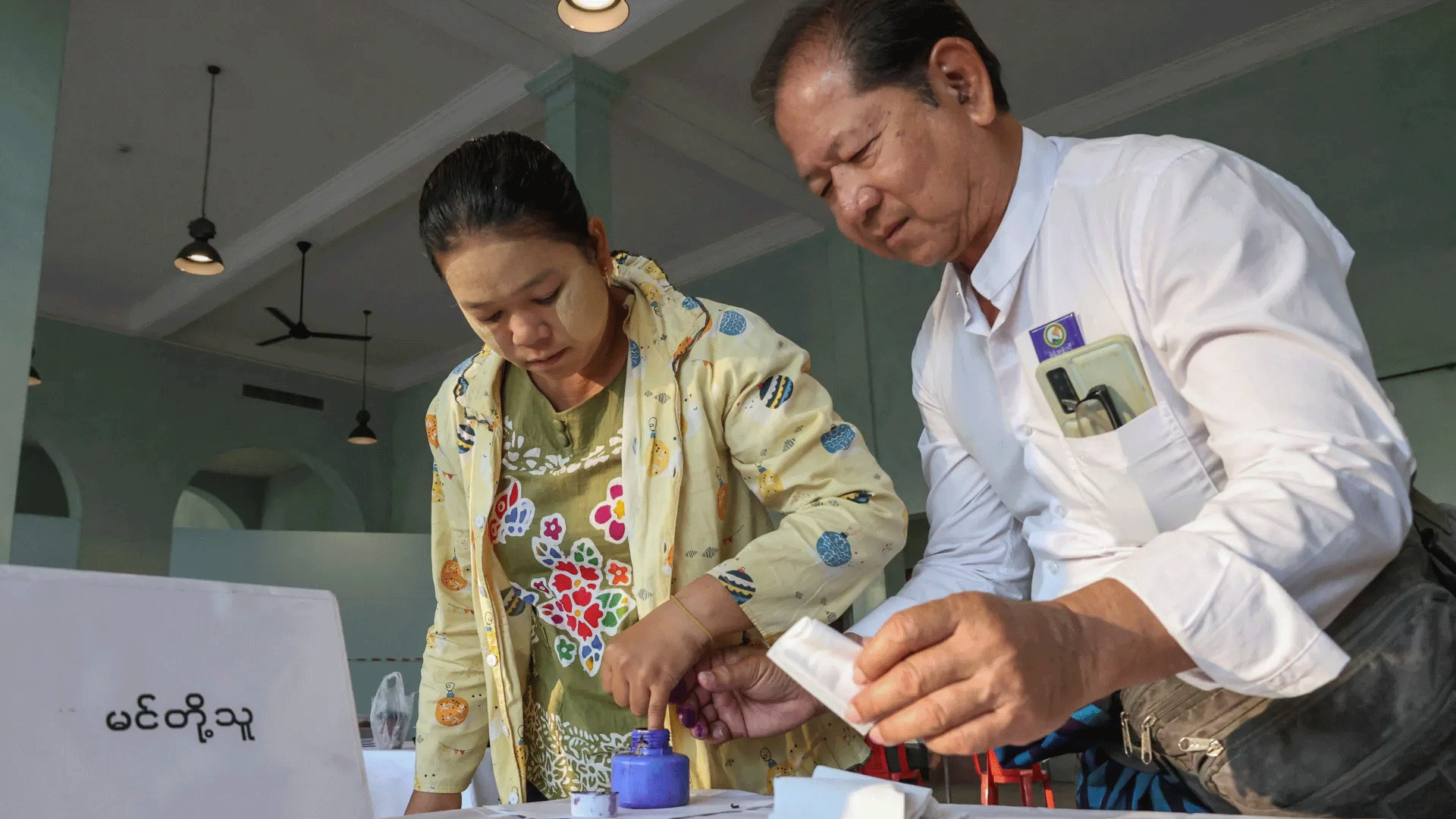
Myanmar has a population of 51.5 million. The voter registration organised in 2024 didn’t include 19 million citizens and over half of the nation’s territory. Nevertheless, General Aung Min Hlaing, Army head and dictator who has ruled since February 2021, decided to organise the repeatedly postponed vote. The elections were divided in 3 stages and limited only to major cities. On December 28, voting took place in 102 of 330 districts. In January 11 and 25, residents of another 100 and 63 municipalities will go to polls. In 56 municipalities, there’s no voting due to ongoing civil war.
The military coup of 2021 marked the beginning of an internal armed conflict. Over 90,000 people have died, thousands of homes burnt, 3.5 million people forced to flee their homes, and 22 million need humanitarian assistance. Just a year ago, the junta controlled only about a quarter of territory, and desertions had reduced army from 300,000 to just 125,000 soldiers. For the first time, the defeat of the Tatmadaw, as the military is called, seemed a real possibility.
A Facade of Democracy
Elections are held under unfair rules, and outcome is known from beginning. Therefore, Thomas Andrews, UN Special Rapporteur on human rights in Myanmar, in October 2025 report, described these as a “fraud” and a “farce” intended only to strengthen the junta’s legitimacy. Burmese people’s opinion is least important, they are merely meant to be extras in a spectacle addressed to “foreign governments,” not domestic voters.
The military’s party, the USDP (Union Solidarity and Development Party), is expected to win. The generals have learned from “unsuccessful” experiment with democratic transformation from 2011-2020 and this time they can’t allow any cracks in the system that could threaten their complete dominance. Recall, it was crushing defeat of USDP and the overwhelming victory of Aung San Suu Kyi’s NLD in November 2020 that prompted them to overturn the tables and change rules of the game.
This time, the NLD (and 40-odd parties) is outlawed and can’t contest and Suu Kyi (along with 22,000 opposition members) is in prison. In addition to 25% of parliamentary seats reserved for active military personnel, the USDP’s dominance is to be ensured by changing to a proportional one. The new electoral law in July is intended to intimidate voters and break Opposition resistance–one can be sentenced to 10 years in prison for “disrupting the electoral process through public speeches, protests, distributing leaflets, or making threats.”
It’s therefore not surprising that Andrew concluded “free and fair elections are not possible when opposition leaders are arrested, detained, tortured or killed, when it is illegal to criticize the junta or the elections, and when journalists are in prison for telling the truth.”
Proxy War
The elections are intended to give the junta a way out of the dead end it has created for itself, to end emergency and its international isolation. These will also determine outcome of long-standing international rivalry between democracy and authoritarianism forces. The 2021 military coup interrupted democratisation and its ties with Europe and USA. Russia readily stepped into this void, becoming the junta’s most important ally, providing it with weapons, political support, and economic assistance. Myanmar has become another front in the proxy rivalry between Russia and the West.
Although the West, focused on Ukraine war, the Burmese people were fighting the same enemy there. At least, that’s what Burmese journalists and activists who reached Europe in recent years claim: “a victory over the junta in Myanmar would be a defeat for Vladimir Putin, and even small arms deliveries tos the armed opposition would also serve Ukrainian cause.”
Over past few years, Moscow has increased its influence in Myanmar, gaining an important foothold in Asia. The Russians promised investments in nuclear power plants, construction of an ocean port in Dawei, down south, refineries, and increasingly sent their own warships on friendly visits to the Indian Ocean. China, which long observed the situation from a somewhat neutral distance, accepted Russia’s growing influence. However, when the risk of the regime’s collapse arose, they sided with it, which changed the course of the war.
In recent months, Beijing has forced several ethnic armed groups to conclude a ceasefire with the army and return the captured cities and communication routes. It is supporting elections, waiting for completion to become fully involved. For China, Myanmar is of strategic importance as an access route to Indian Ocean and a source of rare earth metals and other natural resources. After years of hesitation, Beijing concluded that the junta offered the best guarantee of access to these resources. While Russia saved the regime from collapse, China allowed it to tip the scales of victory in its favour.
The West’s retreat
After the coup, Western countries sided with the democratic opposition and imposed economic and political sanctions on junta members. They offered financial and political support to pro-democracy forces. However, they didn’t recognise National Unity Government (NUG) formed by defectors from the NLD, nor did they provide them with military assistance. Financial and moral support weakened as the attention of Europe and the US became increasingly absorbed in Ukraine war.
The final abandonment of the Burmese democracy cause came in 2025 with a change in US policy. In January, USAID assistance was suspended, which affected independent media and NGOs. In July, the Americans lifted sanctions previously imposed on four companies and individuals linked to the junta. In November, the US revoked the “temporary protected status” of refugees, deeming they could be safely returned to their homeland. Justifying this decision, US Secretary of Homeland Security Kristi Noem positively assessed Myanmar’s preparations for “free and fair elections” and ceasefire agreements as evidence of an improving situation.
Although it’s difficult to predict US administration’s next step, this has weakened the decade-long Western policy of supporting pro-democratic forces in Myanmar. The junta used this for propaganda purposes, emphasising normalisation of relations with the US and elections’ legitimacy. Reports from UN, human rights organisations, and institutions from many Western countries show the superficiality of the entire process.
Predictable results
The elections are being held in an atmosphere of fear, civil war, an opposition boycott, and with tension. Regardless of their course, these will strengthen the army’s position and weaken the democratic movement. These will: give military the power to successively regain control of the country and consolidate power; not end civil war, but will facilitate stabilisation of internal situation; signify not only a victory for the generals, but also for authoritarian patrons: Russia and China. This will create a serious moral and strategic dilemma for Myanmar’s other partners – other ASEAN members, Western countries, and India.
The elections are a final act of a confrontation that the West lost much earlier. Indifference to fate of Burmese people who believed in democracy, refused to accept its loss, and the lack of decisive support for opposition in recent years, sealed Myanmar’s current fate. The quiet but consistent build-up of Russian influence in a country with a strategic location and vast resources of rare earth minerals was overlooked. With the West’s passivity, Myanmar will be a success for the Kremlin. After a series of setbacks in Syria, Iran, and Africa, this could reverse the negative trend for Putin and convince wavering dictators that it’s worthwhile to align themselves with Russia.—INFA
 Follow our WhatsApp channel
