

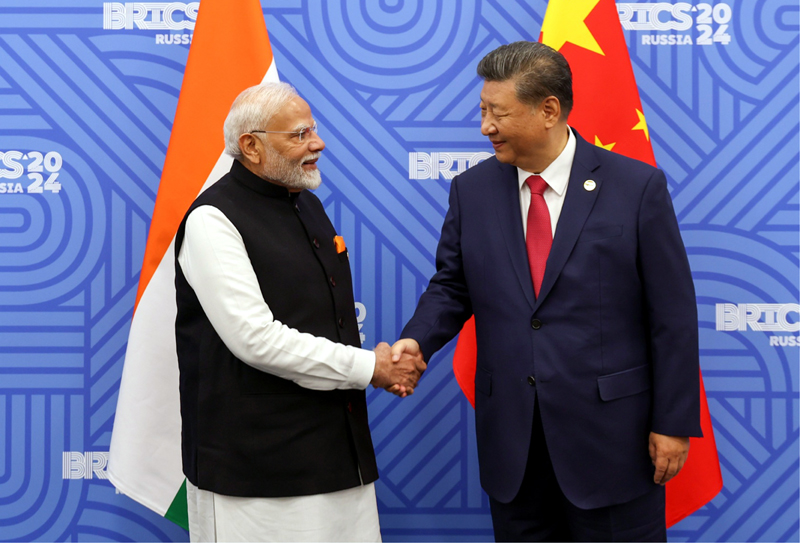
PM for global efforts to deal with terrorism
KAZAN, Oct 23: In their first structured bilateral talks in nearly five years, Prime Minister Narendra Modi and Chinese President Xi Jinping today agreed that India and China can have a “peaceful and stable” relationship by displaying maturity and mutual respect, and endorsed the pact on the resolution of the dragging eastern Ladakh border row.
In the meeting, Modi underscored the importance of properly handling differences and disputes and not allowing them to disturb peace and tranquility.
In a post on ‘X’, Modi said, “India-China relations are important for the people of our countries and for regional and global peace and stability.”
Click Here To Join Daily Excelsior on WhatsApp And Get Latest News
“Mutual trust, mutual respect and mutual sensitivity will guide bilateral relations,” he said.
Foreign Secretary Vikram Misri said at a media briefing that the two leaders noted that special representatives on the India-China boundary question have a critical role to play in the resolution of the issue and for the maintenance of peace and tranquility in border areas.
Modi and Xi instructed the special representatives to meet at an early date and continue their efforts, he said.
“We hope to schedule the next meeting of Special Representatives at an appropriate date,” he said.
The foreign secretary said Modi and Xi reviewed the state of bilateral relations from a strategic and long-term perspective and they were of the view that stable ties between the two countries will have a positive impact on regional and global peace and prosperity.
Both Modi and Xi stressed that with maturity and wisdom, and by showing mutual respect, India and China can have a peaceful and stable relationship, Misri said.
He said restoration of peace and tranquility in border areas will create space for returning towards the path of normalisation of ties.
Officials will now take the next steps to discuss enhancing strategic communication and stabilising bilateral relations by utilising official dialogue mechanisms, he said.
“Welcoming the recent agreement for complete disengagement and resolution of issues that arose in 2020 in the India-China border areas, Prime Minister Modi underscored the importance of properly handling differences and disputes and not allowing them to disturb peace and tranquility,” the Ministry of External Affairs (MEA) said in a statement.
It said the two leaders affirmed that stable, predictable and amicable bilateral relations between India and China, as two neighbours and the two largest nations on earth, will have a positive impact on regional and global peace and prosperity.
“It will also contribute to a multi-polar Asia and a multi-polar world,” the MEA said.
“The leaders underlined the need to progress bilateral relations from a strategic and long-term perspective, enhance strategic communication and explore cooperation to address developmental challenges,” it said.
Meanwhile, Modi today renewed his call for dialogue and diplomacy as being the only way forward to resolve conflicts, in an unambiguous message to press for the resolution of the Russia-Ukraine war through peaceful negotiations.
In his address at the 16th BRICS summit here, Modi said the grouping must give the world a message that it is not a divisive organisation but one that works in the interest of humanity.
The Prime Ministeralso flagged concerns over pressing challenges such as wars, economic uncertainty, climate change and terrorism and said the BRICS can play a positive role to take the world in the right path.
“I believe that as a diverse and inclusive platform, BRICS can play a positive role in all areas,” he said.
“We support dialogue and diplomacy, not war. And just as we were able to overcome a challenge like COVID together, we are certainly able to create new opportunities to ensure a secure, strong and prosperous future for future generations,” he said.
The summit was attended by top leaders of BRICS nations, including Russian President Vladimir Putin and his Chinese counterpart Xi Jinping. The leaders welcomed the 13 new BRICS partner countries.
In his remarks, Modi noted that the summit is happening at a time when the world is undergoing several uncertainties and challenges, including conflicts, adverse climatic impacts, and cyber threats, placing greater expectations upon BRICS.
The prime minister also batted for concerted global efforts to deal with terrorism and that there must not be any “double standards” in fighting the menace.
“In order to counter terrorism and terror financing, we need the single-minded and firm support of all. There is no place for double standards on this serious matter.
“We need to take active steps to stop the radicalisation of youth in our countries. We must work together on the long pending matter in the UN of the Comprehensive Convention on International Terrorism,” he said.
“The same way, we need to work on global regulations for cyber security and for safe and secure AI,” he added.
The Prime Minister also pitched for reform of the UN Security Council and other global bodies. “We must move forward in a time-bound manner on reforms in global institutions such as the UN Security Council, multilateral development banks and the WTO,” he said.
“As we take our efforts forward in BRICS, we must be careful to ensure that this organisation does not acquire the image of one that is trying to replace global institutions, instead of being perceived as one that wishes to reform them,” he said.
The Prime Minister also delved into pressing global challenges.
“Our meeting is taking place at a time when the world is facing several pressing challenges such as wars, economic uncertainty, climate change and terrorism. The world is talking about the North-South divide and the East-West divide,” he said.
Modi said preventing inflation and ensuring food security, energy security, health security and water security are matters of priority for all countries in the world.
“And in this era of technology, new challenges have emerged such as cyber deepfake and disinformation,” he said. (PTI)
 Follow our WhatsApp channel
