

Excelsior Correspondent
NEW DELHI, July 20: Maintaining that Prime Minister, Narendra Modi made a huge departure from previous UPA Government’s weakened and appeasement policies on terrorism, Union Minister in PMO with independent charge of Science and Technology and Earth Sciences, Dr Jitendra Singh said that this yielded tangible results as erstwhile separatists have also fallen in line now.
Follow the Daily Excelsior channel on WhatsApp
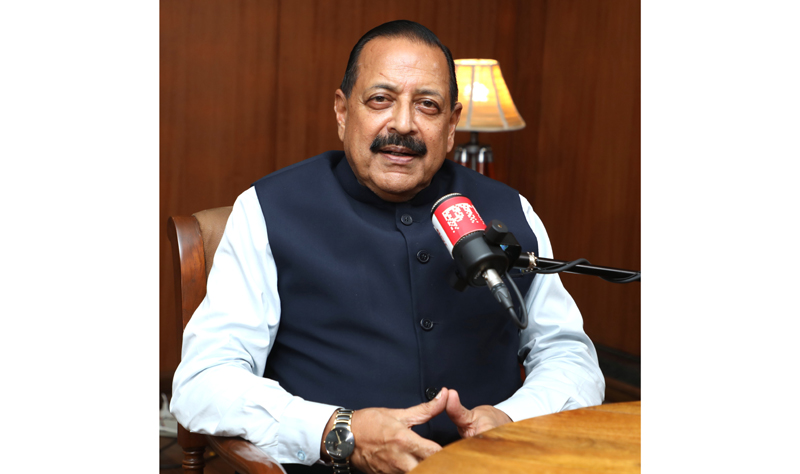
In a podcast conversation with a news agency, here today, Dr Jitendra Singh asserted that the situation in J&K has gone a fundamental transformation after Narendra Modi Government came to power in 2014 and after its historical decision of abrogation of controversial Article 370.
“I think Modi Government made a huge departure from this. The result is that even the erstwhile separatists have fallen in line. Now, we are in a position where peace is no longer bought through appeasement. It is no longer a peace bought at the conditions of the others,” he said.
“It is a peace by the preference of the Government in India or the people of India,” Singh said.
Dr Jitendra Singh said, “Normalcy in J&K is no longer bought by appeasement”. This underlines a complete departure from the approach adopted by the UPA Government and a shift in the Centre’s approach.
Post Article 370, there is a mental union and a feeling of belonging strongly felt among the citizens of J&K, the Union Minister, who represents the Udhampur Lok Sabha constituency of J&K, said. While physical and legal changes post-2019 have been widely acknowledged—such as the extension of rights to women and refugees previously denied due to discriminatory provisions—what is less discussed is the psychological shift. “There is now a sense of being one among fellow countrymen,” he said, adding that those from Jammu & Kashmir no longer see themselves as distinct or different from fellow countrymen in the rest of India.
The Minister attributed this change to the removal of Constitutional barriers that had conditioned successive generations. “Earlier, a citizen from J&K would look at himself as someone different… now there is a sense of belonging,” he said. He described it as a “mental blockade” being lifted—an important but underappreciated outcome of the Constitutional changes made in 2019.
Responding to renewed demands from opposition leaders for restoration of full Statehood to Jammu & Kashmir, Dr Jitendra Singh reiterated the Government’s position. He said Prime Minister, Narendra Modi has already assured, more than once, that Statehood will be restored “at the appropriate time”. He said, “There is every reason to trust what the Prime Minister says”.
Talking about the recent Pahalgam attack and broader concerns over security, Dr. Jitendra Singh referred to Pakistan’s longstanding hostility towards India’s sovereignty over J&K. “Pakistan had never reconciled to J&K being a part of India. From wars to infiltration to sponsoring terrorism, it’s been a protracted design,” he remarked. But he added that the current Government’s approach—marked by firmness rather than appeasement—has been a decisive factor in stabilising the region. “Even erstwhile separatists have fallen in line,” he observed.
The Minister cited the return of tourism, completion of long-pending infrastructure projects, and greater youth participation across sectors as visible markers of normalcy. “Terrorism and development share a reciprocal relationship,” he said, pointing out that projects such as the Ring Road and the Udhampur-Srinagar rail link, once stalled, have now resumed.
Referring to the recently flagged-off Vande Bharat train from Katra to Srinagar, he noted the surge in demand to travel by this train and described it as “a reflection of the people’s enthusiasm and optimism.”
The Minister’s remarks came ahead of the fifth anniversary of the abrogation of Article 370 on August 5 and signal the Government’s continued emphasis on development, integration, and a firm stance on national security in Jammu and Kashmir.
The media observation is that while calls for Statehood persist in political quarters, the Centre appears to be maintaining its calibrated approach—linking timing with ground realities and broader strategic considerations.
He said several laws that were not applicable to Jammu and Kashmir because of Article 370, have been implemented over the last six years.
Singh said previous governments used to indulge in talks with Pakistan and try to woo them and would also reach out to the separatists and finally end up nowhere.
Singh said the daughters of Jammu and Kashmir were discriminated against as they did not have rights to property of their parents if they married outside the State.
“This is no longer the case now,” he said, adding that the abrogation of Article 370 made sure that laws applicable in the rest of the country were effective in Jammu and Kashmir as well.
He said refugees from Pakistan too were deprived of citizenship despite the same section of population giving India two Prime Ministers and one Deputy Prime Minister — Inder Kumar Gujral and Manmohan Singh, and L K Advani, respectively.
“This is a huge, huge unravelling happening, not only vis-a-vis the Constitution, democracy, but also by the norms of human dignity. So, all that stands corrected,” Singh said.
He said terrorism had disrupted development in Jammu and Kashmir.
 Follow our WhatsApp channel
