

Excelsior Correspondent
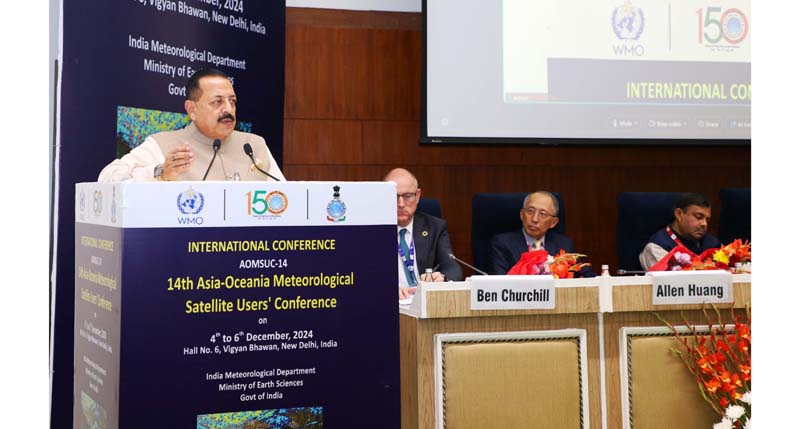
NEW DELHI, Dec 4 : Union Minister of State (Independent Charge) for Science and Technology; Earth Sciences and Minister of State for PMO, Department of Atomic Energy, Department of Space, Personnel, Public Grievances and Pensions, Dr. Jitendra Singh, while inaugurating the 14th Asia-Oceania Meteorological Satellite Users’ Conference, hailed “Mission Mausam” as a transformative initiative set to be a game-changer for India’s weather forecast capabilities India’s approach to climate and weather forecasting.
The conference was attended by eminent scientists and experts from across the region, underscored India’s growing stature in meteorological research and its commitment to global collaboration.
Dr. Jitendra Singh highlighted the significance of Mission Mausam, calling it the first comprehensive scientific initiative by the Government of India dedicated exclusively to addressing climate-related challenges.
“Under Prime Minister Narendra Modi’s visionary leadership, this mission is a reflection of India’s aspiration to play a pivotal role in tackling global climate issues,” he remarked, adding that the initiative has captured international attention for its innovative approach and potential impact.
The Minister noted that India’s advancements in satellite technology and weather forecasting have made it a leader in the Asia-Oceania region. He emphasized the integration of Artificial Intelligence (AI), machine learning, and geoinformatics in forecasting, which has significantly improved accuracy. India, through its satellite capabilities like the GSAT series, is also providing critical meteorological data to neighbouring countries, reinforcing the Neighbourhood First policy.
The Minister highlighted the Asia-Oceania Meteorological Satellite Users’ Conference (AOMSUC-14) as a crucial platform for fostering regional and international collaboration in satellite meteorology. He emphasized the participation of major satellite operators, including the Japan Meteorological Agency, China Meteorological Administration, and Korea Meteorological Administration, as a testament to the growing unity in addressing climate and weather challenges. “India is proud to contribute through ISRO and IMD, sharing our expertise and resources for a sustainable and resilient future,” he remarked.
Dr. Jitendra Singh outlined India’s remarkable journey in satellite meteorology, from relying on international data to becoming self-reliant with indigenous satellite programs. The Bhaskara and INSAT satellite series have revolutionized weather forecasting, enabling real-time cyclone tracking, improved monsoon predictions, and timely disaster alerts. With advanced platforms like INSAT-3DR and GSAT-30, and the upcoming GISAT series, India is set to further enhance its capabilities in weather monitoring and disaster preparedness.
Dr. Jitendra Singh noted a significant 40-50% improvement in severe weather forecast accuracy over the last decade, highlighting its impact on reducing loss of life during cyclones and extreme weather events. IMD’s efforts, coupled with satellite data integration, have not only strengthened India’s disaster management but have also supported neighboring countries in South Asia and the Indian Ocean region, reinforcing India’s leadership in meteorological services.
The Minister proposed fostering deeper regional and global collaborations, inviting experts and stakeholders to explore synergies in areas such as climate modelling, disaster forecasting, and sustainable resource management. He lauded the conference as a vital platform for knowledge sharing, advancing technology, and integrating best practices to combat the growing challenges posed by climate change.
 Follow our WhatsApp channel
