

Parliamentary debates are not just routine legislative formalities; they are the lifeblood of a vibrant democracy. In India, Parliament has long been hailed as the temple of truth, where voices from diverse regions and communities converge to deliberate on issues that shape the nation’s destiny. Every speech delivered within the hallowed halls carries weight, not merely as a statement but as a record of democratic dialogue, preserved for posterity. Historically, these debates have played a transformative role. Members of Parliament have used this platform to spotlight the aspirations and concerns of their constituencies, drawing national attention to local issues. This mechanism ensures inclusivity, allowing governance to be informed by the lived realities of the people. Beyond the chambers, citizens have followed these sessions with keen interest. Live broadcasts make it possible for millions to witness spirited exchanges, reinforcing public trust in the democratic process.
In the digital age, the significance of parliamentary debates has amplified. Any meaningful discussion inside Parliament quickly becomes a trending topic on social media, influencing public opinion and sometimes even Government decisions. These discussions set narratives that dominate national discourse. Unlike outside forums, Parliament enforces a unique standard-no member can knowingly lie on its floor. This sanctity underlines its role as a forum of truth and accountability. Parliamentary debates also serve as a crucible for refining legislation. When bills are tabled, they undergo rigorous scrutiny, with both ruling and opposition members contributing ideas. Constructive criticism often leads to the addition of essential provisions or the removal of problematic clauses, strengthening the legislation. The dialectical nature of debates-where pros and cons are laid bare-ensures that laws reflect collective wisdom rather than unilateral dictates.
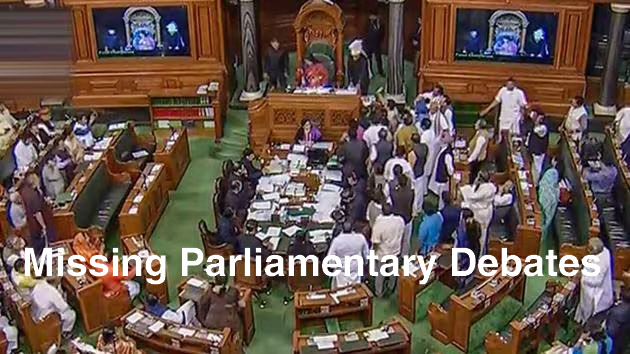
Unfortunately, this noble tradition faces a grave crisis. The frequency and quality of debates have seen a sharp decline in recent years. Increasingly, contentious issues are being stonewalled rather than debated. Opposition members often storm the well of the House, leading to adjournments or complete washouts of sessions. The recent Monsoon session, nearly consumed by relentless protests over electoral roll reviews, is a stark reminder of this malaise.
The consequences of such a deadlock are severe. When working hours are curtailed and session after session becomes unproductive, democracy suffers. Key legislation gets delayed, critical reforms are stalled, and governance faces uncertainty. While the Government accuses the opposition of anarchic behaviour, the opposition counters with charges of authoritarianism. This blame game does little to address the vacuum left by the absence of meaningful debate. The ultimate losers in this equation are the citizens, who expect their representatives to speak, question, and legislate-not disrupt. The grandeur of democratic deliberation is replaced by the din of slogans, which neither enlightens the public nor strengthens governance. Instead of being a temple of truth, Parliament risks becoming a theatre of confrontation. This is not just a procedural lapse; it is a democratic deficit that threatens institutional credibility.
In this bleak scenario, parliamentary committees have emerged as the saving grace. Operating beyond the glare of cameras and partisan theatrics, these committees exemplify collaborative politics. Members from different parties sit together, debate constructively, and produce detailed reports that inform governance. These committees uphold the spirit of informed deliberation that the main House often fails to deliver.
Yet, committees cannot replace the grandeur and transparency of full-fledged parliamentary debates. They work behind the scenes; the nation needs debates in the open, under the watchful eyes of the public. For that to happen, both Government and opposition must rediscover the virtue of dialogue. The Government should allow debates, however uncomfortable, while the opposition must adopt responsible dissent. Disruption cannot be a substitute for deliberation. The health of a democracy is measured not by the noise in its streets but by the quality of its debates in Parliament. Without dialogue, the Government cannot showcase achievements, nor can the opposition highlight shortcomings. Parliamentary paralysis is a collective failure-a sign that the democratic process is losing its essence. Restoring the primacy of debates is not just desirable; it is imperative.
 Follow our WhatsApp channel
