

Nagendra Singh Jamwal
nagendra.s.jamwal@gmail.com
It was the worst of times for Dogras of Jammu. The Duggar lands lay ravaged by the depredations of the Sikh Misals who were on the ascendance in Punjab. From the enlightened and stable rule of Maharaja Ranjit Dev, the Jammu state had slipped into disarray. Internal feuds, weak successors and the decline of Dev dynasty left the region vulnerable.
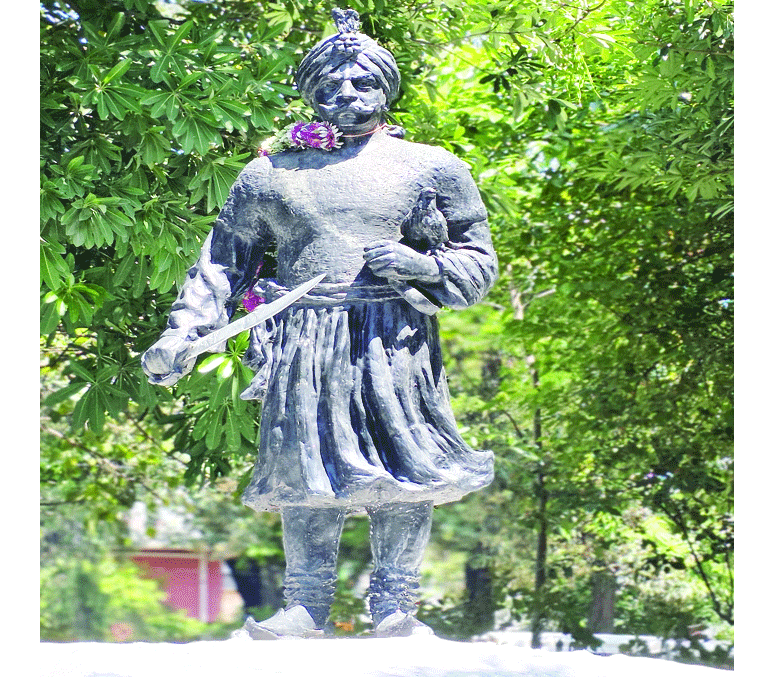
Constant threats of invasion, loot, plunder and tribute eroded the authority of the Dev Dynasty. Compromise, concessions and ransom to the Lahore Court became the order of the day. So much so that the Jammu City was pillaged and burnt to ashes even after a huge tribute was exacted in the late 18th century by marauders. The countryside, too, was devastated by repeated waves of invasion. In this dark age rose Mian Dido, the brave heart who defied tyranny and sought to preserve the dignity and honor of Dogras.
Born in 1780 AD, Mian Dido was the second eldest son of Mian Hazari a Jamwal Rajput of village Jagti near Nagrota. As per chapter titled Zikar Khandan Jagti Wala Jamwal mentioned in the book Tarikh Rajagan Jammu & Kashmir written by Kahn Singh Billowaria in early 20th century, Mian Dido had descended from Raja Haridev (1693 to 1729 Bikrami ) of the Dev dynasty. His ancestors held a Jagir in Jagti and another at Dansal adjoining the Jagir of Mian Mota who dominated the Jammu darbar for over three decades. Billowaria describes Mian Dido as a robust, strong young man, known for his courage and fighting skills.
By the time Mian Dido came of age Jammu had lost its sovereignty to the Lahore Court. So much so that Lahore Court had established its garrisons and thanas in different parts of Jammu which were deeply resented by self respecting Dogras. In these uncertain times, Mian Dido rallied a band of fearless rebels. Together they expelled the oppressive officials, attacked the garrisons, and filled the political vacuum left by dynastic decline. He along with his brave associates including Chaffo, Mian Diwanu Raipuria, Chain Singh Painthalwala, Mian Jawahar Singh Aghoria, Chartu, Bhupa Baladria, Jura Langeh became legendary for their gallant deeds from Jammu to Kangra-Kahlur.
In 1816, Maharaja Ranjit Singh granted Jammu as a jagir to his son, Prince Kharak Singh which was deeply resented by the Dogras. Dido and his band of warriors unleashed attacks on symbols of subjugation. Military outposts were overrun, thanas in Jammu city were attacked, invaders were ambushed and rent collectors were ousted. Mian Dido’s popularity soared in the eyes of people and they petitioned him against the money lenders, oppressive revenue officials and outside interference in their social matters. Dido not only fought against the elements of Lahore Court but also aided the needy and the exploited. He looted the gifts and tribute convoys bound for Lahore Court.
Annoyed with his military exploits and rebellion unleashed by Mian Dido, Maharaja Ranjit Singh sent expeditions after expeditions led by his famous and noted generals and wazirs but to no avail. Observing that his military expeditions had little effect in subjugating the Dogra spirit under Mian Dido and his band of followers, Maharaja Ranjit Singh tasked Gulab Singh, a son of the soil employed in Lahore Court along wth his brothers to checkmate Mian Dido. Bawa Satinder Singh in his biography of Maharaja Gulab Singh titled Jammu Fox mentions that Maharaja Gulab Singh had impressed Maharaja Ranjit Singh with his ability, bravery and had a swift ascendency in the Lahore Court.
The Sikh forces under the command of Gulab Singh attacked Jagti village but Mian Dido escaped to Trikuta mountains. Mian Hazari, father of Mian Dido and his brothers resisted the forces and were martyred at Jagti. Mian Dido was encircled at Sanji Chatt and choose martyrdom over surrender, he fell in 1820. His sacrifice left a permanent imprint on Dogra history and psyche.
Revered as a Hero to this day, Mian Dido’s defiance of the Lahore Court endeared him to the masses. Gulab Singh’s coronation as Raja in 1822 by Maharaja Ranjit Singh at historic Jiopota Ghat on the right bank of river Chenab at Akhnoor symbolised the Lahore Darbar’s acceptance of only nominal suzerainty over Jammu, leaving local matters to the Dogras.
Apologists generally say that very little is known or written about Mian Dido, research reveals his life, struggle and supreme sacrifice are preserved in the bars (ballads), folk songs and oral traditions of Jammu. Prof. Jigar Mohammed’s work on Jammu’s peasant leaders highlights these traditions. Gulabnama by Diwan Kirpa Ram also mentions Mian Dido’s heroics. It was later translated into English from Persian by renowned historian and scholar Professor Sukh Dev Singh Charak. Credit also goes to Narsingh Dass Nargis, an eminent journalist for dedicating one chapter to Mian Dido in his famous book “Tareekh Dogra Desh” (1967) written in Urdu. Interestingly Kripa Sagar (1875-1939) who was a prominent writer cum publisher of Punjabi had penned a play titled Dido Jamwal in the early 20th century.
Credit goes to Yashpaul Nirmal for translating this Punjabi play into Dogri enabling wider readership. This Punjabi play has also been finely translated in Hindi by Sunita Bhadwal an able translator, poetess and storyteller. Professor Ram Nath Shastri gleaned rare documents, books, sources, oral traditions, ballads and presented Mian Dido as great revolutionary and symbol of Dogra identity in his book Duggar de Lok Nayak published by Dogri Sanstha. However as a cautionary note it can be said that the saga of Mian Dido cannot be used in the contemporary times to dismantle the greatness of the Dogra dynasty. A peep into our shared History is not meant to manufacture grudges but to understand the forces shaping our present.
In the recent years, writers like Mansa Ram “Chanchal” have enriched our knowledge about Mian Dido in his book titled Maharaja Gulab Singh. Noteworthy is the endeavor of Mohan Singh, a Padam Shri awardee who has penned Dido Dogra, a Dogri novel on life and times of this great son of the soil. Dr. Abhai Singh Bhadwal has also written a book titled ‘Mian Dido – The Robinhood of Jammu’ as a tribute to the revered hero of Duggar.
Jagti, Dido’s birthplace, now houses the largest township for Kashmiri migrants and has become a hub of learning with institutions like Indian Institute of Management (IIM), Indian Institute of Technology (IIT), Food and Craft Institute (FCI) and Khel Gaon. Naming these after Mian Dido would be a fitting tribute. As Mohan Singh wrote in Dido Dogra. “It is not obligatory to praise if you like the book, but please tell the younger generations about the gallant and revolutionary warrior that Mian Dido was.”
 Follow our WhatsApp channel
