

Amogh Rohmetra
amoghrohmetra@gmail.com
At a glittering alumni gathering in London earlier this year, actor Saif Ali Khan spoke warmly of his association with Mayo College through his close friends and his 1993 film Parampara, shot across its marble corridors in Ajmer. Few in that room, however, would have known that one of his royal predecessors, Nawab Mahomed Mumtaz Hussein Ali Khan of Pataudi, was among Mayo’s earliest students in 1884. One of the first five to join from outside Rajputana.
That small detail captures the vast reach of Mayo College, an institution whose 150-year journey mirrors India’s own transition from colonial era to modernity. What began as a “chiefs’ college” for princes has become a school that continues to draw students from across the country and abroad, while carrying the weight and wonder of its colonial past.
Later this month, Mayo College will mark its 150th anniversary with celebrations that bring together alumni, parents and students from across the world. The lead-up has already seen reunions in Singapore, Australia, Dubai, the US and cities across India. It is a testament to the global network the school has built since its founding.
A School for Princes
The idea of Mayo College was born at a darbar in Ajmer in 1870, when Lord Mayo, then Viceroy of India, proposed a college “for the sons of Chiefs, Princes and Thakurs of Rajputana”. The states were to raise an endowment and build their boarding houses, while the government would contribute an equivalent amount to the endowment fund, provide land and construct the main building, the Principal’s residence and one boarding house – Ajmer House.
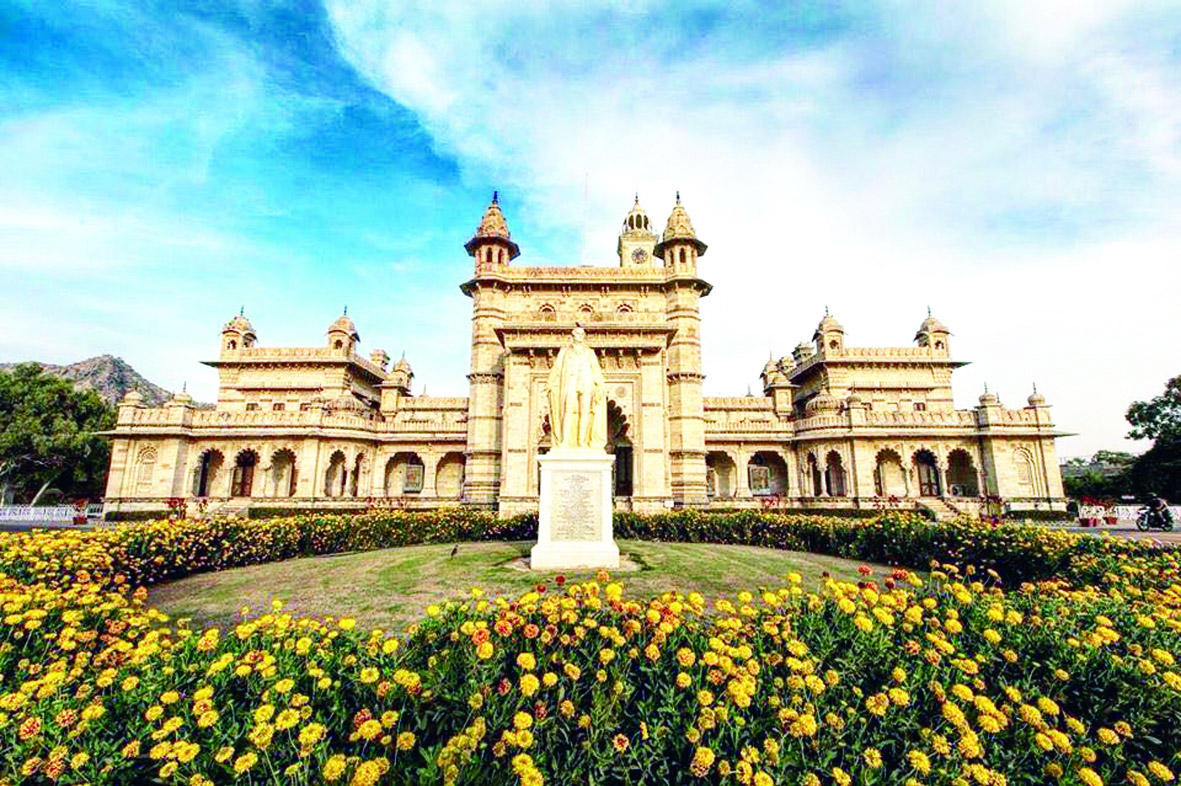
Half a decade later the plan began to materialise in 1875. However, the marble Indo-Saracenic main building, now iconic, took eight years more to complete. On October 23, 1875, Mayo opened its doors with a single student – 15-year-old Maharaja Mangal Singh of Alwar. He lived off campus and arrived each day on an elephant, trailed by a retinue of attendants.
In its early years, Mayo was one of several “chiefs’ colleges” designed to educate heirs of princely states under British supervision. British principals and tutors ran the institution, which soon drew students far beyond Rajputana – from Jammu and Kashmir to present day Tamil Nadu, Gujarat and Manipur. By the 1940s, a British political officer observed that even the secretary of a rival chiefs’ college, Daly College, sent his sons to Mayo for its “superior social prestige”.
Colonial Hierarchies and Change
Mayo’s early records reveal how it was shaped by class and geography. The 1930-31 annual report noted a stark fee disparity: students from Rajputana paid as little as Rs 10 a month, those from central India paid Rs. 300 to Rs. 600 per annum according to the “class in which they are reading”. While other boys from Rs. 450 to 3,000 per annum according to “their status and that of the State from which they come”.
But the 1930s also brought the first signs of major reform much before Indian independence. Debates began over whether Mayo should continue to be both a school and a college (offering diploma and post diploma classes), and whether it should open its doors to those previously excluded. The Viceroy was no longer the President of the General Council (Governing body), replaced by Indian princes like the Maharana of Udaipur. The government was moving out of administration. Boarding houses once managed by states were gradually transferred to college control.
Principal Vincent Stow, who oversaw Mayo’s diamond jubilee in 1935, remarked during the prize giving: “When His Highness the Maharao of Kotah joined the College he came with 200 followers for whom a separate village had to be built. I am glad I am spared the need of any such provisions.”
By the eve of independence, Mayo had begun redefining its purpose – from grooming present and future princes to producing future officers, administrators and professionals for a new India.
Winds of Independence
Mayo’s transition to independence was as symbolic as it was sudden. Politics had long been kept outside its walls. Students in the 1930s admitted to knowing little of Gandhi or Nehru, let alone hearing the national anthem. Then, on August 15, 1947, British principal M.A. McCanlis ordered that the tricolour be hoisted by the youngest boy in the school, symbolising “a new nation being born.”
Government grants soon ended, forcing the institution to survive on its own resources and the support of its alumni. Yet it endured, adapting to the realities of a democratic India while keeping alive its boarding-school traditions.
Jammu and Kashmir Connection
One of the most enduring links beyond Rajputana has been with Jammu and Kashmir. The college records show that Maharaja Hari Singh’s application was received in 1907-08, the same year his father Amar Singh visited the campus. Hari Singh later became an influential member of the governing council at a time when few non-Rajputana rulers held that role. His son Dr. Karan Singh continued that association after independence.
The Maharaja also left a tangible mark. In 1912, he funded the construction of the Kashmir House, as the school still welcomes students from the region. Even during financial crises in the 1920s, Hari Singh remained among Mayo’s largest donors.
That relationship has persisted through generations. In 2023, his grandson, Vikramaditya Singh, was nominated to the college’s General Council, the only patron from outside Rajasthan.
Even before independence, across decades, students from Poonch, Kasgummah and other parts of Jammu and Kashmir have followed in their footsteps. Among them, in the 1910s were Raja Sukhdeo Singh of Poonch, an award-winning rider and Raja Muhammad Wilayat Khan of Kasgummah (now in PoK), who left school in 1916 to take up the post of Wazir Wazarat back home.
Later, Raja Shiv Ratan Dev Singh of Poonch and his brother Rajendra Dev Singh of Poonch too joined the college. Rajendra came back to Mayo later as the principal (1993-96) of the school and lifetime member of the governing council.
Till today students from Jammu and Kashmir continue to be part of this century old legacy as they continue to join this institution over a 1000 kms away.
Alumni Who Shaped India and Beyond
At independence, Mayo’s old boys were already spread across the subcontinent’s power map. Of the three princely states that had not acceded to India or Pakistan by August 15, 1947 – Jammu and Kashmir, Junagadh and Hyderabad – two were ruled by Mayo alumni: Hari Singh of J&K and Nawab Mahabat Khan of Junagadh. One would sign the Instrument of Accession to India, the other would flee to Pakistan. Historian Caroline Keen notes that even the father of Hyderabad’s last Nizam had once considered sending his son to Mayo College but that was never to be.
While many Mayoites from the post-independence years have made their mark, several from the pre-independence era also rose to prominence in the new democratic India across diverse fields. Maharaja Man Singh of Jaipur, a college monitor and winner of the Viceroy’s Best All-Round Athlete Medal (in school) in 1929, went on to be part of India’s polo team to victory in the 1957 World Cup and later served as Ambassador to Spain.
Another sportsperson, Maharajkumar of Vizianagram, a rather controversial captain of the Indian cricket team. He was the only Indian cricketer to be knighted by the queen before renouncing his knighthood in 1947.
In politics, Raja Anand Chand of Bilaspur, a class topper known for his performance in Law and Administration, was part of the Constituent Assembly, later becoming a member of both the Lok Sabha and Rajya Sabha.
In international diplomacy, Justice Dr. Nagendra Singh of Dungarpur, who topped his diploma class (across all chiefs colleges) in 1929, rose to become President of the International Court of Justice (1985-88) – the only Indian ever to hold that post.
Even beyond India’s borders, Mayo’s influence runs deep. The 13th Sultan of Oman, Said bin Taimur, was a star student in his class. His brother, Fahr bin Taimur Al Said, then Oman’s deputy prime minister, returned as chief guest for the school’s centenary Prize giving in 1983. Members of Nepal’s Rana and Shah dynasties also studied at Mayo as early as the 1910s.
A School Still Evolving
The challenges Mayo faces today are very different from those of its colonial past. Gone are the days when “204 snakes” had to be removed from campus, as the 1918-19 report recorded. The questions now are about relevance, inclusion and modernisation.
As new elite schools emerge across India, Mayo’s test is how to stay true to its traditions while meeting the expectations of a more diverse and competitive education system. The digital era, with its global classrooms and new definitions of privilege, demands fresh thinking even in an institution so steeped in history.
Yet one of the key pillars of Mayo College remains what it has always been – its alumni. Union ministers, governors, journalists, politicians, judges, artists, academics, scientists, businessmen, generals, diplomats, the school’s old boys continue to rally around the call of “Go Mayo”, funding scholarships, supporting infrastructure and mentoring students worldwide.
At 150, Mayo College stands not just as a reminder of India’s princely past but as a reflection of culture, modernity and evolution. Few institutions can claim to have shaped so many lives across borders, ethnicities and eras.
From a single student riding an elephant in 1875 to global gatherings of alumni in 2025, the journey of Mayo College is, in many ways, the story of India itself – evolving, resilient and forever learning.
 Follow our WhatsApp channel
